

Sarah Martinez opened her auto insurance bill in March 2024 and stared at the number twice. Her monthly premium had jumped from $127 to $195—not because she'd gotten any tickets or filed claims, but because California's three-year rate freeze had finally ended. The 54% increase forced an impossible choice between full coverage and keeping groceries on the table for her two kids.
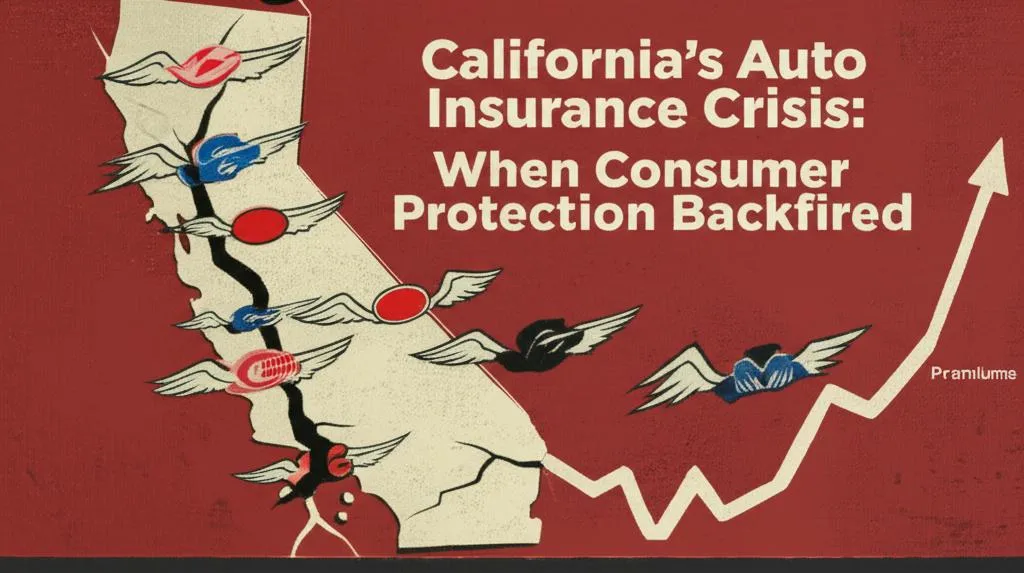
Sarah's experience reflects a hard truth millions of California drivers discovered: sometimes the policies designed to protect us end up causing more harm than the problems they were meant to solve. The state's auto insurance rate freeze, which began as emergency pandemic relief in 2020, ultimately triggered one of the most dramatic insurance market disruptions in modern American history.
Understanding what happened in California matters whether you're shopping for coverage today or watching how policymakers in your state respond to rising insurance costs. The lessons from this three-year experiment touch every driver's wallet and every legislator's desk.
When Pandemic Protection Became Market Paralysis
Picture California's empty freeways in May 2020. Traffic collisions had dropped by half, and Insurance Commissioner Ricardo Lara faced pressure to ensure drivers weren't overpaying for coverage they barely needed. His solution seemed straightforward: freeze all auto insurance rates until the crisis passed.
The freeze wasn't just a temporary pause—it became a complete shutdown of the pricing system. For over two and a half years, the California Department of Insurance refused to approve any new rate filings, regardless of changing costs or market conditions. More than 75% of insurers operating in California submitted rate adjustment requests during this period, only to watch them sit in regulatory limbo.
California's unique regulatory system made this possible. Unlike most states where insurers can adjust rates with oversight, California's 1988 Proposition 103 requires explicit government approval for any rate change. The framework that was designed to protect consumers from arbitrary increases became the tool for unprecedented market intervention.
But the math underneath was shifting dramatically
While regulators held premiums steady at 2020 levels, the cost of insurance claims began climbing sharply. By 2023, the average material damage claim cost 47% more than in 2020. Vehicle theft claims, though rare, averaged over $14,000 each. Auto repair shops struggled with parts shortages and labor costs that pushed even minor repairs into thousands of dollars.
The pandemic didn't just reduce driving—it changed how people drove. With empty roads came more speeding, more reckless behavior, and more severe accidents. Traffic fatalities actually increased per mile driven, meaning fewer crashes but much more expensive ones. Meanwhile, premiums remained frozen at pre-pandemic levels, creating mounting losses that would eventually demand correction.
Jennifer Kim discovered this reality when State Farm finally received approval for rate adjustments in 2023. Her six-month premium jumped from $847 to $1,283 overnight. "I had to drop comprehensive coverage just to afford liability," says the San Diego teacher. "Three years of 'protection' destroyed my budget when reality hit."
The Market Rebellion
By 2023, major insurers began making an unprecedented decision: California wasn't worth the risk anymore. State Farm stopped accepting new auto insurance customers in May 2023. Allstate, Farmers, and USAA followed with significant pullbacks from the California market.
This wasn't typical market competition—it was a fundamental rejection of California's regulatory approach. When businesses can't predict whether they'll be allowed to price their products appropriately, they often choose to leave rather than operate at a loss.
The exodus created immediate problems for consumers. Policy non-renewals accelerated as remaining insurers tightened their standards. Hundreds of thousands of drivers found themselves scrambling for coverage in a shrinking market, often paying substantially more for inferior protection.
Maria Rodriguez, a Los Angeles nurse, felt the impact directly when her claim took four months to process. "They told me the delay was due to 'regulatory uncertainty' and backlogs from the rate freeze," she recalls. "I needed my car for work, but rental coverage ran out after 30 days."
Consumer complaints exploded
The Consumer Financial Protection Bureau recorded 23,429 California insurance complaints in May 2025 alone—nearly double the previous year's level. Auto insurance complaints dominated, with most focused on claims processing delays and coverage cancellations.
These weren't just numbers in a database. Each complaint represented a real person dealing with transportation disruption, financial stress, and the practical challenges of navigating a destabilized insurance market.
What Other States Got Right
While California implemented its rate freeze, most other states took collaborative approaches that proved more effective for everyone involved. When driving patterns changed during lockdowns, insurers in Texas, Florida, and New York voluntarily issued premium rebates—typically 15-25% during peak lockdown periods.
The key difference was cooperation instead of mandates. Voluntary programs allowed quick adjustments as conditions changed, avoiding the sudden price corrections that shocked California drivers. In Texas, premium increases rarely exceeded 15-20% annually compared to California's sudden 40-50% spikes.
Major insurers that retreated from California maintained or expanded operations in states with more predictable regulatory environments. The lesson was clear: regulatory certainty matters as much as premium affordability in maintaining competitive insurance markets.
The Real Cost of Good Intentions
California's rate freeze experiment reveals an uncomfortable truth about market intervention: suppressing prices doesn't eliminate costs—it just delays and amplifies them. Consumers now face cumulative premium increases approaching 40% since the freeze ended, while choosing from significantly fewer carriers than before.
The employment impact rippled through entire communities as insurance companies downsized their California operations. Customer service centers closed, underwriting offices contracted, and thousands of insurance professionals either relocated or changed careers entirely.
Perhaps most troubling, some drivers began dropping coverage altogether as premium shock overwhelmed their budgets. This trend threatens to undermine the entire insurance system by concentrating risk among fewer participants while leaving more people financially vulnerable to accidents.
Finding a Better Path Forward
California policymakers are now exploring alternatives that address affordability without market disruption. Proposed solutions include:
Targeted assistance programs that help low-income families afford coverage without distorting overall pricing mechanisms. Rather than controlling prices for everyone, these programs provide direct support where it's needed most.
Risk reduction incentives through tax credits for activities like defensive driving courses or safety equipment installation. By helping people become genuinely lower-risk drivers, these programs can reduce premiums naturally.
Regulatory modernization to streamline approval processes while maintaining consumer protections. Faster, more predictable regulatory responses could help prevent the backlogs that contributed to sudden rate adjustments.
Early signs suggest these approaches may be working. Industry analysts report that premium adjustments are approaching levels that reflect actual costs, reducing pressure for dramatic future increases. Some insurers are cautiously re-entering the California market as regulatory uncertainty decreases.
Lessons for Every Driver
Sarah Martinez's story began this article, but it could describe millions of Americans facing rising insurance costs nationwide. Climate change, inflation, and evolving technology are pressuring insurance markets from coast to coast. The California experience offers valuable guidance for addressing these challenges without repeating costly mistakes.
The data shows clearly that working with market forces rather than against them typically produces better outcomes for consumers. Voluntary cooperation between insurers and regulators proved more effective than mandatory controls at achieving affordability goals while maintaining market stability.
For families dealing with premium increases today, the lesson is that sustainable affordability comes from genuine risk reduction and competitive markets, not from regulatory mandates that create artificial conditions. Shopping among multiple carriers, maintaining good driving records, and taking advantage of available discounts remain the most reliable paths to affordable coverage.
For policymakers watching California's experience, the evidence suggests that collaborative approaches preserving market incentives while addressing acute consumer needs provide more durable solutions than price controls, regardless of their initial political appeal.
California's three-year experiment in insurance market control cost consumers billions in delayed premium adjustments, reduced their choices significantly, and destabilized markets that took years to repair. Sometimes the best way to help people is to let markets work while providing targeted assistance where it's truly needed.
The road back to a functional insurance market in California remains long, but the lessons learned may help other states avoid similar disruptions. In insurance, as in many areas of policy, good intentions divorced from market reality often produce the opposite of their intended effects.