

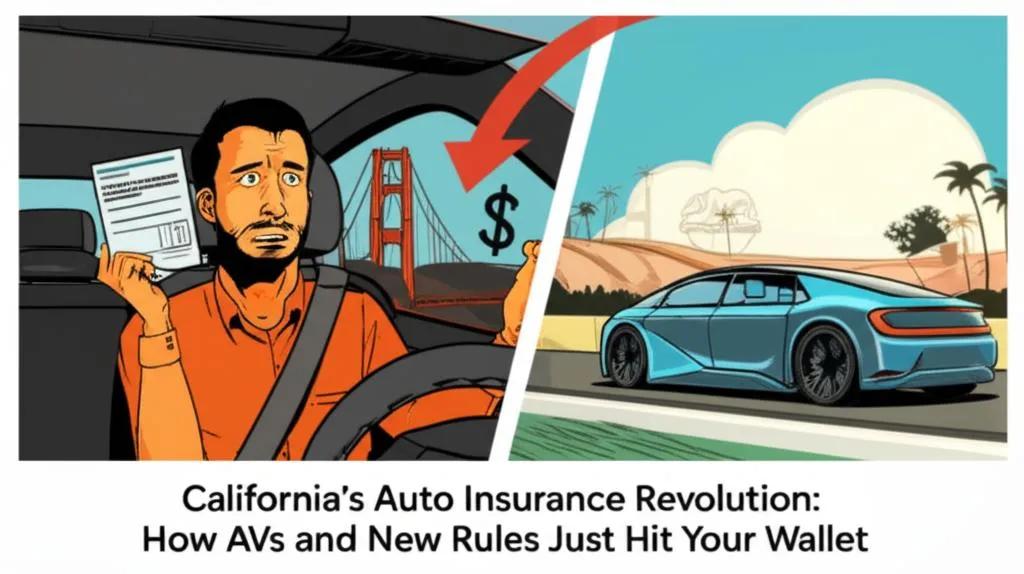
California Drivers Just Got Hit With a $456 Annual Insurance Increase
California drivers just got blindsided by the largest insurance cost spike in four decades—and most don't even realize what's happening. When the state doubled minimum coverage requirements in January 2025, it triggered premium increases averaging $456 annually. But that's just the beginning of a complete insurance overhaul that will reshape what you pay and how protection works.
Here's what makes this transformation urgent: while you're paying more for traditional coverage, autonomous vehicles are quietly rewriting the entire liability playbook. The result? A collision between old insurance models and new technology that's creating both major risks and unexpected opportunities for smart drivers.
The bottom line for your budget: These changes aren't theoretical—they're hitting bank accounts right now, and understanding them could save you hundreds of dollars while ensuring you're actually protected when accidents happen.
Your Insurance Costs Just Doubled—Here's Why
The Sticker Shock Numbers You Need to Know
On January 1, 2025, California's insurance minimums jumped more dramatically than they had in 40 years:
- Bodily injury coverage: Doubled from $15,000/$30,000 to $30,000/$60,000 per person/accident
- Property damage: Tripled from $5,000 to $15,000 per accident
- Real-world impact: Minimum coverage premiums increased 30-50% overnight
Carlos Hernandez discovered this firsthand when his delivery driver insurance jumped from $89 to $127 monthly—a brutal $456 annual increase that forced him to cut family expenses just to stay legal.
Why These Increases Hit Working Families Hardest
The geographic lottery makes this worse. If you're in Los Angeles or San Francisco, you're seeing the steepest increases because accident costs are higher. Rural drivers get smaller bumps, but urban workers—who often drive for rideshare or delivery services—are getting hammered twice.
Young drivers face a double penalty: A clean-record 22-year-old in Oakland saw premiums spike from $180 to $245 monthly. That's nearly $800 more per year for the same basic protection.
The hidden danger: Early reports suggest some drivers are dropping coverage entirely due to cost, which ironically makes roads more dangerous and drives up uninsured motorist costs for everyone else.
How Autonomous Vehicles Are Quietly Revolutionizing Liability
While you're dealing with higher traditional insurance costs, autonomous vehicles are fundamentally changing who pays when crashes happen. This shift will eventually save you money—but only if you understand how it works.
The Game-Changing Liability Flip
Here's the revolution in simple terms: When autonomous vehicles cause accidents, manufacturers pay instead of drivers.
Sarah Chen experienced this shift when her Tesla's autopilot nearly caused a crash in LA. The crucial question wasn't about her driving ability—it was whether Tesla or her insurance would handle liability if the software had actually caused an accident.
What this means for your wallet: As autonomous vehicles become more common, they'll handle the most dangerous driving situations, gradually reducing accident rates and insurance costs for everyone. Industry experts project 20-30% premium decreases by 2030.
The New Players Taking Financial Responsibility
Dr. James Park at UC Berkeley estimates product liability claims will surge 40% as AV adoption accelerates. Here's who's now on the hook:
- Technology companies for software failures and AI decision errors
- Manufacturers for sensor malfunctions and system integration problems
- Fleet operators for cybersecurity breaches and maintenance failures
This creates a massive cost shift: instead of individual drivers bearing insurance expenses through personal premiums, manufacturers are embedding these costs into vehicle prices and service fees.
California's New AV Rules That Affect Everyone
California's April 2025 AV regulations created risk changes that impact all drivers' insurance costs:
Commercial AV trucks over 10,001 pounds can now operate autonomously on major roads. While this seems irrelevant to commuters, it changes traffic patterns and accident risks that insurers factor into everyone's rates.
Clear accountability chains now exist when AVs violate traffic laws. Assembly Bill 1777 established specific response protocols and liability frameworks that eliminate the guesswork about who pays for AV-caused problems.
AI Is Making Your Insurance Smarter (And Potentially Cheaper)
Artificial intelligence isn't just changing autonomous vehicles—it's revolutionizing how insurance companies assess your risk and set your rates. Understanding this can help you take advantage of opportunities to lower your premiums.
How AI is Personalizing Your Rates
Instead of relying on broad demographic categories, AI now analyzes your actual behavior to create personalized rates. Laura Martinez in Fresno connected her smartphone to an AI-powered system that analyzed her driving for two weeks, resulting in premiums 25% lower than traditional underwriting offered.
What AI analyzes about you: - Acceleration and braking patterns - Cornering behavior and speed management - Phone usage while driving - Route selection and risk exposure - Time-of-day driving patterns
The speed advantage: AI-driven underwriting operates 90% faster than traditional methods while achieving 25% better accuracy in predicting claims.
The Data Your Car Shares (And How It Affects Your Rates)
Modern vehicles generate 25 gigabytes of data per hour. This creates unprecedented opportunities for insurers to understand your actual risk level rather than making demographic assumptions.
Real-world example: Tom Rodriguez, a Sacramento insurance agent, explains how this changes customer relationships: "Instead of annual check-ins, we have continuous insight. When someone develops unsafe habits, we can provide coaching before accidents happen."
The Prevention Revolution
The most exciting change involves preventing accidents rather than just paying for them afterward. AI systems now:
- Predict mechanical failures before they cause accidents
- Send real-time weather alerts for dangerous conditions
- Identify high-risk traffic situations and suggest alternatives
- Provide maintenance recommendations with premium discounts for compliance
What Smart Drivers Are Doing Right Now
Understanding these changes is only valuable if you take action. Here's how to protect yourself and potentially save money during this transition.
Immediate Steps to Manage Higher Costs
Review your coverage carefully: The new minimums might still leave you underprotected. A typical ER visit now costs more than the old property damage minimum, so consider whether you need more than just the legal requirement.
Shop aggressively: Insurance companies are responding differently to the new requirements. Some are absorbing costs better than others, creating significant price variations.
Explore usage-based insurance: If you drive safely, AI-powered monitoring could reduce your premiums even with higher coverage requirements.
Position Yourself for AV Savings
Understand hybrid coverage options: As vehicles incorporate more autonomous features, ask insurers about policies that account for reduced human error risk.
Consider the total cost equation: If you're shopping for vehicles with advanced driver assistance, factor potential insurance savings into your purchase decision.
Stay informed about manufacturer liability: When evaluating vehicles with autonomous features, understand what the manufacturer covers versus what requires personal insurance.
Prepare for the Transition
Document your driving patterns: Clean driving records will become even more valuable as AI systems create more personalized pricing.
Maintain cybersecurity awareness: As vehicles become more connected, cyber risks become insurance considerations.
Budget for integrated costs: Start thinking about transportation as a service rather than separate vehicle and insurance expenses, as this will become the dominant model.
Your Road Forward in California's Insurance Revolution
The convergence of higher coverage requirements, autonomous vehicle deployment, and AI-driven underwriting is creating the biggest insurance transformation since cars replaced horses. The winners will be drivers who understand these changes and adapt proactively rather than reactively.
The immediate reality: You're paying more now for traditional insurance while the foundation for future savings is being built through AV technology and AI innovation.
The opportunity: Drivers who embrace telematics monitoring, maintain excellent records, and choose vehicles with advanced safety features will see the biggest benefits as the transition accelerates.
The timeline: Expect continued premium pressure through 2027 as higher minimums take full effect, followed by gradual savings as AV adoption reduces overall accident risks by 2030.
California's insurance revolution isn't just changing coverage—it's reshaping the entire relationship between drivers, vehicles, and financial protection. The question isn't whether you'll be affected by these changes. The question is whether you'll be prepared to benefit from them.
Take action now: Review your current coverage, explore AI-powered monitoring options, and stay informed about manufacturer liability developments. The drivers who understand this transition will navigate it successfully—while those who ignore it will pay the price.
References
-
California Department of Motor Vehicles. (2025, April 25). California autonomous vehicle regulations. https://www.dmv.ca.gov/portal/vehicle-industry-services/autonomous-vehicles/california-autonomous-vehicle-regulations/
-
California Department of Motor Vehicles. (2025, April 25). California DMV releases updated autonomous vehicle regulations. https://www.dmv.ca.gov/portal/news-and-media/california-dmv-releases-updated-autonomous-vehicle-regulations/
-
Legislative Counsel of California. (2025, March 4). Assembly Bill 33. https://legiscan.com/CA/text/AB33/id/3153197
-
Legislative Counsel of California. (2025). Senate Bill 511 - Amended. https://legiscan.com/CA/text/SB511/id/3206053/California-2025-SB511-Amended.html
-
Crowell & Moring LLP. (2025, May 13). Californian autonomous vehicles get a revised regulatory load if new DMV law passes. https://www.crowell.com/en/insights/client-alerts/californian-autonomous-vehicles-get-a-revised-regulatory-load-if-new-dmv-law-passes
-
California Department of Insurance. (2025). New year means new changes for insurance. https://www.insurance.ca.gov/0400-news/0102-alerts/2025/New-Year-Means-New-Changes-for-Insurance.cfm
-
Insurance Thought Leadership. (2025, February 26). AI revolution insurance what expect 2025. https://www.insurancethoughtleadership.com/ai-machine-learning/ai-revolution-insurance-what-expect-2025
-
Victoria Transport Policy Institute. (2025, May 22). Autonomous vehicle implementation predictions. https://www.vtpi.org/avip.pdf