
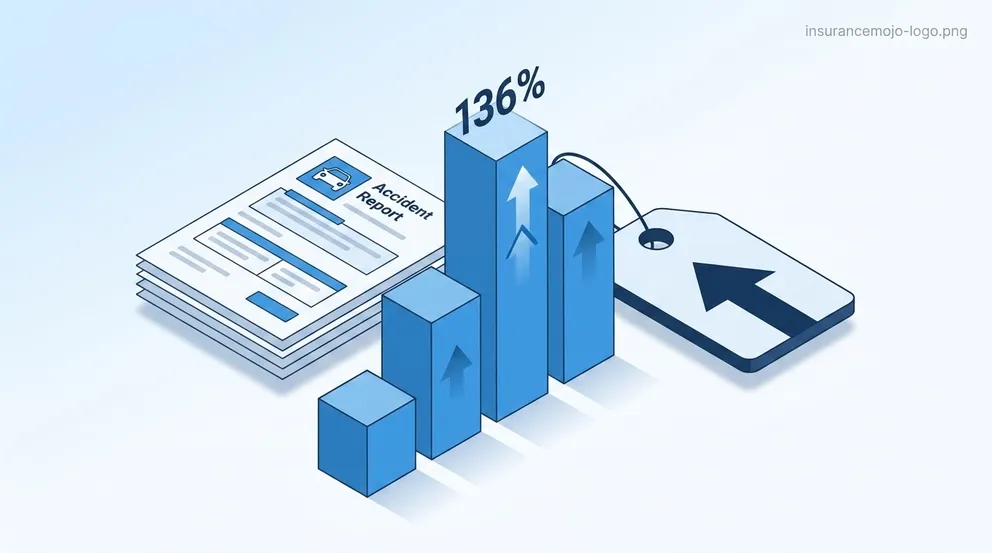
Two at-fault property damage accidents over $2,000 raise your annual premium by an average of 136%, per Insure.com's April 2026 analysis. Most standard insurers will still cover you after two accidents, but rates spike 50% to 150%. Non-standard carriers like Dairyland, Bristol West, and The General write coverage when standard insurers non-renew, typically after three accidents in three years.
- State Farm raises rates the least after accidents at 26%, while Farmers raises them the most at 82%, per Insure.com 2026 data
- Two at-fault accidents typically push annual premiums above $4,000 nationally before state and credit adjustments
- Non-standard insurers charge 30% to 300% more than standard rates but accept drivers other carriers reject
- Filing an SR-22 is automatic in some states after a second at-fault accident with injury or property damage above a state threshold
- Every accident drops off your insurance rating after 3 to 5 years, with Texas and California enforcing 3-year lookbacks
What Counts as "Multiple Accidents" to Insurers
Insurance underwriters do not count every fender bender the same way. A "multiple accident" record usually means two or more at-fault crashes within a three-to-five-year lookback window, with at-fault being the key word. Comprehensive claims (hail, theft, animal strikes) sit in a separate bucket and almost never trigger a high-risk reclassification on their own.
Three signals push you into high-risk territory fastest:
- Two or more at-fault accidents in 36 months. This is the threshold Progressive, Allstate, and State Farm use for surcharge stacking, per their public rate filings.
- Any at-fault accident with bodily injury. Bodily-injury claims raise rates 64% on their own, per Insure.com, even before a second accident gets added.
- An at-fault accident plus a moving violation. A speeding ticket layered onto one at-fault crash effectively functions as a second incident for rating purposes.
"Multiple accidents" applies to anyone listed on the policy, not just the named insured. If your teen driver has one at-fault crash and you have one, the household counts as a two-accident risk. Per the National Association of Insurance Commissioners (NAIC) 2025 Auto Insurance Database Report, household-level loss history drives renewal decisions at every major carrier.
How Much Two At-Fault Accidents Raise Your Premium
The headline number from Insure.com's April 2026 analysis: two at-fault property damage accidents over $2,000 each push the national average annual premium 136% above the clean-record baseline. On a $2,578 baseline, that pencils out to roughly $3,506 in added premium per year, or about $292 extra per month.
Here is how that increase breaks down by major carrier. The clean-record figure is the carrier's average rate for a 35-year-old with no incidents. The post-accident figure adds one at-fault accident; with two accidents, expect the increase percentage to roughly double.
| Carrier | Clean Record (annual) | After 1 At-Fault Accident | Single-Accident Increase |
|---|---|---|---|
| State Farm | $2,875 | $3,634 | +26% |
| Travelers | $1,962 | $2,823 | +44% |
| Amica | $2,769 | $4,308 | +56% |
| Progressive | $2,569 | $4,061 | +58% |
| Nationwide | $2,524 | $4,359 | +73% |
| Allstate | $3,159 | $5,589 | +77% |
| GEICO | $2,159 | $3,872 | +79% |
| Farmers | $3,207 | $5,823 | +82% |
Source: Insure.com, updated April 1, 2026. Rates reflect full coverage for a 35-year-old driver with one at-fault property damage accident. Add a second at-fault accident and most carriers stack surcharges, pushing total increases into the 130% to 200% range. Compare these single-accident effects against our deeper breakdown at car insurance rates after an accident.
State Farm raises rates the least after a single accident at 26%, while Farmers stacks the steepest surcharge at 82%. The gap between carriers is the single largest savings opportunity for multi-accident drivers, often worth more than $2,000 a year.
Will Your Current Insurer Drop You After a Second Accident
Insurers cannot cancel your policy mid-term for a new accident in any state, but they can non-renew you when your six- or twelve-month term ends. Non-renewal is a quiet exit: you get a letter 30 to 60 days before renewal saying coverage will not continue, and you scramble to find a new carrier.
Three thresholds reliably trigger non-renewal at standard carriers:
- Three or more at-fault accidents within a 36-month window
- Two at-fault accidents plus any major moving violation (reckless driving, DUI)
- One at-fault accident with a fatality or bodily injury claim above the policy limit
A non-renewal stays on your insurance record and gets disclosed to every future carrier through the C.L.U.E. report (Comprehensive Loss Underwriting Exchange). Per LexisNexis, which administers C.L.U.E., the report holds seven years of claims history that any insurer can pull during underwriting. Letting your policy non-renew is worse than switching voluntarily, because the next carrier sees the rejection.
You have leverage even after a second accident, though. Call your current insurer before renewal, ask whether you qualify for accident forgiveness on the second incident, and request a rate quote on the renewal. If they will not write you, ask for the non-renewal letter in writing so you can show a new carrier that you were not canceled for non-payment.
Best Carriers for Drivers with Multiple Accidents
The carrier market splits cleanly into two tiers after a second at-fault accident: standard insurers that will still write you at a surcharge, and non-standard insurers that specialize in drivers other companies reject. Get quotes from both before renewing, and reference our pillar on high-risk car insurance for a violation-by-violation carrier matchup.
Standard Carriers Still Writing Multi-Accident Drivers
State Farm, Progressive, and GEICO continue to write coverage for drivers with two at-fault accidents in most states, though their underwriting tightens. State Farm has the lowest post-accident rates by a wide margin nationally, per MoneyGeek's 2026 analysis, charging an average of $1,091 a year for full coverage after a single accident.
- Lowest post-accident surcharge at 26%, per Insure.com 2026
- Accident forgiveness available after 9 years claim-free
- Drive Safe & Save telematics can offset surcharges by 5% to 30%
- Local agents can often re-quote risks the call center declines
- Snapshot telematics rewards safer current driving regardless of past
- Name Your Price tool lets you adjust coverage to hit a target premium
- Continues to write drivers with three incidents in many states
- Files SR-22 in all 50 states where the form exists
- Below-average post-accident rates at +44%, per Insure.com
- IntelliDrive program offers up to 30% discount for safe drivers
- Accident forgiveness available in 44 states as a paid endorsement
- Underwrites multi-accident drivers more leniently than Allstate or Farmers
Source: MoneyGeek 2026 rate analysis based on full-coverage quotes for a 35-year-old driver with one at-fault accident, plus Insure.com's April 2026 carrier surcharge comparison. Add a second at-fault accident and most carriers stack surcharges, pushing monthly rates 50% to 100% higher than figures shown.
Non-Standard Carriers When Nobody Else Will Write You
Non-standard insurance is purpose-built for drivers the standard market has declined. Per Dairyland, the non-standard segment serves roughly 15% to 20% of US drivers at any given time. Rates run 30% to 300% above standard market pricing, but acceptance is broad and SR-22 filings are routine.
| Carrier | States Served | SR-22 Filing | Best Fit |
|---|---|---|---|
| Dairyland | 38 states | Yes, SR-22 and FR-44 | 2+ accidents plus DUI or license issue |
| Bristol West (Farmers subsidiary) | 42 states | Yes, SR-22 | Multiple violations plus poor credit |
| The General | 47 states | Yes, SR-22 | Coverage lapse plus accidents |
| National General (Allstate subsidiary) | 50 states | Yes, SR-22 | Non-renewal from standard carrier |
| SafeAuto | 19 states | Yes, SR-22 | Minimum-coverage budget shoppers |
Source: Carrier filings and Insurance Information Institute (III) 2025 non-standard market overview. Verify state availability and rates directly with each insurer, as non-standard carriers update appetite frequently.
Many non-standard carriers are subsidiaries of standard ones (Bristol West under Farmers, National General under Allstate, Dairyland under Sentry). When the parent company declines you, ask the agent to quote the subsidiary. The same underwriting team often approves the risk at a higher premium under the non-standard brand.
State-by-State Rate Impact After Multiple Accidents
State regulation, repair cost, and litigation climate drive enormous variation in post-accident rate increases. New Jersey, Texas, and California impose the steepest surcharges nationally, while Wyoming and Hawaii apply much smaller ones. Below is the rate-increase percentage applied after a single at-fault accident; multiply by 1.8 to 2.2 for an estimate after a second incident.
| State | Single-Accident Increase | Estimated 2-Accident Increase | Surcharge Lookback |
|---|---|---|---|
| New Jersey | +95% | +170% to +209% | 5 years |
| Texas | +93% | +167% to +204% | 3 years |
| California | +86% | +154% to +189% | 3 years (Prop 103 cap) |
| Massachusetts | +72% | +130% to +158% | 6 years (SDIP) |
| Florida | +68% | +122% to +149% | 5 years |
| National average | +49% | +88% to +108% | 3 to 5 years |
| Vermont | +56% | +101% to +123% | 3 years |
| Hawaii | +41% | +74% to +90% | Prohibited beyond minor |
| Wyoming | +34% | +61% to +75% | 3 years |
Source: Insure.com state-by-state analysis, April 2026, plus each state's Department of Insurance rate-impact filings. The 2-accident estimates apply Insure.com's reported 1.8x to 2.2x stacking multiplier for two at-fault property-damage claims over $2,000 each. Massachusetts uses the Safe Driver Insurance Plan (SDIP) which spreads surcharges over six years.
How to Lower Your Rate with Multiple Accidents on Record
You cannot erase accidents from your record, but you can compress the dollar impact through three lanes: shop aggressively across both standard and non-standard markets, layer telematics, and adjust coverage strategically. Drivers with two at-fault accidents who switch carriers save an average of $923 a year, per Insurify's 2025 quote data.
Pull your C.L.U.E. report before shopping
Request your free Comprehensive Loss Underwriting Exchange report from LexisNexis. Dispute any incident that is incorrectly listed or older than your state's lookback window. About 4% of C.L.U.E. reports contain errors per FTC accuracy studies, and removing a wrongly-coded claim can drop rates 15% to 40%.
Get quotes from 5 carriers spanning both tiers
Quote at least 3 standard carriers (State Farm, Progressive, Travelers) and 2 non-standard (Dairyland, The General). Standard carriers will surprise you sometimes; non-standard quotes give you a price floor. Use an independent agent if you want all five quotes in one sitting.
Enroll in telematics or pay-per-mile
Progressive Snapshot, Allstate Drivewise, and State Farm Drive Safe & Save reward current driving behavior, not historical claims. Discounts range from 5% to 30%. If you drive fewer than 8,000 miles a year, ask about pay-per-mile from Metromile or Nationwide SmartMiles.
Raise your collision deductible to $1,000 or higher
Moving from a $500 to $1,000 deductible cuts collision premium by 15% to 25% on average. After two accidents, your collision premium is already elevated, so the savings amount in dollars is larger than for a clean-record driver. See our breakdown at how to choose a car insurance deductible.
Drop comprehensive on older vehicles
If your car is worth less than 10 times your annual comp-and-collision premium, dropping it makes math sense. The Insurance Information Institute recommends this threshold as the break-even point.
Re-shop every 6 months until you exit high-risk
Non-standard carriers reassess risk at each renewal. After 18 to 24 claim-free months, you may qualify for standard market rates again. The drivers who save the most are the ones who quote three carriers at every renewal.
If you have not had a third accident or violation in 18 months, request a re-rate from your current insurer instead of waiting for renewal. Many carriers will re-quote mid-term if you ask, and the new rate takes effect immediately rather than at your next renewal date.
When Multiple Accidents Stop Mattering
Each at-fault accident drops off your rating record after 3 to 5 years, depending on the state. The clock starts on the date of the accident, not the date the claim was paid. For a driver with two accidents 18 months apart, the first stops affecting rates 36 to 60 months after that first crash, while the second hangs around for another 18 to 24 months. See our deeper breakdown of how long an accident stays on your driving record for the state-by-state lookback windows.
Here is the lookback window by state, sorted by length:
- 3 years: California (Prop 103), Texas, Massachusetts (initial rating), Colorado, Arizona, Wyoming, most other states
- 5 years: Florida, New Jersey, Pennsylvania, New York
- 6 years: Massachusetts (Safe Driver Insurance Plan surcharge spread)
- 7 years: How long the accident stays on your C.L.U.E. report regardless of state, per LexisNexis
The C.L.U.E. report is the longest memory in the system. Even after your state's surcharge window closes, a new carrier can see the incident for up to seven years when pulling underwriting reports. That does not always mean a higher rate; some carriers only surcharge within the state's window. But it can affect your eligibility for premium-tier programs like USAA's clean-driver discount or State Farm's accident forgiveness.
Looked at another way: each at-fault accident costs the average driver about $4,450 in surcharges over five years, before factoring in deductibles or out-of-pocket repair costs. That is why the right move after a second accident is not just paying the surcharge; it is shopping every six months and using telematics to chip away at the premium increase before the lookback window closes naturally.
Frequently Asked Questions
Two at-fault property damage accidents over $2,000 each raise the national average premium by 136%, per Insure.com's April 2026 analysis. On a $2,578 baseline, that adds about $3,506 a year. The exact increase depends on your carrier, state, and time between accidents.
Most standard insurers will not drop you after two at-fault accidents. They renew you at a higher rate. The non-renewal threshold typically kicks in at three at-fault accidents in 36 months, or at two accidents plus a major violation like a DUI.
State Farm raises rates the least after accidents at an average 26% increase, per Insure.com 2026 data. Progressive and Travelers also write multi-accident drivers at competitive rates. If standard carriers decline you, Dairyland, Bristol West, and The General specialize in multi-accident risks.
Each accident affects your premium for 3 to 5 years depending on your state. California, Texas, and most states use a 3-year lookback. Florida, New Jersey, Pennsylvania, and New York use 5 years. Massachusetts spreads surcharges over 6 years through its Safe Driver Insurance Plan. The C.L.U.E. report holds claim history for 7 years.
SR-22 filing is required after a court order or state mandate, not automatically after multiple accidents. Most drivers with two property damage accidents do not need one. However, if a second accident involved injury, uninsured driving, or a license suspension, an SR-22 typically becomes required. See our SR-22 insurance guide for state-by-state rules.
Yes. Shopping across both standard and non-standard carriers saves an average of $923 a year for drivers with two accidents, per Insurify 2025 quote data. Enroll in telematics for an additional 5% to 30% off, raise your collision deductible to $1,000, and re-shop every 6 months until your accidents drop off the rating record.
Non-standard insurance is coverage written for drivers the standard market has declined, typically because of multiple at-fault accidents, DUIs, lapses in coverage, or poor credit. Rates run 30% to 300% above standard rates, but acceptance is broad. Major non-standard carriers include Dairyland, Bristol West, The General, National General, and SafeAuto.
- Insure.com: How much will my insurance go up after an accident? (April 2026)
- MoneyGeek: Best Cheap Car Insurance After an Accident, 2026 Rates
- NAIC: Auto Insurance Database Report 2025
- Dairyland: Nonstandard Auto Insurance Guide
- LexisNexis: C.L.U.E. Auto Claim History Report
- Insurance Information Institute: Auto Insurance Basics
- The Zebra: How Car Accidents Affect Insurance Rates 2026