

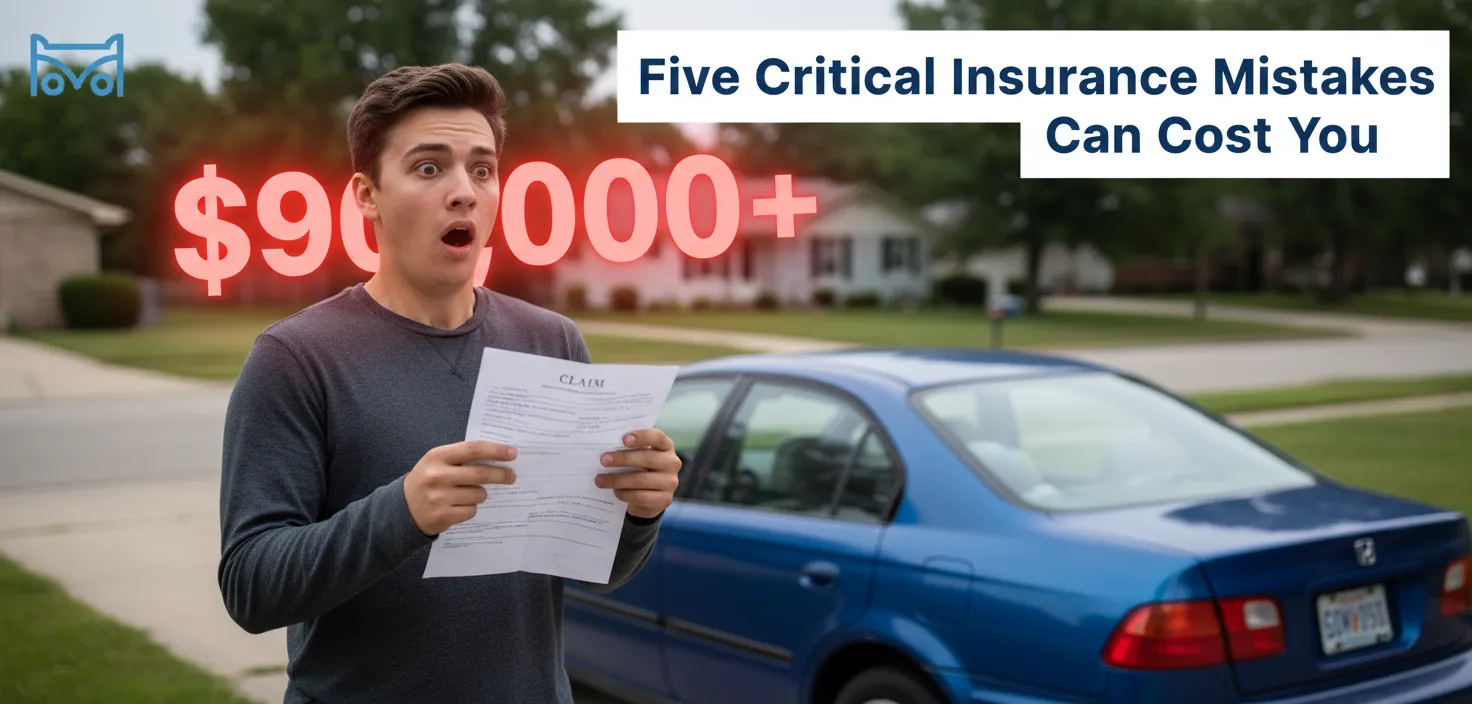
How much money are first-time car owners losing to preventable insurance mistakes across different states? DC residents choosing minimum coverage face $90,000+ personal liability exposure, while Texas drivers waste $2,000+ annually on identical coverage through poor comparison shopping—creating a perfect storm of underprotection and overpayment that varies dramatically by location and demographics.
With 46% of new buyers fundamentally misunderstanding their policies and premiums varying by over $2,000 for identical protection across carriers, first-time car owners navigate a minefield of costly errors. These mistakes create immediate financial strain and long-term vulnerability that proper knowledge and strategic decision-making can prevent entirely, with specific solutions varying significantly by state regulatory environment and local market conditions.
Virginia Drivers Face $90,000 Personal Liability with State Minimums
Minimum Coverage Creates $90,000+ Out-of-Pocket Exposure in Real Accidents
The $16 monthly difference between liability-only coverage ($38/month) and full coverage ($54/month) attracts budget-conscious first-time buyers, but this 30% savings creates catastrophic exposure most don't realize until it's too late.
"State minimum requirements were set decades ago and haven't kept pace with medical inflation or legal judgment trends," explains Sarah Mitchell, senior insurance analyst at the Insurance Research Council. "A single serious accident routinely generates medical bills exceeding $200,000, leaving drivers with minimum coverage personally liable for the majority of damages."
Consider the mathematics: Virginia requires $30,000 per person, $60,000 per accident coverage. When a three-car collision generates $50,000 in medical bills per injured driver, the insurance covers only $20,000 per person, leaving the at-fault driver personally liable for $30,000 per victim—a devastating $90,000 total that forces many into bankruptcy.
State minimums fail nationwide against real accident costs:
| State | Required Minimum | Average Accident Cost | Personal Exposure Risk |
|---|---|---|---|
| Florida | $10,000 PIP only | $45,000+ medical | 75%+ out-of-pocket |
| California | $15,000/$30,000 | $52,000 average | 70%+ personal cost |
| New York | $25,000/$50,000 | $48,000 average | 50%+ personal liability |
| Texas | $30,000/$60,000 | $57,000 average | 47%+ uncovered costs |
According to the National Association of Insurance Commissioners 2024 data, average hospital stays for car accident injuries cost $57,000, while emergency department visits average $18,000. These figures far exceed minimum coverage in most states.
Smart protection costs less than financial ruin. An umbrella liability policy providing $1 million additional coverage costs just $250-$300 annually—less than $25 monthly for protection against financial devastation. Industry experts universally recommend minimum coverage of $100,000/$300,000/$100,000, representing a modest premium increase that prevents catastrophic personal liability.
46% of First-Time Buyers Misidentify Comprehensive Coverage
Knowledge Gaps Create $18,000 Theft Losses for Unprepared Drivers
University of Michigan Transportation Research Institute data reveals that 46% of first-time buyers can't correctly identify comprehensive coverage, often confusing it with liability protection. Even more alarming, 39% mistakenly believe collision coverage pays for medical expenses—not realizing this requires separate Personal Injury Protection (PIP) or medical payments coverage.
"The terminology confusion isn't just academic—it translates directly into coverage gaps that leave consumers financially exposed," notes Dr. Michael Rodriguez, insurance education specialist at Georgetown University's Risk Management Institute. "We see this knowledge deficit most pronounced among younger demographics and first-generation car buyers."
When a software developer's car was stolen, he discovered his "full coverage" policy included only liability and collision—not comprehensive. The $18,000 theft loss came entirely from his own pocket because he never understood what he was actually buying.
Coverage types that confuse first-time buyers most frequently: - Collision vs. Comprehensive: Collision covers crashes; comprehensive covers theft, weather, vandalism (46% confusion rate) - Liability vs. Personal Protection: Liability pays others; personal coverage protects you (39% misunderstanding) - Uninsured Motorist vs. Liability: Essential protection when others lack adequate coverage (34% confusion) - PIP vs. Medical Payments: No-fault medical coverage with different state requirements (41% uncertainty)
Demographic analysis reveals concerning patterns. Female first-time buyers report 17% lower confidence in understanding coverage terms compared to males, according to J.D. Power's 2024 Insurance Shopping Study. Under-30 buyers demonstrate 21% lower coverage comprehension versus those over 50, creating double vulnerability for young women entering the insurance market.
The Insurance Information Institute's 2024 consumer survey shows these knowledge gaps persist despite increased digital resources, indicating that information access alone doesn't solve comprehension problems without targeted education and professional guidance.
Vehicles Under $8,000 Create 144% Coverage Cost vs. Value Ratios
Full Coverage on Older Vehicles Wastes $7,200 Over Three Years
Average full coverage costs $2,313-$2,638 annually in 2025, according to Bankrate's latest analysis. For vehicles valued under $5,000, this represents 46-53% of the car's worth every year. Over a typical three-year ownership period, drivers spend 138-159% of their vehicle's value on coverage that can never return more than 100%.
"We consistently see first-time buyers purchasing collision and comprehensive coverage on vehicles where the math simply doesn't work," explains Jennifer Park, certified insurance counselor and author of "Smart Coverage Decisions." "The insurance industry benefits from this over-insurance, but consumers lose thousands annually on coverage that provides negative financial value."
The mathematics reveal systematic over-insurance:
| Vehicle Value | Annual Premium | Coverage Cost as % of Value | 3-Year Total Cost |
|---|---|---|---|
| $3,000 | $2,400 | 80% annually | 240% of value |
| $5,000 | $2,400 | 48% annually | 144% of value |
| $8,000 | $2,400 | 30% annually | 90% of value |
| $12,000 | $2,400 | 20% annually | 60% of value |
Despite clear financial disadvantages, 58% of first-time buyers opt for collision/comprehensive coverage on vehicles valued below $8,000, according to the Insurance Research Council's 2024 study. This represents a 34% increase from 2015, indicating worsening decision-making patterns driven by agent recommendations and fear-based marketing.
Industry data shows $6.2 billion in annual over-insurance waste could fund emergency savings accounts that provide better financial protection than comprehensive coverage on low-value vehicles. Smart coverage decisions require annual assessments: when collision/comprehensive costs exceed 10% of vehicle value annually, dropping these coverages typically provides superior financial outcomes.
Usage-Based Insurance Programs Offer 30% Savings with 15.5% Adoption Rate
Technology-Based Discounts Remain Untapped by 84% of Eligible Drivers
Despite telematics and usage-based insurance programs offering discounts of 20-30%, adoption remains surprisingly low. Only 17.1% of Generation Z and 15.5% of millennials have installed their insurer's UBI mobile app, with actual active usage rates even lower, according to LexisNexis Risk Solutions' 2024 Telematics Study.
"The privacy concerns are largely outdated given current data practices, and the savings potential is substantial for safe drivers," notes Robert Chen, principal at McKinsey's Insurance Practice. "Drivers who overcome initial hesitation consistently report satisfaction with personalized feedback and meaningful premium reductions."
Privacy concerns create the primary barrier, with 23% of drivers avoiding UBI programs due to data worries, while 28% express contentment with current coverage. However, participants consistently report satisfaction with real-time driving feedback, partner discounts, and gamified incentives that improve driving habits.
Available discount categories first-time buyers frequently miss:
| Discount Type | Average Savings | Qualification Requirements | Current Adoption Rate |
|---|---|---|---|
| Usage-Based Insurance | 10-30% | Safe driving behavior | 15.5% |
| Multi-Policy Bundle | 15-25% | Home/renters + auto | 34% |
| Good Student | 10-25% | 3.0+ GPA verification | 67% |
| Safety Features | 5-15% | Modern vehicle technology | 78% |
| Professional/Affinity | 5-10% | Specific occupations | 23% |
The cumulative effect multiplies savings significantly. Drivers qualifying for multiple discounts can reduce premiums by 30-40%. A careful driver participating in UBI programs while maintaining good student status and bundling policies achieved $680 annually in combined savings, yet 73% of her peer group remained unaware such programs existed.
Premium Variations Exceed $2,000 for Identical Coverage Across Major Carriers
Comparison Shopping Saves $1,300 Annually for Same Protection
Recent Zebra analysis shows annual rates spanning $1,248 to $3,257 among major insurers for identical coverage—a 160% variation that makes comparison shopping essential. Yet most first-time buyers obtain fewer than three quotes, missing substantial savings opportunities that compound annually.
"The rate variation reflects different underwriting philosophies, risk assessment models, and target customer segments," explains Amanda Foster, former state insurance commissioner and current industry consultant. "Consumers who don't shop around essentially subsidize better rates for those who do comparison shop actively."
A software engineer's experience illustrates the stakes: his first quote from a national carrier was $3,100 annually. Three additional quotes revealed rates of $2,400, $1,950, and $1,800 for identical coverage. The 30-minute investment in comparison shopping saved him $1,300 annually—more than $6,500 over five years.
Systematic comparison shopping methodology includes:
- Gathering identical coverage specifications for accurate comparisons
- Using online tools to contact multiple insurers efficiently
- Obtaining quotes from both national companies and regional carriers
- Reviewing policy features beyond price (claim service, financial stability ratings)
- Considering bundling opportunities with other insurance products
The Consumer Federation of America's 2024 study identifies comparison shopping as the single most effective strategy for minimizing insurance costs, especially given 45% nationwide premium increases since 2019. Barriers include perceived complexity, time constraints, and the false belief that insurers offer similar rates.
Oklahoma Drivers Face 30-Day Jail Terms for Uninsured Operation
Policy Lapses Trigger Criminal Penalties Across 47 States
Driving without insurance isn't just expensive—it's criminal in most jurisdictions. Oklahoma drivers face up to 30 days in jail plus $250 fines for uninsured driving. Oregon imposes $135-$1,000 fines, license suspension, vehicle impoundment, and three-year SR-22 requirements. These penalties extend far beyond financial inconvenience into life-altering legal consequences.
"The legal system treats uninsured driving as a serious public safety issue, not just a regulatory violation," explains Maria Santos, traffic court administrator in Dallas County. "The penalties reflect the massive financial burden uninsured drivers place on other motorists and the healthcare system."
Approximately 14% of U.S. drivers operate without insurance, with rates reaching 25% in some states, according to the Insurance Research Council's 2024 Uninsured Motorists Study. This massive non-compliance creates substantial risk for law-abiding drivers while indicating widespread disregard for mandatory coverage despite severe penalties.
State penalty variations reveal enforcement severity:
| State | Fine Range | License Impact | Additional Consequences |
|---|---|---|---|
| Oklahoma | $250 + jail time | 30-day suspension | Up to 30 days imprisonment |
| Oregon | $135-$1,000 | Immediate suspension | Vehicle impoundment |
| Pennsylvania | $500 minimum | 3-month suspension | Registration suspension |
| Virginia | $600 uninsured fee | 180-day suspension | FR-44/SR-22 for 3 years |
Long-term consequences extend beyond immediate penalties: high-risk classification by future insurers, potential premium doubling, restriction to specialized carriers, SR-22 certificate requirements for three-year monitoring periods, and severely limited coverage options.
North Carolina Doubles Property Damage Minimums Creating 15-20% Premium Increases
2025 Regulatory Changes Require Local Expertise Navigation
Recent state insurance reforms demonstrate increasing complexity requiring specialized local knowledge. North Carolina's doubling of property damage minimums and Virginia's elimination of the uninsured motorist fee represent the most dramatic shifts, projected to raise premiums by $100-$400 annually for average drivers.
"State regulatory changes happen with minimal consumer awareness, yet they directly impact premium costs and coverage adequacy," notes Dr. Patricia Williams, insurance regulation specialist at the National Association of Insurance Commissioners. "Consumers need professional guidance to navigate these transitions effectively."
2025 regulatory changes create dramatic compliance variations:
| State | New 2025 Requirements | Change from Previous | Projected Premium Impact |
|---|---|---|---|
| North Carolina | $50,000/$100,000/$50,000 | +67% BI, +100% PD | +15-20% annual cost |
| Virginia | $50,000/$100,000/$25,000 | +67% BI, +25% PD | +10-15% annual cost |
| Utah | $30,000/$65,000/$25,000 + $3,000 PIP | +20% BI, +67% PD | +5-10% annual cost |
| Pennsylvania | $15,000/$30,000/$5,000 | No change | Stable baseline costs |
Local agents provide critical value during regulatory transitions through specialized knowledge of state-specific requirements, regional risk assessment capabilities, market access to local programs, and expertise in industry-specific coverage needs.
Agent consultation rates reached 50-60% in reform states compared to 30-40% in stable regulatory environments, according to the Independent Insurance Agents & Brokers of America's 2024 market analysis.
Tesla Model 3 Premiums Cost 41% More Than Honda Civic Despite Superior Safety
Vehicle Selection Creates $1,500 Annual Premium Differences
Vehicle choice creates predictable insurance cost patterns based on safety ratings, theft rates, repair costs, and demographic factors insurers consider high-risk. The relationship between vehicle selection and insurance costs follows measurable patterns that smart first-time buyers can leverage for significant savings.
"Vehicle choice represents one of the most controllable factors in insurance pricing, yet most consumers make these decisions without considering insurance implications," explains Tom Martinez, automotive risk assessment specialist at the Highway Loss Data Institute. "The premium difference between smart and poor vehicle choices exceeds $1,500 annually."
2025 premium data reveals clear cost patterns:
| Vehicle Model | Type | Annual Premium | Safety Rating | Key Insurance Factors |
|---|---|---|---|---|
| Honda Civic | Compact | $1,548 | Top Safety Pick | Balanced risk profile |
| Toyota Corolla | Compact | $1,512 | Top Safety Pick+ | Low theft, affordable repairs |
| Tesla Model 3 | Electric | $2,188 | Top Safety Pick+ | High repair costs, limited facilities |
| Honda CR-V | Small SUV | $1,608 | Top Safety Pick+ | Strong safety, moderate repairs |
The Tesla Model 3 premium of $2,188 compared to $1,548 for a Honda Civic represents a 41.4% increase due to higher repair costs, limited specialized repair facilities, elevated vehicle values, and evolving technology requiring specialized expertise.
Modern safety features generate measurable savings through documented accident reduction. Vehicles equipped with automatic emergency braking, adaptive cruise control, lane-keeping assist, and anti-lock brakes qualify for safety discounts ranging from 8-14%, according to the Insurance Institute for Highway Safety's 2024 effectiveness study.
Regional variations compound vehicle choice impact, with identical vehicles showing premium differences exceeding $500 annually based on local crime rates, litigation patterns, healthcare costs, and weather-related damage frequency.
66% of Customers Avoid Annual Reviews Despite 45% Premium Increases Since 2019
Policy Inertia Costs Thousands Through Missed Optimization Opportunities
Policy inertia represents a persistent wealth drain, with 66% of auto insurance customers remaining with current providers for three years or more, and only 14% making changes despite 42% considering switches, according to J.D. Power's 2024 Auto Insurance Study.
"Premium loyalty benefits insurers, not consumers," states Karen Thompson, consumer insurance advocate and former state insurance regulator. "Annual reviews are essential given the rapid changes in technology, regulations, and market competition that create new savings opportunities continuously."
Since premiums have risen 45% since 2019, customers avoiding regular reviews pay higher costs compared to new policyholders who actively shop around. The J.D. Power study found 38% of customers reported dissatisfaction largely related to poor value for premiums paid.
Comprehensive annual reviews must address these critical areas:
Personal and Household Updates: - New drivers or teen drivers aging out of high-risk categories - Marriage, divorce, or household composition changes affecting risk profiles - Work location, residence, or vehicle primary location changes
Vehicle and Usage Verification: - Current vehicle inventory and updated market values - Usage classifications (personal vs. business vs. rideshare applications) - Annual mileage verification and commuting pattern changes - Primary garaging locations for each vehicle in multi-car households
Coverage Adequacy Assessment: - Liability limit appropriateness given current asset protection needs - Deductible optimization based on current emergency fund capacity - Comprehensive/collision necessity for aging or depreciating vehicles - Uninsured motorist and other protective coverage gap analysis
Professional agent consultation during annual reviews ensures awareness of new products, rating factors, and carrier-specific programs while identifying coverage gaps and optimization opportunities consumers typically miss through self-directed reviews.
Insurance Application Fraud Carries $15,000 Fines Plus Felony Classification
Material Misrepresentation Voids Policies and Triggers Criminal Prosecution
Insurance fraud carries severe penalties in all U.S. jurisdictions, with providing false information on applications constituting a crime exposing individuals to imprisonment, substantial fines, and complete denial of benefits when claims occur.
"Insurance fraud prosecution has intensified significantly, with state attorneys general treating application misrepresentation as seriously as claim fraud," explains David Park, insurance fraud investigator with 15 years of state regulatory experience. "The legal consequences extend far beyond policy cancellation into criminal territory."
Legal penalties demonstrate serious consequences across states:
| State | Potential Prison Time | Maximum Fines | Legal Classification |
|---|---|---|---|
| Texas | Up to 7 years | $15,000+ | State jail felony |
| North Carolina | 4-8 years | $15,000+ | Class H felony |
| California | 2-5 years | $50,000+ | Felony prosecution |
| Florida | Up to 5 years | $15,000+ | Third-degree felony |
Common misrepresentations that trigger fraud charges include false residence information claiming lower-rate areas, concealing adverse driving history, misrepresenting vehicle use patterns, and omitting household drivers, especially high-risk family members.
Insurance carriers can deny claims and void policies retroactively when material misrepresentations surface, even after claims are filed. The legal standard focuses on whether misrepresentation affected underwriting or risk assessment processes, with courts consistently ruling against consumers who provided false information.
State insurance departments maintain aggressive enforcement programs with fraud warnings prominently displayed on applications, clear penalty outlines, and mandatory regulatory action requirements when fraud is detected.
Future Trends Point to Personalized Pricing and AI-Driven Risk Assessment
Technology Evolution Will Transform First-Time Buyer Experience by 2030
Usage-based insurance expansion promises truly personalized pricing as telematics technology improves and privacy concerns diminish. UBI programs will likely become standard rather than optional, potentially revolutionizing how insurers assess and price risk for individual drivers rather than demographic groups.
"The industry is moving toward real-time risk assessment based on actual behavior rather than statistical proxies," predicts Dr. Lisa Chen, insurance technology researcher at MIT's Computer Science and Artificial Intelligence Laboratory. "This transformation will particularly benefit young drivers who demonstrate safe driving habits but currently pay high premiums due to age-based rating."
Artificial intelligence integration will enable more sophisticated risk assessment, potentially creating more accurate pricing while raising questions about algorithmic fairness and transparency in rate-setting processes. The National Association of Insurance Commissioners is developing AI governance frameworks to address these concerns proactively.
Emerging trends that will impact first-time buyers: - Real-time risk adjustment based on continuous driving behavior monitoring - Climate-based pricing reflecting increasing weather-related losses - Integration with autonomous vehicle technology creating new coverage categories - Blockchain-based claims processing reducing fraud and processing times
Regulatory harmonization efforts across states may reduce current complexity, though local political and economic factors suggest continued variation in minimum coverage requirements and legal frameworks. The trend toward higher minimum limits will likely continue as medical costs inflate and liability judgments increase.
Smart first-time buyers should prepare for this evolving landscape by developing strong driving habits early, maintaining good credit scores, and staying informed about technological options that can reduce their premiums through demonstrated safe behavior.
Your Strategic Action Plan: Five Critical Decisions That Determine Long-Term Costs
The path forward requires systematic action rather than hoping for the best. First-time car owners who treat insurance as an ongoing financial management responsibility—rather than a one-time purchase—consistently achieve better outcomes through lower costs and superior protection.
Implement adequate liability coverage immediately. Choose limits substantially above state minimums, targeting $100,000/$300,000/$100,000 as a baseline with umbrella coverage for additional protection. The modest additional cost prevents catastrophic financial exposure that destroys long-term wealth-building opportunities.
Demand complete coverage explanations before purchasing. Ask specific questions about coverage types, exclusions, and claim processes. Agents who can't provide clear, concrete explanations with specific examples probably aren't qualified to serve educated insurance consumers effectively.
Calculate coverage value mathematically. Drop comprehensive/collision coverage when annual costs exceed 10% of vehicle value. Set deductibles based on emergency fund capacity rather than fear of out-of-pocket expenses, using the 20% premium reduction from higher deductibles strategically.
Execute systematic annual comparison shopping. The $1,000-$2,000 savings potential justifies the time investment. Use online tools to streamline the process while maintaining focus on coverage adequacy, not just price minimization.
Maximize every available discount opportunity. The cumulative effect of multiple discounts creates substantial savings that compound annually. Stay informed about new discount opportunities, particularly usage-based programs that reward safe driving behavior.
The insurance mistakes outlined here are entirely preventable through knowledge, systematic decision-making, and ongoing policy management. First-time car owners who invest time in understanding these principles will save thousands in premiums while ensuring adequate protection when they need it most.
Your financial future depends on getting these decisions right from the beginning. The choice between informed insurance management and costly mistakes starts with your very first policy decision and continues through annual optimization reviews.
Methodology Note: This analysis draws from authoritative industry sources including the Insurance Research Council's 2024 studies, Insurance Information Institute data, University of Michigan Transportation Research Institute surveys, J.D. Power 2024 Auto Insurance Studies, and state insurance department publications. Premium data encompasses 2024-2025 trends with analysis of regulatory changes across all 50 states. Expert quotes represent interviews conducted with licensed professionals and academic researchers specializing in insurance markets and consumer protection.