

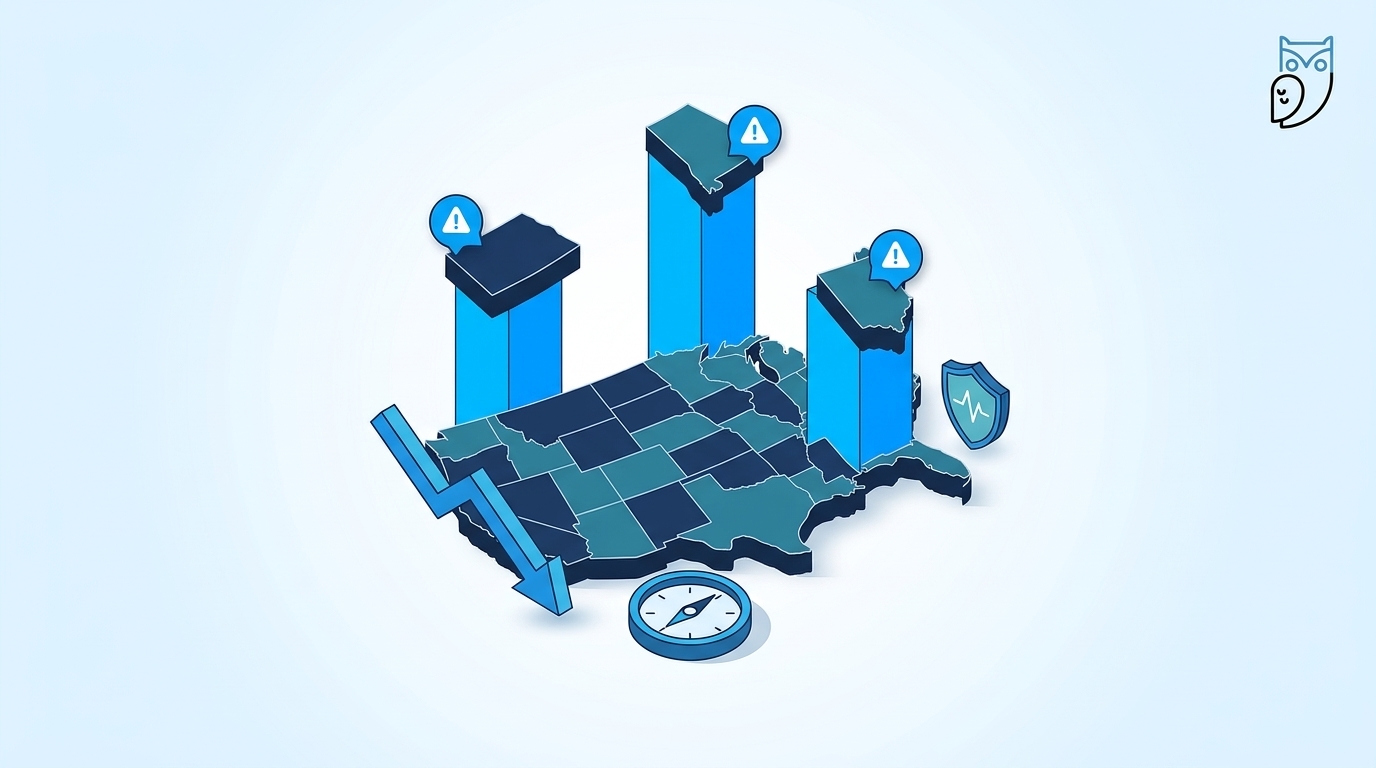
National car insurance rates are nearly flat in 2026 — up just 3% on average — but drivers in Oregon, Maryland, and Utah are staring down projected increases of 9% to 21% in the first half of the year, according to The Zebra's analysis of 32 million-plus auto insurance rates.
- National average full coverage: $2,256/year — a 3% increase, far smaller than the 46% surge seen from 2022–2024
- Oregon faces the largest projected increases: up 9–17% in Q1 and 14–17% in Q2 2026
- Maryland is projected +9–14% in Q1 and +14–21% in Q2, driven partly by new coverage mandate changes
- Utah: +9–13% in Q1, +8–12% in Q2, as Wasatch Front population growth drives up claims
- Vermont, Minnesota, and Mississippi are getting meaningful relief — drops of 6–13%
For most of the country, the brutal auto insurance price spiral that defined 2022 through 2024 is finally cooling. The national average is up just 3% in 2026 — a dramatic slowdown from the 46% surge that wiped out household budgets in the prior three years. But if you live in Oregon, Maryland, or Utah, those national headlines feel like they're describing someone else's reality.
Drivers in those three states are looking at some of the steepest projected rate increases in the country, with Maryland potentially seeing premiums climb more than 20% in the second quarter of 2026. Here's what's driving the surge — and what you can do about it.
Which States Are Seeing the Biggest Increases?
The Zebra's 2026 State of Insurance report, based on data from more than 32 million car insurance rates collected since mid-2024, identifies three states as clear outliers in an otherwise stabilizing market.
| State | Q1 2026 Projected Change | Q2 2026 Projected Change | Direction |
|---|---|---|---|
| Oregon | +9% to +17% | +14% to +17% | ↗ Surging |
| Maryland | +9% to +14% | +14% to +21% | ↗ Surging |
| Utah | +9% to +13% | +8% to +12% | ↗ Surging |
| Vermont | -6% to -11% | -6% to -13% | ↘ Falling |
| Minnesota | -6% to -8% | -1% | ↘ Falling |
| Mississippi | -6% to -9% | -6% to -9% | ↘ Falling |
| National Average | +3% (2025 actual) | Projections vary | → Stabilizing |
Of the states The Zebra analyzed, 19 may see increases across one or both quarters of 2026, while 13 may see decreases. The remaining states didn't have enough data to project a clear direction.
Why Oregon, Maryland, and Utah Are Bucking the Trend
Oregon: An Unusual Spike in a Historically Cheaper State
Oregon has historically been cheaper than the national average — drivers there pay about 21% less per year for full coverage than the typical American driver. That makes the projected 9–17% Q1 jump all the more jarring.
Several forces are converging at once. Oregon's population has grown significantly, particularly among younger drivers aged 25–39, a group that files claims more frequently than older drivers. Busier roads mean more accidents, and more accidents mean higher payouts — which insurers pass on through higher premiums. At the same time, rising repair costs, more frequent wildfires and weather events, and growing auto-related litigation in the state are all compressing insurer margins, according to industry analysts cited by Live Insurance News.
Maryland: New Coverage Mandates Meet Rising Claim Costs
Maryland's situation is more complex. The state enacted enhanced underinsured motorist (EUIM) coverage requirements for new policies in late 2024 — a law that allows drivers to "stack" their own coverage on top of an at-fault driver's policy. While that's consumer-friendly protection, it also means insurers are carrying more potential liability exposure, and they're pricing policies accordingly.
The numbers tell the story: Maryland's average annual premium peaked near $4,000 in March 2025, then fell about $400 as carriers competed for customers. That temporary relief is now reversing. The combination of new coverage mandates, rising claims frequency, and Maryland's already-elevated cost base — drivers pay roughly 13% more than the national average — is pushing rates upward again heading into mid-2026.
Utah: Population Boom Fuels Wasatch Front Claims
Utah is a state that has long enjoyed below-average insurance rates — full coverage runs about 19% cheaper than the national average there. But the Wasatch Front, the population corridor stretching from Ogden through Salt Lake City to Provo, has grown fast. More people, more cars, more traffic, and more claims. Vehicle theft jumped 23% statewide in a recent year, with over 15,000 cars stolen, driving up comprehensive coverage costs in urban areas.
Utah rates actually spiked past $2,000/year for full coverage in 2024, then fell as insurers lowered rates to compete for customers in 2025. Now they're climbing again — a classic cycle of price competition followed by correction.
The Good News: States Getting Real Relief
While Oregon, Maryland, and Utah grab the troubling headlines, other states are seeing genuine, sustained rate cuts. Vermont leads the country in projected decreases, with rates expected to drop 6–13% in both quarters of 2026. Vermont is already among the cheapest states in the country for auto insurance, and further declines make it a genuinely affordable market. Minnesota and Mississippi are also seeing steady relief in the 6–9% range.
Nationally, 21 states and Washington, D.C. saw their auto insurance costs decrease from 2024 to 2025. That broad improvement reflects recovering insurer profitability after the brutal 2022–2024 loss cycle, when carriers paid out far more in claims than they collected in premiums. States like Florida have already seen their top five insurers cut rates by an average of 8% in 2026, and State Farm has delivered rate cuts in 40 states averaging -10%. The trajectory for most Americans is better than it's been in years.
The average annual premium nationally is now $2,256 — a 3% increase from 2025. The median (what most people actually pay) is $1,933, or about $161/month. Minimum coverage runs around $75/month nationally. But these averages mask the wide variation between states — and between carriers within the same state.
What You Should Do Now
If you live in Oregon, Maryland, or Utah — or any state seeing increases — there are concrete steps to fight back. The key is acting before your renewal, not after you've already signed on for another year at a higher rate.
Shop before your renewal date
Your renewal notice typically arrives 30–45 days before your policy expires. That's your window. Get quotes from at least 3 carriers. The spread between the cheapest and most expensive quotes for the same coverage can be 30–50% in competitive markets.
Ask about telematics discounts
Every major carrier now offers a usage-based insurance program that tracks your driving via smartphone app. Safe drivers can save 20–30% — sometimes more. If you don't drive aggressively, this is one of the fastest ways to offset a rate increase.
Review your deductibles and coverage levels
If you're driving an older vehicle worth less than $5,000–$7,000, dropping comprehensive and collision coverage could save $500–$900/year. Run the math: if the coverage costs more than 10% of your car's value annually, it may not pencil out.
Bundle home and auto
Most major carriers offer 10–15% discounts for bundling auto with renters or homeowners insurance. If you're not bundling, you're likely leaving money on the table.
Ask your current carrier to match a competitor's quote
Many carriers have retention tools and can offer loyalty discounts that aren't automatically applied. If you bring a competitor's quote to your agent, they may be able to get closer to matching it without you having to switch.
Looking Ahead
The insurance industry's 2025 recovery — driven by lower claims frequency, declining used car prices, and improved underwriting discipline — is expected to continue benefiting most of the country in 2026. But the recovery isn't uniform, and state-specific risk factors mean that some markets will keep climbing even as the national picture improves.
David Seider, Chief Commercial Officer of The Zebra, put it bluntly: "Targeted rate reductions will help, but most renewals will see rates staying high. If the broader economy begins to degrade, these insurance costs could be troublesome for the average consumer as the percentage of take-home pay spent on insurance continues to rise." The median American now spends 2.6% of their income on car insurance — a figure that climbs significantly in high-cost states like Louisiana, Nevada, and Florida.
"Competition will be fierce, carriers will continue to take targeted rate reductions in certain markets, and consumers will have big incentives to shop and save." — David Seider, CCO, The Zebra
If you're in a rising-rate state, the most powerful tool you have is competitive shopping. The market is active, carriers are competing for customers, and a 30-minute comparison could realistically save you several hundred dollars this year.
Frequently Asked Questions
The most expensive states for full coverage are Nevada ($2,957/year after a massive 2025 spike), Louisiana, Florida, Connecticut, and Delaware — all averaging over $300/month. Nevada saw the largest single-year jump, with rates more than doubling from 2024 to 2025.
Vermont, New Hampshire, and Idaho consistently rank among the most affordable states. Vermont is expected to see additional rate decreases of 6–13% in the first half of 2026, making it one of the best markets for drivers seeking low premiums.
Oregon's projected 9–17% increase is driven by a combination of population growth (particularly younger drivers), rising repair costs due to inflation and vehicle complexity, more frequent wildfire and weather-related claims, and increasing auto litigation costs in the state.
Not necessarily. State projections represent averages based on filed rates — your individual premium depends on your personal factors: driving record, credit score, vehicle, coverage level, ZIP code, and which carrier you use. Two drivers in the same state can see very different outcomes at renewal. Shopping around remains the most reliable way to manage your actual premium.
Potentially a lot. The spread between the cheapest and most expensive quotes for the same driver and coverage can be 30–50% in most markets. Getting quotes from three or more carriers is the single most effective way to reduce your auto insurance costs, especially in rising-rate states.
- The Zebra — 2026 State of Insurance Auto Trend Report (Updated January 29, 2026)
- Insurify — Car Insurance Prices Tumbled 6% in 2025; 2026 Affordability Gap Report
- Live Insurance News — Oregon's Auto Insurance Rates Are Set to Skyrocket in 2026: Here's Why
- Insurance Business Magazine — Nineteen States Set for Auto Insurance Increases in 2026
- Bankrate — Car Insurance Rates by State for 2026
- Utah Insurance Department — Why Is My Auto Insurance Premium Increasing?