

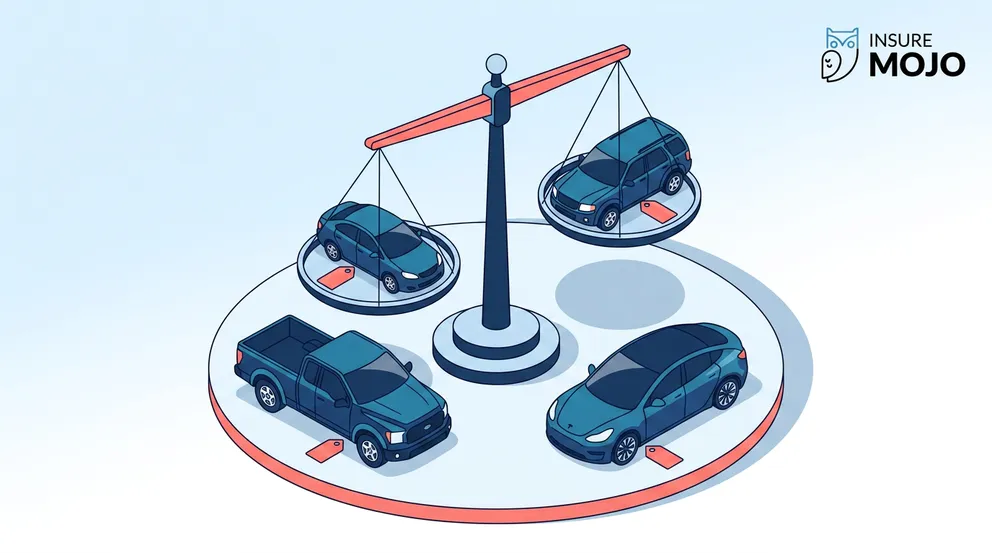
SUVs cost an average of $2,553 per year to insure in 2026, roughly 21% less than sedans at $3,222, according to Insure.com's multi-carrier analysis. The Honda CR-V is the single cheapest vehicle to insure at $1,932 annually, while the Maserati Quattroporte tops the list at $7,090.
Your choice of vehicle can swing your annual insurance bill by thousands of dollars. A driver picking a Honda CR-V over a BMW M8 Gran Coupe saves roughly $4,057 per year on premiums alone, per Insure.com's April 2026 data. If you're exploring how much car insurance costs on average, the vehicle sitting in your driveway is one of the biggest variables behind your quote.
Insurers evaluate repair costs, theft frequency, safety ratings, and claims history for every make and model. Compact SUVs with IIHS Top Safety Pick ratings consistently land at the bottom of the premium scale, while luxury sedans and performance coupes cluster at the top.
How Vehicle Type Affects Your Car Insurance Rate
Four factors explain most of the premium gap between vehicle categories, according to the Insurance Institute for Highway Safety (IIHS) and NAIC filing data.
Repair and parts costs carry the most weight. Replacing a bumper on a Maserati Quattroporte runs $3,800 or more at a certified shop, while a Honda CR-V bumper replacement averages $1,100, per Mitchell International's 2025 collision repair benchmarks. Insurers bake those expected claim payouts directly into your premium.
Theft rates push premiums higher for specific models. The NICB's 2025 Hot Wheels report lists the Hyundai Elantra, Hyundai Sonata, and Kia Optima among the most-stolen vehicles, which inflates comprehensive coverage costs for those models by 15% to 30%.
Safety and crash performance work in favor of larger vehicles. IIHS data from the 2021 to 2023 model years shows that station wagons, SUVs, and minivans exhibit lower bodily injury liability claim frequencies than smaller cars. Occupant protection improves with vehicle size, so injury claims drop and premiums follow.
Crash frequency by driver profile also matters. Sports cars attract younger, higher-risk drivers statistically, which pushes the entire category's actuarial pool upward. An 18-year-old male insuring a Maserati Quattroporte faces a $26,802 annual premium versus $7,090 for a 40-year-old, per Insure.com.
Average Car Insurance Cost by Vehicle Type in 2026
Insure.com collected full-coverage quotes from major carriers across all 50 states and averaged premiums by vehicle category. MoneyGeek and Insurify published similar datasets confirming the same ranking: SUVs cheapest, sedans in the middle, trucks and sports cars at the top.
| Vehicle Type | Avg. Annual Premium | Avg. Monthly Premium | vs. National Avg ($2,314) |
|---|---|---|---|
| SUV / Crossover | $2,553 | $213 | +10% |
| Truck / Pickup | $2,658 | $222 | +15% |
| Sedan | $3,222 | $269 | +39% |
| Electric Vehicle (all types) | $4,000 | $333 | +73% |
| Luxury / Performance | $5,989 | $499 | +159% |
Source: Insure.com April 2026, based on full-coverage quotes (100/300/100 liability, $500 deductible) for a 40-year-old driver with a clean record. National average from Bankrate April 2026.
Choosing a compact SUV like the Honda CR-V or Subaru Forester over a midsize sedan can save you $500 to $700 per year on premiums. Pair that with a multi-policy or safe-driver discount and your total savings could exceed $1,200 annually.
Top 10 Cheapest Cars to Insure in 2026
Nine out of the 10 cheapest vehicles to insure are SUVs or crossovers, according to Insure.com's April 2026 analysis. Only the Subaru Impreza, a sedan, cracks the list. Every model on this table carries an IIHS Top Safety Pick or Top Safety Pick+ designation, which correlates with lower bodily injury claims and cheaper premiums.
| Rank | Vehicle | Type | Avg. Annual Premium | Cheapest Carrier |
|---|---|---|---|---|
| 1 | Honda CR-V Cheapest | SUV | $1,932 | Nationwide ($1,402) |
| 2 | Honda HR-V | Crossover | $1,956 | GEICO ($1,601) |
| 3 | Volkswagen Tiguan | SUV | $1,968 | Nationwide ($1,465) |
| 4 | Hyundai Venue | Crossover | $1,987 | Nationwide ($1,687) |
| 5 | Subaru Forester | SUV | $1,992 | Nationwide ($1,444) |
| 6 | Subaru Outback | Wagon/SUV | $1,968 | Nationwide ($1,448) |
| 7 | Mazda CX-5 | SUV | $2,016 | GEICO ($1,637) |
| 8 | Chevrolet TrailBlazer | SUV | $2,028 | State Farm ($1,675) |
| 9 | Ford Maverick | Truck | $2,118 | Nationwide |
| 10 | Subaru Impreza | Sedan | $2,120 | Nationwide |
Source: Insure.com April 2026, full-coverage rates averaged across major carriers for a 40-year-old driver with a clean record.
Nationwide dominates the cheapest-carrier column, offering the lowest quotes on 6 of 10 models. GEICO takes second place with 3 lowest quotes. Shopping between just those two carriers could cut your premium by $400 to $530 compared to the all-carrier average, based on the spread in Insure.com's data.
The Ford Maverick is the only pickup truck that cracks the top 10 cheapest list. At $2,118 per year, it costs $540 less to insure than the next cheapest truck, the Ford Ranger, at $2,156 annually (Insure.com 2026).
Top 10 Most Expensive Cars to Insure in 2026
Luxury and performance models from Maserati, BMW, Mercedes, and Porsche occupy every slot. Allstate quoted the highest premiums on 7 of these 10 vehicles, with Farmers pricing the other 3 highest.
| Rank | Vehicle | Avg. Annual Premium | Highest Carrier Quote |
|---|---|---|---|
| 1 | Maserati Quattroporte | $7,090 | Allstate ($10,737) |
| 2 | Maserati Ghibli | $6,384 | Allstate ($10,141) |
| 3 | BMW M8 Gran Coupe | $5,989 | Allstate ($7,938) |
| 4 | Mercedes GT | $5,412 | Allstate ($7,532) |
| 5 | Porsche 911 GT3 | $5,287 | Farmers ($7,357) |
| 6 | Mercedes G63 | $5,214 | Farmers ($7,245) |
| 7 | BMW M8 | $5,148 | Allstate ($7,236) |
| 8 | Porsche 911 Turbo | $4,962 | Allstate ($6,758) |
| 9 | Mercedes S-Class | $4,887 | Allstate ($6,778) |
| 10 | Maserati Levante | $4,734 | Allstate ($8,271) |
Source: Insure.com April 2026, full-coverage rates averaged across major carriers for a 40-year-old driver with a clean record.
Allstate quoted $10,737 per year for a Maserati Quattroporte, nearly $3,647 above the multi-carrier average. Always compare at least 3 to 5 quotes on luxury vehicles, because carrier-to-carrier spread on high-end models regularly exceeds 40%.
The gap between the cheapest and most expensive vehicle to insure is $5,158 per year. Over a 5-year ownership period, that difference adds up to $25,790 in premium costs alone, before factoring in higher deductibles that luxury car owners often carry.
Why EVs Cost More to Insure Than Gas Cars
EV drivers pay roughly $4,000 per year for full coverage, about 49% more than comparable gas vehicles, according to MoneyGeek's 2026 analysis. The NAIC flagged this gap in a January 2026 bulletin, attributing it to three structural cost drivers that won't disappear overnight.
Battery replacement is the biggest factor. A new EV battery pack costs between $4,000 and $20,000 depending on make and model, per SelectQuote's 2026 data. Compare that to $100 to $200 for a traditional car battery. Even minor collisions that damage the battery enclosure can trigger total-loss declarations.
Specialized repair labor compounds the problem. Fewer than 30% of independent body shops are certified to work on high-voltage EV systems, according to Mitchell International. Limited shop availability means longer repair timelines and higher labor rates, both of which feed into insurer loss projections.
On the bright side, the Chevrolet Silverado EV bucks the trend at $1,947 per year for full coverage, making it cheaper to insure than many gas-powered sedans. The Mini Cooper Electric comes in at $1,522 annually through Nationwide, the lowest EV premium in Insure.com's database.
When comparing EV vs. gas insurance costs, match the same comprehensive and collision coverage levels. Some EV quotes default to higher liability limits because of the vehicle's purchase price, which inflates the comparison.
What Makes a Car Cheap or Expensive to Insure
Repair cost is the single strongest predictor, but four other variables interact with it. Understanding these factors helps when you're choosing which coverage types to carry on a specific vehicle.
Vehicles under $40,000 MSRP with IIHS Top Safety Pick ratings and low NICB theft rankings consistently fall below the $2,200 annual premium mark. The Honda CR-V checks all three boxes: $32,450 base MSRP, Top Safety Pick+, and it doesn't appear on the NICB's top 10 stolen vehicles list.
Your age and credit score interact with the vehicle type to produce your final quote. A 25-year-old with a clean record pays roughly 35% more than a 40-year-old on the same Honda CR-V, while a driver with poor credit can see a 71% surcharge in states that allow credit-based pricing, per Bankrate's 2026 analysis.
If your current premiums feel too high after a rate increase, check our guide on why your car insurance went up for 12 specific reasons and fixes.
Frequently Asked Questions
Yes. SUVs average $2,553 per year for full coverage versus $3,222 for sedans, a 21% difference, according to Insure.com's April 2026 multi-carrier analysis. IIHS data confirms that SUVs and larger vehicles have lower bodily injury claim frequencies than smaller cars, which directly reduces premiums.
The Honda CR-V is the cheapest vehicle to insure at $1,932 per year on average across major carriers. Through Nationwide specifically, the rate drops to $1,402 annually, or about $117 per month. The Honda HR-V and Volkswagen Tiguan round out the top three cheapest models.
EV premiums run about 49% higher than gas car premiums because battery replacement costs range from $4,000 to $20,000, fewer than 30% of body shops can service high-voltage systems, and higher MSRPs increase replacement value calculations. The NAIC and MoneyGeek both documented this gap in their 2026 reports.
Newer model years typically cost 10% to 15% more to insure than vehicles 3 to 5 years old, per Bankrate's 2026 data. Higher replacement value and costlier parts on new models drive this increase. Once a vehicle reaches 8 to 10 years old, you may save money by dropping collision and comprehensive coverage entirely.
- Insure.com — The Most Expensive and Cheapest Cars to Insure in 2026
- Bankrate — Average Cost of Car Insurance in April 2026
- MoneyGeek — Electric Vehicle Insurance: Costs and Coverage in 2026
- NAIC — Electric Vehicle Insurance Rates
- IIHS-HLDI — Insurance Loss Information by Vehicle Size and Type
- Insurify — Car Insurance Quotes by Vehicle Type 2026
- SelectQuote — Insurance Cost Comparison: Electric vs. Traditional Vehicles