

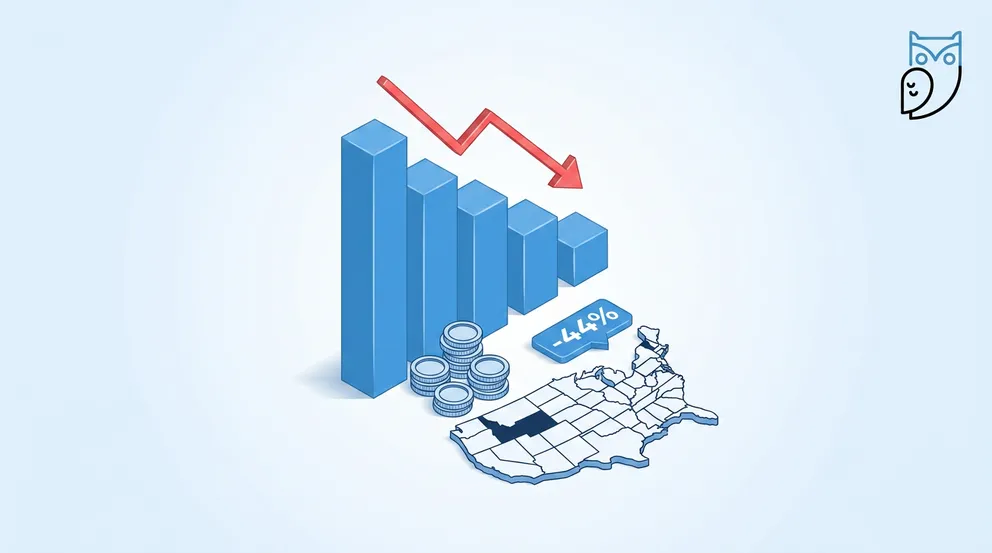
Vermont, Idaho, and Maine consistently rank as the cheapest states for car insurance in 2026, with average full coverage premiums roughly 30% to 44% below the $2,578 national average reported by Bankrate. Wyoming, New Hampshire, and Ohio round out the top six, all benefiting from low population density, low litigation, and fewer severe-weather claims.
Drivers in Vermont pay roughly $138 per month for the same full coverage policy that costs a Floridian $303 per month, according to The Zebra's 2026 state rate analysis. That $165 monthly gap adds up to nearly $2,000 per year for the same liability limits and the same comprehensive deductibles. If you're comparing states, the rates and rules vary significantly from one coverage type to the next, and our state-by-state car insurance requirements guide covers the full breakdown of what every state forces drivers to buy.
This article focuses on a different question: not what's required, but where insurance is genuinely cheap and why. The 2026 affordability gap between the cheapest and most expensive states is the widest Insurify has recorded in five years, with Wyoming drivers averaging $685 per year while Florida drivers cross $3,600 for comparable coverage.
The 15 Cheapest States for Car Insurance in 2026
Bankrate's 2026 rate database, J.D. Power filings, and Insurify's quote analysis disagree on the absolute dollar values, but the relative ranking has been remarkably stable since 2023. Below is a consolidated top 15 using Bankrate's full coverage averages with the national benchmark fixed at $2,578 per year.
| Rank | State | Avg. Annual Full Coverage | vs. National Avg. | Primary Reason for Low Rates |
|---|---|---|---|---|
| 1 | Idaho | $1,443 | -44% | Low theft, top-10 infrastructure ranking, rural mileage |
| 2 | Wyoming | $1,510 | -41% | Lowest population density in the lower 48, no major metro |
| 3 | Indiana | $1,624 | -37% | Tort reform, competitive carrier market |
| 4 | Vermont | $1,660 | -36% | Few major highways, low litigation volume |
| 5 | New Hampshire | $1,689 | -34% | Only state without mandatory liability insurance |
| 6 | Iowa | $1,690 | -34% | Iowa rates dropped 20%+ in 2025, the steepest cut nationally |
| 7 | Maine | $1,701 | -34% | 5.7% uninsured rate, lowest in the country |
| 8 | North Dakota | $1,727 | -33% | 9th-best highway infrastructure, low fatal-crash count |
| 9 | Hawaii | $1,757 | -32% | State law bans credit, gender, and ZIP from rate calculations |
| 10 | Washington | $1,752 | -32% | No mandatory PIP, large competitive carrier pool |
| 11 | Ohio | $1,783 | -31% | Aggressive rate-filing review by ODI, low litigation |
| 12 | Wisconsin | $1,795 | -30% | Modest population density, low theft rates |
| 13 | Virginia | $1,896 | -26% | Strict speeding enforcement reduces accident frequency |
| 14 | Massachusetts | $1,907 | -26% | Rate-cap regulation and managed competition |
| 15 | Nebraska | $2,295 | -11% | Rural Midwest geography, though hail claims are pushing rates up |
Source: Bankrate Auto Insurance Rate Database (March 2026 update), full coverage policy assuming a 40-year-old driver with a clean record, 100/300/100 liability limits, and a $500 collision/comprehensive deductible. National average benchmark: $2,578.
Vermont and Idaho have held a top-five cheapest position every quarter since Q1 2023, according to Insurify's quarterly tracker. Florida and Louisiana have done the inverse, never leaving the top three most expensive list during that same window.
Why These States Have the Lowest Car Insurance Rates
Insurance pricing is built from claims math, and the cheapest states share a few quantifiable traits that suppress claim frequency and severity.
Low population density means fewer cars in close proximity
Wyoming has 6 people per square mile, while New Jersey has 1,263 people per square mile, according to 2024 Census Bureau estimates. The Highway Loss Data Institute reports that collision-claim frequency tracks population density almost linearly, with rural states filing 35% fewer collision claims per insured vehicle than urban-dense states. Fewer collisions translate directly into lower loss ratios, which carriers pass back as lower base rates.
Low litigation volume keeps loss costs predictable
Idaho, Vermont, and Maine each rank in the bottom 10 for tort lawsuits per capita, per the U.S. Chamber Institute for Legal Reform's 2025 ranking. By contrast, Florida insurers paid $1.78 in claims for every $1 of premium collected during the 2022 to 2024 stretch, largely from attorney-driven roof and windshield claims. Predictable claim costs let carriers price aggressively without padding for litigation surprise.
Fewer hurricanes, floods, and hail events reduce comprehensive losses
NOAA's 2025 billion-dollar disaster report counted 27 named events in 2024, with concentrations in Texas, Florida, and the Gulf Coast. Vermont, Idaho, and Maine recorded zero billion-dollar weather events in 2024. Comprehensive coverage in cheap-insurance states often costs under $200 per year because comprehensive claims are concentrated in storm-prone regions where a single hailstorm can total tens of thousands of vehicles in one afternoon.
Low uninsured driver rates lower the UM/UIM premium
Maine has a 5.7% uninsured driver rate, according to the Insurance Research Council's 2024 report, the lowest in the country. The national average sits near 14%. When fewer drivers are uninsured, your uninsured/underinsured motorist premium drops because carriers face fewer claims for hit-and-run and unrecovered damages. In Mississippi, where 29.4% of drivers carry no insurance, the UM/UIM portion alone can exceed Maine's entire annual liability premium.
If you live in a state with high UM/UIM premiums, raising your UM limits to match your liability limits typically costs $40 to $80 per year and protects you from the gap left by underinsured drivers. Most state minimum UM limits leave a coverage hole of $30,000 or more.
The Hidden Trade-offs of Cheap-Insurance States
Low rates often correlate with low mandatory coverage minimums, which can leave drivers underprotected after a serious crash. New Hampshire requires no liability insurance at all, leaving drivers personally liable for damages they cause unless they buy coverage voluntarily. Florida, despite being one of the most expensive states, requires only $10,000 in property damage liability, a 1979-era number that no longer covers a modern vehicle's repair cost.
Idaho's $25,000/$50,000/$15,000 minimum looks affordable on paper but covers only one moderate hospital stay before the at-fault driver's personal assets are exposed. Bankrate's 2025 medical claim data shows the average per-person bodily injury claim in a multi-vehicle accident exceeds $32,000, which already breaches Idaho's $25,000 per-person cap. Buying full coverage at 100/300/100 in Idaho still costs less than buying state minimum in California, so the "cheap" state advantage compounds when you upgrade limits.
State minimum coverage in any cheap-insurance state will not protect a driver who totals a $45,000 truck or causes a multi-injury accident. The IIHS reports that 22% of all single-claim payouts in 2024 exceeded $50,000, meaning a $25,000 liability limit is insufficient one in five times the policy is used.
Can You Move to a Cheaper State Just for Insurance?
The math almost never works. Moving from Florida to Vermont saves a typical driver about $1,920 per year in insurance premiums, based on the rate gap between Bankrate's Florida average ($3,580) and Vermont average ($1,660). Vermont's median home price hit $387,000 in February 2026, per Redfin, while Florida's sits at $397,000, so housing is roughly equivalent. The deal-breaker is income: Vermont's median household income trails Florida's by about $4,200 annually after tax, per the Tax Foundation's 2025 state comparison, which fully erases the insurance savings.
Garaging-address fraud, where drivers register a vehicle at a friend's address in a cheaper state, is treated as insurance fraud in all 50 states. New York, California, and New Jersey have prosecuted hundreds of cases since 2022, with penalties reaching $5,000 plus a five-year policy non-renewal stamp on the driver's CLUE report. The CLUE record alone makes future insurance 30% to 60% more expensive at every carrier in every state.
The realistic path to cheaper insurance without relocating is shopping carriers, raising deductibles, and stacking discounts. NerdWallet's 2025 carrier shopping study found drivers who got three quotes saved an average of $584 per year, which exceeds the actual rate gap between many neighboring states. Compare your current premium against your local average using our overpayment check tool before assuming geography is the problem.
How Much You Could Save Without Moving
Drivers in expensive states still beat their state average by 25% to 40% through carrier shopping and discount stacking. A 35-year-old Detroit driver paying Michigan's $4,294 average can drop to roughly $2,800 by switching from a state-minimum no-fault policy to a managed-care PIP option, per Insurance Information Institute filings. A New Orleans driver paying Louisiana's $3,512 average typically saves $700 to $1,100 by bundling auto with renters or homeowners coverage.
The largest single discount nationally is the safe-driver discount, which averages 22% off the base rate at Progressive, GEICO, and State Farm filings. Multi-policy bundling adds another 14% on average. Telematics enrollment programs like Allstate Drivewise and Progressive Snapshot can cut another 10% to 30% for drivers who score well. For deeper rate context, our guide to average car insurance cost in 2026 breaks down what every age, coverage level, and driving record typically pays.
Frequently Asked Questions
Idaho holds the top spot for full coverage at roughly $1,443 per year, about 44% below the $2,578 national average reported by Bankrate. Wyoming ranks second at $1,510, with Vermont, New Hampshire, and Iowa rounding out the top five. Insurify's data, which uses minimum coverage rates, places Wyoming first at $685 per year.
Rural states have lower population density, which reduces collision frequency by about 35% per insured vehicle compared to dense urban states, according to the Highway Loss Data Institute. Lower theft rates, fewer attorney-driven claims, and minimal exposure to billion-dollar weather events all compound the savings. Insurance is priced from claims data, so fewer claims directly translate to lower base rates.
No. Registering a vehicle at an address where it is not garaged is insurance fraud in all 50 states, with penalties up to $5,000 and a five-year non-renewal mark on your CLUE driving report. The CLUE flag raises future premiums by 30% to 60% at every carrier nationally, erasing any short-term savings. Carriers cross-check garaging addresses against DMV records, EZ-Pass data, and claim locations.
- Bankrate — Car Insurance Rates by State for 2026
- Insurify — Cheapest States for Car Insurance: Quotes, Discounts for 2026
- The Zebra — Cheapest 2026 Car Insurance Rates by State
- MoneyGeek — Car Insurance Rates by State: Average Cost in 2026
- Insurance Research Council — Uninsured Motorists, 2024 Edition
- IIHS-HLDI — Insurance Loss Information
- NOAA NCEI — Billion-Dollar Weather and Climate Disasters
- U.S. Census Bureau — Population Density Estimates