

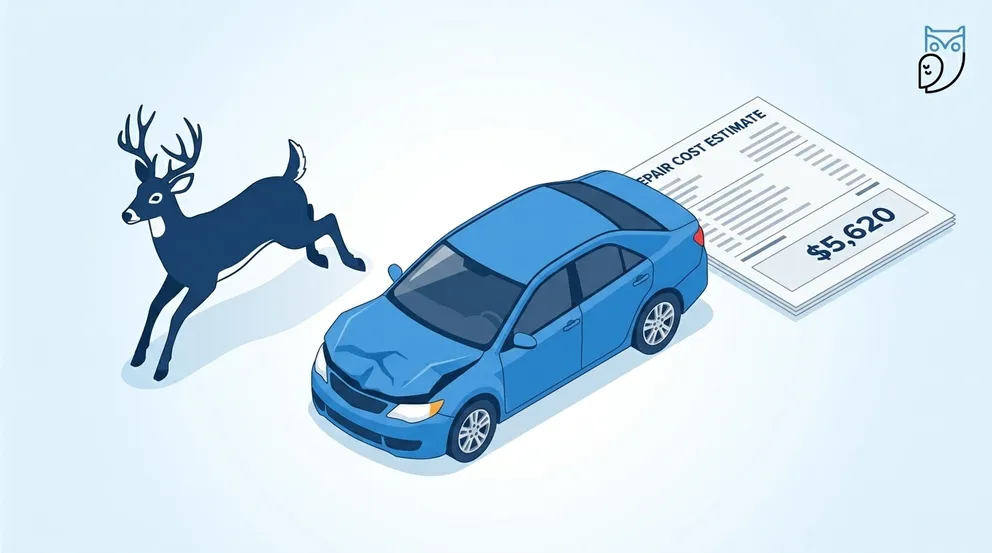
Comprehensive coverage pays for deer strikes. Collision coverage does not. State Farm logged 1.1 million deer claims between July 2024 and June 2025, and MoneyGeek puts the 2024 average repair at $5,620 in high-risk regions. You still pay your deductible, most commonly $500.
- Only comprehensive coverage pays for an animal strike, and roughly 20% of insured drivers skip it entirely
- Swerve into a guardrail instead of hitting the deer and the claim flips to collision, which many insurers code as at-fault
- West Virginia drivers face 1-in-40 odds of an animal collision, versus 1-in-966 in Nevada
- A single comprehensive claim typically adds 0% to 10% at renewal, or about $30 to $140 a year
- October through December produce roughly 650,000 animal claims, about 38% of the annual total
Does Car Insurance Cover Hitting a Deer?
Comprehensive coverage handles it. If a whitetail steps out of the treeline on a two-lane road and you take the impact on your grille, your comprehensive policy pays for the bumper, the radiator, the hood and the headlight assembly, minus your deductible. Collision coverage pays nothing, even though most drivers buy both on the same full-coverage policy.
That split confuses people, and for good reason. You collided with something. But GEICO, Progressive, Allstate and State Farm all file animal strikes under comprehensive, the same bucket that covers hail, theft, fire, flood and a cracked windshield. Insurers reserve collision coverage for impacts with vehicles and fixed objects like poles, fences and parked cars.
Carry liability only, and you get nothing after a deer strike. State minimum liability pays for damage you cause to other people, never for your own vehicle. About 1 in 5 insured U.S. drivers carries no comprehensive coverage, and every dollar of that $5,620 average repair lands on them.
Why Insurers Call It Comprehensive, Not Collision
Underwriters treat a deer as an act of nature rather than a driving error. Nobody assigns fault to a deer, and no other policyholder exists to subrogate against, so the claim never enters the at-fault chain that drives up premiums for three to five years. Our full breakdown of comprehensive vs. collision coverage walks through which perils land in each bucket.
The practical upshot matters at renewal. Comprehensive claims sit in a lower-severity rating tier than at-fault collisions, which is why a deer strike usually costs you far less over time than rear-ending someone at the same repair price.
The Swerve Exception That Changes Everything
Jerk the wheel to miss the deer, clip a guardrail, and your claim just moved from comprehensive to collision. Progressive states this plainly in its own coverage guidance: hitting an object while avoiding an animal is a collision loss, and many carriers code it at-fault because you steered the car into the thing you hit.
That reclassification carries real money. A collision claim can push renewal premiums up 40% or more in some states, while the same repair filed as comprehensive might cost you nothing. Brake hard, stay in your lane, and accept the hit. Safety agencies give the same advice for a different reason: swerving at 55 mph puts you into oncoming traffic or a ditch, and NHTSA recorded 164 deaths from animal-involved crashes in 2021, most of them in October through December.
Never tell an adjuster you swerved if you did not. Fabricating the sequence to chase a lower deductible is insurance fraud, and carriers routinely pull event data recorder logs showing steering input and braking force in the two seconds before impact.
What a Deer Claim Actually Costs
Repair estimates cluster higher than most drivers expect. CARSTAR reports that nearly 70% of its franchise partners put the average deer repair between $2,500 and $4,999, with a meaningful share landing between $5,000 and $10,000. MoneyGeek's 2024 figure for high-risk regions came in at $5,620, up from $5,000 in 2023, a 12.4% jump in a single year.
Modern sensor packages drive that inflation. A deer strike takes out the grille, and behind the grille sits the adaptive cruise control radar, the forward collision camera and the parking sensors, each requiring recalibration after replacement.
| Repair Scenario | Typical Cost | vs. 2024 Deer Average ($5,620) | Your Cost with $500 Deductible |
|---|---|---|---|
| Cosmetic bumper and grille | $1,800 | -68% | $500 |
| Bumper, hood, headlight | $4,200 | -25% | $500 |
| Front end plus radiator and sensors | $5,620 | Baseline | $500 |
| Airbag deployment, frame damage | $11,000 | +96% | $500 or total loss |
Sources: MoneyGeek analysis of 2024 deer collision repairs and CARSTAR franchise partner survey data. Figures assume a comprehensive claim with a $500 deductible on a full-coverage policy. Actual estimates vary by vehicle, sensor package and regional labor rates.
Deductibles run from $100 to $2,000 depending on what you selected, though $500 remains the most common pick. Raising yours from $500 to $1,000 trims comprehensive premiums about 15% on average, which sounds appealing until a deer costs you an extra $500 out of pocket. Our guide to choosing the right deductible amount runs the tradeoff in detail.
Will a Deer Claim Raise Your Rates?
Usually not much, and sometimes not at all. Industry estimates put a single comprehensive claim at 0% to 10% on your next premium, translating to roughly $30 to $140 per year for a typical policyholder. File two or more comprehensive claims inside three years, though, and most carriers flag the policy for rate review or non-renewal.
Carrier behavior varies more than any national average suggests. The Consumer Federation of America tested this directly by pulling quotes from five major insurers across 10 cities, and the results split sharply.
| Carrier | Behavior on Not-At-Fault Claims (CFA Testing) | Practical Impact |
|---|---|---|
| State Farm | Never raised the premium in any tested city | $0 surcharge |
| Progressive | Surcharged in every test where state law permitted | Highest exposure of the five |
| GEICO | Sometimes raised rates 10% or more | $120+ on a $1,200 annual policy |
| Farmers | Sometimes raised rates 10% or more | $120+ on a $1,200 annual policy |
| Allstate | Occasionally penalized blameless drivers | Varies by city and rating territory |
Source: Consumer Federation of America premium testing, published February 2017, covering five insurers across 10 U.S. cities. Averaged across all carriers, moderate-income drivers saw a $208 increase (9.6%) after a not-at-fault accident and higher-income drivers saw $78 (6.6%). Excluding State Farm, those averages rose to $264 (12.1%) and $99 (8.3%). CFA tested not-at-fault collisions rather than animal strikes specifically; comprehensive claims typically carry lighter surcharges.
Two states shut the practice down entirely. California and Oklahoma prohibit insurers from surcharging drivers for accidents they did not cause, so a deer claim in Bakersfield or Tulsa cannot legally move your base rate.
Ask your agent one question before filing: does this carrier surcharge comprehensive claims in my state? State Farm's public claims guidance says animal strikes generally do not affect rates, but Progressive and GEICO handle it territory by territory. If your renewal jumps, that is the moment to shop, and our analysis of the best time to shop for car insurance explains why 2 to 3 weeks before renewal beats waiting for the bill.
Should You File the Claim or Pay Out of Pocket?
Run the arithmetic before you call. Your net benefit equals the repair estimate minus your deductible, minus whatever surcharge you absorb over the next three years. At $30 to $140 per year, that surcharge exposure totals $90 to $420 across a three-year lookback.
| Repair Estimate | Insurer Pays ($500 Deductible) | 3-Year Surcharge Risk | Worth Filing? |
|---|---|---|---|
| $700 | $200 | $90 to $420 | No, you likely lose money |
| $1,200 | $700 | $90 to $420 | Marginal, depends on carrier |
| $2,500 | $2,000 | $90 to $420 | Yes, clear net gain |
| $5,620 | $5,120 | $90 to $420 | Yes, file immediately |
| $11,000 | $10,500 | $90 to $420 | Yes, file immediately |
Methodology: surcharge range reflects the 0% to 10% typical impact of a single comprehensive claim on an average annual premium, applied across a standard three-year claims lookback. Drivers insured by State Farm or living in California and Oklahoma should treat the surcharge column as $0.
Anything under roughly $1,200 deserves a hard look at self-paying, particularly if you already have a comprehensive claim on file from hail or glass. Our deeper walkthrough on whether to file a claim or pay out of pocket covers the same math for collision and liability losses.
Where Deer Collisions Are Most Likely
State Farm counted 1.7 million animal collision claims between July 2024 and June 2025, down 5.6% from 1.8 million the prior year. Deer accounted for more than 1.1 million of those, roughly 65% of the total. National odds improved to 1 in 139, from 1 in 128 a year earlier, a 7.9% drop in risk.
| State | Odds of an Animal Collision | vs. National (1 in 139) | Estimated Annual Claims |
|---|---|---|---|
| West Virginia | 1 in 40 | 3.5x riskier | Not reported |
| Montana | 1 in 53 | 2.6x riskier | Not reported |
| Wisconsin | 1 in 58 | 2.4x riskier | Not reported |
| Michigan | 1 in 61 | 2.3x riskier | 126,000 |
| Pennsylvania | 1 in 62 | 2.2x riskier | 147,000 |
| Arizona | 1 in 577 | 4.2x safer | Not reported |
| Nevada | 1 in 966 | 6.9x safer | Not reported |
Source: State Farm animal collision study covering claims filed July 1, 2024 through June 30, 2025. Odds represent the likelihood that any given driver in that state files an animal collision claim during the study period. Ratios comparing state odds to the 1-in-139 national figure are calculated by InsureMojo.
Pennsylvania leads the country on raw claim volume at 147,000, followed by Michigan at 126,000, North Carolina at 88,000, Texas at 86,000 and Ohio at 80,500. Drivers in West Virginia have held the top risk spot for more than a decade running.
When Deer Strikes Peak
Mating season and shortened daylight collide in autumn. State Farm attributes roughly 650,000 claims to October, November and December, meaning about 38% of the year's animal collisions compress into 25% of the calendar. November alone runs 12 to 14 claims per 1,000 vehicles, triple the 4 per 1,000 recorded in April and August.
Timing within the day matters just as much. Collisions occur 14 times more often in the two hours after sunset than in the two hours before, and 76% happen in darkness. A University of Washington study of more than 1 million collisions from 1994 through 2021 found the fall clock change alone triggers a 16% spike, and estimated that permanent daylight saving time would prevent 36,550 deer deaths, 33 human deaths and $1.19 billion in collision costs each year.
Is Comprehensive Coverage Worth It Where You Live?
Comprehensive runs $200 to $350 a year on its own, per MoneyGeek's analysis of more than 2.4 million quotes, and NAIC data shows comprehensive premiums rose 21% in 2023. Multiply your state's collision odds by the average payout and you can see exactly how much of that premium the deer risk alone justifies.
| State | Collision Odds | Expected Annual Animal Payout | Share of a $275 Comprehensive Premium |
|---|---|---|---|
| West Virginia | 1 in 40 | $128.00 | 46.5% |
| Montana | 1 in 53 | $96.60 | 35.1% |
| Wisconsin | 1 in 58 | $88.28 | 32.1% |
| Michigan | 1 in 61 | $83.93 | 30.5% |
| Pennsylvania | 1 in 62 | $82.58 | 30.0% |
| National average | 1 in 139 | $36.83 | 13.4% |
| Arizona | 1 in 577 | $8.87 | 3.2% |
| Nevada | 1 in 966 | $5.30 | 1.9% |
Methodology: InsureMojo calculation. Expected annual payout equals each state's animal collision probability (State Farm, July 2024 to June 2025) multiplied by $5,120, the $5,620 average repair less a $500 deductible. The $275 comparison premium is the midpoint of MoneyGeek's $200 to $350 standalone comprehensive range. Animal strikes are one of many perils comprehensive covers, so this column measures the deer-risk slice only.
A West Virginia driver recovers nearly half the annual comprehensive premium on deer risk alone, before counting hail, theft, falling branches or glass. A Nevada driver recovers under 2%, which means the case for comprehensive there rests almost entirely on those other perils. Neither result argues for dropping the coverage on a financed or late-model car, since lenders require it and a single hailstorm can exceed $8,000. Where the math genuinely shifts is on an older vehicle, and our guide on when to drop collision and comprehensive on an older car sets the threshold.
What to Do in the First 30 Minutes After Hitting a Deer
Check everyone and call 911 if anyone is hurt
Airbag deployment at highway speed causes chest and facial injuries. Medical payments coverage or PIP handles those bills regardless of who or what you hit.
Pull off and turn on your hazards
Secondary crashes kill more people than the original strike, and 76% of deer collisions happen in the dark where a stopped car is nearly invisible.
Stay away from the animal
An injured 150-pound buck kicks hard enough to break bones. Call the state highway patrol or DNR and let them handle it.
Photograph everything before the tow truck arrives
Shoot the damage from four angles, the deer, the road, the skid marks and any crossing signs. Adjusters use those images to confirm an animal strike rather than a swerve.
File a police report if damage tops your state threshold
Several states require a report above $1,000 to $2,000 in damage, and the report number speeds the comprehensive claim considerably.
Call your insurer within 24 hours
Have your policy number, the photos and the location ready. Ask specifically whether the claim is being coded comprehensive before you approve any repair.
Do not drive away assuming the damage is cosmetic. A bent radiator support or a punctured coolant line can seize an engine within 20 miles, and insurers routinely deny the resulting engine claim as a separate, uncovered mechanical failure.
State Rules on Reporting and Keeping the Deer
Roughly 30 states let drivers legally salvage a deer they struck, though the paperwork differs everywhere. Three of the highest-risk states illustrate the range.
| State | Police Report Required? | Keeping the Carcass |
|---|---|---|
| Pennsylvania | Only if the vehicle is undriveable or someone is injured | Notify the PA Game Commission within 24 hours |
| Michigan | Not required for the animal alone | Request a free salvage permit at Michigan.gov/RoadKillPermit |
| Wisconsin | Not required for the animal alone | Driver holds first claim; register the deer with a DNR customer ID |
Skipping the notification step carries fines in most states, since an unregistered deer is legally indistinguishable from a poached one. Wisconsin gives the driver first priority on the carcass and passes it to anyone else at the scene who wants it, while Pennsylvania ties the permit to a 24-hour Game Commission call.
How to Cut Your Odds of Hitting a Deer
Deer travel in groups, so spotting one means slowing down immediately rather than accelerating past it. Drop 10 to 15 mph below the posted limit on rural roads between dusk and dawn during October, November and December, the three months carrying 650,000 claims.
- High beams reveal eye reflection at roughly 500 feet, buying you about 5 seconds of reaction time at 55 mph
- Yellow crossing signs mark documented collision corridors, not decoration; treat them as speed advisories
- One long horn blast moves deer better than flashing headlights, which tend to freeze them in place
- Brake firmly and hold your lane; swerving converts a covered comprehensive claim into an at-fault collision
- Wildlife crossing structures cut collisions 85% to 95% in treated corridors, per federal transportation data
Two weeks after the fall clock change is the single most dangerous stretch of the year for deer strikes, with collision claims spiking 16% as commuters suddenly drive home in the dark.
Frequently Asked Questions
Yes, if you carry comprehensive coverage. Comprehensive pays for animal strikes minus your deductible, which is most commonly $500. Liability-only policies pay nothing toward your own vehicle, leaving you responsible for the full repair, which averaged $5,620 in high-risk regions in 2024.
Comprehensive. GEICO, Progressive, Allstate and State Farm all classify animal strikes as comprehensive losses because no other vehicle or fixed object is involved. Collision coverage applies only if you swerve and hit something else, such as a guardrail, tree or another car.
A single comprehensive claim typically adds 0% to 10% at renewal, roughly $30 to $140 per year. State Farm did not surcharge not-at-fault claims in any city Consumer Federation of America tested, while Progressive surcharged wherever state law allowed. California and Oklahoma prohibit not-at-fault surcharges outright.
Yes. Comprehensive deductibles range from $100 to $2,000, with $500 the most common selection. On a $5,620 repair with a $500 deductible, your insurer pays $5,120 and you pay $500. Raising the deductible to $1,000 cuts comprehensive premiums about 15% but doubles your out-of-pocket cost per claim.
Absolutely. Most insurers declare a total loss when repairs reach 70% to 75% of the vehicle's actual cash value. A $5,620 deer repair on a car worth $7,500 hits 75% and gets totaled. Airbag deployment and frame damage push estimates past $11,000, which totals most vehicles under 10 years old.
The claim becomes a collision loss instead of comprehensive, and many carriers code it at-fault because you steered into the object you struck. That reclassification can raise premiums 40% or more in some states, versus the 0% to 10% typical of a comprehensive animal claim.
Rules vary by state. Pennsylvania requires a report only when the vehicle is undriveable or someone is injured, while Michigan and Wisconsin require no report for the animal alone. Several states mandate a report once damage exceeds $1,000 to $2,000, and a report number speeds your claim regardless.
- State Farm Newsroom - Animal Collision Claims Data, July 2024 to June 2025
- Insurance Information Institute - Facts + Statistics: Deer Vehicle Collisions
- MoneyGeek - Deer-Vehicle Collisions: Risk by State, Times and Coverage
- Consumer Federation of America - Major Insurers Raise Premiums After Not-At-Fault Accidents
- MoneyGeek - Comprehensive Insurance: What It Is and What It Covers
- Wisconsin DNR - Wildlife-Vehicle Collisions
- Progressive - Does Insurance Cover Hitting a Deer?