

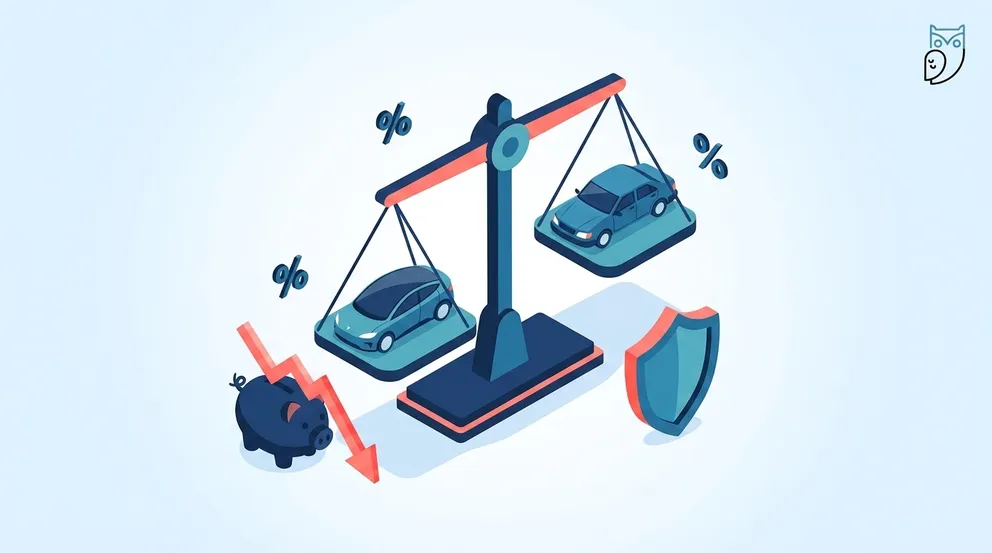
Electric vehicle owners are catching a break in 2026. According to Insurify rate data, full-coverage premiums for the nine top-selling EVs now average $309 per month, just 18% above the gas-vehicle average of $262. That gap stood at 23% in 2025, marking the first material narrowing of the EV-to-gas spread since 2022.
Battery repair, not full pack replacement, has become viable on damage that once triggered automatic total-loss declarations. In 2025, three major carriers added more than 200 certified-EV body shops to their networks. Actuaries now have four years of claims data in hand, enough to price EVs without padding the risk with uncertainty surcharges.
The EV-to-gas insurance premium gap fell from 23% in 2025 to 18% in 2026, the largest single-year compression in four years. Mainstream models from Hyundai, Chevy, Subaru, and Ford now insure within 5% to 15% of their gas counterparts, while Tesla and Audi e-tron prices remain 40% to 60% above the segment average.
- Average EV full coverage runs $309 per month, versus $262 for comparable gas vehicles
- Premium gap dropped from 23% in 2025 to 18% in 2026, per Insurify
- Battery replacement claims still average $21,000, keeping severity high
- State Farm prices EVs at $201 per month, 40% below the all-carrier average
- The Ford F-150 Lightning costs only 4% more to insure than the gas F-150
How EV Premiums Compare in 2026
MoneyGeek's 2026 dataset across 33 EV models pegs full-coverage premiums at $3,281 per year on average, versus $2,956 for hybrids and roughly $2,200 for comparable gas crossovers. The cheapest EV to insure is the Chevrolet Silverado EV at $1,947 annually, followed by the Hyundai Ioniq 5 at $1,962 and Subaru Solterra at $1,973. All three undercut the typical gas-crossover policy in the same dataset. Hybrid shoppers can see comparable figures in our hybrid car insurance breakdown.
The luxury end tells a sharper story. Audi's SQ8 e-tron tops $10,402 per year for full coverage. Tesla rates remain elevated, with the Model X at $4,469, Model S at $4,347, Model Y at $3,343, Model 3 at $3,268, and Cybertruck at $2,805. All five Tesla models exceed $2,800 annually.
| Vehicle | Full Coverage (Annual) | vs Gas Equivalent | Tier |
|---|---|---|---|
| Chevrolet Silverado EV | $1,947 | Near parity | Mainstream |
| Hyundai Ioniq 5 | $1,962 | +5% to +10% | Mainstream |
| Ford F-150 Lightning | $3,228 | +4% over gas F-150 | Mainstream |
| Tesla Model 3 | $3,268 | +25% to +30% | Premium |
| Tesla Model Y | $3,343 | +25% to +30% | Premium |
| Audi SQ8 e-tron | $10,402 | +60% or more | Luxury |
Sources: MoneyGeek 2026 EV insurance dataset (full-coverage averages, clean-record driver) and Insurify (Ford F-150 Lightning monthly rate of $269). Lightning annual figure is calculated from monthly average.
Why the Premium Gap Is Shrinking
Modular battery designs let trained technicians swap damaged cells without scrapping the whole pack. Severity on a typical battery loss has dropped from $21,000 toward $5,000 to $8,000 on most claims, according to Mitchell International's 2025 collision repair benchmark. HLDI tracking already shows the EV total-loss payment differential versus gas equivalents shrinking from nearly $14,000 in 2013 to about $1,810 by 2019.
Fix Auto USA, CARSTAR, and Abra (all under Driven Brands Collision Group) hold more than 300 combined OEM certifications and are expanding their EV-trained networks nationwide. State Farm, Progressive, and Allstate added approximately 200 certified-EV repair shops to their direct-pay programs in 2025. Cycle times that used to push rental car costs past $3,000 per claim are now closer to 22 days at certified shops, down from 45 days at uncertified ones.
Loss data finally matches actuarial assumptions. EVs represented under 2% of the U.S. fleet five years ago and were priced with thick uncertainty buffers. EVs now account for more than 8% of new vehicle registrations, and rate filings reflect actual claims rather than worst-case projections. Anyone shopping electric car insurance in 2026 sees the result of that data accumulation in their quotes.
Which Carriers Price EVs Cheapest
State Farm leads the market on EV affordability. Its average rate of $201 per month across the top-selling EVs runs 40% below the all-carrier average of $339, per FinanceBuzz analysis. American Family follows at $241 per month with its KnowYourDrive telematics program. Travelers ranks among Insurify's top picks for hybrid and EV coverage, with bundling discounts that often beat direct competitors on Tesla Model 3 and Hyundai Ioniq 5 quotes. Read the full State Farm auto insurance review for details on the Drive Safe and Save program.
| Carrier | Avg Monthly Premium (Top EVs) | Notable Discount |
|---|---|---|
| State Farm | $201 | Drive Safe and Save (up to 30% off) |
| American Family | $241 | KnowYourDrive telematics |
| Travelers | $255 | Hybrid/EV discount in select states |
| Progressive | $268 | Snapshot usage-based rating |
| All-carrier average | $339 | Industry baseline |
Tesla's in-house insurance program and Rivian's third-party policies sit in a separate tier at roughly $419 per month, 48% above legacy-carmaker EV rates. The premium reflects proprietary parts, aluminum body panels, and recalibration costs on Autopilot and Driver+ sensor stacks after even minor collisions. Owners of Tesla vehicles can compare carrier-by-carrier pricing in our Tesla car insurance guide.
"It's cheaper to insure EVs made by companies that also sell gas cars, like Ford and Volkswagen. Rates for EV-only companies like Tesla and Rivian are much higher," FinanceBuzz noted in its April 2026 analysis of EV insurance carriers.
The Ford F-150 Lightning Test Case
The Lightning offers the cleanest comparison in the market. A gas-powered Ford F-150 averages $258 per month for full coverage, versus $269 for the F-150 Lightning, a 4% spread. That gap sat at 11% just two years ago, when the Lightning launched and insurers had no Lightning-specific claims data.
Two factors drove the convergence. Body panels and chassis components are shared between Ford's gas and electric F-150 variants, simplifying parts sourcing for collision repair. Most Ford-certified body shops can now handle Lightning collision work without OEM dispatch delays. Compare that to the Tesla Cybertruck at $4,649 per year, where stainless steel body panels still require Tesla-controlled supply chains and certified-only repair facilities.
Battery replacement claims still average $21,000 per incident, and EV depreciation runs roughly 60% over five years versus 45% for all vehicles. That depreciation gap makes gap insurance more valuable on financed EVs, especially during the first 24 months when loan-to-value ratios stay above market resale.
What This Means for EV Buyers
Quote three carriers before you commit to a model. The same Hyundai Ioniq 5 can quote at $135 per month with State Farm and $260 per month with a legacy regional carrier. Treat carrier pricing as a vehicle-selection filter, not a post-purchase task.
Quote Three Carriers Including State Farm
State Farm's $201 EV average reflects its mutual structure and Drive Safe and Save telematics. Round out the comparison set with Allstate, Progressive, and Travelers to capture the full pricing range. See the full car insurance hub for state-specific carriers worth quoting.
Enroll in Telematics Within 30 Days
EV drivers tend to keep predictable commute patterns and use one-pedal driving, both of which score well in usage-based programs. Discounts of 15% to 30% are common when drivers opt in early.
Verify Your Carrier Has a Certified Repair Network
Ask whether your insurer maintains direct partnerships with Tesla-, Ford-, or Rivian-certified shops in your ZIP code. Cycle time on uncertified shops still averages 45 days versus 22 days at certified networks.
Add Gap Coverage on Financed EVs
The 60% five-year depreciation rate exceeds gas-vehicle norms by 15 percentage points. Gap policies cost $20 to $40 per year and protect against $5,000 to $12,000 in negative equity exposure during the first three years.
Looking Ahead
If certified-shop expansion continues at the 2024-2025 pace, mainstream EVs (the Chevy Equinox EV, Hyundai Ioniq 5, and Ford Mustang Mach-E in particular) should reach effective parity with gas crossovers by 2028. Industry analysts project another 3% to 5% EV premium reduction in 2027 as battery repair scales further and total-loss frequency continues falling.
Federal EV tax credit changes that took effect in early 2025 reshuffled demand toward sub-$45,000 models, which insurers can price more cheaply due to lower replacement values. Watch for additional state-level rate filings from Allstate and Liberty Mutual in mid-2026 reflecting that segment shift.
Frequently Asked Questions
Full coverage on the top nine EVs averages $309 per month, or $3,708 per year, per Insurify rate data. MoneyGeek's broader 33-model dataset puts the EV average at $3,281 per year for full coverage and $1,679 for state minimum coverage.
Tesla insures at $419 per month on average versus $241 for legacy-carmaker EVs because of proprietary parts, aluminum body panels, and Autopilot sensor recalibration costs. All five Tesla models exceed $2,800 per year for full coverage in the MoneyGeek 2026 dataset.
State Farm averages $201 per month on top EVs, 40% below the all-carrier average of $339. American Family at $241 and Travelers at $255 round out the most competitive options for mainstream EV models.
Industry analysts project another 3% to 5% reduction in 2027 as battery repair networks expand and total-loss frequency falls. Mainstream EVs are expected to reach effective parity with gas crossovers by 2028 if certified-shop expansion continues at the 2024-2025 pace.
Yes, on financed or leased EVs. Five-year EV depreciation averages 60%, versus 45% for all vehicles, which creates negative equity exposure of $5,000 to $12,000 in the first three years of ownership. Gap coverage costs $20 to $40 annually.
- MoneyGeek - Electric Vehicle Insurance Costs and Coverage in 2026
- Recharged - Electric Car Insurance Rates 2026
- Recharged - EV Insurance Cost vs Gas Cars in 2026
- IIHS-HLDI - Insurance Losses by Make and Model
- FinanceBuzz - Best Insurance for Electric Vehicles 2026
- Ford Authority - Ford F-150 Lightning Insurance Costs Compared to Cybertruck
- CNBC Select - Best Car Insurance for Electric Vehicles April 2026
- PR Newswire - Abra, CARSTAR, and Fix Auto USA Expand Certified EV Repair Network