

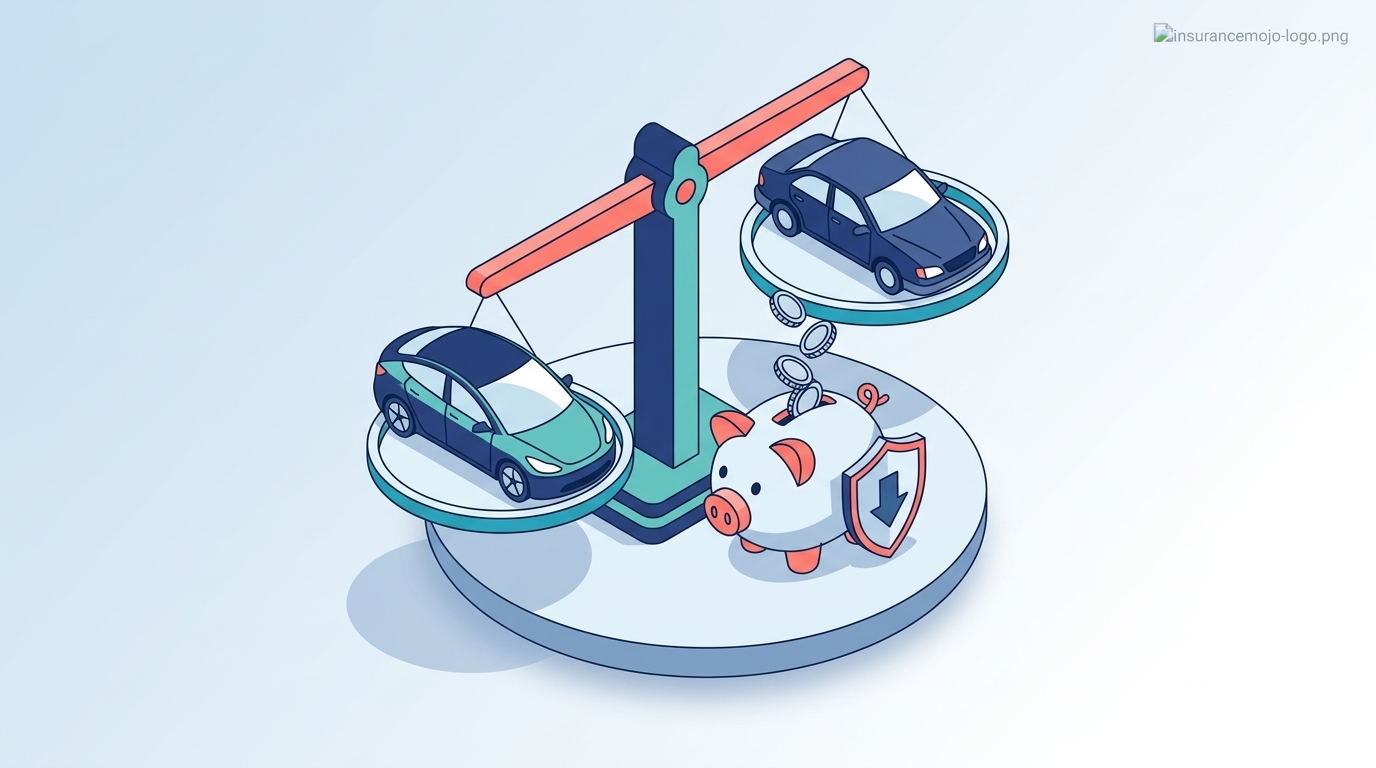
Electric vehicles now cost 23% to 49% more to insure than comparable gas-powered cars, according to data from Insurify and The Zebra. With more than 10 million EVs on U.S. roads and tariffs on imported batteries threatening to push repair costs even higher, the insurance gap is becoming a serious financial blind spot for a rapidly growing class of drivers.
The average full-coverage EV premium runs about $3,430 per year compared to $2,778 for a conventional vehicle, Insurify data shows. But the gap varies wildly by model — and so do the opportunities to save.
- EV insurance averages $3,430/year vs. $2,778 for gas vehicles — a 23% premium that can reach 49% for certain models
- Tesla and Rivian owners pay up to 48% more than EV owners with traditional automakers
- Travelers and Nationwide offer dedicated 10% EV discounts — most carriers don't
- The Chevy Bolt and MINI Cooper Electric are among the cheapest EVs to insure, sometimes less than the average gas car
- New tariffs on lithium-ion batteries could push EV repair costs — and premiums — even higher in late 2026
Why EVs Cost More to Insure
The insurance premium gap isn't arbitrary. It traces back to four factors that directly affect what insurers pay out in claims.
Higher Vehicle Prices
EVs carry a higher sticker price than their gas-powered equivalents. A 2025 Tesla Model 3 starts around $38,990 while a comparable Toyota Camry begins near $28,855. Since comprehensive and collision coverage are tied to the vehicle's value, a higher purchase price automatically means a higher premium.
Expensive Battery Repairs and Replacement
The battery pack is the single most expensive component in an EV, and it's also the most vulnerable in a collision. Replacement costs range from $4,000 to $20,000 depending on the make and model, according to data from Recurrent Auto. Compare that to $100 to $200 for a traditional car battery. Even minor fender-benders can damage battery housing, triggering diagnostic procedures that can cost thousands before any physical repair begins.
Lithium-ion batteries also require specialized diagnostic equipment found only at manufacturer-endorsed service centers. That limited repair network drives up labor costs and wait times, both of which insurers factor into premiums.
Specialized Labor and Parts Scarcity
EV repair requires technicians with high-voltage certification. There simply aren't enough of them yet. According to the Bureau of Labor Statistics, the average hourly rate for EV-certified technicians runs 15% to 25% higher than for conventional auto mechanics. Parts availability is another bottleneck — especially for newer brands like Rivian and Lucid, where proprietary components can take weeks to source.
Higher Total-Loss Rates
When battery damage is involved, insurers are more likely to total an EV rather than repair it. A 2024 report from Mitchell International found that EVs are totaled at a rate roughly 25% higher than ICE vehicles after comparable accidents, largely because battery replacement costs can exceed the vehicle's depreciated value within just a few years.
Which EVs Cost the Most — and Least — to Insure
The model you drive matters far more than the fact that it's electric. Insurance costs across popular EVs vary by more than $1,500 per year.
| EV Model | Avg. Annual Premium | vs. Gas Car Avg. |
|---|---|---|
| Tesla Model S | $3,365 | +21% |
| Porsche Taycan | $3,093 | +11% |
| Tesla Model X | $2,915 | +5% |
| Rivian R1S | $2,850 | +3% |
| Toyota bZ4X | $2,768 | ~Avg. |
| Kia Niro EV | $2,654 | -4% |
| Hyundai Kona Electric | $2,544 | -8% |
| Fiat 500e | $2,447 | -12% |
| Tesla Model 3 | $2,086 | -25% |
| MINI Cooper Electric | $2,099 | -24% |
| Chevy Bolt | $1,717 | -38% |
Sources: Insure.com, Insurify, and The Zebra (2025-2026 data). Premiums reflect national full-coverage averages for a 35-year-old driver with a clean record.
The Chevy Bolt stands out as the most affordable EV to insure — at $1,717 per year, it actually costs significantly less than the average gas car. The MINI Cooper Electric and Tesla Model 3 also come in below the ICE average. On the other end, the Tesla Model S and Porsche Taycan push well past $3,000 annually.
One surprising finding: Tesla and Rivian owners pay roughly 48% more for insurance than EV owners who drive models from traditional automakers like Chevrolet, Hyundai, or Kia, according to Insurify. The reason is twofold — higher repair costs due to proprietary parts networks and higher performance ratings that correlate with more severe claims.
How Tariffs Could Make It Worse
The EV insurance gap may widen before it narrows. The 25% tariffs on lithium-ion batteries and EV components imported from China are already affecting the cost of replacement parts. Since battery packs are the most expensive repair item in any EV claim, higher parts costs flow directly into higher premiums.
According to CarEdge, auto insurance rates are particularly sensitive to tariff impacts because higher repair costs translate almost immediately into rate adjustments. Steel and aluminum tariffs are pushing up body panel costs across the board, but EV-specific components — battery modules, power electronics, thermal management systems — face additional tariff exposure because a larger share of these parts is sourced from overseas suppliers.
For EV owners, the practical implication is clear: locking in a competitive rate now, before the next round of rate filings, could save hundreds of dollars over the next policy year.
The 25% tariffs on Chinese-made lithium-ion batteries and EV components took effect in 2025. Industry analysts expect insurers to begin reflecting higher parts costs in rate filings by late 2026. EV owners should compare quotes now before the next adjustment cycle.
Which Carriers Offer EV-Specific Discounts
Most auto insurers don't offer a dedicated EV discount — but a few do, and the savings are meaningful.
Travelers leads the market with a 10% discount on policies for both electric and hybrid vehicles, according to Quote.com. Travelers also offers specialized Tesla coverage that includes home charger and battery pack protection — two items not covered under standard auto policies.
Nationwide matches Travelers with a 10% EV discount and layers it on top of its existing multi-policy and safe driver discounts. For an EV owner who bundles home and auto, the combined savings can reach 25% or more.
The Hartford offers an EV discount as well, though the exact percentage varies by state. Liberty Mutual also extends discounts to EV drivers in select markets.
Allstate doesn't offer a dedicated EV discount, but its new-vehicle and safety-feature discounts can apply to many EVs. Allstate also provides EV-specific roadside assistance add-ons, which address a real concern — getting towed to a compatible service center when you drive an EV isn't always straightforward.
Progressive and USAA don't advertise dedicated EV discounts, but both consistently rank among the most competitively priced carriers for EV owners in rate comparison studies by The Zebra and Insurify.
What EV Owners Should Do Now
Ask Your Carrier About EV Discounts
Don't assume your current insurer applies EV-specific savings automatically. Call and ask directly whether they offer a hybrid/EV discount. If they don't, that's a signal to shop around.
Get Quotes from Travelers and Nationwide
Both offer 10% EV discounts that stack with other savings. Even if you don't switch, a competing quote gives you leverage to negotiate with your current carrier.
Enroll in a Telematics Program
Usage-based insurance programs like Progressive's Snapshot or Allstate's Drivewise can offset the EV premium gap. EV drivers tend to benefit from telematics because electric vehicles encourage smoother acceleration and braking habits.
Bundle Home and Auto
Bundling typically saves 10% to 25%. Combined with an EV discount, bundling with Nationwide or Travelers could cut your premium by a third compared to standalone coverage from a carrier with no EV discount.
Choose Your Next EV with Insurance in Mind
If you're shopping for a new EV, insurance cost should be part of the calculation. A Chevy Bolt at $1,717/year saves more than $1,600 annually over a Tesla Model S at $3,365/year — that's $8,000 over five years in insurance alone.
Coverage Gaps EV Owners Need to Know
Standard auto insurance wasn't designed with EVs in mind, and there are coverage gaps that catch many EV owners off guard.
Home charging equipment is not covered. Your Level 2 home charger, the 240-volt outlet installation, and any electrical panel upgrades are considered home improvements — not auto accessories. If your charger is damaged by a power surge, storm, or accident, your auto policy won't pay for it. You'll need to confirm your homeowner's policy covers the equipment, or add a rider.
Battery degradation is not a covered loss. Auto insurance covers sudden, accidental damage — not gradual wear. If your battery capacity drops below usable levels outside of warranty, that's an out-of-pocket expense. Battery replacement runs $10,000 to $20,000 for most models, according to Recurrent Auto.
Roadside assistance may not include EV towing. Not all roadside assistance programs can handle EVs properly. Flatbed towing is required for most EVs (wheel-lift towing can damage the drivetrain), and your vehicle needs to be taken to an EV-certified shop — not just the nearest garage. Confirm your policy includes flatbed service and check which shops are in your insurer's network.
The Bigger Picture: Is the Gap Closing?
There are reasons for cautious optimism. Some data sources show the EV-ICE insurance gap narrowing to near parity for certain model comparisons, particularly for EVs from established manufacturers with mature parts networks. The NAIC (National Association of Insurance Commissioners) has also begun studying EV insurance pricing patterns, which could lead to regulatory guidance on fair rating practices.
Safety ratings are helping too. Several popular EVs earned IIHS Top Safety Pick+ awards for 2026, including the Hyundai Ioniq 5, Hyundai Ioniq 6, Genesis GV60, and even the Tesla Cybertruck. Strong safety ratings can qualify drivers for insurer safety discounts, chipping away at the premium gap from the other side.
But tariffs on EV components, a still-limited repair network, and ongoing parts scarcity for newer brands like Rivian and Lucid will keep upward pressure on EV premiums through at least late 2026. The smartest move for EV owners right now is to shop aggressively, ask explicitly about EV discounts, and lock in rates before the next filing cycle.
Frequently Asked Questions
EV insurance costs more primarily because of higher repair costs. Battery packs cost $4,000 to $20,000 to replace, EV-certified labor rates run 15% to 25% higher, and parts availability for newer brands is limited. These factors increase what insurers expect to pay on claims, which drives up your premium.
The Chevy Bolt is consistently the most affordable EV to insure at roughly $1,717 per year for full coverage — less than the average gas car. The MINI Cooper Electric ($2,099) and Tesla Model 3 ($2,086) also come in below the national ICE average of $2,778.
Yes. Travelers and Nationwide both offer 10% discounts for EV and hybrid vehicles. The Hartford and Liberty Mutual also provide EV discounts in select states. Most major carriers, however, do not yet offer a dedicated EV discount — making it important to shop around.
No. Home charging equipment — including the charger unit, electrical wiring, and panel upgrades — is considered part of your home, not your vehicle. Your homeowner's or renter's policy may cover it, but you should verify. Travelers is one of the few carriers that offers charger coverage as part of its EV-specific auto policy.
Likely, yes. The 25% tariffs on lithium-ion batteries and EV parts imported from China increase the cost of repairs — especially battery replacements. Industry analysts expect insurers to reflect these higher costs in rate filings by late 2026. Shopping for competitive rates now is advisable.
- Insurify - Electric Vehicle Insurance Costs Report
- The Zebra - Insurance Rates for Hybrid and Electric Cars
- Insure.com - Most Expensive and Cheapest Electric Cars to Insure in 2026
- CarEdge - How Tariffs Will Impact Auto Insurance Rates
- Quote.com - Best Electric Vehicle Insurance Discounts in 2026
- NAIC - Electric Vehicle Insurance Rates
- Recurrent Auto - Does EV Insurance Cost More?