

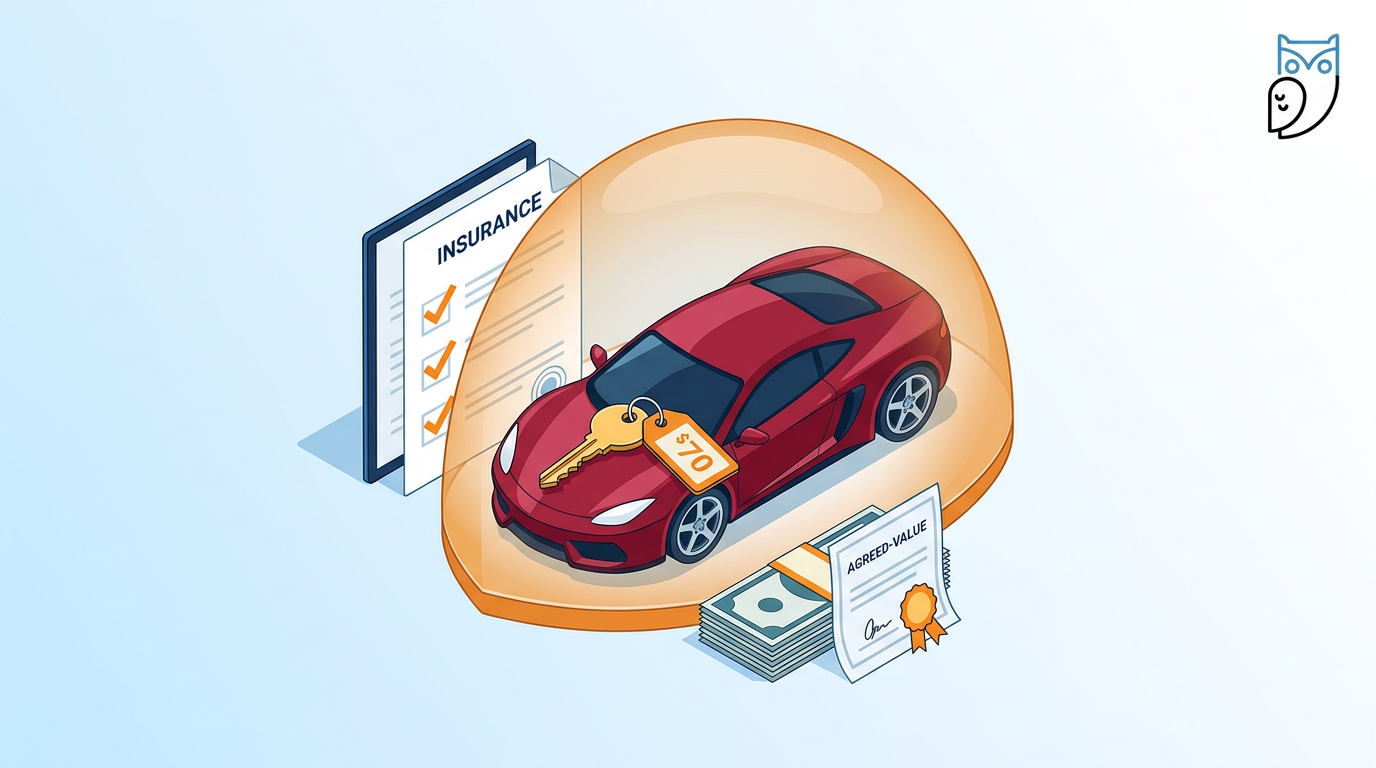
Exotic car insurance typically costs between $5,000 and $20,000 per year — roughly 3 to 5 times more than insuring a standard vehicle. The key to protecting your exotic car is agreed value coverage from a specialty insurer like Hagerty, Grundy, or PURE, which guarantees you'll receive the full value of your vehicle in a total loss — no depreciation deductions.
- Exotic car insurance averages $5,000-$20,000 annually depending on the make, model, and your driving profile
- Agreed value coverage is essential — it pays the full pre-set value with no depreciation in a total loss
- Specialty insurers like Hagerty and Grundy often provide better coverage than mainstream carriers
- Grundy's premiums can be half of Hagerty's for similar agreed value policies
- A single Ferrari engine rebuild can exceed $40,000 — making comprehensive coverage non-negotiable
You've finally done it. Maybe it's that Lamborghini Huracán you've been eyeing for years, or a Ferrari 488 GTB that makes your heart race every time you turn the key. Owning an exotic car is a dream come true — but insuring one? That's where things get complicated fast.
Here's the deal: your regular auto insurance policy isn't going to cut it for a $200,000+ vehicle. The coverage limits, the payout structures, the whole approach is designed for everyday cars. Exotic cars play by different rules, and your insurance needs to keep up.
Whether you're a first-time exotic car buyer or you've got a collection sitting in a climate-controlled garage, this guide breaks down exactly what you need to know about insuring your prized machine — without overpaying or leaving yourself exposed.
What Qualifies as an Exotic Car?
Before we dive into insurance specifics, let's clear up what actually counts as "exotic." It's not just about a high price tag — although that's certainly part of it. Exotic cars are defined by their rarity, performance capabilities, and tendency to appreciate in value over time.
Think brands like:
- Ferrari — From the 488 GTB to the F8 Tributo
- Lamborghini — Huracán, Aventador, Urus Performante
- McLaren — 720S, Artura, GT
- Bugatti — Chiron, Veyron
- Porsche — 911 GT3 RS, 918 Spyder
- Aston Martin — DB12, Vantage, Valkyrie
- Pagani — Huayra, Utopia
- Koenigsegg — Jesko, Gemera
What separates these from your typical luxury vehicle (like a BMW 7 Series or Mercedes S-Class) comes down to exclusivity, performance engineering, and replacement costs. A standard luxury sedan might cost $80,000-$120,000. An exotic car? You're looking at $200,000 to well over $3 million — and that distinction makes all the difference when it comes to insurance.
How Much Does Exotic Car Insurance Cost?
Let's get straight to the numbers, because this is probably why you're here.
The honest answer? It depends on what you're driving. A Porsche 911 Turbo S will cost significantly less to insure than a Bugatti Chiron. Here's a breakdown of what real owners are paying:
For context, the average American pays about $2,697 per year for full coverage on a Toyota Camry. So yes, insuring your exotic is going to cost considerably more — but when you're protecting an asset worth six or seven figures, the premium is a fraction of what you'd lose without coverage.
If you own multiple exotic or collector vehicles, ask about multi-car policies. Many specialty insurers offer significant discounts — sometimes 10-15% off each additional vehicle — when you bundle your collection under one policy.
Why Exotic Car Insurance Costs So Much
Ever wonder why insuring a Ferrari costs as much as a down payment on a regular car? It's not just the sticker price — though that's obviously a big factor. Insurance companies look at risk from every angle, and exotic cars light up the risk board in ways that standard vehicles just don't.
Astronomical Repair Costs
This is the biggest driver of exotic car premiums. These aren't vehicles you take to your neighborhood mechanic. A replacement carbon fiber hood for a McLaren 720S runs approximately $15,000. A Ferrari engine rebuild? That can easily exceed $40,000. Even something as "simple" as a fender bender can generate a repair bill north of $25,000 because of specialized materials, limited parts availability, and the skilled labor required.
Limited Authorized Repair Shops
Insurance companies can't just send your Lamborghini to any body shop. These vehicles require manufacturer-authorized service centers with certified technicians, specialized tools, and genuine OEM parts. That exclusivity drives up both labor rates and parts costs — and insurers pass those costs along to you.
Performance Equals Risk
Let's be real — a car that can hit 60 mph in 2.9 seconds is statistically more likely to be involved in a high-speed incident. Insurance actuaries know this. The same performance characteristics that make exotic cars thrilling to drive also make them riskier to insure. More horsepower generally means higher premiums.
Theft and Vandalism Targets
Exotic cars attract attention — and not always the good kind. Their high resale value and desirability make them prime targets for theft. Even comprehensive coverage claims for vandalism tend to be more expensive simply because of the cost to repair or repaint specialty finishes.
Standard auto policies typically use "actual cash value" to determine payouts — meaning they deduct depreciation. For a $300,000 exotic car that appreciates in value, this could mean getting tens of thousands less than your car is actually worth. Always insist on agreed value coverage.
Essential Coverage Types for Exotic Cars
Exotic car insurance isn't one-size-fits-all. Depending on how you use and store your vehicle, you'll want a tailored combination of coverage types. Here's what matters most:
You and your insurer agree on your car's value upfront. In a total loss, you get the full amount — no depreciation games. This is the single most important coverage for exotic owners.
Covers theft, vandalism, weather damage, fire, and animal strikes. Given the theft risk and repair costs for exotics, this is absolutely non-negotiable.
Pays for damage to your vehicle in an accident, regardless of fault. With repair bills easily exceeding $25,000 for minor damage, you need this.
Standard liability limits won't protect your assets if you own a $500,000 car. Carry at least $500K/$1M in liability coverage to match your net worth.
Specialty Coverage Worth Considering
Beyond the basics, exotic car owners should look at these additional protections:
- OEM Parts Coverage — Guarantees your insurer uses original manufacturer parts, not aftermarket substitutes. Critical for maintaining your car's value and integrity.
- Automobilia Coverage — If you collect memorabilia, license plates, hood ornaments, or manufacturer literature, this covers those items under your auto policy.
- Tools Coverage — Protects personal tools and equipment you use to maintain your exotic vehicle, often at a lower deductible than your homeowners policy.
- Gap Insurance — Essential if you financed or leased your exotic car. Covers the difference between what your insurer pays and what you still owe.
- Track Day Coverage — Standard policies exclude coverage at the track. If you take your exotic to track days, you'll need a separate endorsement costing roughly $500-$800 per $10,000 in modifications.
Agreed Value vs. Actual Cash Value: Why It Matters
This is probably the most important concept in exotic car insurance, and honestly, it's where a lot of owners get burned. Here's the difference in plain English:
Actual Cash Value (ACV) is what most standard auto policies use. Your insurer determines what your car is worth at the time of the claim — minus depreciation. For a $40,000 Honda Accord, the difference might be a few thousand dollars. For a $350,000 Ferrari that's appreciated to $425,000? You could lose out on $75,000 or more.
Agreed Value means you and your insurer agree on exactly what your car is worth when you start the policy. If it's totaled, you get that full amount — period. No depreciation, no arguments, no lowball offers.
- Full payout of the pre-agreed amount in a total loss
- No depreciation deductions — critical for appreciating vehicles
- Sales tax often included in the payout
- Peace of mind knowing exactly what you'll receive
- Insurer determines value at time of loss — often lower than expected
- Depreciation is deducted, even if the car has appreciated
- May require negotiation or appraisal disputes after a claim
- Can leave you tens of thousands short on a high-value vehicle
Here's what most people don't realize: many exotic cars appreciate in value, especially limited editions and discontinued models. An agreed value policy lets you update your coverage annually to reflect that growing value — something an ACV policy will never do.
Best Insurance Companies for Exotic Cars
Not every insurance company knows how to handle a car worth more than most people's homes. You have two main routes: specialty insurers built specifically for high-value and collector vehicles, or mainstream carriers with exotic car programs.
Specialty Insurers
These companies live and breathe exotic and collector cars. They understand agreed value, appreciate what your vehicle is worth, and have claims processes designed for high-end vehicles.
- "Guaranteed Value" — full agreed amount with zero depreciation
- Restoration coverage for vehicles being rebuilt
- Flexible usage plans including car shows and pleasure driving
- Automobilia and spare parts coverage available
- Premiums often 50% less than Hagerty for similar coverage
- Agreed value coverage included on all policies
- Unlimited mileage on many collector policies
- Highly competitive pricing for multi-car collections
- Designed for high-net-worth individuals
- Agreed value policies for collectors and exotics
- Bundling with homeowners, umbrella, and watercraft coverage
- White-glove claims handling experience
Mainstream Carriers with Exotic Programs
If your exotic is your daily driver or you prefer sticking with a major carrier, several mainstream insurers have solid exotic car programs:
| Insurance Company | Monthly Rate | Annual Rate | Best For |
|---|---|---|---|
| Progressive Top Rated | $250+ | $3,000+ | Daily-driven exotics |
| Travelers | $275+ | $3,300+ | Bundling with other policies |
| State Farm | $300+ | $3,600+ | Local agent support |
| USAA | $225+ | $2,700+ | Military members and families |
Mainstream carriers may not offer agreed value coverage for all exotic models. If your vehicle is worth over $200,000 or is a limited-production model, a specialty insurer will almost always provide better protection. Always ask specifically about agreed value vs. actual cash value before signing.
How to Get Exotic Car Insurance
Getting insured isn't as simple as plugging your VIN into an online quote tool — though some carriers are getting better at that. Here's the process that'll get you covered correctly:
Document Everything
Take detailed photos of your vehicle's exterior, interior, engine bay, and any modifications. Keep receipts for upgrades, maintenance records, and purchase documentation handy.
Get a Professional Appraisal
Hire a certified appraiser to determine your car's current market value. This is essential for establishing your agreed value amount and should be updated annually.
Compare Specialty and Mainstream Quotes
Get quotes from at least 2 specialty insurers (like Hagerty and Grundy) and 2 mainstream carriers. Compare not just price, but coverage type, payout terms, and restrictions.
Read the Fine Print on Restrictions
Some policies limit annual mileage, restrict who can drive the car, or exclude track use. Make sure the policy matches how you actually use your vehicle.
Update Your Agreed Value Annually
Exotic cars can appreciate significantly year over year. Set a reminder to review and update your agreed value each renewal period to ensure you're fully covered.
How Storage and Usage Affect Your Rates
Here's something a lot of exotic car owners overlook: how and where you keep your vehicle has a huge impact on what you'll pay for insurance.
If your Ferrari sits in a climate-controlled garage and only comes out for weekend cruises and car shows, you're going to pay significantly less than someone driving their Lamborghini as a daily commuter in Los Angeles traffic. Insurers look at three main factors:
- Storage Security — A locked, climate-controlled garage with a security system can qualify you for lower rates. Parking on the street? Expect to pay more.
- Annual Mileage — Less driving means less risk. Many specialty insurers offer better rates for vehicles driven under 5,000 miles per year. Some collector policies restrict mileage but offer dramatically lower premiums in return.
- Primary vs. Secondary Vehicle — If you have a daily driver and your exotic is a secondary vehicle, insurers view that as lower risk. Make sure your policy correctly reflects this.
Installing a GPS tracking system and a quality car alarm can reduce your comprehensive premium by 5-15%. Some insurers also offer discounts for vehicles stored in facilities with fire suppression systems or 24/7 security monitoring.
7 Ways to Save on Exotic Car Insurance
Exotic car insurance will always cost more than insuring a Camry — but that doesn't mean you should overpay. Here are proven strategies to keep your premiums in check:
- Bundle Your Collection — Insuring multiple vehicles with one carrier often unlocks 10-15% multi-car discounts. This applies to both specialty and mainstream insurers.
- Raise Your Deductible — Going from a $500 to a $2,500 deductible can reduce your premium by 15-25%. If you can comfortably absorb a higher out-of-pocket cost, this is easy money saved.
- Invest in Anti-Theft Measures — VIN etching, GPS tracking, aftermarket alarms, and storing in a secured garage can each reduce your comprehensive premium. Some insurers specifically ask about these features.
- Compare Specialty vs. Mainstream — Don't assume specialty insurers are always more expensive. Grundy's premiums are often half of what mainstream carriers charge for comparable agreed value coverage.
- Maintain a Clean Driving Record — This sounds obvious, but it's especially impactful for exotic car owners. A single speeding ticket can increase your exotic car premium by 20-30% because insurers already view these vehicles as high-risk.
- Verify Your Policy Details — Make sure your annual mileage, storage location, and primary driver assignment are accurate. Being listed as a daily driver when you only drive weekends can cost you hundreds annually.
- Take a Defensive Driving Course — Several insurers offer 5-10% discounts for completing approved driving courses. Some even offer specific performance driving courses that satisfy this requirement.
Common Mistakes Exotic Car Owners Make with Insurance
After talking to specialty insurers and exotic car owners, these are the most frequent — and costly — mistakes people make:
Never let your exotic car insurance lapse, even for a single day. A coverage gap can increase your rates by 20-35% when you get a new policy, and some specialty insurers won't cover you at all if you have a recent lapse in coverage.
- Using a standard auto policy — Regular policies cap payouts at actual cash value, which often falls far short of what your exotic is worth. You need agreed value coverage.
- Not updating agreed value annually — If your car appreciated from $350,000 to $425,000 and your agreed value still says $350,000, you're underinsured by $75,000.
- Skipping comprehensive coverage — Theft, hail, and vandalism claims on exotics are devastatingly expensive. This isn't where you want to cut corners.
- Assuming track day coverage is included — Almost every standard and specialty policy excludes incidents that happen on a racetrack. You need a separate endorsement.
- Not disclosing modifications — Aftermarket upgrades that aren't on your policy won't be covered in a claim. Worse, undisclosed modifications can give your insurer grounds to deny your entire claim.
Frequently Asked Questions
Exotic car insurance typically costs between $250 and $450 per month for most models, though hypercar owners can expect $3,000+ monthly. A Ferrari 488 GTB averages around $450-$600 per month, while a Lamborghini Huracán runs approximately $455-$662 per month. The exact cost depends on the vehicle's value, your driving record, location, and the type of coverage you choose.
Yes, several mainstream carriers like Progressive, State Farm, and Travelers offer exotic car coverage. However, specialty insurers like Hagerty, Grundy, and PURE often provide better protection through agreed value policies and specialized claims handling. For vehicles worth over $200,000, a specialty insurer is usually the better choice.
Agreed value coverage means you and your insurer pre-determine your car's value when the policy starts. If the vehicle is totaled, you receive the full agreed amount with no depreciation deductions. This is critical for exotic cars because many appreciate in value, and standard actual cash value policies would pay significantly less than the car is actually worth.
No, standard exotic car policies — both specialty and mainstream — exclude coverage for incidents on racetracks. If you take your car to track days, you'll need a separate track day endorsement, which typically costs $500-$800 annually per $10,000 in coverage. Some specialty insurers can add this to your existing policy.
The most effective strategies include: bundling multiple vehicles (10-15% savings), raising your deductible to $2,500+ (15-25% savings), installing anti-theft devices and GPS tracking (5-15% savings), storing your car in a secured garage, maintaining a clean driving record, and comparing quotes from both specialty and mainstream insurers. Grundy Insurance often offers premiums 50% lower than other specialty carriers.