

Introduction
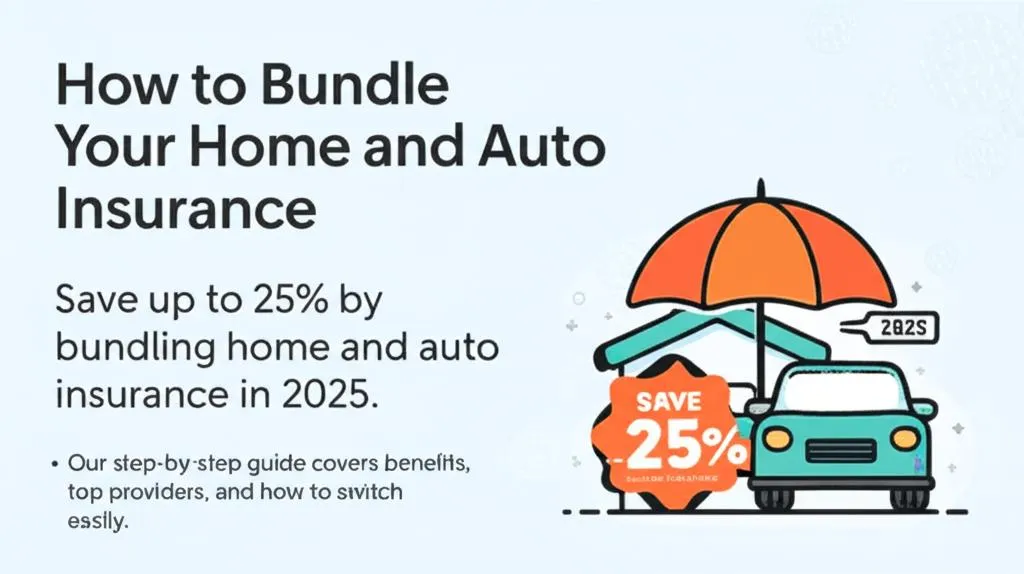
In 2025, U.S. consumers are feeling the pinch of rising insurance premiums. Bundling home and auto policies offers an effective remedy, delivering average savings of 18 – 25 %—roughly $900 on a $5,000 spend—and simplifying policy management under one provider. This guide walks you through bundling basics, step-by-step instructions, leading insurers, state regulatory considerations, and the latest statistics to help you secure maximum value and coverage.
Insurance Bundling Basics & Benefits
Definition and Mechanics
Insurance bundling means purchasing two or more distinct policies—such as home, auto, renters, or boat—from the same insurer. Although each policy remains separate, they’re managed under a single account, streamlining billing, customer service, and renewals.
Types of Policies You Can Bundle
- Homeowners + auto (most common)
- Renters + auto, condo + auto
- Motorcycle or RV with homeowners or umbrella
- Life insurance with property policies
- Boat insurance paired with other lines
Typical Savings When Bundling
- Multi‐policy discounts average 18 % (NerdWallet)
- Savings range from 5 % to 25 % depending on provider and profile
- Mercury Insurance offers up to 14.7 % off on bundled policies
- Example: $5,000 in combined premiums → ~$900 saved at an 18 % discount
Primary Benefits Beyond Cost Savings
Simplified Management
- Single point of contact for questions and claims
- One renewal date and fewer bills to track
- Streamlined policy changes across all lines
Enhanced Coverage Options
- Access to exclusive endorsements (identity theft protection, green home reimbursements)
- Potentially higher liability limits
- Easier customization of add‐on coverages
Reduced Hassle During Claims
When a single event—like a storm—damages both your home and vehicle, a bundled policy means one claims process instead of coordinating between multiple insurers.
Step-by-Step Bundling Process
Preparation Phase
Review existing policies: note renewal dates, coverage limits, deductibles, and current premiums. Research insurers known for multi‐policy discounts and strong service reputations.
Obtaining Quotes
- Engage independent agents or brokers for multiple carrier quotes
- Use online comparison tools to assess bundle options
- Provide detailed vehicle and property information for accurate pricing
Evaluation Phase
Compare the total cost of a bundled package versus separate policies. Review coverages, deductibles, customer-service ratings, and any special terms or exclusions.
Making the Switch
- Finalize and activate your new bundled policies before canceling old ones.
- Arrange payment setups and confirm refund timelines.
- Submit any required written cancellation notices to your previous insurer.
- Verify there are no coverage gaps or cancellation penalties.
Common Challenges
- Risk of choosing lower-quality coverage just to chase discounts
- Potential cancellation fees or overlapping/underlapping coverage
- Complexity in comparing different policy terms and deductibles
Tips for a Smooth Transition
- Time your switch around existing renewal dates to avoid penalties
- Keep detailed records of all communications and confirmations
- Review your bundle annually or after major life changes
Top Insurance Providers for Bundling (2025)
Leading Providers & Discounts
| Provider | Maximum Discount | Avg. Annual Cost | Key Feature |
|---|---|---|---|
| State Farm | 25 % (up to \$1,356) | \$2,559 | Extensive local agent network |
| Allstate | Up to 25 % | Varies by state | Homesharing & green improvements |
| Amica | Up to 30 % | Varies by profile | Highest discount ceilings |
| USAA | Not specified | ~\$1,080 (renters+auto) | Competitive pricing for military families |
Notable Mentions
- American Family: discounts up to 23 %
- Auto-Owners: variable bundling rates
- Erie: cheapest renters+auto (~\$70/month)
- Farmers & Nationwide: unique or significant multi-policy savings
How Providers Compare
- Coverage add-ons and endorsements vary widely
- J.D. Power customer-service ratings favor State Farm, Amica, and USAA
- Digital tools vs. traditional agent networks influence convenience
Emerging Trends
- Discount rates remain competitive at 23 – 30 %
- Growth in specialized bundles (e.g., renters + auto)
- Differentiation through value-added services rather than just price
State-Specific Bundling Regulations
Regulatory Framework
Bundling practices are governed by state versions of the NAIC’s Unfair Trade Practices Act (Model #880), prohibiting inducements or rebates that could lead to unsuitable or predatory offerings.
Cross-State Bundling Variations
Some insurers allow multi-state bundles under specific conditions, while others restrict bundling to in-state policies, so check provider rules if you own properties in different states.
Hawaii Highlights
- All auto insurers must join the Hawaii Joint Underwriting Plan (HJUP)
- Minimum \$1,000 annual membership fee
- In-state sales and claims offices required under §431:10C-119
Texas Approach
- Insurers have shifted pricing models to effectively require bundling
- Texas Department of Insurance has approved non-renewal of unbundled policies
- Legal challenges continue over the legality of tied selling
Consumer Protections
State regulators oversee partnerships between non-licensed entities (e.g., auto subscriptions) and insurers to ensure all products are sold by licensed agents and comply with anti-rebating laws.
Bundle Insurance Statistics & Data
Average Savings & Discount Ranges
| Statistic | Value | Source |
|---|---|---|
| Avg. multi-policy discount | 18 % | NerdWallet (2025) |
| Typical discount range | 5 – 25 % | Gaudette Insurance |
| Avg. annual savings | ~\$496 | Industry Average |
Consumer Adoption Rates
One-third (33 %) of auto insurance shoppers in 2025 seek to bundle with homeowners coverage (J.D. Power).
Satisfaction & Loyalty Indicators
Bundled customers stay with insurers 7.0 years on average versus 5.5 years for non-bundlers, reflecting higher loyalty and satisfaction (J.D. Power).
Future Outlook
With 57 % of auto customers shopping annually and premiums rising more slowly than before, bundling remains a key strategy for both consumers aiming to save and carriers seeking “stickier” policyholders.
Conclusion & Next Steps
Bundling home and auto insurance offers substantial savings, streamlined management, and enhanced coverage options. Begin by gathering current policy details, obtain quotes from top providers like State Farm or Amica, and evaluate both cost and service quality. Review state regulations to ensure compliance, and revisit your bundle annually or after significant life changes to maintain the best value.
References
- EV Magazine. (2025, January 13). Auto insurance rate hikes slow to 7.5 % in 2025. https://evmagazine.com/mobility/auto-insurance-rate-hikes-slow-to-7-5-in-2025
- Gaudette Insurance. (2024, November 26). Is it time to shop your 2025 auto and home insurance renewal? https://gaudette-insurance.com/blog/is-it-time-to-shop-your-2025-auto-and-home-insurance-renewal/
- J.D. Power. (2025, April 29). 2025 US insurance shopping study. https://www.jdpower.com/business/press-releases/2025-us-insurance-shopping-study
- NAIC. (n.d.). Unfair Trade Practices Act, Model #880. National Association of Insurance Commissioners.
- NerdWallet. (2025, May). Best home and auto insurance bundles. https://www.nerdwallet.com/insurance/homeowners/best-home-auto-insurance-bundles