

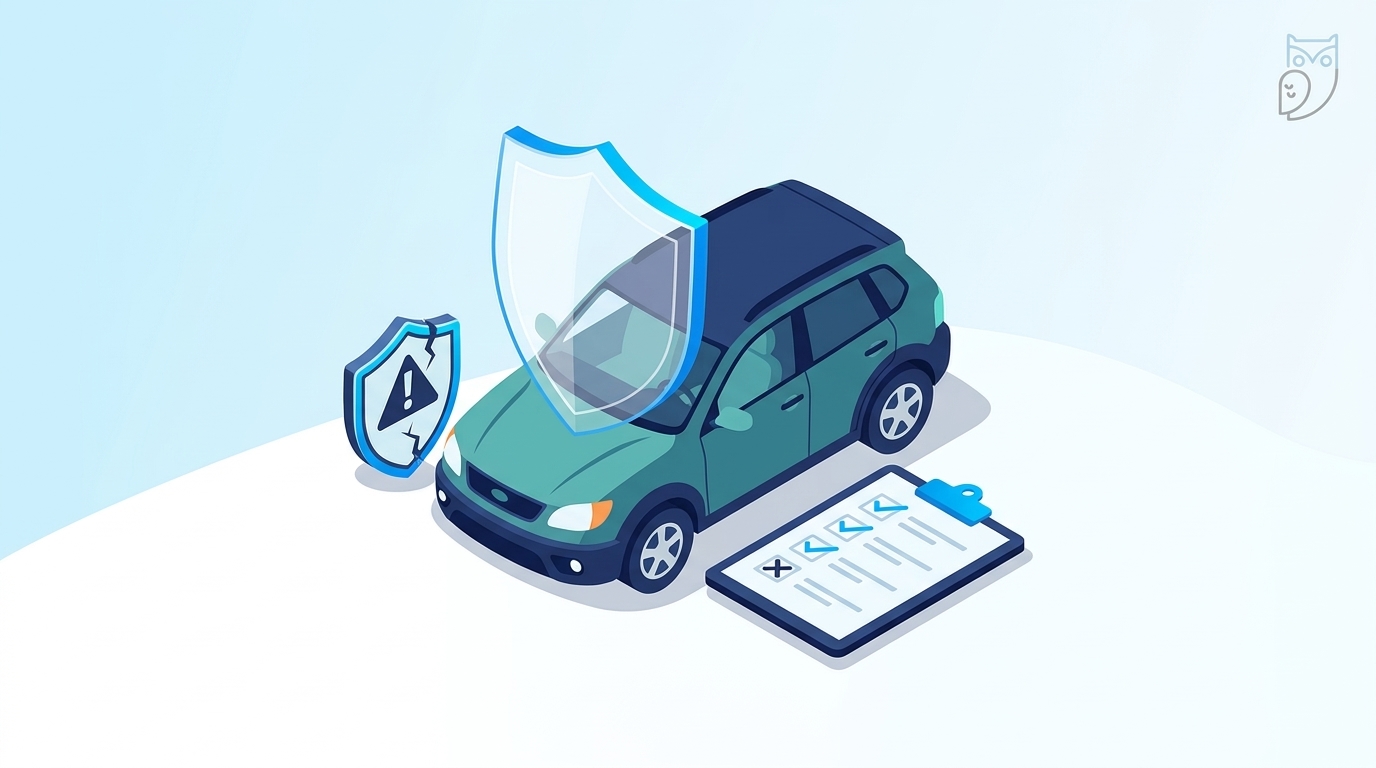
The Insurance Institute for Highway Safety launched a brand-new whiplash prevention test on January 27, 2026 — and 14 of the first 18 small SUVs tested failed to earn a top rating. Only four models earned "Good": the Toyota RAV4, Subaru Forester, Hyundai Ioniq 5, and Audi Q3. Three popular models — the Ford Bronco Sport, Hyundai Tucson, and Mazda CX-50 — earned the lowest "Poor" rating.
- IIHS launched a tougher whiplash prevention test in January 2026 — the first in this category since 2022
- Only 4 of 18 small SUVs earned a "Good" rating: RAV4, Forester, Ioniq 5, and Audi Q3
- Ford Bronco Sport, Hyundai Tucson, and Mazda CX-50 received "Poor" — the worst possible rating
- Neck sprains and strains are the #1 most frequently reported injury in U.S. auto insurance claims
- Better whiplash protection = fewer injury claims = lower insurance costs over time
The Insurance Institute for Highway Safety made a troubling discovery: even though virtually every small SUV on the market aced the old whiplash test, drivers were still suffering neck injuries at widely varying rates. So IIHS went back to the lab — and built a harder test. The results, announced January 27, 2026, reveal that most of the country's most popular small SUVs still have significant room to improve.
Only 4 of the 18 small SUVs tested earned a top "Good" rating. Fourteen fell short — including three models that earned a "Poor" rating, meaning their seats provided dangerously inadequate neck protection in rear-end crashes. If you drive a Ford Bronco Sport, Hyundai Tucson, or Mazda CX-50, your vehicle is in that bottom tier.
Why This Test Matters for Your Wallet
This isn't just a safety story — it's an insurance story. "Neck sprains and strains are the most frequently reported injuries in U.S. auto insurance claims," said IIHS President David Harkey. Whiplash claims are often soft-tissue injuries that are difficult to verify, making them one of the most significant cost drivers in the auto insurance industry.
The IIHS's affiliated research arm, the Highway Loss Data Institute (HLDI), tracks actual insurance claim rates by vehicle model. Vehicles with higher whiplash injury claim rates directly contribute to higher premiums — not just for their owners, but across the broader insurance pool. As HLDI incorporates the new test data over time, vehicles that perform poorly could see their insurance claim rates reflected in higher premiums.
Full Results: All 18 Small SUVs Tested
Here is every model IIHS tested, with ratings applying to 2025 and in most cases 2026 model years:
| Vehicle | Model Years | Rating |
|---|---|---|
| Toyota RAV4 | 2025 | Good |
| Subaru Forester | 2025–26 | Good |
| Hyundai Ioniq 5 | 2025–26 | Good |
| Audi Q3 | 2025 | Good |
| Buick Encore GX | 2025–26 | Acceptable |
| Chevrolet Equinox | 2025–26 | Acceptable |
| Honda CR-V | 2024–25 | Acceptable |
| Jeep Compass | 2025–26 | Acceptable |
| Kia Sportage | 2025–26 | Acceptable |
| Mercedes-Benz GLB-Class | 2025 | Acceptable |
| Mitsubishi Outlander | 2025–26 | Acceptable |
| Volkswagen Taos | 2025–26 | Acceptable |
| Volvo XC40 | 2025–26 | Acceptable |
| BMW X1 | 2025 | Marginal |
| Nissan Rogue | 2025–26 | Marginal |
| Ford Bronco Sport | 2025–26 | Poor |
| Hyundai Tucson | 2025–26 | Poor |
| Mazda CX-50 | 2025–26 | Poor |
What Makes a Vehicle Fail the Whiplash Test?
The new IIHS evaluation removes the driver seat from the vehicle, mounts it to a sled, and uses a crash dummy with an articulated spine to simulate a rear-end collision at two speeds: 20 mph and 30 mph. The test measures multiple factors simultaneously — head and spine support, how well the head restraint interacts with the occupant's head, and how well the seat absorbs crash energy.
In the three poor-rated vehicles, the dummy's head moved dramatically relative to the spine. In the Tucson, the head restraint pushed the chin down toward the chest. In the CX-50, the head slid backward and upward. The Bronco Sport performed particularly poorly — it took too long for the head restraint to contact the dummy's head, and the difference in velocity between the pelvis and the head was extremely high. The cervical spine, which should retain its natural curve during impact, was visibly stretched and straightened in video footage.
"Neck sprains and strains are the most frequently reported injuries in U.S. auto insurance claims. This new test challenges automakers to further improve their seats and head restraints to provide better protection in the rear impacts that typically cause these injuries." — David Harkey, IIHS President
Why IIHS Brought Back This Test
IIHS discontinued its original head restraint evaluation in 2022 — not because whiplash was solved, but because the old test was too easy. Almost every vehicle tested earned a top score. Yet drivers were still suffering neck injuries at rates that varied significantly by vehicle model.
The institute went back to basics, analyzing 36 late-model vehicle seats at three different impact speeds. They then cross-referenced that data with insurance claim rates from HLDI. The result is a more rigorous two-speed test that captures the real differences between vehicles that the old test missed entirely. "We don't yet fully understand the mechanisms that cause whiplash injuries," said IIHS senior research engineer Marcy Edwards, who developed the evaluation. "But our research makes us confident that reducing these types of movements and stresses should cut down on whiplash injuries in the real world."
Yes. The Cars.com analysis of the IIHS test notes that proper head restraint positioning is critical — the restraint should contact the middle of your head near its center of gravity. If your head restraints are adjustable, raise them to their highest position for best protection. A restraint that hits too low tilts your head backward; one that hits too high pushes your chin down.
What You Should Do Now
Check Your Vehicle's Rating
Look up your specific model year in the table above. The ratings apply to 2025 models and in most cases extend to 2026. If you own a 2024 or older version of these vehicles, the results may not apply — check the IIHS website for updates.
Adjust Your Head Restraint Now
If your vehicle has an adjustable head restraint, raise it to the highest comfortable position. The center of the restraint should align with the back of your head near the level of your ears. This is a free, immediate improvement available in almost every vehicle.
Factor This Into Your Next Vehicle Purchase
If you're shopping for a small SUV, prioritize models with a "Good" rating. The Toyota RAV4 and Subaru Forester in particular are both affordable, widely available, and top-rated — making them strong picks for safety-conscious buyers.
Review Your Insurance Coverage
If you drive a poor-rated vehicle, make sure your policy includes adequate medical payments (MedPay) or personal injury protection (PIP). Whiplash injuries can mean weeks of physical therapy and lost work — coverage matters. Get quotes to compare your current policy against alternatives.
What to Watch For Next
IIHS tested only 18 small SUVs in this first round. Expect additional models to be added — including other popular segments like compact SUVs, midsize SUVs, and sedans — as the evaluation expands throughout 2026 and into 2027. Automakers have historically responded quickly to new IIHS tests by redesigning seats in subsequent model years.
For the three poor-rated vehicles — Bronco Sport, Tucson, and CX-50 — watch for 2027 model year announcements. Ford, Hyundai, and Mazda will likely be under pressure to redesign their seat and head restraint systems. If you're currently considering buying one of these models, it may be worth waiting to see if a redesign addresses the problem.
Frequently Asked Questions
Not necessarily. This test evaluates one specific type of protection: neck injury prevention in rear-end crashes. A vehicle can earn poor in this test while still performing well in other IIHS evaluations like frontal crash protection, side impact, or roof strength. Always look at the full set of safety ratings when evaluating a vehicle.
Not immediately. Insurance rates are based on actual claim data tracked by HLDI, which takes time to accumulate. However, vehicles with consistently higher injury claim rates tend to have higher insurance costs over time. As HLDI incorporates real-world data on these models, the ratings could influence future pricing — especially for vehicles in the poor category.
Yes. IIHS tested a 2024 CR-V (rather than a 2025) because the design is essentially the same. The "Acceptable" rating applies to both the 2024 and 2025 Honda CR-V. IIHS notes the exception explicitly in their results.
The original test used only a single 20 mph impact speed and measured a limited set of metrics. The new test adds a 30 mph impact simulation and incorporates additional measurements including pelvic displacement, head-to-neck bending forces, and how quickly the head restraint contacts the dummy's head. These additional measurements better predict real-world injury rates than the original test did.
IIHS tested 18 models in this first round. Many popular small SUVs — including the Toyota Venza, Nissan Kicks, Mazda CX-30, and others — have not yet been tested. Check the IIHS website at iihs.org for updates as new models are added to the evaluation throughout 2026.
- Insurance Institute for Highway Safety — IIHS Launches New Whiplash Prevention Test (January 27, 2026)
- Cars.com — 4 SUVs Get Top Rating in New IIHS Whiplash Protection Test (January 27, 2026)
- Consumer Reports — Small SUVs and the New IIHS Whiplash Injury Test
- IIHS — Whiplash Prevention Test Protocol and Technical Information
- IIHS Research Paper — Relationship of Whiplash Injury Metrics and Crash Pulse Severity to Injury Claim Rates