

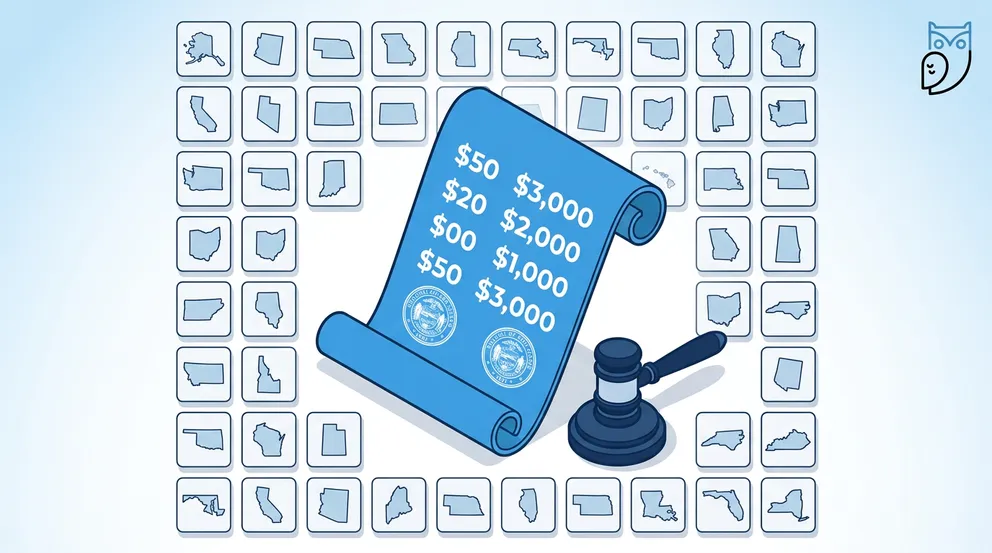
Paying for a car accident out of pocket is legal. No state law forces you to file a claim, according to Insurance.com. Reporting the crash is a separate duty: every state requires a report in some circumstance, with damage thresholds starting at $50 in Tennessee, and California suspends the licenses of drivers who skip the SR-1 form.
A $600 scrape on a neighbor's bumper, a handshake, and cash out of your pocket. The appeal is obvious against a rate hike that Bankrate measures at 43% after a single at-fault accident. The instinct is legal. The execution is where drivers lose their license, their coverage, or both.
Two obligations survive your decision to keep the insurance company out of it, and neither one cares that you paid cash.
- Filing a claim is optional. No state statute requires it, and Insurance.com confirms no state law requires notifying your insurer either.
- Reporting to police or the DMV is mandatory above state damage thresholds: $50 in Tennessee, $250 in Washington D.C., $3,000 in Hawaii and Vermont.
- Your policy's notice clause is a contract duty. Break it and the insurer can deny a later claim or void the policy.
- CCC's 2026 Crash Course report puts the average repair at $4,818, which clears the $1,000 threshold in 20 states by nearly 5x.
- Colorado, Nevada, and Ohio require a report for any crash, with no dollar minimum at all.
Is It Legal to Not Use Your Car Insurance?
Yes. Nothing in any state's vehicle code obligates you to submit a claim to your own carrier after a crash. You bought a financial product, and using it is your choice, the same way you can pay a $400 dentist bill in cash while holding dental coverage.
Insurance.com states the rule bluntly: no state law requires you to notify your insurance company after an accident. Attorney Thomas Simeone of Simeone & Miller in Washington, D.C. and other practitioners quoted in that analysis agree that policyholders carry no statutory duty to report every fender bender to their carrier.
The confusion starts because a popular claim circulating online says otherwise. The Zebra's guide on this question tells readers that if you are legally obligated to carry auto insurance, then it is illegal to refuse to use it for at-fault accidents involving another party. That framing conflates three separate duties. Carrying liability coverage is mandatory everywhere except New Hampshire. Compensating the person you hit is mandatory. Routing that compensation through a claim is not.
Legal to skip the claim does not mean legal to skip the paperwork. Tennessee requires a crash report at $50 of damage, an amount smaller than most deductibles, and 96 times smaller than the $4,818 average repair.
Three Obligations Drivers Confuse
Untangling these three duties answers the entire question, because only one of them is optional.
No statute compels it. Skip it to protect a claims-free record, and you accept 100% of the repair bill yourself.
Damage above your state's threshold triggers a legal duty to file with police or the DMV. Georgia, Delaware, and 11 other states set that bar at $500.
Your policy's notice clause demands prompt reporting, typically within 3 to 7 days. Violating it costs you coverage, not a criminal charge.
Notice the asymmetry. Duty two carries a license suspension. Duty three carries a denied claim years later. Only duty one, the claim itself, sits entirely under your control, and it happens to be the one drivers assume is compulsory.
Accident Reporting Requirements by State
Competitors covering this topic mention that thresholds exist without ever publishing them. The numbers decide whether your private settlement is quietly legal or quietly a misdemeanor, so here they are for all 51 jurisdictions, per the AAA Digest of Motor Laws.
Start with the distribution, because it reveals how rarely the "minor accident" exemption actually applies:
| Damage threshold | Jurisdictions | Average $4,818 repair vs. threshold |
|---|---|---|
| Any damage, no minimum | 3 (CO, NV, OH) | Always reportable |
| $50 to $750 | 16 | 6x to 96x over |
| $1,000 | 20 | 4.8x over |
| $1,500 to $3,000 | 9 | 1.6x to 3.2x over |
| Injury or death only | 3 (MD, PA, VA) | Not damage-based |
Source: AAA Digest of Motor Laws, cross-referenced with state DMV guidance. Average repair cost of $4,818 from CCC Intelligent Solutions' 2026 Crash Course report, released March 2026. Thresholds reflect total property damage unless otherwise noted.
In 39 of 51 jurisdictions the reporting bar sits at $1,000 or less. Against a $4,818 average repair, the exemption you are counting on covers a slice of crashes far thinner than the phrase "minor accident" suggests.
| State | Report required if there is | Deadline |
|---|---|---|
| Alabama | Death, injury, or property damage over $500 by an uninsured motorist | 30 days |
| Alaska | Death, injury, or property damage over $2,000 | 10 days |
| Arizona | Death, injury, or property damage over $300 | 6 months |
| Arkansas | Death, injury, or property damage over $1,000 | Immediate (injury) or 30 days |
| California | Death, injury, or property damage over $1,000 | 10 days (SR-1) |
| Colorado | Death, injury, or any property damage | 10 days |
| Connecticut | Death, injury, or property damage over $1,000 | 5 days |
| Delaware | Death, injury, or property damage over $500 | Immediately |
| District of Columbia | Property damage over $250 | 5 days |
| Florida | Death, injury, or property damage over $500 | As soon as possible |
| Georgia | Death, injury, or property damage over $500 | Immediately |
| Hawaii | Death, injury, or property damage over $3,000 | Immediately |
| Idaho | Death, injury, or property damage over $1,500 | Immediately |
| Illinois | Death, injury, or damage over $1,500 ($500 if a vehicle is uninsured) | 10 days |
| Indiana | Death, injury, or property damage over $750 | Immediately |
| Iowa | Death, injury, or damage of $1,500+ (waived if police investigated) | 3 days |
| Kansas | Death, injury, or property damage over $1,500 | Immediately |
| Kentucky | Death, injury, or property damage over $500 | 10 days |
| Louisiana | Death, injury, or property damage over $500 | Immediate or 1 day |
| Maine | Death, injury, or property damage over $1,000 | Immediately |
| Maryland | Death or injury | 15 days |
| Massachusetts | Death, injury, or property damage over $1,000 | 5 days |
| Michigan | Death, injury, or property damage over $1,000 | Immediately |
| Minnesota | Death, injury, or property damage over $1,000 | 10 days |
| Mississippi | Death, injury, or property damage over $500 | 10 days |
| Missouri | Death, injury, or property damage over $500 | 5 days |
| Montana | Death, injury, or property damage over $1,000 | Immediately |
| Nebraska | Death, injury, or property damage over $1,000 | 10 days |
| Nevada | All crashes | Immediately |
| New Hampshire | Death, injury, or property damage over $1,000 | 5 days |
| New Jersey | Death, injury, or property damage over $500 | Immediately |
| New Mexico | Death, injury, or property damage over $500 | Immediately |
| New York | Death, injury, or property damage over $1,500 | 10 days |
| North Carolina | Death, injury, or property damage over $1,000 | Immediately |
| North Dakota | Death, injury, or property damage over $1,000 | Immediately |
| Ohio | All crashes | Immediately |
| Oklahoma | Death, injury, or property damage over $500 | Immediate or 6 months |
| Oregon | Injury, death, damage over $2,500, or any vehicle towed | 72 hours |
| Pennsylvania | Death, injury, or if a vehicle is disabled | 5 days |
| Rhode Island | Death, injury, or property damage over $1,000 | 21 days |
| South Carolina | Death, injury, or property damage over $1,000 | 15 days |
| South Dakota | Death, injury, damage over $1,000 to one party or $2,000 total | Immediately |
| Tennessee | Death, injury, or property damage over $50 | Immediate or 20 days |
| Texas | Death, injury, or property damage over $1,000 | Immediate or 10 days |
| Utah | Death, injury, or property damage over $1,000 | 10 days |
| Vermont | Death, injury, or property damage over $3,000 | 3 days |
| Virginia | Death or injury | Immediately |
| Washington | Death, injury, or property damage over $700 | 4 days |
| West Virginia | Death, injury, or property damage over $1,000 | Immediately |
| Wisconsin | Death, injury, damage over $1,000, or $200+ to government property | Immediately |
| Wyoming | Death, injury, or property damage over $1,000 | Immediately |
Source: AAA Digest of Motor Laws. Thresholds and deadlines change through legislative sessions, so confirm with your state DMV before relying on an exemption. Highlighted rows mark the outliers most likely to catch drivers off guard.
California's SR-1 Rule Catches Almost Everyone
California deserves its own paragraph because the SR-1 form defeats three assumptions at once. Damage above $1,000 or any injury, however minor, triggers a mandatory DMV filing within 10 calendar days. Fault is irrelevant. Police attendance is irrelevant.
The part that surprises drivers: filing a police report or an insurance claim does not satisfy the SR-1 requirement. It is a separate document, submitted separately, and the California DMV suspends the driving privilege of anyone who skips it. A driver who pays $2,400 cash for a bumper, shakes hands, and drives away has just started a 10-day clock toward a suspension. Getting reinstated afterward means shopping for car insurance after a license suspension, where rates run far above what the original claim would have cost.
The 10-day SR-1 clock starts on the accident date, not the day a body shop tells you the damage crossed $1,000. Discovering on day 12 that the repair hit $1,400 does not reset the deadline.
Why a $600 Estimate Becomes a $4,818 Repair
The private settlement math assumes the first estimate is the final number. Modern vehicles broke that assumption years ago.
CCC Intelligent Solutions pegs the average repair at $4,818 in its 2026 Crash Course report. Sensor calibration explains much of the climb: 28.3% of repairable estimates in Q4 2025 included at least one calibration, up from 21.8% in Q4 2024, and each one adds $350 to $500. A bumper cover on a car with parking sensors and a forward camera is no longer a bumper cover. Our analysis of record total loss rates found 23.1% of claims now end in a total loss, a figure that keeps rising as repair bills chase vehicle values.
Illustrative build-up using CCC's Q4 2025 calibration frequency and $350 to $500 per-calibration cost range. Actual figures vary by vehicle and market.
That $600 handshake just became $1,855, crossing the reporting threshold in 39 jurisdictions and roughly tripling your insurance deductible at the $500 level. Worse, the driver already promised to cover it. Whether you should absorb that bill or file is a genuine calculation, and we walk through the breakeven in our guide on filing a claim versus paying out of pocket.
What Your Policy Requires Even If You Never File
Your carrier wrote two clauses specifically to prevent the arrangement you are considering.
The notice clause obligates prompt reporting of any accident, generally within 3 to 7 days depending on the contract. Reporting is not the same as claiming. Telling State Farm that a crash occurred while declining to open a claim satisfies the clause and costs you nothing in most rating systems, since insurers rate on claims paid rather than notice given.
The cooperation clause obligates you to help the insurer investigate and defend. Settling privately with the other driver, signing a release, or admitting fault in a text message can each breach it. Courts rarely void a policy over a technical breach: as the National Law Review and multiple coverage practitioners note, most jurisdictions apply a notice-prejudice rule requiring the insurer to prove the late notice actually harmed its ability to investigate. Some states skip that requirement entirely and treat timely notice as a condition of coverage, voiding it regardless of prejudice.
Call your insurer and say the words "I want to report an accident, not file a claim." Ask for a reference number. That single call preserves your notice compliance while keeping the claim closed, and it puts your version of events on record before the other driver changes their mind.
What Filing Actually Costs You
Drivers avoid claims for a rational reason. The penalty is steep and it is measurable.
| Driving record | Average annual premium | Increase vs. clean record | Added cost per year |
|---|---|---|---|
| Clean record Baseline | $1,897 | Baseline | Baseline |
| At-fault, property damage under $2,000 | $2,936 | +55% | $1,039 |
| At-fault, property damage over $2,000 | $2,964 | +56% | $1,067 |
| At-fault with bodily injury | $3,092 | +63% | $1,194 |
| Two at-fault accidents over $2,000 | $4,225 | +122% | $2,328 |
Source: Insurance.com analysis using Quadrant Information Services data across 34,588 ZIP codes, full coverage for a 40-year-old driver. Bankrate's separate 2026 analysis found a 43% increase after one at-fault accident; Insurify measured 34%, or $396 per year. Methodology differences explain the spread.
Read the first two rows together, because they contain the insight that changes the decision. A claim for $1,900 of damage raises your premium $1,039 per year. A claim for $2,100 raises it $1,067. Severity barely moves the needle at 1.5 percentage points, since carriers surcharge the at-fault event rather than the invoice.
Over the three years a surcharge typically lasts, that $1,039 becomes $3,117 in added premium. Paying a $1,855 repair yourself now looks cheap. Flip it around, though: absorbing a $6,000 repair to avoid $3,117 in surcharges costs you $2,883. The crossover point sits near the three-year surcharge total, and accidents that stay on your record work differently by state, which we cover in how long an accident stays on your driving record.
When Paying Out of Pocket Makes Sense
- Damage is confined to your own vehicle in a single-car incident, with nobody else to make a claim against you
- A body shop's written estimate lands below both your deductible and your state's reporting threshold
- You already carry one at-fault accident, and a second would push you to +122% and $4,225 per year
- Nobody was hurt, and everyone at the scene confirmed it in writing
- Total repair cost falls under roughly three years of surcharge, near $3,117 for a typical driver
- Anyone reports pain, stiffness, or a headache, since injury claims run 1 to 6 years under state statutes of limitations
- The other driver hesitates, delays, or asks to think it over
- Damage involves airbags, frame rails, or ADAS sensors, where $4,818 is merely the average
- More than two vehicles were involved, multiplying the parties who can sue you later
- You live in Colorado, Nevada, or Ohio, where every crash is reportable regardless of cost
Single-car incidents are the cleanest case by far. Back into your own mailbox, and the only party with a claim is you. Coverage for that damage would come from collision anyway, and our breakdown of comprehensive versus collision coverage explains which one applies to which scenario.
How to Settle Privately Without Losing Coverage
Check your state's threshold first
Look up your number in the table above before agreeing to anything. Tennessee drivers clear $50 by denting a door.
Photograph everything at the scene
Capture both vehicles, both license plates, the other driver's license, and the surrounding area. Insurers investigating a claim 8 months later rely on what you documented in the first 10 minutes.
Report to your insurer without opening a claim
This satisfies the notice clause. Get a reference number and the representative's name.
Get two written estimates before naming a price
Agreeing to $600 before a shop looks behind the bumper commits you to a bill that averages $4,818 nationally. Calibration alone appeared on 28.3% of CCC's Q4 2025 estimates.
Use a signed release of liability
Payment without a release buys nothing. The document must state that the money settles all claims, including injuries discovered later, and both parties sign it.
A release you draft yourself can fail in court if it omits future injury claims or lacks consideration language. Attorneys charge $200 to $400 to review one, which is cheap against a $3,092 premium and a lawsuit you defend alone.
The Injury That Shows Up Three Weeks Later
Soft tissue injuries hide. Whiplash and disc injuries frequently present days after impact, long after the cash changed hands and the other driver drove off feeling fine.
Statutes of limitations give that driver a long runway to change their mind. Tennessee and Kentucky allow 1 year to sue. Maine and North Dakota allow 6. Most states land at 2 or 3. Throughout that window, the person you paid $600 can retain a lawyer, file suit, and pursue you for medical bills that dwarf the settlement.
A private settlement without a signed release is not a settlement. It is a gift, followed by a lawsuit you now defend without the insurer you never told.
Should that suit arrive, your carrier learns of an 18-month-old accident you concealed. Whether they defend you depends on the notice-prejudice rule in your state and how badly the delay damaged their investigation. The other driver's own carrier may also pursue you through subrogation, and if that driver was uninsured, collecting anything requires your own uninsured motorist coverage. Liability limits matter enormously here, which is why we recommend reviewing how much car insurance you actually need rather than defaulting to state minimums.
Frequently Asked Questions
No. Paying out of pocket instead of filing a claim is legal in every state, and Insurance.com confirms that no state law requires you to notify your insurance company after an accident. What remains mandatory is reporting the crash to police or the DMV once damage exceeds your state's threshold, which ranges from $50 in Tennessee to $3,000 in Hawaii and Vermont. Colorado, Nevada, and Ohio require a report for any crash.
No law requires it, but your policy does. Nearly every auto policy contains a notice clause requiring you to report accidents promptly, typically within 3 to 7 days. Reporting is not the same as filing a claim. You can notify your insurer that a crash occurred and decline to open a claim, which satisfies the contract without triggering a surcharge, since carriers rate on claims paid rather than notice given.
Insurance.com data from Quadrant Information Services shows the average premium rising from $1,897 to $2,936 after an at-fault accident with under $2,000 in property damage, a 55% increase costing $1,039 per year. Bankrate measured a 43% increase and Insurify found 34%, or $396 annually. Surcharges typically last about three years, putting the total cost of one claim near $3,117.
Yes, unless they signed a release of liability covering future claims. Statutes of limitations for car accident injury suits run from 1 year in Tennessee and Kentucky to 6 years in Maine and North Dakota, with most states allowing 2 to 3 years. Soft tissue injuries like whiplash often appear days after impact, so a driver who felt fine at the scene can still file suit months later.
Penalties vary by state and typically include fines and license suspension. California suspends the driving privilege of any driver who fails to file an SR-1 within 10 days of a crash involving injury or more than $1,000 in damage, and filing a police report or insurance claim does not satisfy that requirement. Concealing a reportable accident can also give your insurer grounds to deny a related claim later.
- California DMV - Report of Traffic Accident Occurring in California (SR-1)
- AAA Digest of Motor Laws - Accident Reporting Requirements by State
- Insurance.com - How to Settle a Car Accident Without Insurance
- Enjuris - State-by-State Laws and Requirements for Reporting a Car Accident
- Enjuris - Car Accident Statutes of Limitations by State
- Insurify - How Much Does Car Insurance Go Up After an Accident?
- National Law Review - The Duty to Cooperate in Insurance Clauses
- FindLaw - When Is a Car Accident Report Required?