

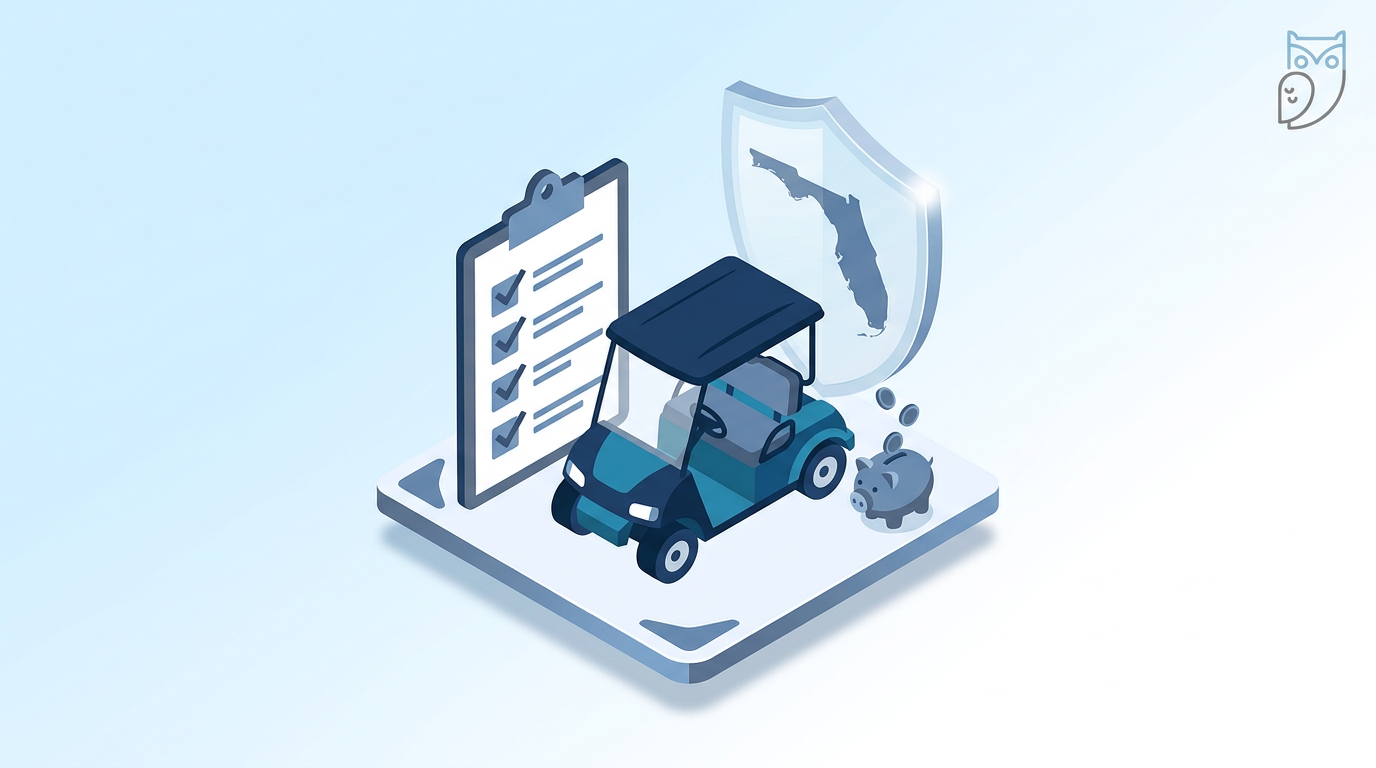
In Florida, LSV (Low-Speed Vehicle) insurance is legally required. You need at least $10,000 in Personal Injury Protection (PIP) and $10,000 in Property Damage Liability (PDL). Basic policies start around $100–$200 per year, though full coverage with collision and comprehensive can run $500–$700+. Without it, you cannot legally register or drive your LSV on public roads.
So you've got yourself a street-legal golf cart — or maybe a Polaris GEM, a Tomberlin, or another low-speed vehicle — and you're wondering what it takes to drive it legally in Florida. Good news: LSVs are a blast, incredibly practical for beach towns and retirement communities, and surprisingly affordable to insure.
Bad news? A lot of Florida LSV owners get this wrong. They assume their homeowner's policy covers it, or they figure it's "just a golf cart" and skip insurance altogether. That's a mistake that can cost you thousands.
Here's everything you need to know about LSV insurance in Florida — what it is, what it costs, where to get it, and how to stay legal on the road.
- Florida law requires LSV owners to carry $10,000 PIP and $10,000 PDL insurance
- LSVs are legally different from golf carts — and the insurance rules are very different too
- Basic liability policies start as low as $100–$200/year; full coverage runs $400–$700+
- LSVs can only be driven on roads with speed limits of 35 mph or less
- You need a valid driver's license, registration, title, and proof of insurance to operate legally
- Converting a golf cart to an LSV requires additional documentation and a VIN assignment
What Is an LSV, Exactly?
Before diving into insurance, let's make sure we're talking about the same thing. A Low-Speed Vehicle (LSV) is defined under Florida law as any four-wheeled vehicle with a top speed greater than 20 mph but no more than 25 mph.
That might sound oddly specific, and it is — because it's the legal dividing line between a recreational golf cart and a street-legal vehicle. Cross that threshold (faster than 20 mph, slower than 25 mph), and your vehicle becomes an LSV under Florida Statute 316.2122.
Common examples of LSVs include:
- Polaris GEM vehicles
- Tomberlin E-Merge
- Club Car Villager LSV
- Yamaha Drive2 LSV
- Golf carts that have been modified and converted to meet LSV standards
If your vehicle's top speed is 20 mph or under, it's classified as a golf cart — not an LSV — and different rules apply. Golf carts in Florida don't require the same mandatory insurance as LSVs, though many communities still recommend coverage.
LSV vs. Golf Cart Insurance: The Key Difference in Florida
Here's where most people get confused — and where skipping research can really hurt you.
In Florida, golf carts do not require mandatory insurance. That's right — if your cart stays under 20 mph and you're using it within a designated golf cart community or on private property, you technically don't need insurance (though you'd be foolish not to carry some form of coverage anyway).
LSVs are a completely different story. The moment your vehicle qualifies as an LSV — either because it came from the factory that way or because you modified a golf cart to go faster — you're in mandatory insurance territory. No exceptions.
- No mandatory insurance required by Florida law
- No driver's license required to operate (in many contexts)
- No title or registration typically required
- Limited to specific areas and private property
- Cannot legally be driven on most public roads
- Mandatory PIP and PDL insurance required
- Valid driver's license required at all times
- Must be titled, registered, and have a VIN
- Can operate on public roads with speed limits ≤ 35 mph
- Must meet federal safety equipment standards
Florida LSV Insurance Requirements: What the Law Says
Florida is a no-fault insurance state, meaning your own insurance pays for your medical bills after an accident — regardless of who caused it. That's why the state requires LSV owners to carry:
- $10,000 Personal Injury Protection (PIP) — covers your medical expenses, lost wages, and death benefits after an accident, no matter who's at fault
- $10,000 Property Damage Liability (PDL) — covers damage you cause to someone else's property (their car, fence, mailbox, etc.)
These are the same minimums required for traditional automobiles in Florida, which makes sense — your LSV is sharing the road with cars, trucks, and cyclists, and accidents happen.
Florida's minimum coverage limits are notoriously low. $10,000 PDL won't go very far if you cause a serious accident. If you rear-end a newer vehicle, repairs alone could easily exceed your policy limits — leaving you personally on the hook for the rest.
Required Safety Equipment on LSVs
Insurance requirements go hand-in-hand with safety equipment requirements. Your LSV must have all of the following to legally operate on Florida roads and to obtain insurance and registration:
- Headlamps (front)
- Front and rear turn signals
- Stop lamps and tail lamps (rear)
- Red reflex reflectors on sides and rear
- Driver and passenger side mirrors
- Parking brake
- Windshield
- Seat belts for every seat position
- Vehicle Identification Number (VIN)
If your vehicle doesn't have all of these, you won't be able to register it — which means you can't insure it as an LSV either. Make sure everything is in place before you start the insurance process.
How Much Does LSV Insurance Cost in Florida?
Here's the good news: LSV insurance is genuinely affordable. We're not talking car-insurance prices here.
Liability-only coverage — the state minimum — typically runs between $100 and $200 per year in Florida. If you want to add comprehensive and collision to protect your own vehicle from theft, weather damage, or accident repairs, expect to pay $300–$700+ annually, depending on your LSV's value and the insurer.
What Affects Your LSV Insurance Rate?
Several factors influence what you'll actually pay:
- Vehicle value: A brand-new $15,000 Polaris GEM costs more to insure than a basic converted golf cart
- Coverage type: Liability-only is cheapest; full coverage adds meaningful cost
- Your driving record: Yes, insurers look at your regular driving history
- Modifications: Aftermarket upgrades can increase the vehicle's insured value
- Insurance company: Rates vary significantly between providers — sometimes by 30–40% for the same coverage
- Location: Urban areas or areas with higher theft rates may see slightly higher premiums
Always get quotes from at least 3 different insurers before committing. LSV insurance is a specialty product, and not all insurers price it the same way. A 15-minute quote comparison could save you $100+ annually.
Best Insurance Companies for LSVs in Florida
Not every major auto insurer offers LSV coverage, and some that do treat it as a specialty product. Here are the key players to contact when shopping for LSV insurance in Florida:
- Widely available in Florida
- Competitive rates for basic liability
- Easy online quote process
- Bundling discounts with auto and home
- Specialty vehicle coverage available
- Snapshot discount program for safe drivers
- 24/7 claims support
- Good for bundling with other policies
Other insurers worth contacting include:
- American Modern Insurance — specialty vehicle insurer with LSV experience
- National General — competitive rates for non-standard vehicles
- American Integrity Insurance — Florida-focused insurer
- Local independent agents — agencies like Shane Griffis specialize in LSV coverage and can shop multiple carriers on your behalf
Working with an independent insurance agent who specializes in specialty vehicles can be a game-changer. They know which carriers actually write LSV policies and can find you coverage that a standard auto quote wouldn't turn up.
Optional Coverage Types Worth Considering
Florida's minimums get you legal — but they don't necessarily get you protected. Here's what additional coverage options can do for you:
Covers repair or replacement costs if your LSV is damaged in an accident, regardless of fault. Worth it if your vehicle is valued over $3,000.
Covers non-collision damage — theft, vandalism, hurricane damage, flooding, falling trees. Especially valuable in Florida's storm-prone environment.
Protects you if an uninsured driver hits your LSV. Florida has one of the highest rates of uninsured drivers in the country — about 20%.
Medical payments (MedPay) coverage and roadside assistance are also available from some carriers. If your LSV breaks down on a public road, roadside assistance can be surprisingly handy.
Where Can You Drive an LSV in Florida?
This is one of the most practical questions LSV owners have — and the answer matters for your insurance too.
Under Florida law, LSVs may only operate on streets and highways where the posted speed limit is 35 mph or less. That's it. No highways, no arterials — just neighborhood streets, beach roads, and other lower-speed zones.
LSVs cannot legally cross roads with speed limits over 35 mph, except at marked crosswalks or intersections. So if you live in a community where the main road runs 45 mph, you may have some navigational challenges.
Florida municipalities can expand LSV operating zones beyond the state defaults. Some beach towns and retirement communities have local ordinances that allow LSVs on additional roadways. Check with your local government for specific rules in your area.
Some of Florida's most LSV-friendly communities include The Villages, Dunedin, Venice, and many of the Florida Keys communities — where LSVs are practically the unofficial transportation of choice.
How to Register Your LSV in Florida
Insurance and registration go together — you can't get one without the other. Here's the process for titling and registering an LSV in Florida:
Get Your Insurance First
You need proof of Florida PIP and PDL insurance before you can register. Get quotes, purchase a policy, and obtain your insurance ID card or binder letter.
Gather Required Documents
For a factory-built LSV: Manufacturer's Certificate of Origin (MCO), Form HSMV 82040 (Application for Title), proof of insurance, government-issued ID, and applicable fees.
Visit a Motor Vehicle Service Center
Bring all documents to your local FLHSMV service center or county tax collector's office. They'll process your title, assign a plate, and complete registration.
Pay Applicable Fees
Fees include title ($75.25), registration (based on vehicle weight), and plate fees. Total typically runs $150–$250 at initial registration.
Converting a Golf Cart to an LSV in Florida
Here's where things get interesting — and more complicated. Many Florida residents want to convert their existing golf cart into a street-legal LSV. It can be done, but the process involves more steps than buying a factory-built LSV.
To convert and register a modified golf cart as an LSV, you'll need:
- Proof the vehicle has been modified to meet all LSV safety equipment requirements
- Photographs of the front, back, and both sides of the converted vehicle
- Original bill of sale or Manufacturer's Certificate of Origin for the base golf cart
- Form HSMV 84490 (Statement of Builder) — completed with a Compliance Examiner/Inspector
- Form HSMV 86064 (Affidavit for Golf Cart Modified to a Low-Speed Vehicle)
- Original receipts for all parts used in the conversion
- A certified weight slip for the completed vehicle
Once the inspection is complete and documents are verified, the state will assign a VIN to your converted vehicle. Only then can you title, register, and insure it as an LSV.
The conversion inspection must be done at a Motorist Services Regional Office — not a regular tax collector's location. Call ahead to schedule, as wait times can vary. Some counties are faster than others.
One important quirk: when a converted golf cart is titled as an LSV, the title date reflects when it was registered — not when the underlying golf cart was manufactured. Your "new" LSV might actually have a frame that's 10+ years old, which can affect insurance valuation and financing.
Smart Tips for Getting the Best LSV Insurance in Florida
Getting covered is only half the battle — getting covered well, at a fair price, is the real goal. Here's what experienced LSV owners recommend:
- Shop specialty carriers first. Companies like American Modern specialize in non-standard vehicles and often have better pricing than general auto insurers for LSVs.
- Bundle if you can. If you have home, auto, or boat insurance, check whether adding your LSV to the same carrier creates a multi-policy discount.
- Consider the vehicle's replacement value. If your LSV is worth $8,000 or more, collision and comprehensive are probably worth the extra cost — especially given Florida's hurricane and theft risks.
- Ask about seasonal coverage. If you only use your LSV part of the year, some carriers offer seasonal policies or storage coverage options.
- Keep your driving record clean. Yes, your regular auto driving record affects your LSV rates. Multiple violations or recent accidents will increase your premium.
- Document modifications. If you've added aftermarket accessories, document them with photos and receipts so they're properly covered if you need to file a claim.
What Happens If You Drive an LSV Without Insurance in Florida?
Let's be direct about this: driving an uninsured LSV on Florida public roads is illegal, and the consequences are real.
If caught, you face the same penalties as driving an uninsured automobile in Florida:
- License suspension until you can prove financial responsibility
- Vehicle registration suspension
- Reinstatement fees of $150 for a first offense, $250 for subsequent offenses
- Possible requirement to file an SR-22 (a high-risk insurance certificate) for up to three years
And if you're in an accident without insurance? You're personally liable for all damages and medical costs — which can easily reach tens of thousands of dollars. For a policy that costs less than $200 a year, there's really no good reason to skip it.
Frequently Asked Questions
Yes. Florida law requires all LSVs operated on public roads to carry at minimum $10,000 in Personal Injury Protection (PIP) and $10,000 in Property Damage Liability (PDL) insurance. This applies to any four-wheeled vehicle with a top speed between 20 and 25 mph.
Basic liability-only LSV insurance in Florida starts around $100–$200 per year. Full coverage policies that include collision and comprehensive coverage typically run $350–$700+ annually, depending on the vehicle's value, your driving record, and the insurer you choose.
Generally, no. Standard auto insurance policies typically exclude LSVs and low-speed vehicles. You'll need a separate specialty policy or an endorsement specifically covering your LSV. Always confirm with your insurer before assuming your existing policy covers it.
The key difference is speed and legal classification. A golf cart has a maximum speed of 20 mph or less and doesn't require mandatory insurance, title, or registration for most uses. An LSV goes between 20–25 mph and legally requires insurance, a title, registration, a VIN, and a valid driver's license to operate on public roads.
Florida law allows LSVs on public streets and roads where the posted speed limit is 35 mph or less. LSVs cannot legally be driven on roads with speed limits above 35 mph. Some municipalities have local ordinances that permit LSVs in additional areas — check with your local government for specifics.
Yes. Unlike golf carts, which can sometimes be operated by younger riders in certain communities, LSVs require a valid Florida driver's license at all times. This applies to all public road use.
- Florida Department of Highway Safety and Motor Vehicles - Low Speed Vehicles
- Florida Statute 316.2122 - Low-Speed Vehicles
- FLHSMV - Low Speed Vehicle Requirements PDF
- Shane Griffis Agency - Low Speed Vehicle Insurance in Florida
- Progressive - Florida Golf Cart Insurance Requirements
- Orange County Tax Collector - Low Speed Vehicles