

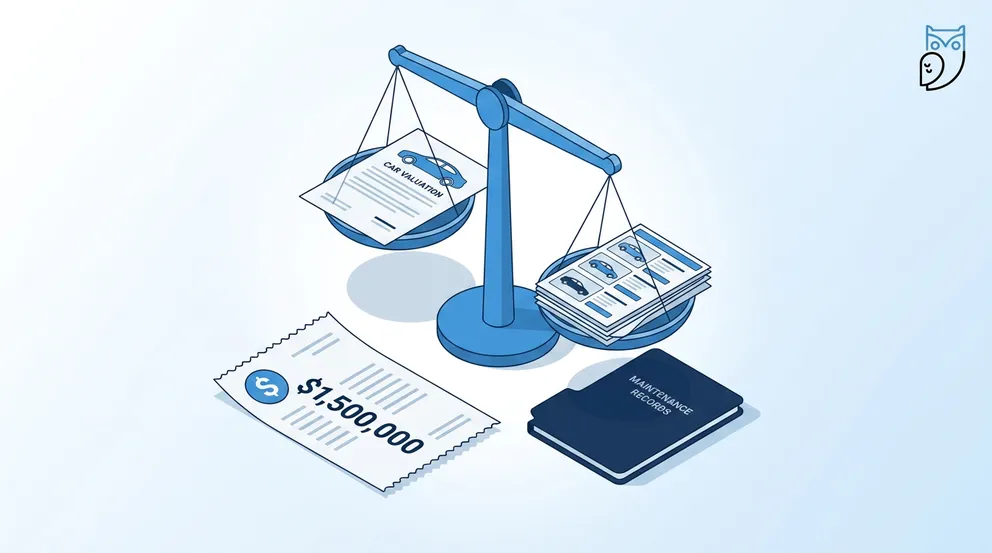
The first total loss offer your insurer hands you is almost never the final number. According to LexisNexis Risk Solutions, more than a quarter of collision claims in 2023 ended in total losses, a 29% jump from 2020 driven largely by the 7.6% rise in vehicle repair costs the U.S. Bureau of Labor Statistics recorded between April 2024 and April 2025. Negotiation is built into the process, since insurers expect counter-offers, every standard policy includes an appraisal clause, and a 2025 North Carolina class action accuses CCC ONE of trimming comparable values by as much as 9%. If you are still mapping the broader claim flow, our step-by-step car insurance claim guide covers the full workflow, while this piece zeroes in on the actual cash value (ACV) dispute.
You can dispute a total loss settlement by pulling 5 to 10 comparable for-sale listings from your local market, documenting your car's pre-loss condition with service records and dated photos, and presenting a written counter-offer. Drivers who push back typically recover $1,500 to $3,000 more than the carrier's first number, and every standard auto policy includes an appraisal clause as a binding backup if direct talks stall.
Why the First Offer Is Almost Always Negotiable
Insurers calculate ACV using proprietary databases, with CCC ONE, Mitchell, and Audatex handling the bulk of the U.S. market. These platforms pull from dealer ads, but they also apply automatic deductions for "projected sold adjustments" and condition that policyholders rarely see in writing. A North Carolina class action filed against State Farm in 2025 alleges that CCC ONE knocks comparable listings down by as much as 9% before the adjuster rounds the figure. Industry experts cited by snapclaim and Auto Claim Consultants peg the gap between automated valuations and realized local sale prices at 3% to 10% on most vehicles.
Carriers are also under active regulatory pressure on this exact issue. State Farm agreed to pay $15.6 million to Arkansas drivers in early 2026 over total loss underpayments, a settlement we covered in our Arkansas total loss case study. Sign a release at the first number and you forfeit the right to revisit any of the math behind it.
Research Your Car's Real Market Value
Three valuation guides carry weight when an adjuster reviews your counter-offer. NADA Guides anchors retail benchmarks. Edmunds True Market Value reflects transaction-adjusted pricing. Kelley Blue Book splits trade-in and private-party numbers cleanly. Pull all three, record each dollar figure, and screenshot the exact condition tier you selected.
Active for-sale listings carry the most leverage because adjusters can verify them independently. Pull 5 to 10 listings on Autotrader, Cars.com, and CarGurus within a 100-mile radius matching your year, model, trim, and mileage band (within 10,000 miles of yours). Save each listing as a PDF, including the dealer name, asking price, mileage, and listing date, since adjusters reject screenshots that lack provenance. Insurance.com documented a real case in which a policyholder named Miriam used this approach to push her ACV from $15,000 to $17,500, a $2,500 swing on a single counter-offer. Carfax history reports for those comparables (about $44 per report) are worth the spend if your car had a clean record, because they neutralize the insurer's condition-deduction arguments.
For context on why these gaps keep widening, our analysis of how inflation redefined auto insurance costs covers the parts and labor data driving repair severity higher every quarter.
Document Your Car's Pre-Loss Condition
Maintenance records and photos move the number more than any other evidence category. Pull your service history from your dealer or the repair chain that handled your work, and highlight anything within the past 12 months: new tires, brakes, transmission service, timing belts, suspension components. Aftermarket upgrades count too, with a $1,200 sound system, a $2,400 lift kit, or $800 in tinted windows all adding to ACV when receipts back the claim.
Pull 36 months of service records
Request a printed history from your dealer or repair shop covering oil changes, tire purchases, brake service, and major repairs. Highlight every line item from the past 12 months because recent maintenance carries the most weight in valuation discussions.
Photograph every exterior and interior angle
Shoot 8 exterior angles, 4 interior angles, the odometer reading, and the dashboard with no warning lights illuminated. Date-stamp every file by enabling your phone's location and timestamp metadata before shooting.
Total parts and labor receipts
Add up the dollar value of work done in the past 24 months. Cars with $3,000+ in recent documented maintenance often gain $1,000 to $1,500 in ACV when the receipts accompany the counter-offer.
Capture odometer proof
Find your most recent oil change invoice or state inspection report showing the mileage reading. Verbal mileage claims get discounted by adjusters, while a printed odometer reading dated within 90 days of the loss holds up under review.
Write a Counter-Offer in Writing
Verbal counter-offers go nowhere because adjusters need a paper trail to escalate. Compose a one-page letter, state the carrier's offer, name your counter-figure, and attach the comparable listings, valuation printouts, and maintenance records as numbered exhibits. Send the package by email and certified mail, then ask the adjuster to acknowledge receipt in writing within 5 business days. Frame the counter-figure with the supporting math directly: if your three comparables average $19,400 and your offer was $17,200, write "the comparable market average exceeds the offer by $2,200" and let the data argue the case.
A $500 to $1,000 increase on the first counter is common, and a second round nets another $500 to $1,500 when the documentation is strong. Hold the line if the math justifies it, because signing a release at any stage closes the file permanently.
Once you sign the carrier's release form, the claim is closed and you forfeit the right to dispute ACV. Read every line before signing, and never sign on the day the offer arrives. Take 7 to 14 days to review the offer, the release language, and any attached arbitration waivers.
When a Public Adjuster Is Worth the Fee
Public adjusters are state-licensed professionals who represent the policyholder, not the carrier, and they typically charge 5% to 15% of the final settlement on a contingency basis. A $1,500 fee on a $20,000 claim makes sense if the public adjuster lifts the offer by $5,000, which is common on high-value vehicles ($30,000 ACV and up) or when the carrier has dug in after two counter-offers. Skip the public adjuster on cars valued under $10,000 because the fee math rarely works in the policyholder's favor.
Verify the adjuster's license through your state insurance department before signing a contract, and confirm the contingency rate, the fee floor, and any cancellation terms in writing. Florida, Texas, and California publish online license lookups updated weekly.
Invoke the Appraisal Clause When Talks Stall
Every standard auto policy contains an appraisal clause that triggers a binding three-party process. You hire one appraiser. The carrier hires another. The two appraisers select an "umpire" who breaks ties, and the umpire's decision is final and unappealable. Each side pays its own appraiser ($300 to $600 typically), and the parties split the umpire fee ($500 to $1,500).
The Sixth Circuit recently decertified a 90,000-member class action against State Farm partly because the appraisal clause provides individualized recourse, which signals that federal courts view it as a meaningful remedy rather than a paper formality. File the appraisal demand in writing, reference the policy section number, and the carrier has 20 days in most states to name its appraiser.
The Salvage Retention Option
Keeping your totaled car is allowed in 49 states, with state-specific severity tiers determining eligibility. The carrier pays the ACV minus the salvage value, which usually runs 15% to 25% of ACV. On a $20,000 ACV with a $4,000 salvage value, you pocket $16,000 cash and keep the vehicle. The math works for mechanical totals (cars with airbag deployments and minor frame damage) and for daily drivers you intend to repair piecemeal.
Skip salvage retention on cars with structural frame damage because rebuilt titles depress resale value by 20% to 40%, and most carriers refuse comprehensive coverage on rebuilt-title vehicles entirely.
How Long the Insurer Has to Respond
The NAIC Model Unfair Claims Settlement Practices Act, adopted with state-specific variations across most states, gives insurers 15 calendar days to send claim forms after a request, 30 days to affirm or deny coverage after receiving documentation, and 45 days between status updates if the investigation runs long. Florida shortens the affirm-or-deny window to 14 days under Florida Statute 627.70131. New York requires a written status letter every 30 days. California demands a 40-day acknowledgment of new claims under Insurance Code Section 790.03(h).
File a complaint with your state insurance commissioner if the insurer misses these deadlines, since regulators routinely fine carriers for unfair claims practices, and the threat of regulatory action moves stalled negotiations faster than another email to the adjuster.
| Negotiation Tactic | Typical Increase | Cost to You | Best For |
|---|---|---|---|
| Comparable listings counter | $500 - $2,500 | $0 | Every total loss claim |
| Service records packet | $500 - $1,500 | $0 | Cars with recent maintenance |
| Public adjuster | $2,000 - $7,000 | 5% - 15% contingency | $30,000+ ACV vehicles |
| Appraisal clause | $1,000 - $5,000 | $800 - $2,100 | Disputes over $3,000 apart |
| State commissioner complaint | Varies | $0 | Missed response deadlines |
Source: Aggregated case data from Bankrate, Insurance.com, and Insurance Information Institute publications, 2024-2026. Increases reflect typical net gains after fees on a $20,000 baseline ACV claim.
If your loan or lease balance exceeds the carrier's ACV offer, gap insurance covers the shortfall, but only if the policy was active at the time of loss and the claim is reported promptly. Our gap insurance guide walks through the activation rules and the carriers that bundle it free with new-car replacement endorsements. For a deeper breakdown of what total loss means and when carriers declare one, see our total loss insurance explainer.
Frequently Asked Questions
Verbal acceptance is not binding. The carrier needs a signed release form to close the claim. Until you sign, you can still submit a written counter-offer with comparable listings, valuation printouts, and updated documentation. Insurance.com confirms that adjusters routinely revisit offers as long as the release is unsigned.
A counter-offer typically adds 7 to 21 days to the settlement timeline. The trade-off averages $500 to $2,500 in additional payout based on Insurance.com case data and Bankrate negotiation analyses, which is a strong return for two to three weeks of patience.
No. Actual cash value is calculated from the vehicle's pre-loss condition, mileage, options, and local market data. Your driving record affects premiums and deductibles, while your insurance score affects rate filings, but neither input touches the ACV math the adjuster runs.
You owe the lender the difference unless gap insurance is active on the policy. Gap insurance pays the shortfall between the ACV settlement and the remaining loan or lease balance, and it must be in force at the time of loss to apply. Lenders begin reporting unpaid balances to credit bureaus 30 days after the settlement check clears.
- LexisNexis Risk Solutions: U.S. Auto Insurance Trends Report (2024)
- U.S. Bureau of Labor Statistics: Consumer Price Index, Motor Vehicle Maintenance and Repair (April 2025)
- National Association of Insurance Commissioners: Model Unfair Claims Settlement Practices Act (Model Law 900)
- NAIC: Unfair Property/Casualty Claims Settlement Practices Model Regulation (Model Law 902)
- Insurance Information Institute: Auto Insurance Claims Handbook
- National Automobile Dealers Association: Consumer Vehicle Values
- Bankrate: How to Negotiate With a Car Insurance Company After a Total Loss
- Insurance.com: Can You Negotiate the Insurance Payout for a Totaled Car?