

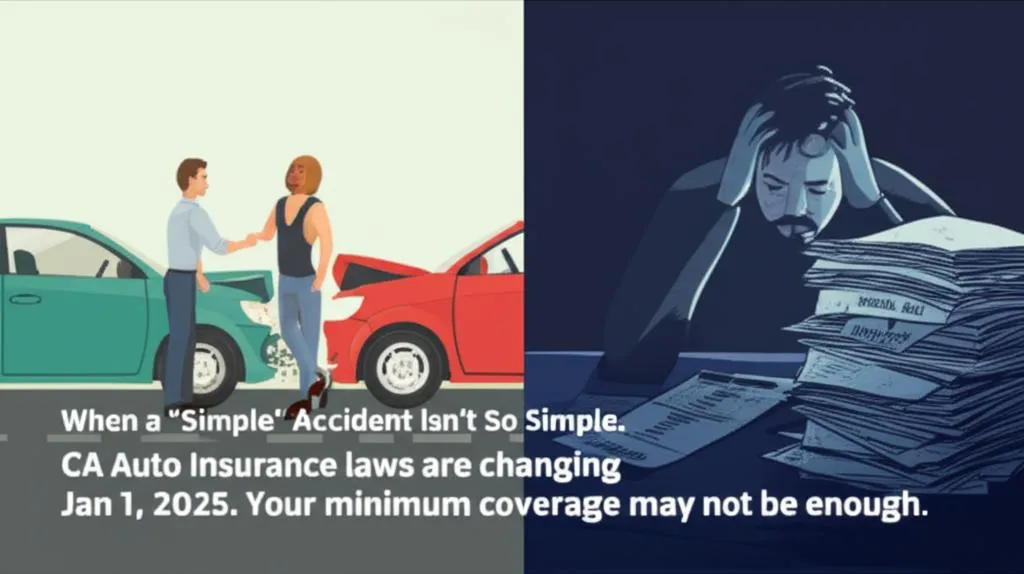
Picture this: You're running late for work, it's raining, and traffic's crawling. Your phone buzzes with a text just as the car in front of you stops suddenly. Crunch.
What happens next could change your life forever.
Take Sarah, a nurse from Fresno. She was rear-ended at a red light by someone just like you—a responsible person who'd been paying insurance for years. Sarah walked away saying she felt fine. Three days later? Severe neck pain. The MRI showed herniated discs.
The bills piled up fast:
- Emergency room: $2,800
- MRI and imaging: $3,500
- Specialist visits: $4,200
- Physical therapy: $6,800
- Total: $17,300
Here's the gut punch: The other driver's insurance only covered $15,000. Sarah was stuck with the rest. And the driver? They're now facing a lawsuit that could wipe out their savings.
This nightmare scenario used to play out thousands of times across California every year. That's exactly why the state finally said "enough" and overhauled insurance requirements that were older than your parents.
Starting January 1, 2025, every California driver needs liability coverage of at least $30,000 per person, $60,000 per accident, and $15,000 for property damage. If you're thinking "didn't we already have insurance minimums?"—we did. They just hadn't changed since 1967.
Yes, 1967. When gas cost 33 cents a gallon and a hospital stay ran about $50 a day.
Why Your "Adequate" Coverage Wasn't Actually Adequate
Let's talk real numbers for a second. That $15,000 minimum for bodily injury? In 1967 dollars, it made sense. Today, it's laughable.
If we'd just kept up with inflation, that $15,000 would be worth about $125,000 now. Instead, California drivers were running around with coverage that couldn't even handle a basic ER visit.
Dr. Amanda Torres sees this firsthand in her San Diego emergency room. "I can't tell you how many times I've had to explain to accident victims that their treatment will cost more than the other driver's entire insurance policy," she says. "A simple broken wrist runs $8,000 to $12,000. Add any complications, and you're looking at five figures before the patient even starts recovery."
Car repairs? Don't get me started. Your neighbor's Honda Civic might look basic, but fixing those sensors, cameras, and electronic systems after even a minor crash often hits $10,000 or more. The old $5,000 property damage minimum wouldn't even cover the bumper.
Here's What Actually Changed (And What It Costs)
The new minimums aren't just bigger numbers—they're designed to actually cover real-world accident costs:
$30,000 per person instead of $15,000
$60,000 per accident instead of $30,000
$15,000 property damage instead of $5,000
So what's this going to cost you?
If you're already carrying minimum coverage, expect your premium to go up about $10 to $15 per month. That's roughly $120 to $180 more per year.
Before you panic: your insurance company handles everything automatically. When your policy renews in 2025, you'll see the new coverage limits and the adjusted premium. You don't need to call anyone or fill out forms.
But here's what might surprise you—if you're already carrying coverage above the old minimums, you might not see any increase at all.
The Premium Reality Check
"My insurance went up $14 a month," says Miguel, a delivery driver from Sacramento. "But you know what? That's less than two coffee shop visits. And after hearing what happened to my neighbor who got sued, I'm actually sleeping better."
The increase hits different people differently:
Biggest impact: People currently carrying bare-bones coverage—often younger drivers or folks trying to save every dollar they can.
Smallest impact: Anyone who already carries higher limits. If you've got 50/100/25 coverage, you're already above the new requirements.
Regional differences: Los Angeles drivers already pay around $3,000+ annually for car insurance, so an extra $150 feels different than it does to someone in Bakersfield paying $1,200 a year.
What This Really Means for Your Family
Let's get personal for a minute. How much could you actually afford to pay out of pocket if you caused a serious accident?
If you own a home, have any savings, or earn decent money, you're at risk for way more than insurance minimums cover. Think about it: you cause an accident that seriously injures two people. Medical bills and lost wages hit $75,000 each. Your new minimum coverage pays $60,000 total.
You're personally on the hook for $90,000.
That's mortgage-destroying, retirement-killing money for most families.
"I see too many people who think insurance is just something you need to avoid tickets," says Maria Santos, who's been selling auto insurance in Fresno for 15 years. "But it's really about protecting everything you've worked for. Your house, your savings, your future earnings—all of it."
The Fine Print You Actually Need to Know
Here's stuff your insurance company might not emphasize but you should understand:
Uninsured driver protection goes up too. The new minimums include matching increases in uninsured/underinsured motorist coverage. This protects you when someone without adequate insurance hits you. Given that about 1 in 6 California drivers are uninsured, this matters more than you might think.
Low-income programs exist. California offers reduced-cost auto insurance for people who qualify based on income and vehicle value. If the premium increases are genuinely unaffordable, look into the California Low Cost Auto Insurance Program.
Usage-based insurance can help. Many companies now offer programs that track your driving and reduce premiums for safe, low-mileage drivers. If you don't drive much or stick to low-risk times, these programs could offset the minimum increases.
What's Coming Next (And Why You Should Care)
California didn't just update the minimums once—they planned ahead. On January 1, 2035, requirements jump again to 50/100/25.
That's a decade away, but smart drivers can use that time strategically. Instead of waiting for another mandated increase, consider gradually building up your coverage now. Spread the cost over time and you might discover you can afford better protection than you thought.
"I tell people to think about their insurance like they think about their career," explains financial planner Jennifer Kim. "You don't stay at entry level forever if you can help it. Same with insurance—start with minimums if you must, but work toward coverage that actually protects your life."
Your Action Plan (Keep It Simple)
Right now: 1. Check what coverage you currently have 2. Budget for the premium increase if you're at minimums 3. Shop around—market changes create opportunities for better deals
When your renewal comes: 1. Review the updated policy carefully 2. Make sure you understand your new coverage limits 3. Consider if minimum coverage is really enough for your situation
Looking ahead: 1. Think about your total financial exposure 2. Explore discounts for bundling, good driving records, or safety features 3. Consider gradually increasing coverage beyond minimums
The Bottom Line
Maria from our opening story had been a reliable customer for eight years. She paid her premiums on time, never filed claims, did everything "right." But when that split second of distraction changed everything, her insurance from the 1960s couldn't handle 2020s reality.
Under California's new requirements, both Maria and Sarah would be protected. Sarah's medical bills would be covered. Maria wouldn't face financial ruin from a simple mistake.
That's worth $12 a month to most people.
Your 2025 policy renewal might feel like a bill increase, but it's really protection that finally matches the world we live in. California spent 58 years with insurance requirements that made no sense. Now we have minimums that actually minimize your risk.
The next time you're sitting in rain-soaked traffic, stressing about work and bills and life, you'll know that if the unthinkable happens, you've got coverage that works in 2025, not 1967.
And honestly? That peace of mind is priceless.
Need help understanding your specific coverage situation? Contact your insurance agent or get quotes from multiple providers to ensure you're getting the best protection for your budget.