

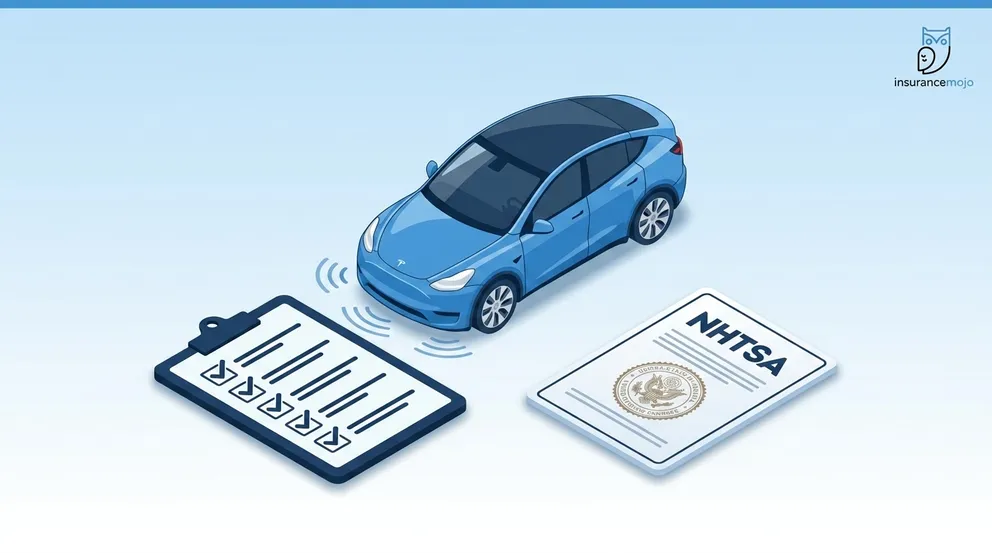
NHTSA expanded its New Car Assessment Program (NCAP) on May 7, 2026 to include eight pass/fail Advanced Driver Assistance System tests, and the 2026 Tesla Model Y is the first vehicle to clear all of them. The federal label gives auto insurers their first uniform benchmark for the crash-avoidance technology that HLDI data shows can cut property-damage claims by 39%.
The U.S. Department of Transportation announced Wednesday that 2026 Tesla Model Y vehicles built on or after November 12, 2025 met every threshold under NHTSA's expanded ADAS test framework. The pass/fail label is the first federal benchmark for crash-avoidance tech, and it lands inside an insurance market where major carriers already discount these features 5% to 15% based on their own claim data.
- Eight ADAS features now have a federal pass/fail benchmark under NCAP, replacing the previous spec-sheet check
- Only 2026 Model Y vehicles built on or after November 12, 2025 carry the new label
- HLDI March 2026 data shows comprehensive ADAS bundles cut property-damage claims 39% and bodily-injury claims 21%
- Forward collision warning plus automatic emergency braking already earn 10% to 15% off new-vehicle policies at most major carriers
- Telematics programs can stack a 10% to 40% behavioral discount on top of the safety-feature credit
The Eight Tests and What Changed
NCAP added four ADAS evaluations under its 2024 final decision notice, then graded them on a pass/fail basis instead of the old "feature present" check. The 2026 Tesla Model Y cleared every threshold across both the new and previously required tests.
The four newly added tests cover pedestrian automatic emergency braking, lane keeping assistance, blind spot warning, and blind spot intervention. NCAP also retained four original ADAS criteria, which test forward collision warning, crash imminent braking, dynamic brake support, and lane departure warning. Each evaluation measures actual stopping distance, lane-correction performance, and warning timing in repeatable test conditions, not just the presence of an icon on the dashboard.
"Today's announcement marks a significant step forward in our efforts to provide consumers with the most comprehensive safety ratings ever. By successfully passing these new tests, the 2026 Tesla Model Y demonstrates the lifesaving potential of driver assistance technologies and sets a high bar for the industry." - Jonathan Morrison, NHTSA Administrator
The new framework grew out of NCAP's 10-year roadmap, which NHTSA finalized in November 2024 and published in the Federal Register on December 3, 2024. That roadmap covers three program tracks (crashworthiness, crash avoidance, and vulnerable-road-user safety) through 2033, with refreshes scheduled every four years.
What This Means for Your Insurance Rate
The pass/fail framework matters for premiums because insurers price ADAS through claim-data feedback rather than marketing claims. HLDI's March 2026 Mazda study found the most comprehensive crash-avoidance bundle cut property-damage claims 39% and bodily-injury claims 21% across 2018-2024 model years. A basic two-feature package containing only forward collision warning plus automatic emergency braking still reduced property-damage liability claims 13% and bodily-injury liability claims 9%, according to the same HLDI analysis.
A federal pass/fail label lets carriers stop guessing which factory ADAS bundles deliver those reductions in the real world. Bankrate's 2026 carrier survey shows forward collision warning and AEB earn 10% to 15% off new-vehicle policies at most major insurers, while broader safety-feature discounts cluster between 5% and 10%. Insurers that currently apply a flat "advanced safety package" credit now have data to tier discounts to NCAP-pass status, which rewards drivers whose specific trim and build week passed all eight tests rather than every nameplate variant.
Our deep dive into how HLDI claim data shapes carrier discounts walks through the methodology in more detail, including the 28% rear-AEB claim reduction that triggered the original wave of state filings.
HLDI Claim Data by ADAS Bundle
| ADAS Bundle | Property Damage Claims | Bodily Injury Claims | Coverage Type Affected |
|---|---|---|---|
| Comprehensive (6+ features) | -39% | -21% | PDL, BIL |
| Basic (FCW + AEB) | -13% | -9% | PDL, BIL |
| Rear AEB only | -28% | Not statistically significant | PDL |
Source: Highway Loss Data Institute, March 2026 Mazda crash-avoidance bundle study, covering 2018-2024 model years across non-fleet personal-use claims. Bodily injury reduction in the comprehensive bundle was directionally positive but not statistically significant per HLDI's confidence-interval analysis.
Why a Federal Label Matters for Underwriters
Insurance underwriters have asked for a federal ADAS benchmark since at least 2020, when HLDI first documented wide claim-frequency variation across nameplates carrying identical "spec-sheet" features. Two cars with the same "blind spot monitor" listing could behave very differently on the road, which pushed claim frequencies in opposite directions despite matching feature lists. Production-week differences add another layer of complexity, since only post-November 12, 2025 Model Y builds carry the new federal label even though Tesla has sold the same nameplate for years.
ADAS also creates a frequency-versus-severity trade-off that the federal label helps insurers price cleanly. Crash-avoidance tech eliminates lower-speed, lower-cost claims and shifts the average severity upward on the crashes that still happen, because radar arrays, lidar units, and bumper-mounted camera modules cost thousands to replace. CCC Intelligent Solutions has tracked steady increases in ADAS-equipped repair invoices since 2020, with average parts costs rising every quarter. A pass/fail standard lets carriers grant the larger frequency discount to NCAP-pass vehicles while pricing the severity bump into base rates instead of penalizing the most capable safety packages.
NHTSA's pass/fail label applies only to 2026 Model Y vehicles manufactured on or after November 12, 2025. A 2026 Model Y rolling off the line on November 5, 2025 carries the prior NCAP rating, not the new label. Check the door-jamb manufacturing date sticker before assuming your car qualifies for any new carrier discount tied to NCAP-pass status.
What to Do Now as a Policyholder
Verify Your Trim's NCAP Status
Search "[your make/model] NCAP rating" at nhtsa.gov/ratings and confirm your build date matches the production window required for the new label. The Model Y example proves that two cars with the same model year can carry different ratings.
Request a Safety-Feature Discount Review
Call your carrier and ask for an explicit review of the ADAS discount on your policy. Most insurers do not auto-apply the credit on a vehicle you have owned for years, so policyholders who never asked are paying 5% to 15% above what they could.
Stack ADAS With Telematics
Enrolling in a usage-based program like SmartRide, Drive Safe and Save, or Snapshot can layer a 10% to 40% behavioral discount on top of the safety-feature credit. Progressive Snapshot raises rates for roughly 20% of enrollees who score poorly, while State Farm, Nationwide, USAA, Farmers, and American Family operate discount-only programs that cannot increase your rate.
Compare Three Quotes Before Renewal
Carriers update their rating plans on different timelines, so an NCAP-pass vehicle priced fairly at one company may cost 12% more at another. Get quotes from at least three carriers and reference the federal pass/fail status when you ask about safety-feature credits. Drivers in Florida and other rate-relief states have additional leverage during the current pricing cycle.
How Much Can the Stacked Discount Save
The math depends on your starting premium and your carrier mix, but the order-of-magnitude is significant. A driver paying the U.S. average full-coverage premium of about $2,150 in 2026 who claims a 10% safety-feature credit captures $215 in annual savings. Adding a 30% telematics discount on the remaining premium adds another $580 in savings, for a combined annual reduction near $795. Drivers in high-cost states like Nevada (where rates average $2,957) see proportionally larger dollar savings, even at the same percentage discounts.
Comprehensive coverage rates do not benefit much from the new label because ADAS does not prevent theft, hail, falling-tree, or animal-strike claims. Liability premiums show the largest reduction, because that is where HLDI documents the 21% bodily-injury claim drop and 39% property-damage drop.
Looking Ahead: The Next NCAP Wave
NCAP's published roadmap lists car-to-motorcycle automatic emergency braking as a candidate for inclusion in the 2028 model year, modeled on similar Euro NCAP tests already in use. The roadmap also flags potential future requirements for driver-monitoring systems, intersection AEB, and impaired-driver detection through 2033. Each new test addition resets the discount math because carriers will need updated HLDI claim data to price the next generation of features.
Other manufacturers have indicated they will submit 2026 vehicles for testing in the coming months, but the Tesla Model Y holds the unique position as the only vehicle currently on sale with a federal pass/fail certification across all eight active ADAS tests. Drivers shopping for a 2026 vehicle who want to lock in the maximum carrier discount today have one option, while drivers waiting for non-Tesla alternatives should check nhtsa.gov/ratings every few weeks for new pass/fail labels.
Frequently Asked Questions
No. NHTSA limits the new pass/fail label to 2026 Model Y vehicles built on or after November 12, 2025. Older Model Ys carry the prior-generation NCAP scores, and most insurers will continue applying the existing ADAS-equipment discount tier to those vehicles, which still ranges from 5% to 15% depending on the carrier and state.
Not immediately. Carriers update rating plans through state-level filings, and each state insurance department reviews them on its own timeline. Some carriers act within 60 to 90 days while others wait a year or more for additional claim data. Ask your insurer directly whether they have filed an updated ADAS rating factor that references NCAP-pass status.
Stacking a 5% to 15% safety-feature discount with a 10% to 40% telematics discount can reduce a $1,800 annual premium by roughly $270 to $990, depending on the carrier and your driving record. State Farm Drive Safe and Save caps at 30%, Nationwide SmartRide tops out at 40% with a 15% sign-up credit, and Progressive Snapshot offers a 10% sign-up discount with up to 30% additional after the policy term completes.
Several major manufacturers have stated publicly that they will submit vehicles for testing in the coming months, but NHTSA does not publish a backlog list. Consumers should check nhtsa.gov/ratings every two to four weeks for new pass/fail labels. Vehicles already earning IIHS Top Safety Pick Plus designations are the most likely candidates to clear the NCAP framework first.
No. HLDI claim data shows ADAS primarily reduces property-damage liability and bodily-injury liability claim frequency, so liability premium discounts see the biggest gains. Comprehensive coverage (theft, vandalism, weather damage, animal strikes) is not meaningfully affected by ADAS performance, so those premium components stay roughly flat after the discount.
- NHTSA Press Release - Tesla Model Y First to Pass New ADAS Tests (May 7, 2026)
- NHTSA NCAP 10-Year Roadmap (November 2024)
- Federal Register - NCAP Final Decision Notice on ADAS (December 3, 2024)
- HLDI Mazda Crash-Avoidance Bundle Study (March 2026)
- Bankrate - Safety-Feature Discount Guide for Auto Insurance
- State Farm Drive Safe and Save Program
- Nationwide SmartRide Program Details
- Progressive Snapshot Program Details