

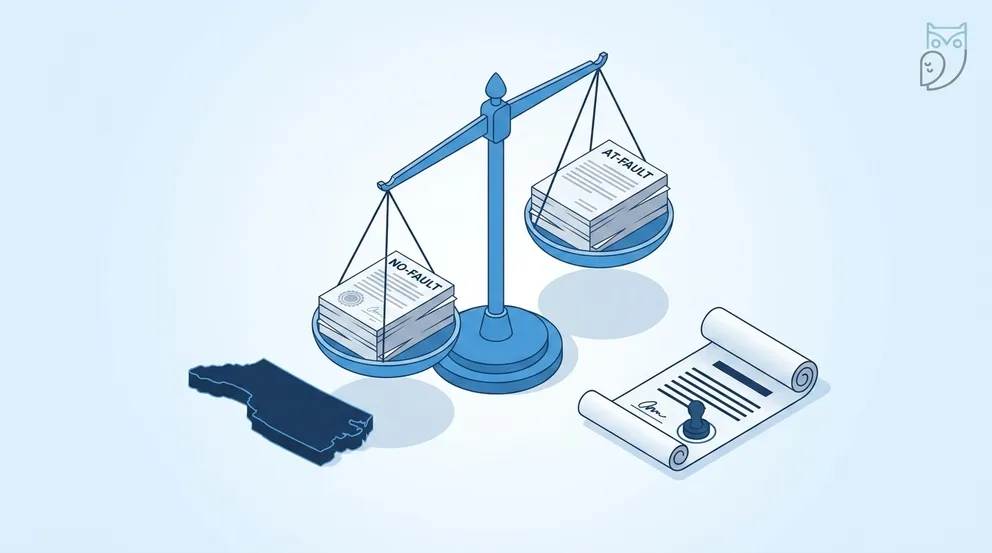
Twelve states use a no-fault system that requires drivers to file injury claims with their own insurer through Personal Injury Protection (PIP), regardless of who caused the crash, according to the Insurance Information Institute. The remaining 38 states plus the District of Columbia follow a traditional at-fault (tort) model where the driver who caused the accident is financially responsible for the other party's medical bills, lost wages, and vehicle damage.
- 12 states are true no-fault: Florida, Hawaii, Kansas, Kentucky, Massachusetts, Michigan, Minnesota, New Jersey, New York, North Dakota, Pennsylvania, and Utah (Insurance Information Institute, 2026).
- PIP minimum requirements range from $3,000 per person in Utah to unlimited lifetime medical benefits in Michigan.
- Five states (Florida, Michigan, New Jersey, New York, Pennsylvania) use a verbal threshold to limit lawsuits; seven other no-fault states use a monetary threshold.
- Three states (Kentucky, New Jersey, Pennsylvania) offer "choice no-fault," letting drivers opt out of the no-fault system at policy purchase.
- In an at-fault state, the at-fault driver's liability insurance pays your medical bills and pain and suffering directly; in a no-fault state, you file with your own insurer first.
If you're shopping for coverage and trying to figure out why a Florida policy looks nothing like a Texas policy, the answer comes down to which fault system your state runs. The rules, the required coverages, and the way claims pay out differ enough to change your premium by hundreds of dollars and your settlement by tens of thousands. Our complete state-by-state requirements guide covers minimums for all 50 states; this article zeroes in on the no-fault vs at-fault split and shows what happens in a real crash under each system.
The 12 No-Fault States and Their PIP Minimums
The Insurance Information Institute counts 12 states plus Puerto Rico as true no-fault jurisdictions. Each one mandates Personal Injury Protection and places some restriction on the right to sue. PIP minimums swing from $3,000 in Utah to unlimited lifetime medical in Michigan, which is why a Detroit policy can cost three times what a Salt Lake City policy costs for identical liability limits.
| State | Minimum PIP Coverage | Threshold Type | Effective Since |
|---|---|---|---|
| Florida | $10,000 | Verbal | 1972 |
| Hawaii | $10,000 | Monetary | 1974 |
| Kansas | $4,500 (medical) + wage loss | Monetary | 1974 |
| Kentucky | $10,000 (choice) | Monetary | 1975 |
| Massachusetts | $8,000 | Monetary | 1971 |
| Michigan | $250K, $500K, or unlimited (driver's choice) | Verbal | 1973 |
| Minnesota | $40,000 ($20K medical + $20K wage loss) | Monetary | 1975 |
| New Jersey | $15,000 (choice) | Verbal | 1973 |
| New York | $50,000 | Verbal | 1974 |
| North Dakota | $30,000 | Monetary | 1976 |
| Pennsylvania | $5,000 (choice) | Verbal | 1990 |
| Utah | $3,000 | Monetary | 1974 |
Source: Insurance Information Institute, 2026; state DOI minimum coverage filings. PIP minimums shown are statutory minimums; drivers can purchase higher limits in every state.
The 38 at-fault states cover the rest of the country: Alabama, Alaska, Arizona, Arkansas, California, Colorado, Connecticut, Delaware, Georgia, Idaho, Illinois, Indiana, Iowa, Louisiana, Maine, Maryland, Mississippi, Missouri, Montana, Nebraska, Nevada, New Hampshire, New Mexico, North Carolina, Ohio, Oklahoma, Oregon, Rhode Island, South Carolina, South Dakota, Tennessee, Texas, Vermont, Virginia, Washington, West Virginia, Wisconsin, and Wyoming. None of these states require PIP, although six (Arkansas, Delaware, Maryland, New Hampshire, Oregon, Texas, Virginia, Washington, South Dakota) offer or mandate PIP-style add-on coverage. The District of Columbia operates a hybrid that lets drivers elect no-fault benefits within 60 days of an accident.
Same Crash, Different Outcome: A Texas vs Florida Comparison
Picture a 35 mph rear-end collision on a wet morning commute. The other driver runs a red light and slams into your sedan. You suffer whiplash and a fractured wrist that requires surgery. Your medical bills total $18,000. Repairs run $7,500. You miss two weeks of work and lose $2,400 in wages. The other driver carries the state minimum policy and admits fault at the scene.
You file a third-party claim against the at-fault driver's bodily injury liability and property damage coverage. Texas minimums are 30/60/25 ($30K per person, $60K per accident, $25K property). Their insurer covers your full $18,000 in medical bills, the $7,500 in repairs, the $2,400 in lost wages, and a pain and suffering settlement that often runs 1.5 to 3 times medical costs. Total potential recovery: $50,000 or more, paid by the other driver's carrier.
You file your own PIP claim first. Florida PIP pays 80% of medical bills up to $10,000 and 60% of lost wages from the same pool. PIP covers $10,000 of your $18,000 in medical bills and roughly $1,440 of lost wages, leaving you with $9,440 in unreimbursed medical and zero pain and suffering compensation. You can sue the at-fault driver only if your injuries clear Florida's verbal threshold under Fla. Stat. § 627.737, which requires permanent injury, significant scarring, or death. A surgical wrist repair may or may not qualify; the answer depends on permanent impairment ratings months down the road.
Same crash, same negligent driver, but the recovery gap runs roughly $40,000 between the two states. In Texas, the entire bill lands on the at-fault carrier. The Florida injured party absorbs $9,440 in unpaid medical and walks away from any pain and suffering claim unless the injury later qualifies as permanent under Fla. Stat. § 627.737.
How No-Fault Claims Actually Work
In a no-fault state, every driver is required to carry Personal Injury Protection on their own policy. After a crash, each driver files a PIP claim with their own insurer for medical bills, lost wages, and certain out-of-pocket expenses, regardless of who caused the accident. The system was built in the 1970s to take small claims out of the courts, speed up payouts, and reduce litigation costs, per the III's policy history.
PIP typically covers four buckets of expenses: medical and hospital costs, a percentage of lost wages, replacement services (housekeeping, child care) when an injured person can't perform them, and funeral or death benefits. Each state caps these benefits differently. Michigan's unlimited PIP can pay seven figures over a lifetime for a catastrophic spinal injury; Utah's $3,000 cap might cover a single ambulance ride. Property damage from a no-fault state crash is handled separately through collision coverage on your own policy or property damage liability from the other driver.
The right to sue is restricted in every true no-fault state, which is the trade for guaranteed first-party benefits. To file a bodily injury lawsuit, your case has to clear the state's threshold. Read our PIP coverage guide for a deeper breakdown of what PIP pays and where it falls short.
How At-Fault (Tort) Claims Work in 38 States
At-fault states stick with the traditional tort system. The driver who caused the accident is legally liable for the other party's damages, and that driver's liability insurance pays the bill. Every at-fault state requires bodily injury liability and property damage liability at minimum, with limits ranging from 25/50/25 in California to 50/100/25 in Maine. The injured party files a third-party claim against the at-fault driver's carrier, negotiates a settlement, and recovers medical costs, lost wages, vehicle damage, and pain and suffering damages with no statutory threshold to clear.
The trade-off is speed. A typical Texas or Ohio bodily injury settlement takes 4 to 12 months from filing to payout, sometimes longer if liability is contested. Pennsylvania choice-tort drivers see similar timelines under their full tort election. The other catch is uninsured drivers. About 14% of US drivers are uninsured according to III estimates, and an at-fault hit-and-run leaves you relying on your own uninsured motorist coverage to recover anything at all.
Verbal vs Monetary Thresholds: Why It Matters
The threshold rule decides when a no-fault driver can sue for pain and suffering. Five states use a verbal (descriptive) threshold; seven use a monetary threshold. Verbal thresholds are tougher to clear because they require statutorily defined serious injuries; monetary thresholds simply require medical bills above a dollar amount.
| Threshold Type | States | What It Takes to Sue |
|---|---|---|
| Verbal (Descriptive) | Florida, Michigan, New Jersey, New York, Pennsylvania | Death, significant disfigurement, permanent injury, significant impairment of body function, or fracture (varies by state statute) |
| Monetary | Hawaii, Kansas, Kentucky, Massachusetts, Minnesota, North Dakota, Utah | Medical bills exceeding the state-defined dollar amount (Massachusetts: $2,000; Minnesota: $4,000; Utah: $3,000) |
Source: Insurance Information Institute, "Background on No-Fault Auto Insurance," 2026 update.
Insurers prefer verbal thresholds because they cut down on fraudulent claims inflated to clear a dollar target. Monetary thresholds create what III analysts call a "dollar target" problem: in lower-threshold states, dishonest providers run up bills to push minor injury claims past the line. Connecticut and Colorado repealed their no-fault laws in part because their thresholds (Connecticut at $400, Colorado at minimal levels) were too easy to game.
Florida and Michigan: The Two Outlier No-Fault States
Florida and Michigan get the most attention in any no-fault discussion because they sit at opposite ends of the coverage spectrum. Florida runs the leanest no-fault system in the country with a $10,000 PIP cap that hasn't moved since the law passed in 1972. Michigan runs the most generous, with optional unlimited lifetime medical that produces some of the highest auto insurance premiums in the United States.
Florida's $10,000 PIP cap is famously inadequate for any serious crash. A single emergency room visit with imaging and an overnight observation can exceed $10,000 before any surgical intervention. The state also doesn't require bodily injury liability for most drivers, which means a Florida driver can legally carry just $10K PIP and $10K property damage and nothing else. State legislators introduced HB 1181 and SB 1256 in the 2025 session to repeal Florida's no-fault statute and shift to a 25/50 bodily injury liability requirement, but Governor DeSantis publicly opposes the change and the bills stalled. Florida remains a no-fault state through 2026 with the existing $10K PIP framework intact. Drivers in the state should review our Florida car insurance guide for the current rules.
Michigan went the opposite direction. A 2019 reform let drivers pick a PIP tier ($50K for Medicaid enrollees, $250K, $500K, or unlimited) instead of mandating unlimited coverage for everyone. The reform cut premiums for drivers who downgraded but introduced a new pitfall: a catastrophic spinal cord injury with $4 million in lifetime care costs blows through the $250K tier in the first year. Drivers who chose the cheaper tiers to save money are sometimes left with bills they can't pay. Our Michigan car insurance breakdown covers the tier choice in detail.
New York rounds out the high-PIP no-fault states with a $50,000 PIP requirement, the second-highest mandatory minimum after Michigan's tiered system. New York's verbal threshold is one of the strictest in the country, which is why most fender-bender claims in the state never reach a courtroom. See our New York car insurance overview for the full minimums.
What Coverage You Actually Need by State Type
The fault system in your state changes which coverages matter most. In an at-fault state, your liability limits do the heavy lifting because they protect you from getting sued; in a no-fault state, your PIP and uninsured motorist limits matter more because that's where your own injuries get paid.
- Buy more PIP than the state minimum if you can afford it; the $5K to $10K floor in most states won't cover a hospital stay.
- Add MedPay or higher PIP if you have weak health insurance, since PIP fills the gap for deductibles and copays.
- Consider higher uninsured motorist limits because the other driver's liability rarely comes into play in no-fault claims.
- Florida and Michigan drivers should look hard at upgrading to optional bodily injury liability, since the state minimums leave huge gaps.
- Push bodily injury liability above the state minimum; 100/300 protects assets far better than 25/50.
- Carry uninsured and underinsured motorist coverage at limits that match your liability, since 14% of drivers nationwide are uninsured.
- Consider MedPay (~$5K) for immediate medical bill coverage that doesn't require fault determination.
- Higher property damage liability matters because new vehicle replacement costs averaged $48,000 in 2025 per Kelley Blue Book.
Whichever state you live in, the state minimum is rarely enough coverage. The minimum was set decades ago in most states and doesn't keep pace with current medical costs or vehicle prices. A 100/300/100 policy with strong UM/UIM and adequate PIP usually costs $30 to $60 more per month than the bare state minimum and makes the difference between a covered claim and a financial disaster.
Frequently Asked Questions
Twelve states operate true no-fault auto insurance systems: Florida, Hawaii, Kansas, Kentucky, Massachusetts, Michigan, Minnesota, New Jersey, New York, North Dakota, Pennsylvania, and Utah, according to the Insurance Information Institute. Three of those (Kentucky, New Jersey, Pennsylvania) are "choice no-fault" states where drivers can opt out at policy purchase.
PIP is not required in any of the 38 at-fault states, but eight states (Arkansas, Delaware, Maryland, New Hampshire, Oregon, South Dakota, Texas, Virginia, Washington) offer it as an optional add-on. In most at-fault states, MedPay serves a similar role with limits of $1,000 to $10,000 and pays medical expenses regardless of fault.
Yes, but only if your injuries clear your state's threshold. In verbal threshold states (Florida, Michigan, New Jersey, New York, Pennsylvania), you need a permanent injury, significant disfigurement, or death. In monetary threshold states (Hawaii, Kansas, Kentucky, Massachusetts, Minnesota, North Dakota, Utah), you need medical bills above the statutory dollar amount, ranging from $2,000 in Massachusetts to $4,000 in Minnesota.
No. No-fault states tend to cost more on average because mandatory PIP coverage adds to the premium and fraud rings inflate claim costs in states with generous benefits. Michigan, Florida, New York, and New Jersey consistently rank among the 10 most expensive states for car insurance, per NAIC and Bankrate analyses. Utah, with its $3,000 PIP minimum, is the exception and runs cheaper than the national average.
- Insurance Information Institute: Background on No-Fault Auto Insurance
- Insurance Information Institute: Compulsory Auto and Uninsured Motorist Laws by State
- Experian: Minimum Car Insurance Requirements by State 2026
- Michigan Department of Insurance and Financial Services: PIP Choice Levels Explained
- Florida Senate: HB 1181 (2025) PIP Repeal Bill Analysis
- Kiplinger: States With No-Fault Car Insurance Laws
- Insurify: No-Fault Insurance: What You Need to Know (2026)