
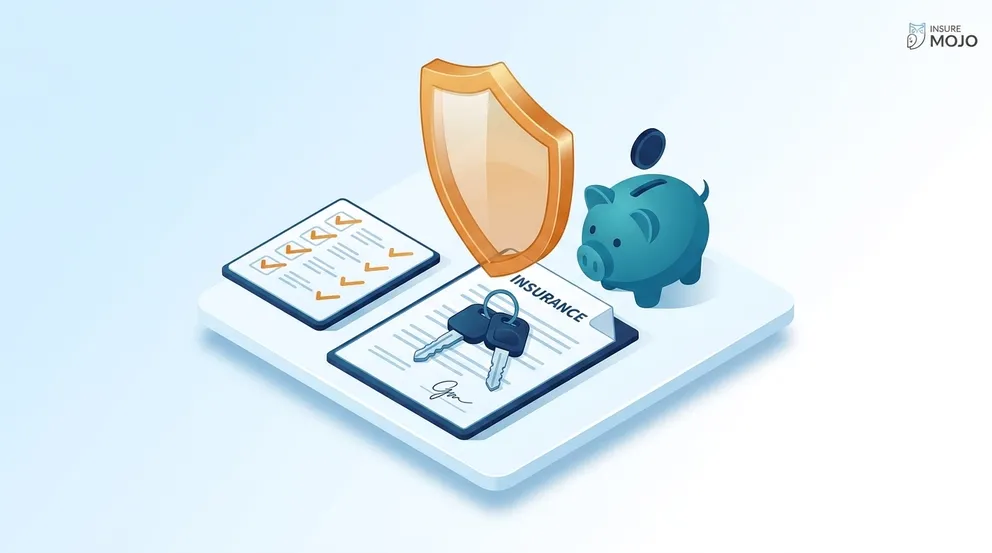
Non-owner car insurance is liability-only coverage for drivers who don't own a vehicle but regularly drive cars they don't own. The average policy costs $407 a year according to Insure.com 2026 rate data, and the most common reason people buy it is to satisfy an SR-22 filing after a DUI or license suspension.
If you're trying to figure out which type of policy fits your situation, our pillar guide on car insurance by driver type breaks down the rules for renters, gig workers, teens, and high-risk drivers in one place. This article zeroes in on non-owner coverage, the policy that most insurance shoppers Google after a DUI conviction lands them with an SR-22 mandate but no car to insure.
- Non-owner policies cost $200 to $750 per year, roughly 30-50% less than a standard liability policy on a vehicle, per MoneyGeek 2026 data.
- The SR-22 use case drives most non-owner sales: GEICO charges $350 for a non-owner policy with an SR-22 filing, $828 if a DUI is on record.
- You generally cannot buy a non-owner policy if you live with someone who owns a car, since insurers consider household vehicles already covered.
- Coverage includes only bodily injury and property damage liability for the other party. Damage to the borrowed car, your medical bills, and rental coverage are excluded.
What Is Non-Owner Car Insurance?
A non-owner policy is a stripped-down liability contract sold to people without a registered vehicle in their name. It pays for injuries and property damage you cause while driving a car borrowed from a friend, rented from Hertz, or shared via Turo, but only after the vehicle owner's primary policy maxes out. Insurance.com calls it "secondary coverage" for that reason: the car owner's insurance pays first, your non-owner policy fills the gap.
State minimum limits apply by default. Bodily injury coverage typically runs $25,000 per person and $50,000 per accident, with property damage at $10,000 to $25,000, according to MoneyGeek's 2026 buyer guide. Carriers will sell you higher limits, and most SR-22 filings require at least $50,000/$100,000/$25,000 (50/100/25) to satisfy state financial-responsibility rules.
Non-owner insurance is liability-only. There is no collision, no comprehensive, no coverage for the car you're driving, and no medical payments unless you specifically add it. If you crash a friend's car, the friend's policy pays for the friend's car, not yours.
Who Actually Needs Non-Owner Coverage?
Roughly 12.6% of U.S. drivers are uninsured according to the Insurance Research Council's most recent estimate, and a chunk of that group are non-owners who'd qualify for cheap coverage they don't realize exists. Five buyer profiles drive nearly all non-owner sales.
Drivers Who Need an SR-22 or FR-44 Without a Car
This is the single largest non-owner segment. After a DUI, reckless-driving conviction, or license suspension, your state DMV requires an SR-22 filing from a licensed insurer to reinstate driving privileges. If you sold the car or never owned one, a non-owner policy with the SR-22 endorsement satisfies the requirement at the lowest possible cost. Florida and Virginia use the FR-44 form instead, which mandates 100/300/50 coverage limits at roughly double the SR-22 premium.
Frequent Renters and Car-Share Users
Renting a car twice a month at $30/day for the rental company's collision damage waiver adds up to $720 a year, and that CDW only covers the car, not your liability to other drivers. A non-owner policy at $407/year per Insure.com averages provides the liability piece, and many car-share services like Zipcar require members to have personal liability coverage.
People Temporarily Between Cars
Letting your previous policy lapse for 30+ days flags you as a high-risk applicant when you next buy insurance, often raising your rate 8% to 25% according to Quadrant Information Services data cited by Bankrate. A non-owner policy at roughly $34/month preserves your continuous-coverage history while you shop for your next vehicle.
Gig Workers Without Company-Provided Coverage
Uber and Lyft drivers using a personal vehicle don't fit the non-owner profile, but couriers who borrow a vehicle from a parent or friend to deliver for DoorDash do. Non-owner coverage is rarely a substitute for true rideshare insurance, which now averages $154/month, but it can fill personal-use gaps when the borrowed car's policy excludes commercial activity.
People Who Regularly Borrow a Specific Car
If you drive your roommate's car three nights a week, the roommate's insurer can deny a claim by arguing you should be listed as a driver. Adding you to that policy raises the premium by an average of 20% to 50% based on driving record. A non-owner policy ducks the rate hike on the owner's main policy and gives you portable liability that follows you to other vehicles too.
What Non-Owner Insurance Covers, and What It Doesn't
- Bodily injury liability up to your selected limits, typically 25/50 minimum.
- Property damage liability for the other vehicle, building, or fence you hit.
- Optional uninsured/underinsured motorist coverage in roughly 35 states.
- Optional medical payments (MedPay) endorsement, usually $1,000 to $5,000.
- SR-22 or FR-44 filing on request, typically a $25 administrative fee.
- Collision damage to the car you're driving, regardless of fault.
- Comprehensive losses (theft, vandalism, hail) on the borrowed vehicle.
- Vehicles you own, lease, or have regular access to, including a roommate's car.
- Business use, including delivery driving and ridesharing in most states.
- Rental car loss-of-use fees charged by the rental company.
The exclusion that surprises most buyers is the household rule. Insurers including GEICO, State Farm, and Progressive will not write a non-owner policy if anyone at your address owns a registered vehicle, even if it's titled to a spouse, parent, or roommate. Their reasoning is that the household vehicle's policy already covers permissive use, and a separate non-owner policy on the same address would create overlapping coverage.
How Much Does Non-Owner Car Insurance Cost?
Insure.com's 2026 rate analysis shows the national average for a non-owner policy at $407 per year for a clean-record driver, while MoneyGeek's larger sample puts the average at $578. The gap reflects different driver profiles: Insure.com benchmarks state-minimum limits, MoneyGeek uses 50/100/50 with uninsured motorist added.
| Insurance Company | Clean Record (Annual) | With SR-22 (Annual) | With 1 DUI (Annual) |
|---|---|---|---|
| USAA Cheapest | $177 | $198 | $367 |
| State Farm | $262 | $360 | $399 |
| GEICO | $333 | $350 | $828 |
| Travelers | $338 | $379 | $528 |
| Progressive | $539 | $595 | $772 |
Source: Insure.com 2026 non-owner SR-22 rate analysis. Rates are national averages for a 40-year-old driver with state-minimum liability limits. USAA is restricted to active military, veterans, and immediate family.
Florida posts the highest non-owner rates in the country at $545 average, climbing to $1,100 with a DUI on record, per Insure.com state data. Iowa is the cheapest at $153 base and $226 post-DUI, a $924 swing that reflects how heavily state regulation and accident frequency influence pricing.
A clean-record non-owner policy from State Farm at $262/year breaks down to roughly $22/month. That's less than half what you'd pay for a minimum-liability policy on a 2015 Honda Civic in most ZIP codes.
Best Companies for Non-Owner Insurance in 2026
Non-owner availability is narrower than standard auto insurance because the policy is unprofitable for many carriers. Five national insurers consistently sell non-owner coverage and file SR-22s in all or most states.
- Files SR-22s in all 50 states with a $25 fee, often same day.
- Online quote and binding without a phone call in most states.
- MoneyGeek score of 86/100 for non-owner buyers.
- Cheapest widely available carrier at $262/year for clean records.
- Bundling with renters insurance saves an average 17%.
- Local agent network helps with FR-44 filings in Florida and Virginia.
- Most flexible underwriting for high-risk and post-DUI applicants.
- Direct online SR-22 filing without an agent visit.
- Available in all 50 states plus Washington, D.C.
Three nonstandard carriers fill the gap when major insurers decline coverage. Dairyland, The General, and SafeAuto specialize in high-risk filings and will write non-owner SR-22 policies after multiple violations or recent DUI convictions. Expect rates 40% to 80% higher than the standard market, but acceptance odds run near 95% for licensed drivers.
Non-Owner SR-22: The Most Common Reason People Need This Coverage
State DMVs filed roughly 1.5 million SR-22 requests in 2024 according to industry estimates compiled by Bankrate, and an estimated 30% to 40% of those filers don't own a vehicle at the time. The math forces them into a non-owner policy: state law requires proof of insurance, but they have no car to insure.
The cost difference between a standard SR-22 policy on a vehicle and a non-owner SR-22 is dramatic. Insurance.com's 2026 data shows the average SR-22 policy on a registered car runs $1,800 to $2,400 a year nationally. A non-owner SR-22 from State Farm at $360 a year delivers the same DMV-required filing for roughly one-fifth the cost.
Buy the non-owner SR-22 policy before you sell your existing vehicle, not after. Insurers can backdate the SR-22 filing to your existing policy effective date, preserving your continuous-coverage credit and avoiding the lapse penalty that adds 8% to 25% to future premiums.
How long you'll need the non-owner SR-22 depends on the offense and the state. Most states require three years of continuous filing for a first DUI, five years for a second, and up to 10 years in California, Florida, and Texas. If your post-DUI insurance situation involves a non-owner policy, switching to a standard policy after you buy a car requires the new insurer to refile the SR-22 without any gap, or your license is suspended again.
How to Get Non-Owner Car Insurance
Confirm you qualify
You need a valid or recently suspended driver's license, no vehicle registered in your name, and no household member with a registered vehicle. Carrier websites typically ask these three questions before quoting.
Decide your coverage limits
State minimums are the cheapest option but rarely enough. Bumping to 50/100/50 adds about $80 a year and brings you above SR-22 thresholds in 47 states. See our breakdown of recommended liability limits before quoting.
Quote at least three carriers
Start with State Farm, GEICO, and Progressive for the standard market. Add Dairyland or The General if you have a recent DUI. Quote the same coverage limits at every carrier so you're comparing identical policies.
Request the SR-22 or FR-44 endorsement at bind
Tell the carrier you need the form filed before paying. The $25 filing fee is one-time, and most carriers electronically transmit the SR-22 to your DMV within 48 hours. Confirm the filing was received by checking your DMV portal before you start driving.
If you let a non-owner SR-22 policy lapse even one day, the carrier is required by state law to file an SR-26 form notifying the DMV. Your license is suspended automatically, and reinstatement requires a new SR-22 plus a fresh suspension fee that runs $75 to $250 depending on state.
When Non-Owner Insurance Doesn't Work
Skip the non-owner policy if you have regular access to a household vehicle, since the existing policy's permissive-use clause already covers you. Skip it if you're a full-time rideshare driver, because Uber and Lyft require commercial-grade rideshare coverage that non-owner policies explicitly exclude. And skip it if you're renting a car for one weekend a year, since the rental counter's daily liability supplement at $12 to $20/day is cheaper than an annual policy you won't otherwise use.
For drivers who own a car part-time or share one, the math is closer. Compare the non-owner premium against adding yourself as an occasional driver on the owner's policy. Standard liability coverage from the vehicle's policy is usually cheaper if you drive less than once a week, while a non-owner policy wins for daily borrowers.
Frequently Asked Questions
The average non-owner policy costs $34 a month based on Insure.com's 2026 national average of $407 per year for a clean-record driver. State Farm runs as low as $22 a month and GEICO around $28. Adding an SR-22 endorsement raises the monthly cost by roughly $8 to $20 depending on carrier and state.
Most major carriers including GEICO, Progressive, and State Farm refuse to write a non-owner policy if anyone at your address owns a registered vehicle, even a spouse or roommate. The exception is if the household vehicle's owner formally excludes you from their policy in writing, which a few states allow. Otherwise you'll need to be added as a listed driver on the household vehicle's policy.
Yes, non-owner insurance covers your liability when you rent a car, satisfying the rental company's requirement that you carry insurance. It does not cover damage to the rental car itself, so you'll still want to either accept the rental company's collision damage waiver or rely on a credit card that includes rental coverage.
- Insurance.com: Non-owner SR-22 insurance rates by state and company (2026)
- MoneyGeek: Cheapest Non-Owner Car Insurance (From $38/Month)
- WalletHub: Non-Owner Car Insurance, 4 Key Things to Know in 2026
- Progressive: Non-Owner SR-22 Insurance Overview
- Bankrate: Non-Owner Car Insurance Cost and Coverage Guide
- Insure.com: How to Get Insurance Without a Car