
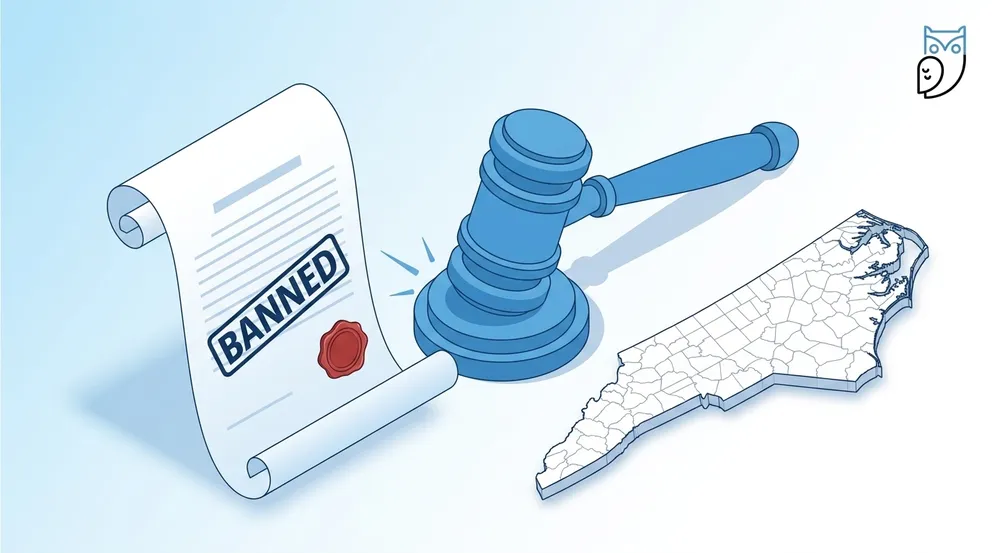
North Carolina became the first state in the nation to outlaw third-party litigation funding on June 22, 2026, when Governor Josh Stein signed House Bill 315 into law. The Prohibit Litigation Investments Act bans outside investors from bankrolling lawsuits for a share of the payout, a practice the insurance industry blames for inflating the liability claims that feed into your auto premium.
North Carolina enacted House Bill 315, the Prohibit Litigation Investments Act, on June 22, 2026, becoming the first U.S. state to broadly ban third-party litigation funding. The law takes effect July 1, 2026, carries civil penalties of up to $50,000 per violation, and anchors a tort-reform push that insurers credit with slowing premium growth. North Carolina drivers face an unusual squeeze right now, with rates up about 5% in 2026 even as national premiums fall roughly 6%.
- House Bill 315 passed 112-0 in the House and 45-1 in the Senate, then took effect July 1, 2026.
- Violators face civil penalties of up to $50,000, enforced by the state attorney general.
- Legal system abuse added an estimated $91.6 billion to $102.3 billion to personal auto liability losses between 2015 and 2024, according to Triple-I and the Casualty Actuarial Society.
- North Carolina rates climbed about 5% in 2026, after the Insurance Commissioner negotiated insurers' requested 22% hike down.
What House Bill 315 Actually Does
The statute makes it "unlawful for a person to engage in litigation investment" or to furnish it "to a party or counsel of record in a civil proceeding," according to the bill text. Lawmakers defined litigation investment as money advanced for the costs of a lawsuit in exchange for a cut tied to the outcome. North Carolina now bars hedge funds, private investors, and foreign-backed financiers from buying a stake in someone else's court case.
A funder who breaks the ban faces civil penalties of up to $50,000 per violation, enforced by the state attorney general, and an injured party can sue to recover damages, court costs, and attorney fees. Courts may also award statutory damages worth triple the full value of the prohibited investment.
House Bill 315 leaves several everyday arrangements untouched. Contingency-fee deals between you and your own lawyer stay legal, your insurer's contractual duty to defend or indemnify you is exempt, and so is funding from a nonprofit legal-aid group or money from an immediate family member for court fees. A standard loan also remains allowed, provided repayment is not tied to how the case turns out.
What the Ban Means for North Carolina Drivers
The practical question for North Carolina motorists is whether House Bill 315 lowers your car insurance bill, and the honest answer is not directly and not right away. The ban targets a single cost driver inside the liability system, so any savings would surface slowly as fewer inflated claims work through the courts.
While the average U.S. car insurance premium is sliding about 6% in 2026, North Carolina rates are rising roughly 5%, putting the state on the wrong side of the national trend. Insurers had filed for a 22% increase, and the state Insurance Commissioner negotiated that figure down before approving the smaller bump. Two state-specific changes fueled the original request: minimum liability limits rose from 30/60/25 to 50/100/50 in 2025, their first update since 1999, while the surcharge window for inexperienced drivers expanded from three years to eight.
What links the courtroom to your renewal notice is something the industry calls legal system abuse, or social inflation. A joint analysis released October 30, 2025 by the Insurance Information Institute (Triple-I) and the Casualty Actuarial Society priced the damage: rising jury awards, litigation financing, and aggressive legal tactics added between $231.6 billion and $281.2 billion to liability insurance losses over the past decade. Personal auto absorbed a heavy share of that total.
| Insurance line | Added losses + defense costs (2015-2024) | Share of losses for the line |
|---|---|---|
| Personal auto liability | $91.6B to $102.3B | 8.7% to 9.7% |
| Other liability (occurrence) | $83.4B to $103.3B | comparable dollar impact |
| All studied lines combined | $231.6B to $281.2B | over the full decade |
Source: Insurance Information Institute (Triple-I) and the Casualty Actuarial Society analysis, released October 30, 2025. Figures estimate the dollars added to losses and defense and cost containment expenses for 2015 through 2024 beyond what economic inflation alone explains.
Claim frequency is actually falling, the analysts found, yet the average cost per claim has outrun the Consumer Price Index. That gap between fewer claims and pricier ones is why a North Carolina renewal can climb about 5% even though your car sits accident-free in the driveway. Curbing third-party funding aims squarely at the top of that curve, the "nuclear verdicts" of $10 million or more that funded litigation can produce.
House Bill 315 does not stop you from hiring a lawyer on contingency, and it does not touch your insurer's duty to defend you or pay a covered loss. It restricts outside investors who bankroll a lawsuit for a financial cut. If you file a car accident claim in North Carolina, your contingency-fee attorney, your own coverage, and a non-contingent personal loan all remain available to you.
The Bigger Picture: A Tort-Reform Wave
Triple-I frames North Carolina, alongside Colorado, as an emerging "blueprint" for attacking the root causes of rising insurance costs rather than the symptoms. Florida set the template with its 2022 and 2023 tort reforms, which preceded a wave of rate cuts and refunds from carriers including State Farm, GEICO, and USAA.
"For too long, dark money has supported the legal system abuse tactics of billboard attorneys, funding an excessive volume of lawsuits through largely undisclosed arrangements," said Sean Kevelighan, CEO of the Insurance Information Institute.
The Perryman Group, an economic analyst, calculated in January 2026 that litigation funding alone costs the average American household about $600 a year, while reform advocates cite a broader "tort tax" near $6,664 per household. Both figures come from groups that favor reform, and plaintiff attorneys contest the methodology, so weigh them as advocacy estimates rather than settled accounting.
Congress is watching too, where federal lawmakers floated the Tackling Predatory Litigation Funding Act, a measure that would tax the profits investors earn from funded lawsuits. Georgia passed its own tort reform in 2025, delivering early auto rate cuts, while other states weigh disclosure rules that stop short of an outright ban.
The Case Against the Ban
Trial lawyers and several access-to-justice advocates warn that a complete ban can lock ordinary people out of expensive cases. Picture a defect that harms hundreds of workers, where no single claim is large enough to interest a contingency-fee firm, yet a class action could recover millions and demands $150,000 in upfront costs. Under House Bill 315, no investor can legally fund that fight.
Funders argue they level the field against deep-pocketed insurers and corporate defense teams. The litigation-finance industry, a multibillion-dollar business, also points out that HB 315 took an unusual route, beginning the session as a gift-card-theft bill before lawmakers rewrote it into a funding ban. Supporters counter that the 112-0 and 45-1 votes signal rare bipartisan agreement on the policy.
What North Carolina Drivers Should Do Now
Compare Quotes From at Least Three Carriers
With North Carolina rates up about 5%, shop your premium well before the renewal date. Pull quotes from a minimum of three insurers, because the same driver profile can swing several hundred dollars between companies.
Check Your Liability Limits Against 50/100/50
Confirm your policy meets the 50/100/50 minimum that took effect in 2025. Carrying only the old 30/60/25 leaves a coverage gap, and stepping up to 100/300/100 often costs less per month than drivers assume.
Keep Uninsured Motorist Coverage in Place
North Carolina is an at-fault state that requires uninsured and underinsured motorist coverage on every auto policy. Review your UM and UIM limits, since that protection pays your medical bills and repairs when an at-fault driver carries too little insurance or none at all.
Ask About Every Available Discount
Request telematics, bundling, and safe-driver discounts at renewal. A young driver now carries the inexperienced-driver surcharge for eight years rather than three, so a usage-based program can offset part of that added cost.
Looking Ahead
Expect a legal challenge. Litigation funders hold deep resources and a direct financial stake, so a constitutional fight over House Bill 315 looks likely before any savings reach drivers. Insurance pricing also moves slowly, which means relief from fewer $10 million verdicts could take two or three renewal cycles to register on a bill.
The larger test is whether other states copy the model. Should North Carolina and Colorado hold up as workable blueprints, legislatures could adopt similar bans in 2027, and federal action on funded litigation would widen the effect nationwide. Until the data lands, judge the law by your own renewal notice rather than the headlines, and compare rates at least once every year.
Frequently Asked Questions
It is an arrangement where an outside investor, such as a hedge fund, pays the costs of someone's lawsuit in exchange for a share of any settlement or verdict. North Carolina's House Bill 315 bans the practice starting July 1, 2026, making the state the first to outlaw it outright.
Not directly or immediately. Insurers argue that curbing funded lawsuits will slow the growth of liability claims, which feed into premiums, but any savings would appear gradually over several renewal cycles. North Carolina rates still rose about 5% in 2026.
Governor Josh Stein signed it on June 22, 2026, and it takes effect July 1, 2026, applying to lawsuits that arise on or after that date. Funders who violate it face civil penalties of up to $50,000 per violation.
No. The law exempts contingency-fee agreements with your own attorney, your insurer's duty to defend you, nonprofit legal aid, family help with court costs, and standard loans whose repayment is not tied to the case outcome.
It does not change how you file or get paid on a car insurance claim. The law restricts outside investors who bankroll lawsuits, not the claims process between you and your insurer.
- North Carolina General Assembly - House Bill 315 / Session Law 2026-14
- Claims Journal - North Carolina Becomes First State to Pass Outright Ban on Litigation Financing
- Insurance Information Institute (Triple-I) - North Carolina Becomes First State to Ban Third-Party Litigation Funding
- Triple-I and Casualty Actuarial Society - Legal System Abuse Drives Liability Losses by More Than $230 Billion (Oct. 30, 2025)
- NC Chamber - North Carolina Becomes First State in the Nation to Ban Third-Party Litigation Investment
- Bloomberg Law - North Carolina Enacts Ban on Third-Party Litigation Investment
- Intelligent Insurer - Third-Party Litigation Funding Costs Each US Household $600 a Year (Perryman Group)
- North Carolina Department of Insurance - Changes to the Rating of Automobile Insurance Policies, Effective July 1, 2025