

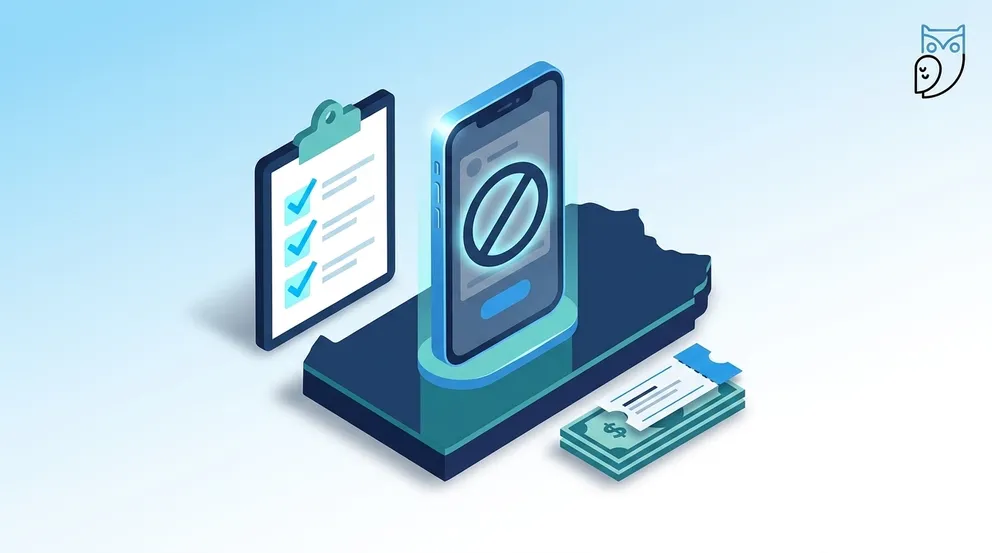
Pennsylvania troopers will start writing $50 tickets for handheld phone use behind the wheel on June 5, 2026, ending a 12-month warning period under Paul Miller's Law. PennDOT and the Pennsylvania State Police announced the enforcement date in an April 2026 statement during National Distracted Driving Awareness Month.
The shift turns a year of verbal corrections into citations that carry court costs, fees, and potential insurance consequences for the state's roughly 9 million licensed drivers who already navigate some of the priciest premiums in the Northeast. Pennsylvania becomes the 30th state to actively ticket handheld device use.
Starting June 5, 2026, Pennsylvania drivers caught holding a cellphone face a $50 fine plus court costs, with totals often exceeding $100. The summary offense adds zero points to a noncommercial driver's record, but auto insurers can still flag the citation as a risk indicator at renewal. Commercial drivers will see the violation logged on their CDL record.
- $50 fine per violation, plus court costs and surcharges that often push the total above $100
- Holding a device remains illegal even at red lights and during traffic backups
- PennDOT counted 9,950 distracted driving crashes in Pennsylvania during 2024, including 49 fatalities
- Nationally, texting violations push premiums up 27% to 32%; Pennsylvania citations alone add no license points but may still trigger insurer scrutiny
- Bluetooth, voice commands, single-touch activation, and integrated GPS stay legal under the statute
What Triggers a Violation
Any handheld contact with a phone, tablet, or similar device qualifies whenever the vehicle is in motion or stopped in traffic. The statute extends to reaching for a device in a way that pulls a driver out of a seated, seat-belted position. Other prohibited actions include scrolling social media, watching video, taking photos, or composing a text or email.
Permitted use includes a single-touch activation for hands-free systems, voice-controlled calling, factory-installed GPS, and Bluetooth audio. Drivers may pull off the road and use a device while parked. Calls to 911 or another emergency service to prevent injury or property damage carry an explicit exemption.
"As the warning period for Paul Miller's Law concludes, troopers will begin issuing citations to drivers using handheld devices behind the wheel," said Pennsylvania State Police Acting Commissioner Lt. Col. George L. Bivens in the PennDOT announcement. He added that even momentary inattention can lead to life-altering consequences.
Pennsylvania Distracted Driving by the Numbers
Driver behavior caused 83% of the roughly 1,100 fatal crashes that occur on Pennsylvania roads in an average year, according to PennDOT. Distracted, impaired, and aggressive driving make up the bulk of that category. Pennsylvania finished 2024 with 1,127 total traffic deaths, the second-lowest figure since record-keeping began in 1928.
The official count almost certainly understates the problem. Drivers rarely admit to scrolling, texting, or video-calling at the moment of impact, which suppresses crash-cause data tracked by police agencies.
The Insurance Question: What a Citation Actually Costs
Pennsylvania classifies a Paul Miller's Law violation as a summary offense. For noncommercial drivers, that means no points on the driver's license and no entry on the official Pennsylvania driving record. Commercial drivers see the citation logged as a non-sanction violation on their CDL record.
That distinction does not guarantee insurance immunity. Carriers can still pull court records during underwriting, and many insurers treat handheld violations as a flag for risky behavior even without points. A driver cited under Paul Miller's Law who later causes an accident faces a much steeper penalty: a moving violation paired with a crash typically triggers a full distracted-driving surcharge.
National data shows what those surcharges look like.
| Violation Type | Avg. Premium Increase | Annual Dollar Cost | How Long It Lasts |
|---|---|---|---|
| Texting while driving (national avg) | 28% | $150 to $900 | 3 to 5 years |
| Distraction-related crash | 49% | $864 | 3 years |
| Texting violation, range across states | 9% to 51% | Varies by state | 3 years |
| PA Paul Miller's Law alone (noncommercial) | 0% (no points) | $50 fine + costs | Citation only |
Source: Insurance.com, AAA Club Alliance, Insurify, and PennDOT statutory guidance. Premium ranges reflect single-violation averages for full-coverage policies on drivers with prior clean records.
Pennsylvania drivers already pay an average of $2,311 a year for full coverage, according to March 2026 data from Experian. Philadelphia residents see the steepest rates in the state at roughly $237 a month, while Pittsburgh drivers pay about $211 a month. A 28% surcharge on a $2,311 policy adds roughly $647 over a year, dwarfing the $50 base fine. For a Philadelphia driver paying about $2,844 a year, the same surcharge runs $796.
How Pennsylvania Stacks Up Against Its Neighbors
New Jersey banned handheld use in 2008 and has enforced it for almost two decades. Ohio strengthened its hands-free statute in 2023 and now treats most violations as primary offenses. New York has prohibited handheld calling since 2001. Pennsylvania was one of the last Northeast holdouts until Governor Josh Shapiro signed Paul Miller's Law in 2024.
Cambridge Mobile Telematics analysis of phone-handling data across states with similar laws found handheld use dropped 9% beyond what texting bans alone achieve once full enforcement kicked in. Colorado documented roughly 600 fewer crashes in the first year of its 2024 hands-free law, a baseline that should preview the kind of impact Pennsylvania can expect after June 5.
What Pennsylvania Drivers Should Do Now
Pair Your Phone Today
Set up Bluetooth or Apple CarPlay/Android Auto with your vehicle so calls route through speakers and the dashboard screen. Single-touch activation remains legal under the statute.
Mount the Device, Don't Hold It
A vent or dash mount keeps navigation and music apps visible without occupying a hand. Mounted devices comply with the law as long as you operate them with one touch or voice command.
Activate Driving Mode
iPhone Focus and Android Driving Mode silence notifications and auto-reply to texts. Both features turn on automatically when the phone connects to car Bluetooth.
Enroll in a Telematics Discount
Programs like Progressive Snapshot, State Farm Drive Safe and Save, and Allstate Drivewise reward documented hands-free behavior with savings of 10% to 30%. The data trail also helps demonstrate safer habits if a future renewal review puts your premium under scrutiny.
Shop Quotes Before Renewal
Carriers vary widely in how they treat hands-free violations during underwriting. Compare three to four quotes annually and ask each insurer specifically how Pennsylvania summary-offense citations factor into your rate.
"Nearly 15 years ago, two Dunmore state troopers knocked on my door to tell me that my son was killed. My son did everything right. He was killed by someone else's unsafe choices behind the wheel," said Eileen Miller, mother of Paul Miller Jr., the law's namesake
Looking Ahead
State police plan to fold Paul Miller's Law citations into existing distracted driving enforcement waves through the summer travel season. Insurance industry observers expect Pennsylvania carriers to update underwriting guidance over the next 12 to 18 months as citation data accumulates. PennDOT will release first-year enforcement statistics in mid-2027, the data point most likely to drive any further legislative tweaks.
Drivers cited during the warning year (June 5, 2025 through June 4, 2026) keep their warning status. Anyone pulled over starting June 5, 2026 faces the citation, the fine, and the longer-tail consequences if a crash follows.
Frequently Asked Questions
Citations under Paul Miller's Law begin June 5, 2026. The 12-month warning period that started June 5, 2025 ends that day. Each violation carries a $50 fine plus court costs and surcharges, with totals often topping $100.
The summary offense adds no points to a noncommercial driver's license and is not recorded on the official Pennsylvania driving record. However, insurance companies can still see citations through court records, and many treat handheld violations as a risk indicator. If a crash or moving violation accompanies the cellphone use, expect a much larger surcharge, often 27% to 32% nationally.
Yes, as long as the device is mounted or integrated into the vehicle and you only need a single touch to operate it. Bluetooth audio, factory navigation, and voice-activated calling all stay legal. Holding a phone in your hand to check directions or change a song is the violation.
Yes. Paul Miller's Law explicitly covers temporary stops in traffic, at red lights, or in any other delay. Only pulling off the highway and parking in a safe location creates an exemption to use the device.
Commercial drivers see the citation logged on their CDL record as a non-sanction violation, while noncommercial drivers do not. That entry can affect employment, insurance through commercial carriers, and federal compliance for interstate trucking operations. The $50 base fine applies to both groups.
- PennDOT - Shapiro Administration Reminds Drivers to Put the Phone Away or Pay a Fine
- PennDOT - Distracted Driving Resources and Paul Miller's Law Overview
- PennDOT - 2024 Traffic Fatalities in Pennsylvania Second Lowest on Record
- National Law Review - How the New Pennsylvania Distracted Driving Law Affects Drivers
- Margolis Edelstein - Hands-Free Law Goes Into Effect in Pennsylvania on June 5, 2025
- Insurify - Distracted Driving Statistics and Insurance Impact
- Experian - Average Cost of Car Insurance in Pennsylvania for 2026
- Insurance.com - Does Distracted Driving Increase Insurance?