

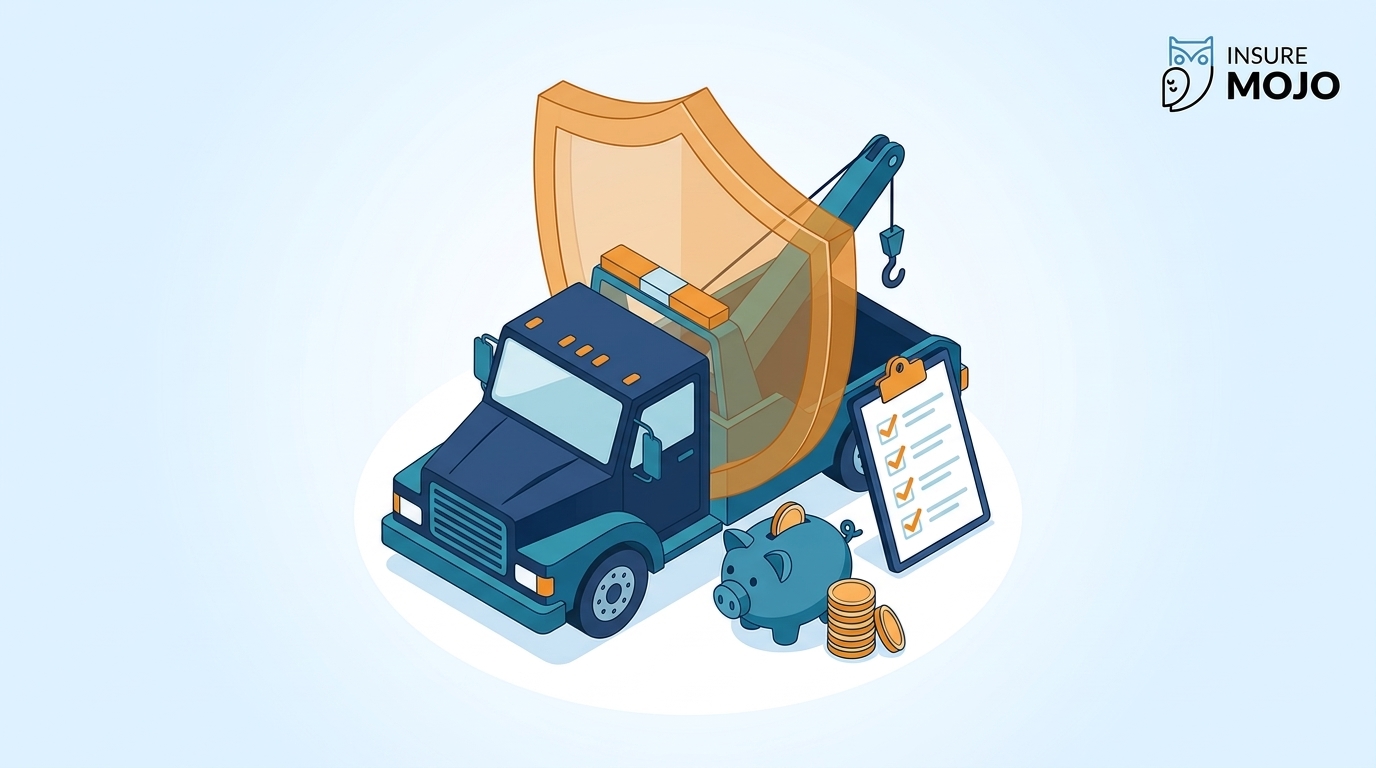
Recovery truck insurance typically costs between $4,000 and $15,000+ per truck per year, depending on your operation type, truck class, and location. Light-duty operators pay around $350-$750/month, while heavy-duty recovery outfits can expect $1,200-$2,500/month. You'll need commercial auto liability at a minimum, but most operators also carry on-hook coverage, garagekeepers liability, and physical damage insurance to stay fully protected.
- Average single-truck premiums run $450-$620/month ($5,400-$7,440 annually) for standard operations
- Heavy-duty recovery and repossession work costs significantly more to insure than basic roadside assistance
- Most states require at least $300,000 in liability coverage, while interstate operators need $750,000
- On-hook and garagekeepers coverage protect the vehicles you're towing and storing -- not just your truck
- Smart safety programs, dash cams, and driver screening can cut premiums by 10-25%
What Is Recovery Truck Insurance?
Recovery truck insurance is a specialized form of commercial auto insurance designed specifically for towing and vehicle recovery operations. Here's what most people don't realize: your standard commercial auto policy won't cut it for recovery work. The risks are fundamentally different from regular trucking, and insurers know it.
Think about it. You're hauling someone else's vehicle -- sometimes a $60,000 SUV, sometimes a wrecked car dripping fluids on a highway shoulder at 2 AM. You're working in active traffic lanes, operating heavy hydraulic equipment, and taking custody of property that doesn't belong to you. That's a completely different risk profile than delivering furniture or hauling lumber.
Recovery truck insurance bundles several specialized coverages together to address these unique exposures. It protects your trucks, the vehicles you tow, your employees, your storage lot, and your business itself from the kinds of claims that can shut down a towing operation overnight.
Recovery truck insurance and tow truck insurance are essentially the same product. The terms are used interchangeably across the industry. Whether you call yourself a towing company, a recovery service, or a wrecker operator, you need the same core coverages.
How Much Does Recovery Truck Insurance Cost?
Let's get straight to the numbers. Recovery truck insurance premiums vary dramatically based on your operation type, but here's what the market looks like in 2026.
Premiums by Truck Type and Operation
| Operation Type | Monthly Cost | Annual Cost |
|---|---|---|
| Light-Duty / Roadside Assistance | $350 - $750 | $4,200 - $9,000 |
| Medium-Duty Towing | $650 - $1,100 | $7,800 - $13,200 |
| Heavy-Duty Recovery / Rotator | $1,200 - $2,500 | $14,400 - $30,000 |
| Repossession Services | $900 - $1,800 | $10,800 - $21,600 |
| Accident Recovery (Highway) | $800 - $1,500 | $9,600 - $18,000 |
Bottom line: if you're running a basic flatbed doing roadside assistance and local tows, you're looking at the lower end. But the moment you start doing accident scene recovery, heavy-duty work, or repossessions, your premiums jump -- sometimes doubling or tripling.
Don't assume your quote has to match the high end. A single-truck operator in a rural area with clean driving records and 5+ years of experience can often get comprehensive coverage for $4,500-$6,000 annually. The key is shopping specialists who understand towing -- not general commercial insurers.
What Drives Your Premium Up (or Down)
Insurance companies look at a handful of specific factors when pricing your recovery truck policy. Understanding these gives you leverage when shopping for quotes.
- Claims history: This is the single biggest factor. Even one at-fault claim in the past 3 years can spike your premium by 20-40%
- Driver MVRs: Motor vehicle records for every driver on your policy matter. Speeding tickets, DUIs, and accidents all count against you
- Operating radius: Local-only operations (under 50 miles) cost less than regional or interstate work
- Service mix: Roadside assistance is cheapest. Accident recovery, impound, and repo work cost more due to higher claim severity
- Truck value and class: A $45,000 flatbed costs less to insure than a $350,000 rotator crane
- Geographic territory: Urban areas and litigation-heavy states like Florida, Texas, and Illinois see higher premiums
- Coverage limits and deductibles: Higher limits cost more; higher deductibles lower your premium
- Years in business: New operations (under 2 years) typically pay 15-30% more than established companies
Essential Coverage Types for Recovery Trucks
Recovery truck insurance isn't a single policy -- it's a package of coverages working together. Skip any of these, and you're leaving a gap that could cost you everything.
Commercial Auto Liability
This is your foundation. Commercial auto liability pays for bodily injury and property damage you cause to third parties while operating your recovery truck. Every state requires it, and most motor clubs and contracts require limits well above state minimums.
For interstate operators (trucks over 10,001 lbs crossing state lines), federal law under 49 CFR Section 387.9 mandates a minimum of $750,000 in combined single limit (CSL) liability. Most contracts and motor club agreements require $1 million.
On-Hook / Towing Coverage
Here's the coverage that separates towing insurance from regular commercial auto. On-hook coverage protects the customer's vehicle while it's being towed -- whether it's on a flatbed, hooked to a wheel lift, or suspended from a boom.
Without on-hook coverage, if the vehicle you're towing gets damaged, stolen, or destroyed during transport, you're paying out of pocket. And that could mean writing a check for $40,000 or more if you drop someone's luxury sedan off a flatbed.
Covered perils typically include collision during transport, fire, theft, vandalism, and weather damage while on the hook. Most policies offer limits from $50,000 to $150,000 per occurrence.
Garagekeepers Legal Liability (GKLL)
Once the towed vehicle lands on your lot or in your storage yard, on-hook coverage stops. That's where garagekeepers liability takes over. GKLL protects customers' vehicles while they're stored at your facility against fire, theft, vandalism, and collision.
If you operate any kind of storage lot, impound yard, or garage -- and most recovery operations do -- you need this coverage. A single fire or break-in could damage dozens of stored vehicles, and without GKLL, you're personally liable for every one of them.
Physical Damage (Comprehensive and Collision)
Physical damage coverage protects your own trucks. Collision covers damage from accidents. Comprehensive covers everything else: theft, vandalism, fire, hail, flooding, falling objects, and animal strikes.
Given that a standard flatbed tow truck costs $45,000-$120,000 and heavy-duty wreckers run $250,000-$500,000+, skipping physical damage coverage is a gamble most operators can't afford to take.
General Liability Insurance
General liability covers non-auto claims against your business. Think slip-and-fall at your office, property damage at a customer's location (like cracking their driveway with an outrigger), or advertising injury claims. The average towing company pays around $58/month ($700/year) for general liability -- it's one of the cheapest and most essential coverages you'll carry.
Workers' Compensation
Required in nearly every state, workers' comp covers your employees' medical bills and lost wages if they're injured on the job. And recovery work is genuinely dangerous.
According to AAA Foundation research, 123 roadside assistance providers were killed on the job between 2015 and 2021 -- roughly 4 times more than official crash databases captured. NIOSH data shows the towing worker fatality rate is approximately 15 times higher than the private-industry average. Workers' comp isn't optional -- it's survival insurance for your business.
Additional Coverages Worth Considering
- Cargo/inland marine: Covers specialized equipment, tools, and accessories on your truck
- Uninsured/underinsured motorist: Protects your drivers when hit by someone without adequate insurance
- Medical payments (MedPay): Pays medical expenses for your occupants regardless of fault
- Hired and non-owned auto: Covers vehicles you rent or borrow for business use
- Umbrella/excess liability: Extends your liability limits above underlying policies -- critical for operations towing high-value vehicles
State Requirements for Recovery Truck Insurance
Every state sets its own minimum insurance requirements for commercial towing operations, and they vary more than you might expect. Let's be honest -- the minimum is almost never enough, but you need to know what's legally required as your starting point.
| Requirement | Intrastate (Within State) | Interstate (Crossing State Lines) |
|---|---|---|
| Minimum Liability | $300,000+ (varies by state) | $750,000 CSL (federal) |
| On-Hook Coverage | Often required by contract | Often required by contract |
| Workers' Comp | Required in most states | Required in most states |
| General Liability | Recommended | Recommended |
| Filing Requirements | State-specific filings | BMC-91 or BMC-91X filing |
States like California, Florida, and Texas tend to have higher effective costs due to dense metro traffic, aggressive litigation environments, and higher claim severity. In contrast, operators in rural states like Wyoming, Montana, or the Dakotas often pay significantly less.
Many states require towing companies to file proof of insurance with the state DOT or public utilities commission. In Texas, for example, you must register with the Texas DMV and maintain minimum liability. In California, tow truck operators need a Motor Carrier Permit and must file evidence of insurance with the CPUC. Check your state's specific filing requirements before you start operating.
Recovery Truck Insurance vs. Standard Commercial Auto
You might wonder: can't I just get a regular commercial auto policy for my recovery truck? The short answer is no -- or at least, you shouldn't.
| Feature | Standard Commercial Auto | Recovery Truck Insurance |
|---|---|---|
| Customer Vehicle Coverage | Not included | On-hook + garagekeepers |
| Specialized Equipment | Limited or excluded | Covered (boom, winch, wheel lift) |
| Storage Lot Liability | Not included | GKLL available |
| Industry-Specific Risks | Not addressed | Roadside operations covered |
| Motor Club Acceptance | Usually rejected | Meets AAA/motor club requirements |
| Premium Level | Lower (but inadequate) | Higher (but appropriate) |
The truth is, a standard commercial policy leaves massive gaps. If you damage a customer's vehicle during a tow and you only have standard commercial auto, your insurer will likely deny the claim. That $47,000 repair bill? It's coming straight out of your pocket.
How to Lower Your Recovery Truck Insurance Costs
Premiums are climbing in 2026 -- that's the reality. But there are concrete steps you can take to keep your costs manageable without sacrificing coverage.
Tighten Driver Qualification Standards
Screen every driver's MVR before hiring and annually after. Set clear standards: no more than 2 minor violations in 3 years, zero DUIs ever. Insurers reward companies with strong driver selection processes -- some offer 10-15% discounts for documented screening programs.
Install Dash Cams and Telematics
AI-powered dash cams and GPS telematics do two things: they reduce fraudulent claims against you, and they prove to underwriters that you take safety seriously. Companies like Lytx and Samsara offer towing-specific solutions. Expect 5-12% savings on premiums after installation.
Document Everything on Every Call
Photos of every vehicle before loading and after delivery. Signed condition reports. GPS-stamped timestamps. This documentation reduces on-hook disputes dramatically and gives your insurer confidence in your professionalism.
Implement a Formal Safety Program
TIM (Traffic Incident Management) training, Move Over Law compliance, regular vehicle inspections, and documented safety meetings. OSHA-compliant safety programs can qualify you for additional premium credits.
Right-Size Your Deductibles
Raising your physical damage deductible from $1,000 to $2,500 can save 8-15% on that coverage. Just make sure you can cover the deductible out of pocket if you need to file a claim.
Bundle Your Coverages
Placing all your coverages -- auto liability, physical damage, on-hook, GKLL, general liability, and workers' comp -- with one carrier or agency usually earns a multi-policy discount of 5-10%.
Work with a Towing Insurance Specialist
General insurance agents often don't understand towing risks and can't access the best markets. Specialized towing insurance brokers have relationships with carriers who actually want to write recovery truck business and can find competitive rates you won't see otherwise.
Real-World Cost Examples
Numbers on a chart are one thing. Here's what actual recovery truck operators are paying in 2026 to give you a realistic picture.
Common Mistakes Recovery Truck Operators Make with Insurance
After talking with towing industry veterans and insurance specialists, these are the mistakes that come up again and again.
- Buying minimum coverage to save money: A $300,000 liability limit sounds like a lot until you're in a highway accident with a $90,000 Tesla and three injured passengers. Medical bills alone can exceed $300K. Don't gamble your business on minimum limits.
- Skipping on-hook coverage: "I've never damaged a car on my hook" isn't a strategy. One incident with a high-value vehicle and you're looking at a five-figure bill with no insurance to cover it.
- Not reporting claims promptly: Late reporting is a top reason insurers deny claims. Report every incident to your carrier within 24 hours, even if you think it's minor.
- Letting drivers use personal vehicles for business: If an employee uses their personal car for any business purpose (picking up parts, running to a call site), you need hired and non-owned auto coverage. Their personal policy won't cover business use.
- Ignoring workers' comp requirements: Some operators try to classify drivers as independent contractors to avoid workers' comp. Most states see through this, and the penalties for misclassification are severe -- fines, back premiums, and even criminal charges.
Insurance rates for recovery trucks have been climbing steadily due to rising repair costs (especially for ADAS-equipped vehicles), medical cost inflation, and an increase in litigation. In high-litigation states like Illinois and Florida, some operators have seen 15-25% premium increases year over year. Shopping your policy annually is no longer optional -- it's essential.
How to Get Recovery Truck Insurance
Ready to get covered? Here's the practical path to getting your recovery truck insured properly.
Gather Your Information
You'll need: VIN and vehicle details for every truck, driver information and MVRs, 3-5 years of loss history, your DOT number and MC number (if applicable), a list of services you provide, and your operating radius.
Contact Towing Insurance Specialists
Don't call your regular auto insurer. Look for agencies that specialize in towing and recovery insurance. National providers like Progressive Commercial, Sentry, and Canal Insurance are known for writing towing risks. Specialty brokers can access multiple carriers at once.
Get at Least 3 Quotes
Compare coverage limits, deductibles, and exclusions -- not just premium price. The cheapest quote often has the narrowest coverage. Make sure each quote includes the same coverages so you're comparing apples to apples.
Review Exclusions Carefully
Every policy has exclusions. Common ones include damage from improper loading, pollution liability, and contractual liability. Know what's NOT covered before you sign.
Already insured but paying too much? Your renewal is the best time to shop around. Start getting competitive quotes 60-90 days before your policy expires. Having competing offers gives you leverage to negotiate with your current carrier.
Frequently Asked Questions
Most single-truck operators pay between $450 and $620 per month for comprehensive recovery truck insurance. Light-duty operations can be as low as $350/month, while heavy-duty recovery runs $1,200-$2,500/month. Your actual cost depends on truck type, location, driving history, and the coverages you select.
Yes. On-hook coverage applies to any vehicle in your care during transport, regardless of how it's being carried. Whether it's on a flatbed, wheel lift, or hook-and-chain setup, the customer's vehicle needs protection while in transit. Damage from road debris, sudden stops, or loading mishaps can happen with any towing method.
Yes, but it will cost more. Specialty high-risk commercial auto insurers can write policies for drivers with violations or accidents on their records. Expect to pay 30-60% more than standard rates. Cleaning up your MVR over 3-5 years will gradually bring your premiums back down.
On-hook coverage protects customer vehicles while they're being towed or transported. Garagekeepers legal liability (GKLL) protects customer vehicles while they're stored at your facility, lot, or garage. You need both if you tow AND store vehicles. Think of it this way: on-hook covers the journey, garagekeepers covers the destination.
Yes. Recovery truck insurance premiums are a legitimate business expense and are fully tax-deductible for towing and recovery businesses. This applies to all your commercial coverages -- auto liability, on-hook, GKLL, general liability, and workers' comp. Consult with a tax professional for your specific situation.
While state minimums are typically $300,000, most industry experts recommend at least $1 million CSL for recovery truck operations. If you tow high-value vehicles, do accident recovery on highways, or operate in litigation-heavy states, consider $2 million or adding an umbrella policy. Motor club contracts (AAA, etc.) typically require $1 million minimum.
- Federal Motor Carrier Safety Administration -- 49 CFR Part 387: Minimum Levels of Financial Responsibility
- AAA Foundation for Traffic Safety -- Roadside Assistance Provider Fatalities Research (2024)
- NIOSH -- Emergency Medical Services Workers: Injury and Illness Data
- ProInsurance Group -- Tow Truck Insurance: 2026 Costs and Coverage Guide
- Logrock -- Tow Truck Insurance 2026: Costs, Coverage Types, State Requirements