

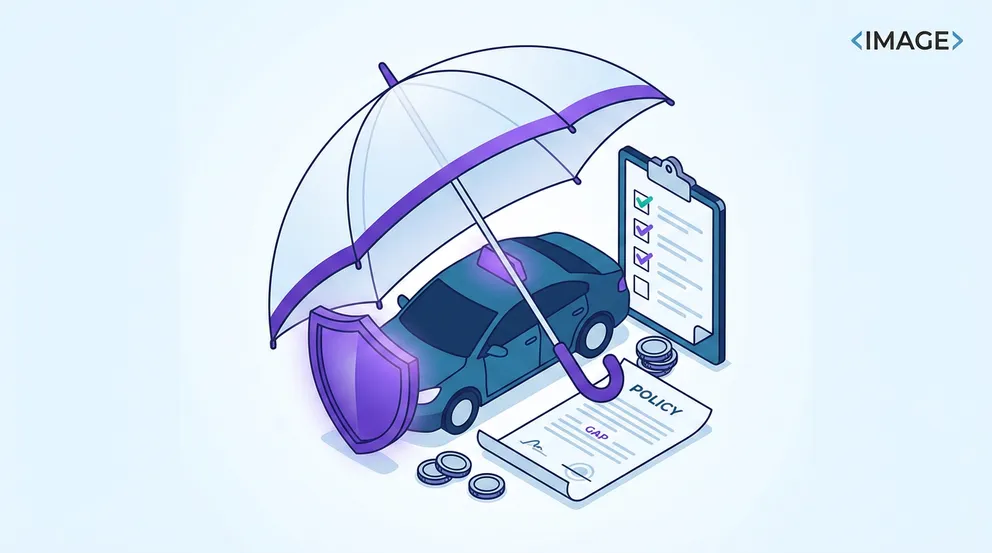
Personal auto insurance excludes "livery services," so it stops covering you the moment you turn on the Uber or Lyft app, according to the Insurance Information Institute. You need a rideshare endorsement ($6 to $40 per month from carriers like State Farm, Allstate, and Farmers) or a commercial policy to fill the Period 1 gap, when Uber and Lyft only provide $50,000 per person in liability.
- Uber and Lyft split coverage into 3 periods, with Period 1 (app on, no passenger accepted) carrying just $50K/$100K/$25K liability and zero collision protection.
- Periods 2 and 3 jump to $1,000,000 in third-party liability plus $1M UM/UIM, but Lyft's collision deductible runs $2,500 and Uber's runs $1,000 to $2,500.
- Rideshare drivers are 73% more likely to be in an accident than the general driving population, according to Insurify's 2025 driver analysis.
- State Farm, Allstate, Farmers, USAA, Progressive, Mercury, and Erie sell rideshare endorsements that cost $6 to $40 per month depending on carrier and state.
- Driving for Uber or Lyft on a personal-only policy can void your coverage entirely, and the carrier can drop you from the policy after a claim discloses rideshare use.
If you drive for Uber or Lyft, the personal auto policy in your glove box probably stops working the second you tap "go online." Most state minimum policies and even mid-tier full-coverage plans contain a "transportation network" or "livery" exclusion that voids coverage during commercial use, per the Insurance Information Institute. Our breakdown of car insurance by driver type covers how rideshare driving fits into the broader specialty-driver landscape, but rideshare deserves its own deep dive because the gap is uniquely dangerous and uniquely fixable.
Why Your Personal Auto Insurance Stops Covering You
Personal auto insurance is priced for personal use, not for accepting payment to transport strangers. The Insurance Information Institute states bluntly that a standard personal policy "will not provide coverage for ride-sharing, stopping from the moment a driver logs into a TNC ride-sharing app to the moment the customer has exited the car." That language sits inside the "livery exclusion" clause in nearly every standard ISO-form auto policy sold in the United States.
File a claim after a Period 1 fender-bender without telling your carrier you drive for Lyft, and the adjuster pulls your phone records during investigation. Once they confirm the app was on, the claim gets denied and the policy can be canceled mid-term. The Illinois Department of Insurance warns drivers directly: insurers can refuse renewal once they discover undisclosed rideshare activity. That leaves you paying for the wrecked car, the other driver's medical bills, and a non-renewal flag that follows you to every future quote.
Telling your carrier you drive for Uber or Lyft will not automatically get you dropped, but driving without disclosing it almost always results in a denied claim. Carriers like Allstate and Farmers explicitly do not drop policyholders who add a rideshare endorsement, while non-endorsed personal policies treat any rideshare claim as a coverage breach.
The Three Rideshare Periods, Mapped to What Each Side Covers
Uber and Lyft both segment a driver's working day into three insurance periods. The bodily injury and property damage limits change at each transition, and so does whether your personal policy is even allowed to step in.
| Period | What's Happening | Uber/Lyft Coverage | Your Personal Policy |
|---|---|---|---|
| Period 0 | App is off (personal driving) | None | Full coverage applies |
| Period 1 | App on, waiting for ride request | $50K per person / $100K per crash bodily injury, $25K property damage. No collision or comprehensive. | Voided by livery exclusion unless you carry a rideshare endorsement |
| Period 2 | Ride accepted, en route to pickup | $1,000,000 third-party liability + $1M UM/UIM. Comprehensive/collision available with $2,500 deductible (Lyft) or $1,000-$2,500 (Uber). | Voided unless endorsed |
| Period 3 | Passenger in vehicle | $1,000,000 third-party liability + $1M UM/UIM. Same deductible structure as Period 2. | Voided unless endorsed |
Source: Uber and Lyft official insurance disclosure documents, plus state minimum requirements compiled by the National Association of Insurance Commissioners (NAIC). Limits shown are nationwide baselines; states like Colorado, New York, and California impose higher mandatory minimums.
Period 1: The Coverage Gap That Quietly Bankrupts Drivers
Period 1 is where the math turns ugly. You have the app on, you are circling for a request, and Uber's contingent policy caps bodily injury at $50,000 per person and $100,000 per crash. A single ER visit with a broken femur runs $40,000 to $60,000 according to Becker's Hospital Review data, so a two-passenger T-bone can blow through the limit before the ambulance reaches the hospital. Anything past $100,000 lands on the driver personally.
Add the collision problem. Uber and Lyft do not provide any physical damage coverage during Period 1. Total your $32,000 Toyota Camry while logged in but unmatched, and Uber pays nothing toward the car. Your personal collision coverage refuses the claim because you were operating commercially. The driver eats the loss.
One Period 1 crash with serious injuries can produce a $150,000+ uncovered liability tab. The $15 to $40 per month rideshare endorsement is the cheapest catastrophe insurance in the auto market.
Rideshare Endorsements: What Each Major Carrier Charges
A rideshare endorsement is a rider you add to your existing personal auto policy that extends coverage into Period 1, and in some cases Periods 2 and 3 as well. Pricing varies wildly because carriers price the rider as either a flat dollar add-on or a percentage of base premium.
| Carrier | Endorsement Cost | Periods Covered | Best For |
|---|---|---|---|
| State Farm Most Comprehensive | 15-20% of premium (~$28/mo) | 1, 2, and 3 (extends personal limits to all periods) | Drivers who want personal-policy deductibles in all 3 periods |
| USAA | $6-$16/mo | Period 1 | Military-affiliated drivers, cheapest option overall |
| Allstate (Ride for Hire) | $10-$20/mo (some states $38/mo) | Period 1 + deductible gap reimbursement in Periods 2/3 | Reducing Lyft's $2,500 deductible to your personal $500 |
| Farmers | ~25% of premium ($6-$25/mo) | Period 1 only | Part-time drivers who only need gap coverage |
| Progressive | Varies by state | Period 1 (commercial policy required for full-time) | Drivers transitioning to commercial coverage |
| Erie | ~$9-$15/mo | 1, 2, and 3 | East Coast drivers in Erie's 12-state footprint |
| Mercury | Varies by state | Period 1 (full coverage) | California drivers who need named-driver flexibility |
Source: State Farm Transportation Network Company Driver Coverage rate guidance, Allstate Ride for Hire product disclosures, Farmers rideshare addendum, USAA member-reported rates, compiled by The Rideshare Guy 2026 carrier review.
State Farm: The Only Carrier That Bridges All Three Periods
State Farm's Transportation Network Company (TNC) endorsement extends your personal policy's exact limits into Periods 1, 2, and 3. The $500 collision deductible on your personal policy stays $500 even when a passenger is in the car. According to State Farm reps quoted by The Rideshare Guy, the endorsement adds 15% to 20% to current premium, about $28 per month for a typical driver.
Allstate Ride for Hire: Deductible Gap Reimbursement
Allstate's product fills Period 1 and adds a clever twist: deductible gap reimbursement during Periods 2 and 3. If Lyft's $2,500 collision deductible hits during a passenger trip, Allstate pays you the difference between Lyft's deductible and your Allstate deductible. A driver with a $500 Allstate deductible would pocket the $2,000 gap. The endorsement runs $10 to $20 per month in most states, climbing to $38 per month in higher-risk metros.
When Full-Time Drivers Need a Commercial Auto Policy
An endorsement works for part-time drivers logging fewer than 20 hours per week. Once you cross into full-time territory (40+ hours per week, or rideshare as primary income), most carriers require a commercial auto policy. According to Insurify's 2025 rideshare driver report, the average rideshare driver pays $270 per month for car insurance, and full-time commercial policies push that figure into the $300 to $500 per month range depending on state.
Driving for Uber Eats, DoorDash, Instacart, and other delivery platforms also voids personal auto policies. DoorDash provides $1 million contingent liability during active delivery, but the same Period 1 gap exists when the app is on without an active order. Allstate, Progressive, and Geico sell commercial policies designed specifically for delivery drivers.
How Driving Rideshare Changes Your Personal Rates
Even with a proper endorsement, rideshare drivers pay more for the underlying personal policy. Insurify's 2025 analysis found rideshare drivers are 73% more likely to be in an accident than the general population, primarily because they log 35,000+ miles per year (vs. 13,500 for the average US driver per the Federal Highway Administration). High-mileage exposure plus dense urban driving translates to roughly 15% to 30% higher base premiums on top of the endorsement cost.
One bright spot: Uber's 2021-2022 fatality rate was 0.87 per 100 million vehicle miles traveled (VMT), compared with the NHTSA national rate of 1.36 per 100M VMT. Rideshare drivers crash more often but kill people less often, likely because the average trip is short and urban with lower speeds. Comprehensive analysis of how each coverage type works can help you decide whether to layer additional protection like an umbrella policy on top of your rideshare-endorsed primary.
California's SB 371: Why 2026 UM/UIM Coverage Just Got Cut by 94%
California passed Senate Bill 371 in 2025, slashing the mandatory uninsured motorist (UM) and underinsured motorist (UIM) coverage TNCs must carry during Period 3 from $1,000,000 down to the state minimum. The law took effect January 1, 2026, and reduces UM/UIM available to passengers hit by an uninsured driver during a Lyft or Uber trip by roughly 94%. Uber's newsroom argues the change will lower rideshare insurance costs across the state, while passenger advocates warn it shifts catastrophic-injury risk to riders' own health and auto policies. If you drive for Uber or Lyft in California, your endorsed personal UM/UIM coverage now matters more than ever.
What Else Your Personal Policy Excludes
The livery exclusion is just one of several gaps in a typical personal auto policy. Our guide to common car insurance exclusions covers wear-and-tear, intentional damage, and non-disclosed driver scenarios that can void claims even when you're not driving for Uber. Drivers with multiple exposures (rideshare plus a teen on the policy plus a recent ticket) often end up in high-risk insurance markets where rideshare endorsements are less common and pricier.
Frequently Asked Questions
No. Standard personal auto policies contain a livery exclusion that voids coverage the moment you log into a rideshare app, according to the Insurance Information Institute. You need a rideshare endorsement (sold by State Farm, Allstate, Farmers, USAA, and others for $6 to $40 per month) or a commercial auto policy.
Period 1 is when the Uber or Lyft app is on but you have not accepted a ride. During this window, Uber and Lyft only provide $50,000 per person and $100,000 per crash bodily injury liability with zero collision coverage. Your personal policy is voided by the livery exclusion, so a serious crash leaves you exposed to six-figure out-of-pocket costs.
Most rideshare endorsements run $6 to $40 per month. USAA sits at the low end ($6 to $16 monthly per member-reported rates), Allstate Ride for Hire ranges from $10 to $20 in most states, State Farm typically adds 15% to 20% to base premium (about $28 monthly), and Farmers charges around 25% of base premium.
Part-time drivers (under 20 hours per week) usually qualify for a rideshare endorsement on their personal policy. Full-time drivers logging 40+ hours per week often must carry a commercial auto policy because most personal-policy endorsements cap mileage or weekly hours. Commercial policies run $300 to $500 per month depending on state and carrier.
- Insurance Information Institute: Ride-sharing and Insurance Q&A
- National Association of Insurance Commissioners: Commercial Ride-Sharing
- Uber: Insurance for Rideshare and Delivery Drivers
- Lyft Help: Insurance Policy and Coverage While Driving
- Insurify: Rideshare Accident Statistics and Driver Trends 2025
- Illinois Department of Insurance: Ride-Sharing and Car-Sharing Consumer Guide
- The Rideshare Guy: 2026 Rideshare Insurance Cost & Coverage by Carrier
- Uber Newsroom: California Insurance Reform (SB 371)