

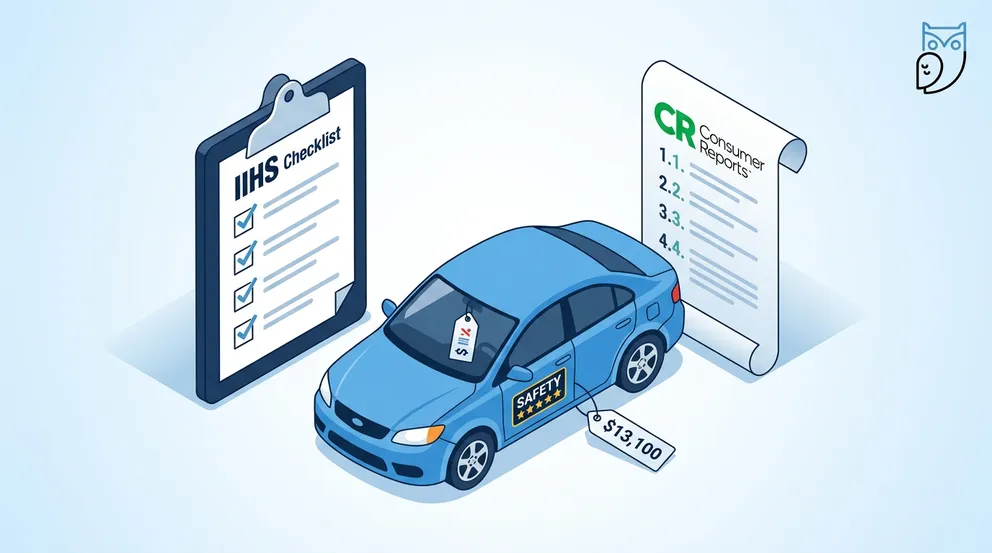
The Insurance Institute for Highway Safety and Consumer Reports released their 2026 list of safest used vehicles for teen drivers on May 27, naming the Toyota Camry, Mazda CX-5, and Subaru Forester among the top picks. Prices on the recommended models start at $13,100, and 45 of the qualifying vehicles cost under $10,000.
Adding a 16-year-old to a parent's policy averages $5,740 a year, according to Bankrate. Choosing a vehicle that insurers favor can trim hundreds of dollars off that premium before the car ever reaches the driveway.
IIHS and Consumer Reports named 74 used vehicles as safe picks for teen drivers in their 2026 guide, published May 27. The list splits into 29 "Best Choices" priced under $20,000 and 45 "Good Choices" under $10,000. The Mazda CX-5 is the cheapest qualifying SUV at $13,100, while the Toyota Camry, Subaru Forester, and Hyundai Ioniq 5 also reached the Best Choices tier.
- IIHS and Consumer Reports published the 2026 teen-vehicle list on May 27, 2026.
- 29 used "Best Choices" cost under $20,000; 45 "Good Choices" cost under $10,000.
- Every vehicle weighs more than 2,750 pounds and earns a good IIHS small-overlap crash rating.
- Mazda CX-5 starts at $13,100, the lowest entry price on the Best Choices list.
- A teen driver still averages $5,740 a year to insure, so vehicle choice cuts the bill.
What Made the 2026 List
IIHS and Consumer Reports built the 2026 guide around three hard cutoffs. Every qualifying vehicle weighs more than 2,750 pounds, earns a good rating in the IIHS driver-side small overlap front crash test, and posts strong braking and emergency-handling scores from Consumer Reports. Models in the higher Best Choices tier add two requirements: automatic emergency braking rated advanced or superior, plus headlights graded acceptable or good.
Mazda, Subaru, and Toyota dominate the rankings. The Mazda CX-5 leads on price at $13,100 for 2018 and newer versions built after March 2018, trailed by the Mazda 3 at $13,200 and the Subaru Crosstrek Plug-in Hybrid at $13,600. Midsize sedans cluster between $15,200 and $18,700, with the Toyota Camry landing at $17,300 and the Subaru Outback at $18,700. Four electric vehicles cleared the bar at this price point, including the Hyundai Ioniq 5 at $16,700 and the Kia EV6 at $18,700.
The automatic emergency braking requirement reflects a wider safety shift. HLDI data shows crash-avoidance features cut insurance claims, and IIHS now treats those systems as a baseline for any car it recommends to a new driver.
Top Best Choices and What They Cost
| Vehicle | Body Style | Used Price From | Teen Insurance Note |
|---|---|---|---|
| Mazda CX-5 | Small SUV | $13,100 | About $440/mo on a shared parent policy |
| Mazda 3 | Small car | $13,200 | Low repair costs, moderate horsepower |
| Subaru Crosstrek PHEV | Small car | $13,600 | All-wheel drive, plug-in hybrid |
| Subaru Forester | Small SUV | $15,900 | Near $1,891/yr as a standalone teen policy |
| Hyundai Ioniq 5 | Small SUV (EV) | $16,700 | Electric; confirm higher repair and premium cost |
| Toyota Camry | Midsize car | $17,300 | High reliability, inexpensive parts |
| Subaru Outback | Midsize car | $18,700 | About $440/mo on a shared parent policy |
Used prices reflect IIHS and Consumer Reports estimates as of May 2026 for the listed model years. Insurance figures come from MoneyGeek, Bankrate, and The Zebra and assume a 16-year-old driver with full coverage; actual premiums vary by state, ZIP code, and driving record.
What the List Means for Your Insurance Bill
Auto-news coverage of the list stops at sticker prices, yet the bigger number for most families is the insurance premium. The Zebra pegs the cost of adding a new teen driver at nearly $8,000 a year, and a parent's policy that runs $3,184 on its own can climb to $7,699 once a 16-year-old joins it. Vehicle choice moves that figure in both directions.
Several IIHS picks rank among the cheapest cars to insure for teens. MoneyGeek data places the Subaru Forester near the bottom of the cost scale at roughly $1,891 a year as a standalone teen policy, and lists the Subaru Outback, Honda CR-V, and Mazda CX-5 around $440 a month for full coverage when a teen shares a parent's plan. All three carry low repair costs and moderate horsepower, the two traits insurers reward most.
None of that is accidental. Insurers price a car on how often it files claims and how much each claim costs to settle, so a heavier crossover with a strong crash record and cheap body panels beats a sporty subcompact on nearly every rating factor. Our breakdown of why a 16-year-old now costs $5,740 a year to add shows how much the right vehicle can offset.
Four electric models reached the safety list, including the Hyundai Ioniq 5 and Kia EV6. Electric vehicles cost more to repair after a crash and often carry higher premiums than comparable gas models, so pull a quote before assuming an EV saves a teen driver money.
Why Bigger and Slower Wins for Teen Drivers
The size rule traces directly to how teens crash. Drivers ages 16 to 19 carry a fatal crash rate per mile nearly three times that of drivers 20 and older, and the risk peaks at ages 16 and 17, according to IIHS. That same rate runs roughly four times higher at night than during daylight hours.
Single-vehicle wrecks drive much of the toll. In 2023, 43% of teen drivers ages 16 to 19 involved in fatal crashes had run off the road or struck a fixed object with no other vehicle involved, the highest share of any age group, and 3,048 teenagers died in U.S. crashes that year. A vehicle over 2,750 pounds absorbs more crash energy than a minicar, which explains why compact SUVs and midsize sedans fill the list while subcompacts and high-horsepower coupes are shut out.
"We curate this annual list specifically for teens because driving holds extra risk for them," said Rebecca Weast, Senior Research Scientist at IIHS.
IIHS pairs the used list with new-vehicle picks for buyers with bigger budgets. Mazda and Hyundai each placed six models on the 2026 new-car list, and shoppers can cross-check those against the 2026 IIHS Top Safety Pick winners before signing a loan.
What You Should Do Now
Match the Car to the List
Confirm the exact model year qualifies, since some picks only count if built after a specific production date. Then run the VIN through the NHTSA recall database to check for open recalls.
Quote the Car Before You Buy It
Premiums swing hundreds of dollars by model, so price the specific vehicle with at least three carriers before you sign. A Forester and a turbocharged sedan can differ by more than $1,000 a year.
Stack the Teen Discounts
Ask every insurer about good-student credits, driver-training discounts, and telematics programs. These three discounts can each cut a teen premium by 10% to 25%.
Compare the Whole Policy
Rates for the same teen and car vary widely between companies. Compare full-coverage quotes across at least three insurers on our car insurance by state hub before renewing.
Looking Ahead
IIHS refreshes the teen list every spring, and the 2027 edition will likely fold in more 2023 and 2024 model years as their prices fall. Expect additional electric models to qualify as used EV inventory grows and repair networks expand past the four that made the 2026 cut. For now, the cheapest safe pick on the board is the $13,100 Mazda CX-5, and rates on every model are worth comparing before the next school year starts.
Frequently Asked Questions
The Mazda CX-5 starts at $13,100, the Mazda 3 at $13,200, and the Subaru Crosstrek Plug-in Hybrid at $13,600 in the Best Choices tier. The lower-cost Good Choices tier holds 45 vehicles under $10,000, including the Honda Civic near $8,100 and the Subaru Impreza near $8,000.
Bankrate puts the average at $5,740 a year to add a 16-year-old to a parent's policy, while The Zebra estimates close to $8,000 a year for a new teen driver. Choosing a vehicle insurers favor and stacking good-student and telematics discounts can lower that total by hundreds of dollars.
The Hyundai Ioniq 5, Kia EV6, Audi Q4 e-tron, and Subaru Solterra all met the 2026 safety criteria. Electric vehicles cost more to repair after a crash and often carry higher premiums than comparable gas cars, so request a quote on the specific EV before buying.
Every qualifying vehicle weighs more than 2,750 pounds because heavier cars absorb more crash energy. Drivers ages 16 to 19 have a fatal crash rate per mile nearly three times that of drivers 20 and older, so size and crash protection matter most for new drivers.
Verify the model year and build date qualify, then search the NHTSA recall database for open recalls before purchase. IIHS also warns parents to avoid high-horsepower vehicles, which raise both crash risk and insurance premiums for inexperienced drivers.
- IIHS - Safe Vehicles for Teens (2026 List)
- CBS News - The Safest Vehicles for Teen Drivers and How Much They Cost
- AutoGuide - The Used Cars Parents Can Trust for Their Teen Drivers
- IIHS - Fatality Facts 2023: Teenagers
- Bankrate - Why Teen Driver Insurance Averages $5,700 a Year
- The Zebra - It Now Costs Nearly $8K a Year to Insure a New Teen Driver
- MoneyGeek - Cheapest Car to Insure for a Teenager (2026)