

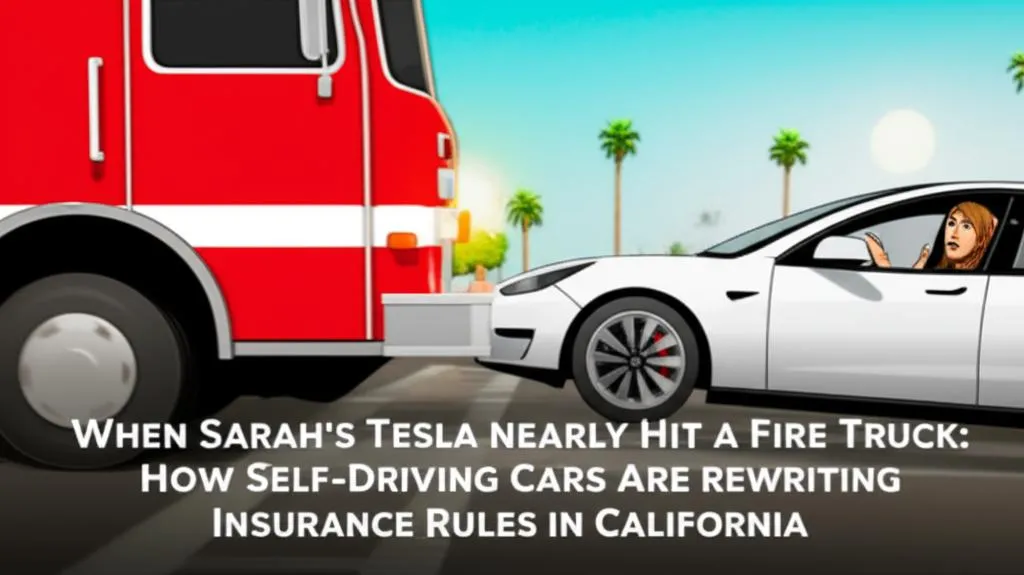
Sarah Martinez was scrolling through her insurance app when she saw the news alert: another autonomous vehicle accident just blocks from her San Francisco office. As she watched the footage of confused firefighters trying to figure out how to move a stalled robotaxi, a familiar knot formed in her stomach. Her Model Y's insurance renewal was coming up, and after seeing three similar incidents this month, she wondered if having a car with self-driving features was about to cost her a lot more money.
If you're like Sarah, you've probably noticed that self-driving cars are no longer science fiction—they're sharing your daily commute. And if you've been wondering how this affects your insurance, you're asking exactly the right question at exactly the right time.
Here's what's happening: California now accounts for 60% of all self-driving car accidents nationwide, with these vehicles crashing at rates significantly higher than conventional cars. For every driver in the state, this reality is quietly reshaping car insurance in ways most people haven't yet realized.
Why California's New Rules Matter to Your Wallet
Starting January 1, 2025, California implemented new insurance requirements that affect every driver on the road. The state doubled minimum coverage requirements: $30,000 for injury or death per person, $60,000 for multiple injuries, and $15,000 for property damage. But here's what makes these changes significant for you personally.
Companies testing self-driving cars must now carry at least $5 million in liability coverage per vehicle—that's 10-20 times what you're required to carry. This massive difference tells you everything you need to know about how risky regulators consider this technology right now.
So what does this mean for your insurance costs? When high-risk vehicles share the roads with regular cars, everyone's exposure increases. Insurance companies can't easily separate the risk of being hit by an autonomous vehicle from their overall risk calculations. This means the increased accident rates and massive repair costs associated with self-driving cars gradually influence everyone's premiums.
Think about it this way: when Sarah's neighbor gets rear-ended by a Waymo vehicle, the resulting claim might involve multiple insurance companies, take months to resolve, and cost tens of thousands of dollars in specialized repairs. Even though Sarah wasn't involved, her insurer operates in the same market facing the same increased costs and complexity. Those costs eventually reach every policyholder.
The Hidden Costs of High-Tech Crashes
Maria Rodriguez learned about these hidden costs the hard way. When a Waymo vehicle rear-ended her Honda Civic in Mountain View, she expected a typical fender-bender claim. Instead, she discovered a world of complexity she never knew existed.
The first surprise? No other driver to exchange information with. Instead, Maria found herself dealing with Waymo's commercial insurer, the vehicle manufacturer's representatives, and eventually a team of technical investigators. What should have been a straightforward claim turned into a four-month investigation involving software engineers and crash reconstruction specialists.
Here's why this matters to you: when accidents involve autonomous vehicles, determining fault requires analyzing software logs, sensor data, and artificial intelligence decision-making processes. This complexity doesn't just affect the other party—it affects how long your claim takes, how much documentation you need, and how much the entire process costs.
The numbers tell the story. Traditional vehicle claims average 30-45 days to process and cost $2,500-$5,000 to investigate. Autonomous vehicle claims take 90-180 days and cost $8,000-$15,000 to investigate. Someone pays for this extra time and expense, and ultimately, that someone is everyone who pays insurance premiums.
But there's another cost factor that's even more significant: repair expenses. When a self-driving car hits your conventional vehicle, the damage bill might shock you. These vehicles carry thousands of dollars worth of sensors, cameras, and computing equipment. A minor fender-bender that might cost $3,000 to fix on a regular car can easily hit $15,000-$25,000 when it involves damaging an autonomous vehicle's sensor array.
What This Means for Your Coverage Right Now
Whether you drive a conventional car or own a vehicle with self-driving features, these changes create immediate implications for your insurance decisions. Let's break down what you need to consider based on your specific situation.
If you're considering buying a vehicle with autonomous features, start by calling your insurance agent before you visit the dealership. Many people discover too late that their "money-saving" safety features actually increase their insurance costs. While basic features like automatic emergency braking often provide discounts, more advanced autonomous capabilities frequently trigger premium increases due to higher repair costs and liability uncertainty.
Ask specific questions about technology coverage. Standard comprehensive coverage typically doesn't adequately protect against autonomous system failures, cybersecurity breaches, or software malfunctions. If your vehicle relies on complex sensors and artificial intelligence, you need to understand what happens when those systems fail or get damaged.
For those driving conventional vehicles, the key is understanding your exposure to autonomous vehicle incidents. Even if you never plan to own a self-driving car, you're sharing the road with them daily in California. This means you need to think about liability coverage differently than drivers in other states.
Consider increasing your liability limits beyond California's minimum requirements. When you're involved in an accident with an autonomous vehicle, the claim resolution process often takes much longer due to complex liability determinations. Higher limits provide better protection during extended negotiations and reduce your exposure if multiple parties share responsibility for damages.
The Investigation Challenge Every Driver Faces
Here's something most people don't realize: if you're involved in any accident with an autonomous vehicle, you become part of a technical investigation whether you want to or not. Understanding this process helps you protect your interests and speeds up your claim resolution.
When police arrive at an accident scene involving an autonomous vehicle, the report process changes significantly. Officers must document not just the physical damage and circumstances, but also the vehicle's operational mode, sensor status, and any available technical data. This means accident scenes take longer to clear and require more detailed documentation from everyone involved.
For you as the other party, this creates both challenges and opportunities. The challenge is that your claim resolution takes longer and requires more documentation. You might need to provide detailed statements about road conditions, weather, traffic patterns, and your vehicle's systems at the time of the accident.
The opportunity is that autonomous vehicles generate enormous amounts of data about accidents. Properly preserved, this data often provides clearer evidence about fault and circumstances than traditional accident investigations. However, accessing and interpreting this data requires legal and technical expertise that most people don't possess.
If you're ever involved in an accident with an autonomous vehicle, document everything you can at the scene. Take photos of visible sensors, cameras, and identification markings. Note whether the vehicle appears to have a human safety driver or shows signs of operating autonomously. Get contact information not just for the vehicle operator, but for the fleet company, manufacturer, or technology company operating the vehicle.
Most importantly, notify your insurance company immediately that the accident involves an autonomous vehicle. This triggers specialized claim handling procedures and ensures your insurer assigns representatives with appropriate technical expertise.
The Real Cost Impact: What The Data Shows
Let's talk about what autonomous vehicles actually cost the insurance system, because these costs directly influence what everyone pays for coverage.
California's comprehensive data collection reveals that between June 2024 and March 2025, the state recorded over 760 autonomous vehicle incidents. Waymo alone reported 462 crashes in 2024, with 79% resulting in property damage. The average property damage claim involving an autonomous vehicle costs $47,000—nearly three times the average for conventional vehicles.
Why are the costs so much higher? First, the vehicles themselves are expensive to repair. A minor collision that damages a front-mounted sensor array can require $20,000-$30,000 in specialized components and recalibration. Second, liability investigations cost significantly more due to technical complexity. Third, rental car and alternative transportation costs accumulate during extended repair times because specialized parts and certified technicians aren't readily available.
These elevated costs create ripple effects throughout the insurance market. Insurers must maintain larger reserves for autonomous vehicle claims, hire specialized investigators and adjusters, and develop new expertise in technology-related liability. All of these costs eventually influence premium calculations for everyone sharing the same roads and insurance markets.
But here's what makes California's situation unique and important for understanding your costs: the state's concentration of autonomous vehicle testing creates localized market disruption. While rural insurers have limited exposure to autonomous vehicle risks, urban carriers in San Francisco, Los Angeles, and Silicon Valley face concentrated liability that's difficult to spread across broader risk pools.
If you live in areas with high autonomous vehicle activity, your premiums may increase faster than drivers in other regions. If you live in areas with minimal autonomous vehicle presence, you might face smaller immediate increases, but you're still affected by statewide claim costs and your insurer's overall exposure.
Preparing for What's Coming Next
The changes happening now are just the beginning. Understanding what's ahead helps you make smart decisions about coverage and preparation.
New California regulations taking effect July 1, 2026, will require fully driverless vehicles to have two-way communication systems for emergencies. This addresses the frustrating incidents where autonomous vehicles stall in front of fire trucks or ambulances without any way for emergency responders to communicate with them. While this improves safety, it also highlights how much liability uncertainty still exists.
More significantly, the California DMV is seeking public comment through June 9, 2025, on comprehensive regulations that could reshape autonomous vehicle insurance nationwide. These proposed rules address commercial operations, liability thresholds, and insurance requirements that other states will likely adopt.
For you personally, this regulatory evolution means you should stay informed about changing requirements and coverage options. Subscribe to updates from the California DMV or work with an insurance agent who specializes in emerging automotive technologies. The regulatory landscape changes rapidly, and staying informed helps you adapt your coverage appropriately.
Consider usage-based insurance options that adapt to changing technology and driving patterns. These policies use real-time data to adjust premiums based on actual vehicle operation rather than traditional demographic factors. As autonomous vehicles become more prevalent, usage-based models may offer better value and more appropriate coverage than traditional annual policies.
Industry Changes That Affect Your Options
The insurance industry is adapting to autonomous vehicle reality through product innovation and operational changes that create new options and challenges for consumers.
Progressive and State Farm have developed specialized autonomous vehicle policies that combine traditional liability coverage with cyber protection and technology failure coverage. While these products currently target fleet operators and technology companies, similar coverage options will eventually become available for individual consumers.
More immediately relevant, insurers are changing how they underwrite and price all automotive coverage. Companies increasingly use real-time data from vehicle telematics, manufacturer safety records, and regulatory compliance histories to assess risk and set prices. This means your premium may fluctuate more frequently based on actual vehicle performance and usage patterns rather than annual renewals based on static factors.
These changes create opportunities for drivers who actively manage their risk exposure. Vehicles with comprehensive data logging and safety monitoring may qualify for better rates. Drivers who avoid high-risk areas or times when autonomous vehicle activity is heaviest might see premium benefits.
However, these changes also create new complexity in choosing and maintaining coverage. Understanding how your insurer evaluates autonomous vehicle risk helps you make decisions about vehicle purchases, coverage levels, and risk management strategies.
Taking Action: Your Next Steps
The autonomous vehicle insurance revolution isn't waiting for perfect technology or complete regulatory clarity. It's happening now, and your decisions today determine how well you're protected as these changes accelerate.
Start with a coverage review focused specifically on autonomous vehicle risks. Contact your insurance agent and ask direct questions about your policy's technology coverage, cyber protection, and liability limits. If your agent lacks expertise in autonomous vehicle insurance, find one who understands these emerging risks.
Document your current vehicle's capabilities and how you use autonomous features if you have them. Some policies require notification when autonomous features are activated, and claim processing may depend on proving whether incidents occurred during human or autonomous control. Keep records of software updates, recalls, and manufacturer communications about system performance.
Review your liability coverage limits with autonomous vehicle scenarios in mind. California's minimum requirements provide barely adequate protection for conventional vehicle accidents and may be insufficient for complex autonomous vehicle incidents. Consider increasing your limits, particularly if you frequently drive in areas with high autonomous vehicle activity.
Stay engaged with regulatory development by following California DMV announcements and participating in public comment periods when regulations affect insurance requirements. Consumer input influences coverage standards that affect everyone sharing the road with autonomous vehicles.
Most importantly, approach autonomous vehicle insurance as an evolving challenge rather than a one-time decision. The technology, regulations, and insurance products continue changing rapidly. Regular reviews of your coverage and staying informed about industry developments ensure you maintain appropriate protection as the transportation landscape transforms around us.
California's experience with autonomous vehicles provides a preview of changes that will eventually affect drivers nationwide. By understanding these changes now and adapting your coverage appropriately, you can benefit from transportation innovation while protecting your financial security in an increasingly complex automotive environment.
The future of driving is arriving one software update and one accident at a time. Making informed decisions about insurance coverage gives you the protection you need to navigate this transformation confidently, whether you're embracing autonomous vehicle technology or simply sharing the road with those who are.