

Quick answer
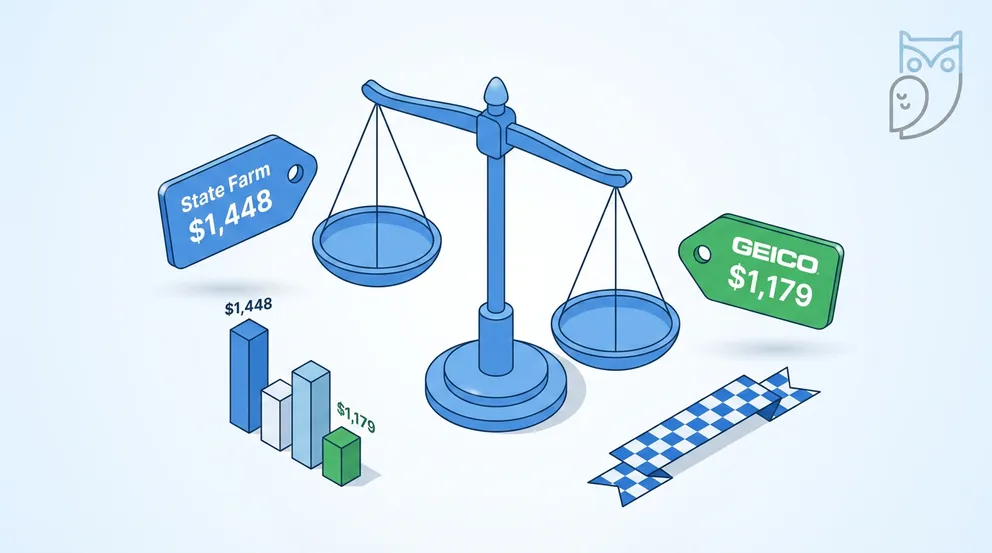
GEICO is cheaper for drivers with clean records and good credit, averaging $1,179/year versus State Farm's $1,448 (MoneyGeek 2026 data). State Farm flips the math after a violation: post-DUI rates average $1,876 with State Farm and $2,774 with GEICO, a $898 swing. State Farm also beats GEICO on J.D. Power claims satisfaction (716 vs. 692) but carries a higher NAIC complaint index (1.21 vs. 0.79).
Key takeaways
- GEICO undercuts State Farm by $269/year for clean drivers in MoneyGeek's sample and $66 in NerdWallet's; State Farm undercuts GEICO by $260 to $898 after major incidents.
- State Farm's bad-credit penalty hits $8,322/year in NerdWallet's 2026 data, roughly 2.9x GEICO's $2,884 for the same profile.
- AM Best cut State Farm's Financial Strength Rating from A++ to A+ on November 14, 2025; GEICO still holds A++.
- Drive Safe & Save can knock up to 30% off State Farm renewals and never raises rates for low scores, per State Farm program rules.
- Re-quote both carriers at every renewal; the cheaper option for your profile can flip in 12 months.
State Farm and GEICO together insure roughly 30% of every personal auto policy written in the United States, according to 2024 NAIC market share data. Picking between them comes down to four numbers: your baseline premium, your accident or DUI history, your credit tier, and how much you weigh claims service over upfront price. This comparison pulls rate data from three independent sources (MoneyGeek, NerdWallet, The Zebra) so you can spot which carrier earns your premium dollars for your specific profile.
The Bottom Line: GEICO Wins on Clean Records, State Farm Wins After Incidents
Rate-aggregator data from 2026 consistently shows GEICO running cheaper for the textbook "good driver, good credit" profile that insurers price hardest for. MoneyGeek puts GEICO at $1,179/year vs. State Farm at $1,448 for a 40-year-old with $100K/$300K liability and a $1,000 deductible. NerdWallet's sampling of a 35-year-old with similar coverage shows GEICO at $2,057 vs. State Farm at $2,123, a much tighter gap of $66.
After an at-fault accident, the ranking inverts in most data sets. NerdWallet reports State Farm at $2,689 versus GEICO at $3,491 (State Farm saves $802). MoneyGeek shows State Farm at $1,693 versus GEICO at $1,953 (State Farm saves $260). State Farm's underwriting penalizes violations less aggressively than GEICO's, especially DUIs and major moving violations.
Average Annual Rates by Driver Profile
The table below stacks three independent 2026 rate samples side by side. Methodology varies (driver age, coverage limits, vehicle), but the directional pattern repeats: GEICO undercuts State Farm for clean drivers, State Farm undercuts GEICO for drivers with major incidents.
| Driver profile | Source | GEICO | State Farm | Cheaper |
|---|---|---|---|---|
| Clean record, good credit | MoneyGeek | $1,179 | $1,448 | GEICO by $269 |
| Clean record, good credit | NerdWallet | $2,057 | $2,123 | GEICO by $66 |
| After speeding ticket | MoneyGeek | $1,582 | $1,566 | State Farm by $17 |
| After at-fault accident | NerdWallet | $3,491 | $2,689 | State Farm by $802 |
| After at-fault accident | MoneyGeek | $1,953 | $1,693 | State Farm by $260 |
| After DUI | MoneyGeek | $2,774 | $1,876 | State Farm by $898 |
| Poor credit, clean record | NerdWallet | $2,884 | $8,322 | GEICO by $5,438 |
| Liability only | NerdWallet | $494 | $497 | Tie ($3 gap) |
Methodology: MoneyGeek used 40-year-old male, $100K/$300K BI, $100K PD, $1,000 deductible. NerdWallet used 35-year-old, 2023 Toyota Camry LE, 12,000 annual miles, standard limits. National averages; your zip code can swing rates 40% in either direction.
The credit tier line is the most extreme finding in any of the data sets. State Farm's $8,322 average for a "good driver with poor credit" is nearly four times its clean-credit baseline, while GEICO charges roughly 40% more for the same swing. If your FICO sits below 670, GEICO is mathematically the safer bet at quote stage. For deeper context on how insurers price credit, see our breakdown of car insurance with bad credit.
Rates by Age Group
Age moves rates more than almost any other underwriting factor. The Zebra's 2026 data set shows GEICO running cheaper at every age tier, with the gap widest for teen drivers (a $2,312 annual difference). FinanceBuzz, citing Insurify data, runs the comparison in the opposite direction for the same age groups.
| Age tier | GEICO (The Zebra) | State Farm (The Zebra) | Annual gap |
|---|---|---|---|
| Teens (16-19) | $3,508 | $5,820 | $2,312 |
| 20s | $1,438 | $2,379 | $941 |
| 30s | $1,218 | $2,379 | $1,161 |
| 40s | $1,189 | $1,587 | $398 |
| 50s | $1,160 | $1,558 | $398 |
| 60s | $1,065 | $1,485 | $420 |
Aggregator disagreements trace back to sampling: each rate aggregator pulls quotes through its own funnel of partner agents and zip-code samples, so the regional mix tilts the average. State Farm uses agent-distributed pricing that varies more by territory than GEICO's centralized direct model, which makes State Farm look cheap in some markets and expensive in others. Skip the headline averages and quote both carriers for your own address.
Customer Satisfaction and Claims Service
Price alone would skip this section. It shouldn't. The probability of a satisfying payout when you file a claim depends heavily on which carrier handles the file. The two industry-standard scorecards (J.D. Power and the NAIC complaint index) tell a split story for these two insurers.
J.D. Power Scores
State Farm beat GEICO on J.D. Power's 2025 U.S. Auto Claims Satisfaction Study, scoring 716 vs. GEICO's 692 (industry average: 695). On the broader U.S. Auto Insurance Study, State Farm posts 650 to GEICO's 645, essentially a wash. Translation: filing a collision claim with State Farm trends slightly smoother, but day-to-day policy management feels similar with both.
NAIC Complaint Index
The complaint index reverses the rankings. GEICO sits at 0.79 (21% fewer complaints than expected for its size), while State Farm runs at 1.21 (21% more complaints than expected). Index values reflect formal complaints filed with state insurance departments, weighted by market share. GEICO has run consistently below 1.00 for the past decade, which puts it among the cleaner records in personal auto.
State Farm's November 2025 AM Best Downgrade
On November 14, 2025, AM Best cut State Farm Mutual Automobile Insurance Company's Financial Strength Rating from A++ (Superior) to A+ (Superior). AM Best cited five consecutive years of underwriting losses in private passenger auto and homeowners, plus elevated weather-related catastrophe losses from hurricanes, convective storms, and wildfires. GEICO holds its A++ rating from Berkshire Hathaway's underwriting strength. The State Farm downgrade does not threaten claims payment ability in any near-term scenario (A+ still means "Superior"), but it does signal that the company's pricing may continue to firm up in 2026.
Coverage Options and Discounts Compared
Both carriers sell the standard six coverages: liability, collision, comprehensive, uninsured/underinsured motorist, medical payments, and personal injury protection where required. The differentiation lives in the add-ons.
GEICO offers but State Farm does not: Mechanical Breakdown Insurance (an extended warranty alternative that covers parts and labor on most vehicle systems for cars under 15 months/15,000 miles at signup), accident forgiveness in 35 states, and Mexico travel coverage. GEICO's roadside assistance runs about $14/year per vehicle.
State Farm offers but GEICO does not: Rideshare endorsement (extends personal coverage to gap periods when an Uber or Lyft driver is logged in but not yet matched with a passenger), Steer Clear for drivers under 25 (knocks up to 15% off through completion of a safe driving program), and Drive Safe & Save telematics that won't raise rates regardless of driving data.
Drive Safe & Save deserves a separate callout: State Farm's program tops out at a 30% renewal discount and never raises rates for poor scores, which makes it lower-risk than most competing telematics programs. GEICO's DriveEasy uses a similar mobile-app sensor model but can raise renewal rates in many states if your driving data shows frequent hard braking or late-night driving.
On discounts, both offer the usual suspects: multi-policy bundling (around 17% with State Farm when combined with home), good student, defensive driving, anti-theft, and multi-vehicle. The Zebra catalogs 17 distinct GEICO discounts vs. 14 for State Farm, though stack-ability and individual savings vary widely by state. State Farm's bundling discount tends to deliver the deepest single-product savings if you carry homeowners or renters insurance with them. For a broader strategy, our guide to how to get cheap car insurance covers tactics that work regardless of carrier.
Pros and Cons
GEICO Pros
- Cheaper for clean records (saves $269 vs. State Farm at MoneyGeek baseline)
- NAIC complaint index of 0.79 (well below the 1.00 industry baseline)
- Accident forgiveness available in 35 states
- Mobile app rated higher than State Farm's by Compare.com 2026 review
- 17 discount programs catalogued by The Zebra
GEICO Cons
- Rates climb 45% to 130% after a DUI, depending on data source
- No rideshare endorsement, which limits delivery driver coverage
- J.D. Power claims score of 692 lags State Farm's 716
- No local agent network for in-person service in most states
State Farm Pros
- Cheaper after at-fault accidents and DUIs in most regional samples
- 716 J.D. Power claims satisfaction score (ranks above industry average)
- Drive Safe & Save telematics has no rate-increase risk for bad data and tops out at 30% off
- Nationwide agent network of 19,000+ local offices
- Rideshare endorsement available in most states
State Farm Cons
- AM Best downgraded its FSR from A++ to A+ on November 14, 2025
- NAIC complaint index of 1.21 (21% more complaints than expected)
- Bad-credit pricing is brutal ($8,322/year in NerdWallet's sample)
- No accident forgiveness or Mexico coverage
- Stopped writing new homeowners policies in California in 2023, affecting bundling for new West Coast customers
Which Company Should You Pick?
Match yourself against the four scenarios below to skip the quote-shopping for the obviously dominant carrier.
| If your situation is... | Pick | Why |
|---|---|---|
| Clean record, FICO 740+, no bundling need | GEICO | $66 to $269/year cheaper across both rate samples; faster online quote-and-bind |
| At-fault accident or DUI in last 3 years | State Farm | $260 to $898/year savings; less severe underwriting penalty for major violations |
| FICO below 670 | GEICO | State Farm's credit-tier penalty is roughly 4x baseline; GEICO charges roughly 1.4x baseline |
| Bundling home + auto, prefer local agent | State Farm | 19,000+ agents, deepest multi-line discount, rideshare endorsement available |
| Teen driver added to policy | Quote both | The Zebra shows GEICO $2,312 cheaper; FinanceBuzz/Insurify shows State Farm $42/month cheaper. Local pricing varies wildly. |
| Drive for DoorDash, Uber, or Lyft | State Farm | Rideshare endorsement keeps coverage active during app-on, pre-passenger periods |
| High-mileage commuter open to telematics | State Farm | Drive Safe & Save caps at 30% off and won't raise rates for bad scores, unlike GEICO DriveEasy |
| Want pay-per-mile or telematics-only | Look outside both | Allstate and Progressive own this niche; see our Allstate review and Progressive review |
How to Get Accurate Quotes From Both Carriers
National averages disguise the only number that matters: your number. Pull quotes from both in under 30 minutes by following the same coverage assumptions for each.
- Lock in your coverage limits before quoting. A starting baseline of $100K/$300K bodily injury, $100K property damage, and $1,000 collision/comprehensive deductibles aligns with how MoneyGeek and NerdWallet sample rates.
- Pull your most recent declarations page so you can match your current liability limits, comprehensive/collision deductibles, and any add-ons like rental reimbursement.
- Quote GEICO at geico.com using identical vehicle VIN, garaging address, and driver list. Note the discounts applied at quote (military, federal employee, alumni, anti-theft) since they cut 5% to 15% each.
- Call a local State Farm agent rather than quoting only online. Agent-distributed pricing often unlocks underwriting flexibility (different tier assignments) that the web quote engine doesn't reach.
- Compare like-for-like declarations pages, not the headline premium. Verify uninsured motorist limits match, medical payments match, and deductibles are identical before declaring a winner.
- Re-quote both at every renewal. Carriers re-tier policyholders annually and the cheaper carrier today may not be the cheaper carrier in 12 months, especially given State Farm's 2025 underwriting pressure.
If you've been with one of these carriers for more than three years without re-shopping, you may be paying a loyalty penalty. NAIC research on price optimization suggests long-term policyholders pay 5% to 10% more than identical new customers in many states. For drivers carrying full coverage already, our full coverage car insurance guide walks through whether you still need both comprehensive and collision based on your car's depreciated value.
A Note on State Farm Claims Litigation
In April 2026, the Sixth Circuit Court of Appeals decertified a 90,000-member class action against State Farm over total-loss vehicle valuations. The plaintiffs alleged that State Farm's typical negotiation adjustment shaved roughly $115 off each total-loss settlement on average. The decertification doesn't dismiss the underlying claims; it just blocks the class mechanism. Drivers with active total-loss disputes can still pursue individual claims. We covered the ruling and its implications in our Sixth Circuit decertification analysis. For broader context on how either carrier handles post-accident pricing, see car insurance after an accident.
Frequently Asked Questions
Is GEICO or State Farm cheaper?
GEICO is cheaper for the majority of drivers with clean records and good credit, averaging $1,179/year vs. State Farm's $1,448 per MoneyGeek's 2026 data. State Farm becomes the cheaper option after most major incidents: $898/year less after a DUI and $260 less after an at-fault accident.
Which has better claims service, GEICO or State Farm?
State Farm scored 716 on J.D. Power's 2025 Auto Claims Satisfaction Study, compared with GEICO's 692. That puts State Farm at #6 of 21 ranked insurers; GEICO ranked #14. The trade-off: GEICO has a much cleaner NAIC complaint index (0.79 vs. 1.21).
Does State Farm or GEICO offer better bundling discounts?
State Farm's multi-line discount runs roughly 17% when you bundle home and auto, and the carrier writes both products under its own brand in 49 states (no homeowners new business in California since 2023). GEICO bundling routes you to partner insurers like Liberty Mutual or Travelers, so the savings depend on the partner's pricing.
Is State Farm financially sound after the AM Best downgrade?
Yes. AM Best lowered State Farm's Financial Strength Rating from A++ to A+ on November 14, 2025, but A+ still means "Superior." The downgrade reflects five years of auto and home underwriting losses, not solvency concerns. State Farm's Best's Capital Adequacy Ratio remains at the strongest level.
Which is cheaper for teen drivers?
The data splits. The Zebra puts GEICO $2,312/year cheaper for the 16-19 age tier ($3,508 vs. $5,820). Insurify data via FinanceBuzz reverses the picture, showing State Farm at $224/month versus GEICO at $266 for the same age group. Quote both, but be sure to ask State Farm about Steer Clear, which cuts up to 15% off for drivers under 25.
Which is better for drivers with poor credit?
GEICO wins by a wide margin. NerdWallet's 2026 sample showed State Farm at $8,322/year for a clean driver with poor credit, vs. GEICO at $2,884. State Farm's pricing tier for the lowest credit band is among the most aggressive in the industry. California, Hawaii, Massachusetts, Michigan, and Washington either ban or restrict credit-based insurance scoring, which narrows the gap in those states.
Is Drive Safe & Save or DriveEasy the better telematics program?
Drive Safe & Save tops out at a 30% renewal discount and won't raise rates regardless of driving data, which makes it the lower-risk option. GEICO DriveEasy uses a similar mobile-app sensor model but can raise renewal rates in many states for hard braking, phone usage, or late-night trips. Conservative drivers chasing the maximum discount and willing to share data should test both at renewal.
When should I switch from State Farm to GEICO or vice versa?
Re-quote both at every renewal, even if your current premium feels reasonable. The threshold worth acting on is a 10% gap or more on equivalent coverage. Time your switch so the new policy starts before the old one ends to avoid a coverage lapse, which can spike your renewal premiums by 9% to 21% on either carrier.
- MoneyGeek: State Farm vs. GEICO Rate Comparison (2026)
- NerdWallet: Comparing Allstate, GEICO, Progressive and State Farm
- The Zebra: GEICO vs. State Farm Rate and Discount Tables
- FinanceBuzz / Insurify: State Farm vs. GEICO Driver Profile Rates
- J.D. Power 2025 U.S. Auto Claims Satisfaction Study
- NAIC Consumer Insurance Information Search (Complaint Index)
- AM Best Downgrades State Farm Mutual Automobile Insurance Company (Nov 14, 2025)
- Repairer Driven News: 2024 NAIC Auto Insurance Market Share Data
- WalletHub: GEICO vs. State Farm Customer Satisfaction Metrics
- U.S. News: GEICO vs. State Farm 2026 Comparison