

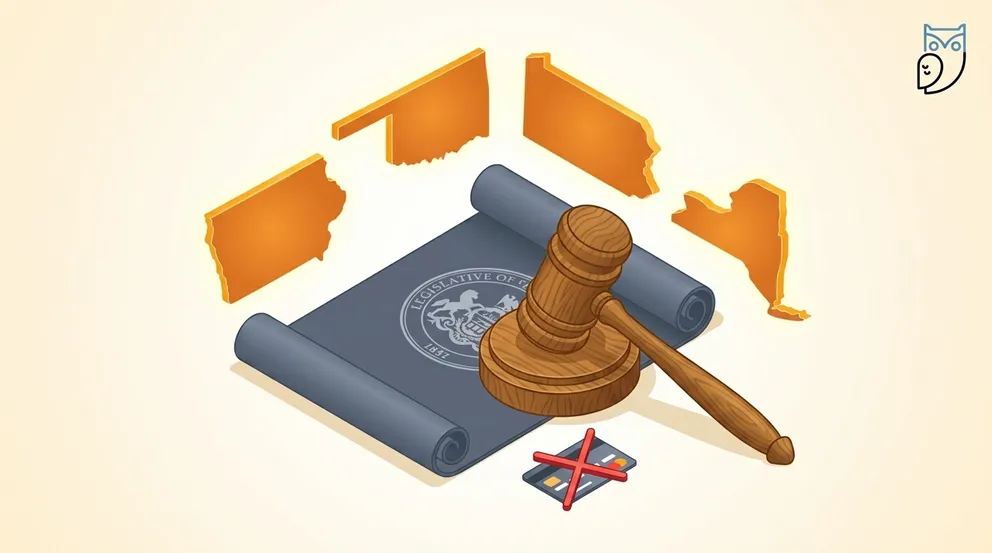
Iowa, Oklahoma, Pennsylvania, and New York have introduced 2026 bills banning credit-based insurance scoring in auto insurance pricing. Forbes Advisor analysis of Quadrant Information Services data shows drivers with poor credit pay 25% to 92% more than those with good credit, an extra $523 to $1,950 per year. California, Hawaii, and Massachusetts already prohibit the practice entirely.
Lawmakers in four states want to stop auto insurers from using your credit score to price your premium. Iowa, Oklahoma, Pennsylvania, and New York all introduced bills in early 2026 that would ban credit-based insurance scoring. Forbes Advisor reported on April 29, 2026, that drivers with poor credit currently pay $4,604 per year for full coverage, while those with excellent credit pay $1,720, a yearly gap of $2,884.
The four bills would expand the small group of states that already prohibit insurers from factoring credit into auto premiums. California, Hawaii, and Massachusetts have full bans in place, and four additional states limit how credit can be used to deny, cancel, or refuse to renew policies. Every other state lets insurers price the same driving record very differently based on a credit-based insurance score.
- Iowa HF 2259, Oklahoma SB 1435, Pennsylvania HB 657, and New York Assembly Bill A10524A target credit-based insurance scoring in 2026 sessions
- Forbes Advisor data shows drivers with poor credit pay $4,604 annually for full coverage versus $1,720 for excellent credit
- Iowa drivers with poor credit pay 140% more than excellent-credit drivers, the steepest penalty among the four bill states
- California, Hawaii, and Massachusetts already prohibit credit-based pricing for auto insurance
- Nationwide ($2,100), USAA ($2,521), and Travelers ($2,811) price most competitively for bad-credit drivers per Forbes Advisor
What the Four State Bills Would Do
Iowa Representative Ken Croken filed House File 2259 after questioning whether credit ratings reflect driving risk. Croken told reporters he expected pricing to track driving history, garaging location, and driver age. State data cited by Insurance Business shows Iowa drivers with poor credit pay 140% more for auto coverage than excellent-credit drivers, the steepest penalty of the four bill states.
In Oklahoma, Senator Julia Kirt introduced SB 1435 in February 2026 as part of a three-bill package targeting insurance costs. The Oklahoma measure would prohibit insurers from using credit scores to set rates for homeowners policies, with companion provisions covering personal lines. Oklahoma drivers currently see some of the widest credit-tier rate gaps in the country.
Pennsylvania House Bill 657 would forbid insurers from using credit history to deny coverage, charge higher premiums, cancel policies, or refuse to renew. The bill covers personal insurance and life insurance, a broader scope than most credit-score reform proposals. Pennsylvania residents pay an average of $2,041 per year for full coverage today.
Assembly Bill A10524A in New York would block auto insurers from using a driver's credit score to refuse to issue or renew a policy or to set premium amounts. New York drivers already pay the highest average premiums in the Northeast, and the bill is one of several reform efforts moving through Albany this session.
How the Credit Score Penalty Breaks Down
The Forbes Advisor analysis of Quadrant Information Services data quantifies the penalty across four credit tiers. Drivers with fair, below-fair, or poor credit pay between 25% and 92% more annually than drivers with good credit, an extra $523 to $1,950 in premium.
| Credit Tier | Avg. Annual Full-Coverage Premium | Extra Cost vs. Excellent Credit |
|---|---|---|
| Excellent | $1,720 | Baseline |
| Good | ~$2,243 | +$523 (+25% range) |
| Fair / Below Fair | ~$2,500–$3,300 | +$780 to +$1,580 |
| Poor | $4,604 | +$2,884 (+92% range) |
Source: Forbes Advisor analysis of Quadrant Information Services data, published April 29, 2026. Rates reflect averages for 40-year-old drivers with full-coverage policies and clean driving records. Quadrant Information Services data is the dataset cited by NAIC and most state insurance departments.
Why Lawmakers Are Pushing Back Now
The Consumer Federation of America has campaigned against credit-based insurance scoring since the early 2000s, calling the practice racially discriminatory in repeated filings. CFA research found drivers with poor credit can pay up to 283% more for auto coverage in some states. CFA also documented that zip codes with majority-Black populations pay higher premiums than majority-white zip codes, even before credit-score effects compound the gap.
Multiple state insurance commissioners have flagged the disparate impact of credit scoring in recent rate hearings. Washington and Maryland have run formal investigations into whether the practice violates anti-discrimination statutes. The April 2026 wave of legislation reflects mounting state-level pressure to act independently of federal rulemaking.
A credit-based insurance score is not your FICO score. Insurers buy a separate scoring product from LexisNexis or TransUnion that weights factors like credit utilization, length of credit history, and number of new accounts. Your auto insurer never sees your full credit report, and the score does not affect your loan or credit card eligibility.
What the Insurance Industry Says
Bob Passmore of the American Property Casualty Insurance Association told CNBC in April 2026 that eliminating credit-based scores would make pricing less accurate and remove savings for many consumers. Industry trade groups argue that credit-based insurance scores correlate with claim frequency and reward drivers who manage finances responsibly. Insurers cite a 2007 Federal Trade Commission study that found credit-based scores predict losses, though that report has been challenged repeatedly by consumer groups for excluding race-related data.
"Credit-based insurance scoring has been especially harmful to Black and Brown drivers, who have faced systemic biases resulting in lower average credit scores and higher auto premiums."
Consumer Federation of America, "The One Hundred Percent Penalty," 2023.
What Drivers in the Four States Could Save
Annual savings would scale with credit tier. A driver in the bottom tier could see reductions approaching $1,950 per year if their state's bill passes. A fair-credit driver might save closer to $523 per year. Forbes Advisor estimated that drivers in any of the four states could save $500 or more annually if credit-based pricing ends.
Iowa drivers face the steepest gap. Insurance Business reported that Iowans with poor credit pay 140% more than excellent-credit drivers, well above the national 25%-to-92% range. Iowa's average full-coverage rate sits below the national mean for excellent-credit drivers, which means the credit penalty hits poor-credit Iowans even harder in absolute dollars.
Companies That Price Competitively for Bad-Credit Drivers
Even where credit-based pricing remains legal, switching carriers can cut hundreds of dollars from a premium. Forbes Advisor identified five carriers with the lowest average rates for drivers with bad credit.
| Carrier | Avg. Annual Cost (Bad Credit) | Forbes Rating | Complaint Level |
|---|---|---|---|
| Nationwide | $2,100 | 5.0 | Low |
| USAA | $2,521 | 4.6 | Low |
| Travelers | $2,811 | 4.6 | Very Low |
| Geico | $2,837 | 4.3 | Low |
| Progressive | $3,315 | 4.1 | Low |
Source: Forbes Advisor's "Best Car Insurance Companies for Bad Credit," April 2026. Costs reflect average annual full-coverage premiums for drivers with credit scores below 580. Ratings are based on Forbes Advisor's proprietary scoring across coverage, complaints, and customer satisfaction.
Pull Your Free Credit Reports
Order all three reports at AnnualCreditReport.com. The Federal Trade Commission requires Equifax, Experian, and TransUnion to provide one free copy per week to every consumer.
Dispute Errors
File disputes for any incorrect accounts, late payments you have paid off, or accounts that do not belong to you. Bureaus must investigate within 30 days under the Fair Credit Reporting Act.
Lower Your Credit Utilization
Pay down credit card balances so you use less than 30% of each card's limit. Utilization is one of the strongest inputs to a credit-based insurance score.
Get Three Quotes
Compare rates from Nationwide, USAA, and Travelers, plus your current insurer. Use identical liability limits and deductibles when comparing.
Contact Your State Legislator
If you live in Iowa, Oklahoma, Pennsylvania, or New York, your representative is voting on these bills now. Find contact details at openstates.org.
What Happens Next
None of the four bills has cleared its full chamber yet. Iowa HF 2259 sits in the House Commerce committee, Oklahoma SB 1435 advanced from the Senate Insurance committee in March 2026, Pennsylvania HB 657 is awaiting House Insurance committee action, and New York A10524A is referred to the Assembly Insurance committee. State legislative sessions in all four states run through May or June 2026, leaving roughly six weeks for floor votes.
Insurance industry lobbyists have filed opposition testimony in every state. The American Property Casualty Insurance Association and the National Association of Mutual Insurance Companies have argued that the bills will raise rates for good-credit drivers. Whether that prediction holds depends on what factors insurers substitute, since California, Hawaii, and Massachusetts have not seen overall rate spikes after their bans.
Frequently Asked Questions
Three states ban the practice entirely: California, Hawaii, and Massachusetts. Four additional states have partial restrictions on using credit scores to deny, cancel, or refuse to renew policies. Iowa, Oklahoma, Pennsylvania, and New York are voting on full bans in 2026.
Forbes Advisor analysis of Quadrant Information Services data shows drivers with poor credit pay 25% to 92% more than drivers with good credit. The annual cost ranges from $523 extra at the fair-credit tier to $1,950 extra at the poor-credit tier. Drivers with excellent credit average $1,720 per year, while drivers with poor credit average $4,604.
Forbes Advisor identifies Nationwide, USAA, and Travelers as the most competitive for bad-credit drivers. Nationwide averages $2,100 per year, USAA averages $2,521, and Travelers averages $2,811. USAA is restricted to military members, veterans, and their families.
Not immediately. Insurers must refile rate plans with the state insurance department to remove credit factors. The refiling process typically takes three to six months after a bill becomes law, and your savings will appear at your next renewal.
No. Insurers pull a soft inquiry that does not affect your FICO score or your credit report. The credit-based insurance score is a separate scoring model sold by LexisNexis or TransUnion specifically for insurance underwriting.
- Forbes Advisor - Car Insurance Could Drop By $500 Or More Under New State Bills, April 29, 2026
- CNBC - Insurance Rates Based on Credit History Draw Scrutiny From Lawmakers in Some States
- Insurance Business - Iowa Bill Targets 140% Credit-Score Penalty in Auto Insurance Rates
- Consumer Federation of America - The One Hundred Percent Penalty Report, 2023
- Experian - Which States Prohibit or Restrict the Use of Credit-Based Insurance Scores
- Forbes Advisor - Best Car Insurance Companies for Bad Credit, 2026