

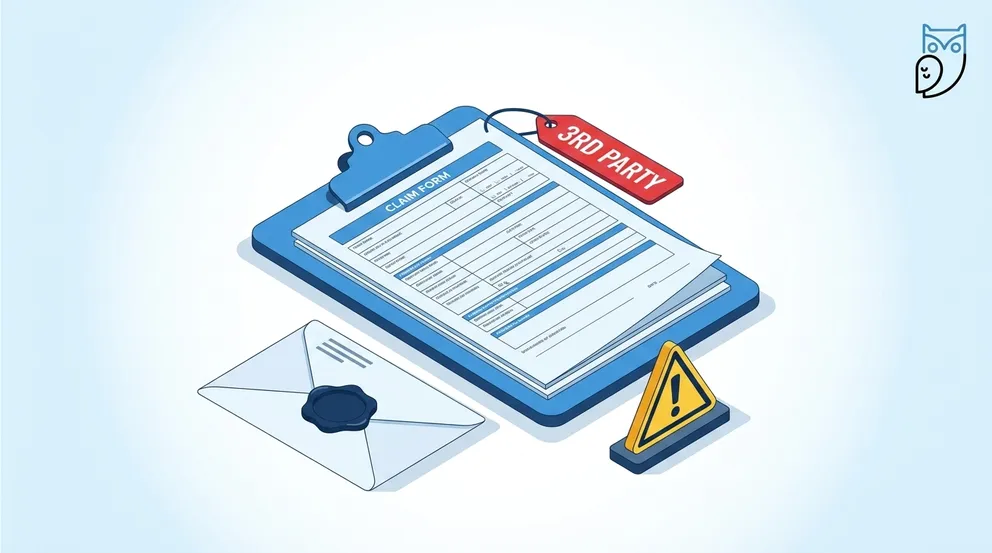
Filing a claim against another driver's insurance, called a third-party claim, starts when you contact the at-fault driver's insurer directly using the policy number from their ID card. You're a claimant, not a customer, so the adjuster has no duty to maximize your payout. The average bodily injury liability claim now sits at $29,900 (CCC Intelligent Solutions, 2025).
Getting rear-ended by a driver carrying state-minimum coverage often turns into a months-long fight over money. The average bodily injury liability claim hit $29,900 per injured person in mid-2025, a 32% jump since 2021 according to CCC Intelligent Solutions, while 28 states still let drivers carry just $25,000 per person in bodily injury limits. If you want the full breakdown of every claim type, our step-by-step guide to filing a car insurance claim covers first-party claims in depth; this guide focuses on the trickier third-party process where you're dealing with the other driver's insurer instead of your own.
When you're hit by a clearly at-fault driver, the rulebook flips. You're not a policyholder of their insurance company. You're a claimant, which means the adjuster on the other end of the phone owes you no contractual duty. A Triple-I and Casualty Actuarial Society analysis published October 2025 found that claim severity drove $231.6 billion to $281.2 billion in extra liability losses over the past decade, and carriers have responded by tightening third-party payouts and pushing adjusters to settle below initial reserves.
What a Third-Party Claim Actually Is
A first-party claim runs through your own policy, where your insurer owes you a duty of good faith. A third-party claim runs through the at-fault driver's liability policy, and you have no such relationship with that company. The Insurance Information Institute defines a third-party claim as one filed by someone other than the policyholder against the insurer. Allstate's claims guide describes the claimant "as the third party because you're filing the claim with an insurer you may not have a policy with."
Practical translation: their adjuster reports to their employer, and every dollar paid to you reduces the company's loss ratio. This matters because a single $29,900 medical bill already exceeds 28 states' per-person bodily injury minimums. New Jersey raised its required limits to 35/70/25 on January 1, 2026, and California moved to 30/60/15 in 2025, but most states still set the floor at 25/50/25.
- A third-party claim targets the at-fault driver's liability policy, not your own coverage.
- The other insurer's adjuster works for the insurance company, with no contractual duty to maximize your recovery.
- You are not legally required to give a recorded statement to a third-party insurer.
- Statute-of-limitations deadlines range from 2 years (Texas, California, Florida personal injury) to 3 years (New York, Maryland) and even longer in a few states.
- If the at-fault driver's limits won't cover your loss, your underinsured motorist coverage fills the gap up to your own limits.
How to File a Third-Party Claim, Step by Step
Lock down the at-fault driver's information at the scene
Capture the driver's full name, phone number, license number, license plate, vehicle make and model, insurer name, policy number, and policy effective dates. Photograph their insurance ID card and driver's license. Progressive's claims center lists exactly seven required items, and missing any one slows fault determination by days or weeks.
Get a police report on file
Call 911 if anyone is injured or vehicles block traffic. If officers don't dispatch, file a counter report at the local station within 24 hours. The III recommends recording the responding officer's name, badge number, and report number before leaving the scene because the at-fault insurer will request the report directly during their investigation.
Notify your own insurer within 24 to 48 hours
Report the accident to your own carrier even if you don't plan to file on your policy, because most policies make prompt notice a condition of coverage. Your insurer can pursue subrogation against the at-fault company if you later use collision coverage to get repaired faster, then refund your deductible after they recover.
Open the claim with the at-fault insurer
Call the other driver's insurance company and state that you're filing a third-party claim against their insured. Provide the policy number, the accident date, the location, and a brief factual summary. Don't speculate about fault, don't apologize, and don't agree to a recorded statement on the first call.
Submit documentation and follow up in writing
Send repair estimates, medical bills, lost-wage records, and the police report through the insurer's claims portal or by certified mail. Keep copies of every email and a phone log noting date, adjuster name, and what was said. Documented submissions are far harder to "lose" than verbal commitments.
What You Need Before Filing
- Police report number and the responding officer's badge ID
- The at-fault driver's insurance company name, policy number, and effective dates
- Photographs of all vehicles, the accident scene, and any visible injuries
- Two written repair estimates from licensed body shops, since the at-fault insurer will push you toward their preferred shop
- Itemized medical bills, ER discharge paperwork, and follow-up treatment records
- Pay stubs covering the four weeks before the crash if you're claiming lost wages
- A written diagnosis from a physician linking your injury to the crash
The Other Driver's Adjuster Is Not a Neutral Party
Adjusters working for the at-fault carrier have one structural job: close the file for as little money as possible. The Triple-I/Casualty Actuarial Society analysis released October 30, 2025 documented $231.6 billion to $281.2 billion in extra liability losses over a decade, and insurers responded by tightening third-party reserves.
The neutrality myth is the single biggest mistake claimants make. Adjusters are professional, often friendly, and trained to sound like they're helping. Their performance reviews track average payout per file. Settling your claim quickly and cheaply is how they get promoted.
The third-party insurer will often ask for a recorded statement on the first call, framed as a routine procedure. United Policyholders, the national consumer insurance watchdog, advises claimants to refuse until they understand their rights. You have no contract with the other driver's insurer, so you have no contractual duty to give one. Florida law explicitly does not require it under Statute § 624.155.
The first settlement offer often arrives within 5 to 14 days and typically lands 30% to 50% below documented damages. Don't sign anything labeled "release of all claims" until your medical treatment has either resolved or stabilized, because that signature closes the file permanently and waives any future claim related to the same accident.
When the Other Insurer Disputes Fault
About 12.6% of US drivers carry no insurance at all according to the Insurance Research Council, and even insured drivers' carriers will dispute fault when their policy is on the hook. If the adjuster claims their insured wasn't at fault, take these specific actions:
- Request a written denial that cites the specific policy provision or factual basis. Verbal denials don't count and can be reversed once put in writing.
- Pull the police report, any traffic camera footage, and any doorbell or dashcam recordings through formal public records requests. Most municipalities respond within 10 business days.
- File a complaint with your state Department of Insurance if the adjuster stops responding or refuses to investigate. NAIC's Consumer Information Source tracks complaints by company, and insurers monitor them at the corporate level.
- Hire a personal injury attorney for any claim involving meaningful injury. Most work on contingency at 33% of recovery, and represented claimants typically settle for substantially more than unrepresented ones according to Insurance Research Council data.
Statute of Limitations: How Long You Have to File
Filing a claim with the insurer is not the same as filing a lawsuit, but if negotiations stall, the lawsuit deadline becomes the binding deadline. Missing it bars your case forever, even if liability is undisputed.
| State | Personal Injury | Property Damage | Notes |
|---|---|---|---|
| California | 2 years | 3 years | 6 months for claims against government entities |
| Florida | 2 years | 4 years | PI cut from 4 years to 2 on March 24, 2023 |
| Louisiana | 2 years | 1 year | PI extended from 1 to 2 years for accidents on/after July 1, 2024 |
| New York | 3 years | 3 years | Among the longest deadlines in the US |
| Texas | 2 years | 2 years | Same deadline for both injury and property damage |
Source: Findlaw and MWL Law 50-state statute of limitations survey, 2025. Government-entity claims often have shorter notice periods (60 to 180 days). Always confirm with a licensed attorney in your state.
When to Use Your Own Insurance Instead
Three scenarios make your own policy the smarter route, even when fault clearly belongs to the other driver:
The at-fault driver's limits won't cover your loss. If your $30,000 vehicle is totaled by a driver carrying a $25,000 property damage limit, your underinsured motorist property damage coverage fills the $5,000 gap. The same logic applies to bodily injury when hospital bills exceed the at-fault driver's per-person limit. Pair this with our breakdown of what happens when your car is totaled for the full settlement math.
The at-fault driver is uninsured or fled the scene. Your uninsured motorist coverage handles both situations, including hit-and-run claims in most states.
You need your car repaired immediately. Your own collision coverage pays out faster than a third-party property damage claim, which can stretch 30 to 90 days during any fault dispute. You'll pay your deductible upfront, but your insurer will subrogate against the at-fault carrier and refund your deductible if recovery succeeds. Our guide on whether to file a claim or pay out of pocket walks through the rate-impact math, and our first 24 hours after a car accident guide covers the immediate post-crash steps that protect your claim.
Settlement negotiations stall most often because claimants accept verbal promises. Send every counter-offer, every estimate, and every demand by certified mail or through the carrier's documented claims portal. Time-stamped paper trails protect you in any later accident claim settlement negotiation or lawsuit.
Frequently Asked Questions
Yes. The at-fault driver's liability coverage applies to anyone they injure or whose property they damage, regardless of whether the claimant carries insurance. California, Louisiana, Michigan, and several other states restrict uninsured drivers from collecting non-economic damages such as pain and suffering, but property damage and medical bills remain claimable in every state.
Property damage claims typically settle within 14 to 30 days when fault is clear and damage estimates align. Bodily injury claims average 4 to 12 months because they require completed medical treatment before final settlement. Disputed liability cases routinely run 6 to 18 months according to Insurance Information Institute claim-handling benchmarks.
Almost never. Initial offers from third-party adjusters typically come in 30% to 50% below documented claim value. Get all repair estimates and medical bills in writing first, then counter with a specific itemized demand letter that lists every dollar of property damage, medical expense, and lost wages, plus a documented multiplier for pain and suffering when injuries are involved.
File a written complaint with your state Department of Insurance. Most state DOIs require carriers to respond to claimants within 10 to 15 business days, and a regulatory complaint usually triggers callbacks within 48 hours. The NAIC Consumer Information Source publishes per-company complaint counts, and a pattern of unanswered claims can support a bad-faith allegation in states like Florida that recognize one. Our car accident legal advice guide covers when to escalate.
- Insurance Information Institute : What to Do at the Scene of an Accident
- Triple-I and Casualty Actuarial Society : Legal System Abuse Drives $230B+ in Liability Insurance Losses (October 30, 2025)
- Progressive : What Is a Third-Party Insurance Claim?
- Allstate : How to File a Third-Party Insurance Claim (Updated January 2026)
- Insurance Research Council : One in Eight Drivers Was Uninsured
- Insure.com : State Minimum Car Insurance Requirement Changes for 2026
- FindLaw : Car Accident Insurance Claims Time Limits by State
- United Policyholders : Consumer Insurance Advocacy Resources