

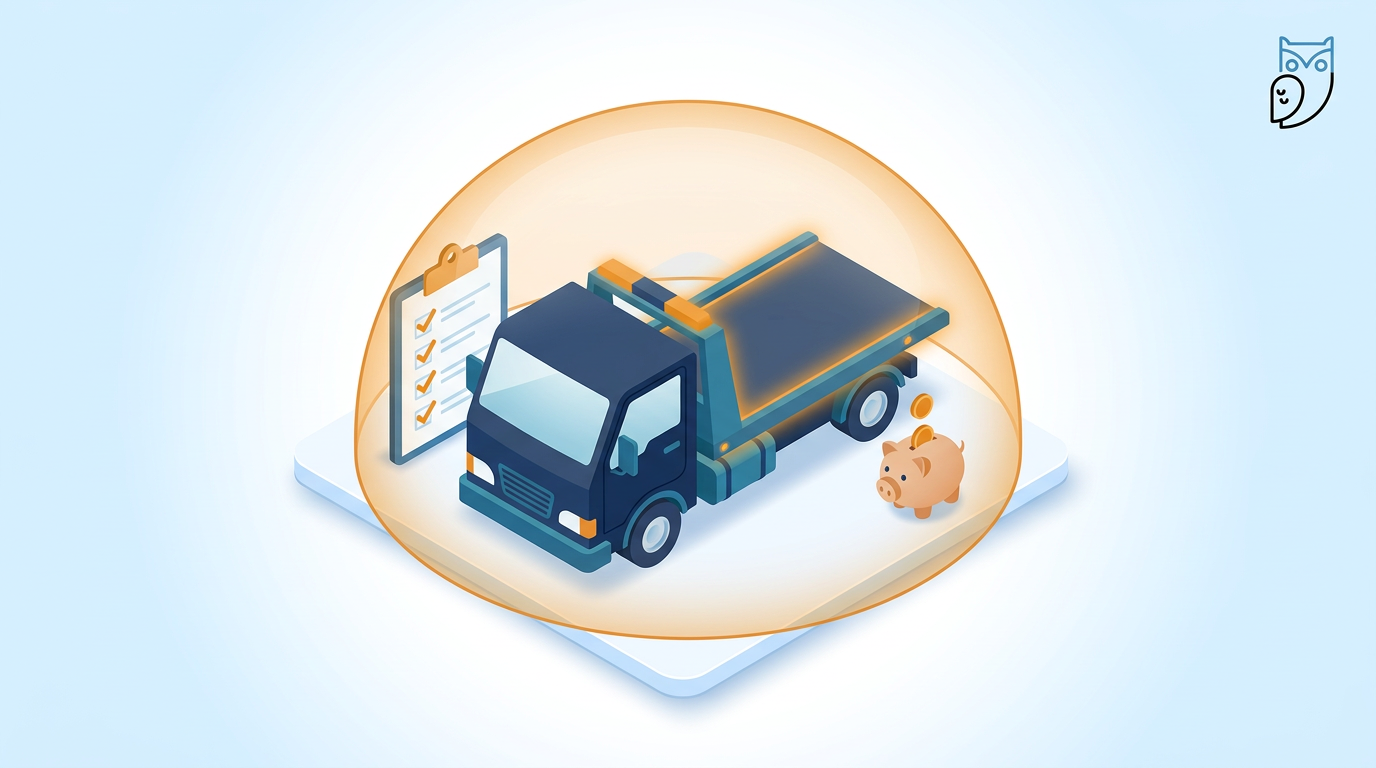
Transit recovery truck insurance costs between $4,200 and $30,000+ per truck per year, depending on truck class, driver history, and operating area. At minimum, you'll need commercial auto liability, physical damage, and on-hook (towing) coverage to legally operate and protect customer vehicles in your care.
- Federal law requires at least $750,000 CSL in liability for for-hire carriers over 10,001 lbs—most contracts demand $1M+
- On-hook coverage is unique to towing: it protects customer vehicles while hooked to your truck
- Light-duty operators typically pay $350–$750/month; heavy-duty rotator operators can pay $1,200–$2,500/month
- Driver MVR records are one of the biggest rate factors—a poor record can double your premium
- Dash cams and telematics can reduce rates and provide critical liability defense after incidents
What Is Transit Recovery Truck Insurance?
If you run any kind of breakdown or vehicle recovery operation—whether you're pulling cars off highways, clearing accident scenes, or providing roadside assistance—you already know the risks are different from regular commercial trucking. Transit recovery truck insurance is a specialized bundle of commercial policies designed specifically for businesses that tow, transport, and recover vehicles for others.
It's not just about protecting your truck. When someone's car is hooked to your rig, you're responsible for it. If something goes wrong in transit—a chain snaps, a vehicle falls off a flatbed—you're liable. Standard commercial auto insurance doesn't cover that. That's where recovery-specific policies come in.
Here's the thing most new operators don't realize: you'll likely need several separate policies working together, not just one catch-all policy. Understanding what each covers—and what it doesn't—is what separates operators who thrive from those who face catastrophic uncovered losses.
Types of Coverage You Need
Recovery truck operations require a stack of policies, each filling a different gap. Skipping any one of them can leave you exposed to a claim that wipes out your business.
Commercial Auto Liability
This is your foundation. Commercial auto liability pays for injuries and property damage you cause to others while operating your recovery truck. Think of it as the equivalent of personal auto liability—just built for commercial vehicles with much higher limits.
For for-hire carriers operating vehicles over 10,001 lbs, the FMCSA mandates a minimum of $750,000 combined single limit (CSL). But here's where it gets real: most motor clubs, city contracts, and rotation lists require $1,000,000 CSL as a baseline. Some roadside assistance networks push that to $2,000,000 per occurrence with a $3,000,000 aggregate. If your certificate doesn't show the right limits, you're off the list.
State minimums for commercial auto liability are almost always lower than what contracts and rotation lists actually require. Always verify what your motor club or city dispatch requires before purchasing—buying to the state minimum could leave you ineligible for work.
On-Hook / Towing Coverage
This is the coverage that's unique to the towing industry—and the one most operators wish they'd understood better before their first incident. On-hook coverage protects a customer's vehicle while it's physically attached to your truck and being transported.
It doesn't matter whose fault it is. If a vehicle rolls off your flatbed or sustains damage during a tow, your general liability or commercial auto policy won't respond. On-hook will. Typical limits range from $25,000 to $100,000 per vehicle, though operators who handle high-value or luxury vehicles should consider higher limits.
Garagekeepers Insurance
Got a storage yard? Then you need this. Garagekeepers covers customer vehicles that are in your physical custody on your premises—whether waiting for pickup, impounded, or stored overnight. It responds to theft, fire, vandalism, and weather damage to vehicles you're holding.
There are two types: direct primary (you pay regardless of fault) and direct excess (only kicks in if the vehicle owner's own policy doesn't cover it). For impound lots and storage yards, direct primary is typically what clients and municipalities expect to see.
Physical Damage Coverage
This covers your trucks—not your customers' vehicles, but your actual recovery equipment. It combines collision (damage from accidents) and comprehensive (theft, fire, hail, vandalism) into one package. For a $150,000 rotator or heavy wrecker, this isn't optional. A single total loss without physical damage coverage can shut down your operation.
General Liability Insurance
This fills the gaps that commercial auto leaves. Slip-and-fall incidents at your facility, property damage from your winch cable hitting something it shouldn't, or a customer injured at your storage yard—general liability handles non-auto third-party claims. Most operators add it on for roughly $58/month or $700/year, and it's required by most commercial leases and contracts.
Workers' Compensation
Towing is dangerous. Research shows tow truck operators face fatality rates approximately 15 times higher than the private-industry average. Most states require workers' comp the moment you hire your first employee, and the exposure in this industry is real—roadside work puts drivers in live traffic constantly.
If you classify drivers as independent contractors to avoid workers' comp, be careful. Many states scrutinize this classification heavily in the towing industry. A misclassification finding could expose you to back premiums, fines, and uncovered claims.
How Much Does Recovery Truck Insurance Cost?
Let's talk actual numbers. Transit recovery truck insurance costs vary dramatically based on truck class, location, and your operation's risk profile—but here's a realistic breakdown for 2026.
For a single-truck operation running a light-duty rollback, most operators report paying between $450 and $620 per month all-in, with some landing closer to $737/month ($8,839/year) depending on territory. Heavy-duty and rotator operators in urban markets can push well past $2,500/month per truck.
Here's what drives your number up or down the most:
Factors That Affect Your Premium
- Driver MVRs: A single DUI or major violation on a driver's record can add 30–60% to your premium. Multiple violations? Some carriers will decline to quote entirely.
- Claims history: Prior at-fault accidents and on-hook claims follow your operation for 3–5 years. Frequent small claims can hurt as much as one large one.
- Operating radius: Local operations (under 50 miles) typically rate lower than regional or statewide operations.
- Service type: Repossession and accident recovery command higher premiums than simple roadside assistance. Some carriers won't write repo work at all.
- Garaging ZIP code: Urban areas with high traffic density and litigation rates cost more to insure.
- Equipment value: A $200,000 rotator requires more physical damage premium than a $35,000 rollback.
The fastest way to inflate your recovery truck insurance premium is to have drivers with poor MVRs. Tighten your hiring standards and implement a formal driver qualification program before shopping for coverage—it makes a measurable difference in what carriers will offer.
Federal and State Requirements
Recovery truck operators don't just answer to state insurance departments—the FMCSA has its own requirements that apply to for-hire carriers crossing state lines or meeting certain weight thresholds.
FMCSA Requirements
If your recovery trucks are used for hire and have a gross vehicle weight rating (GVWR) over 10,001 lbs, federal minimum liability requirements kick in. The baseline is $750,000 CSL for general freight, but most towing operations dealing with passenger vehicles fall into the $750,000 tier. Hazmat carriers face higher minimums—up to $5,000,000 for certain materials.
You'll also need to register with the FMCSA, obtain a USDOT number, and file your insurance electronically (Form BMC-91 or BMC-91X) so your coverage can be verified. Let your insurance lapse without notifying the FMCSA and you risk losing your operating authority.
State-Specific Considerations
Every state sets its own baseline requirements for commercial vehicles, and towing operations are no exception. Beyond state minimums, what really matters are the requirements set by your motor club contracts and any municipal or county rotation lists you want to be on.
Most municipalities maintain approved tow lists with strict insurance minimums—typically $1M auto liability and specific on-hook limits. Get on the list; build your business.
AAA, Agero, NSD, and similar networks have their own insurance requirements. Some require $2M per occurrence—check your specific contract.
State commercial vehicle minimums vary widely. Always buy to contract minimums, not state minimums—they're almost always lower than what work actually requires.
Fleet Coverage for Multiple Trucks
If you're operating three or more recovery trucks, a fleet policy almost always makes more financial sense than insuring each vehicle separately. Fleet policies bundle all your vehicles under a single policy with a single renewal date, which simplifies management and often reduces per-unit cost.
The key advantage beyond cost? Fleet policies typically allow you to add or remove vehicles mid-term without major paperwork headaches. As you grow—adding a new wrecker or retiring an old rollback—the adjustment is straightforward.
- Single policy, single renewal—easier to manage
- Per-unit savings at 3+ vehicles
- Flexible to add/remove vehicles mid-term
- Blanket driver scheduling often available
- One major claim affects the whole fleet's renewal
- Less coverage customization per vehicle
- Some carriers require minimum fleet sizes
- Driver lists must stay current or coverage disputes arise
How to Lower Your Recovery Truck Insurance Costs
Rates for recovery operations have been trending up through 2025 into 2026—claim severity, ADAS-equipped vehicle repair costs, and litigation trends all push premiums higher. But there are legitimate ways to fight back on cost.
Tighten Driver Standards
Implement a formal driver qualification program. Require MVR checks before hiring and annually thereafter. Drivers with clean 3-year records are a major underwriting credit.
Install Dash Cams and Telematics
Carriers offer measurable credits for vehicles equipped with forward-facing dash cams and GPS telematics. More importantly, footage exonerates your drivers in disputed claims—preventing rate increases.
Document Every Tow with Photos
Timestamped before-and-after photos of every vehicle you tow dramatically reduce on-hook claim disputes. This documentation habit can prevent dozens of small claims that add up to significant premium increases.
Shop Your Renewal 30–60 Days Early
Don't wait for your renewal notice. Getting competing quotes 30–60 days out gives you time to negotiate and switch if needed—last-minute shopping means fewer carrier options.
Right-Size Your Deductibles
Raising your physical damage deductible from $1,000 to $2,500 can meaningfully reduce your premium. If you have the cash reserves to absorb smaller losses, higher deductibles make financial sense.
Work with a broker who specializes in commercial trucking and towing—not a generalist agent. Specialty brokers have access to admitted and non-admitted carriers that specifically write towing risks, and they know which markets are competitive for your operation type. A generalist often can only offer one or two options.
What About Repo and Non-Consent Towing?
If your operation includes vehicle repossession or non-consent (police-dispatch) towing, understand that these are higher-risk services that some carriers flat-out won't write—and those that will, charge accordingly.
Repo work introduces confrontational scenarios that increase bodily injury and property damage exposure. Non-consent towing—where the vehicle owner didn't request the tow—generates a disproportionate share of disputes, property damage claims, and even lawsuits compared to consent towing. If you're considering expanding into these services, be upfront with your broker before your policy renews. Hiding it and getting caught mid-claim is worse than paying the higher premium upfront.
Misrepresenting your service types on an insurance application is considered material misrepresentation—a basis for policy rescission. If you list "roadside assistance only" and then get a claim arising from a repo operation, your insurer can deny coverage and potentially void the policy entirely.
Getting the Right Policy for Your Operation
Here's the honest bottom line on transit recovery truck insurance: it's more complex than standard commercial auto, more expensive than most new operators expect, and absolutely non-negotiable if you want to protect your business, your drivers, and your customers.
The good news? With the right broker and the right operational practices, you can get competitive coverage that doesn't eat your profit margin alive. The operators who pay the most are usually those who ignored driver MVRs, skipped documentation practices, or waited until renewal day to shop around.
Before you pick a policy, be clear on these four things: what contracts and rotation lists you need to qualify for, how many trucks and drivers you're insuring, what services you'll actually perform (consent, non-consent, repo, storage), and what your garaging location is. With those answers in hand, a specialty commercial trucking broker can build you a coverage stack that actually fits.
Frequently Asked Questions
Recovery truck insurance costs between $4,200 and $9,000 per year for light-duty trucks, $7,800 to $13,200 for medium-duty wreckers, and $14,400 to $30,000+ for heavy-duty rotators. Single-truck operators typically pay $450–$737 per month. Your specific premium depends on truck class, driver records, operating area, and service types.
On-hook coverage protects a customer's vehicle while it's physically attached to your recovery truck and being transported. Yes, you absolutely need it—your commercial auto liability policy does not cover damage to the vehicles you're towing. It's a separate policy specific to the towing industry.
For-hire carriers with vehicles over 10,001 lbs GVWR must carry a minimum of $750,000 combined single limit (CSL) in commercial auto liability. Most contracts and rotation lists require $1,000,000. You must file proof of insurance with the FMCSA via Form BMC-91 or BMC-91X to maintain operating authority.
No. Personal auto insurance explicitly excludes commercial vehicle use and for-hire operations. If you're using a truck to tow vehicles for others—even part-time—you need a commercial auto policy. Operating without proper commercial coverage puts your personal assets at risk and exposes you to regulatory penalties.
Yes. Fleet policies cover three or more vehicles under a single policy with one renewal date, simplifying management and often reducing per-unit costs. Fleet coverage allows you to add or remove vehicles mid-term and typically includes blanket driver scheduling options.
- Logrock - Tow Truck Insurance: 2026 Costs & Coverage Guide
- Pro Insurance Group - Tow Truck Insurance: 2026 Costs & Coverage
- MKI Wheels - Insurance for Towing and Recovery Companies
- FMCSA - Insurance Filing Requirements for Motor Carriers
- Insurance Information Institute - Commercial Lines Insurance Facts