

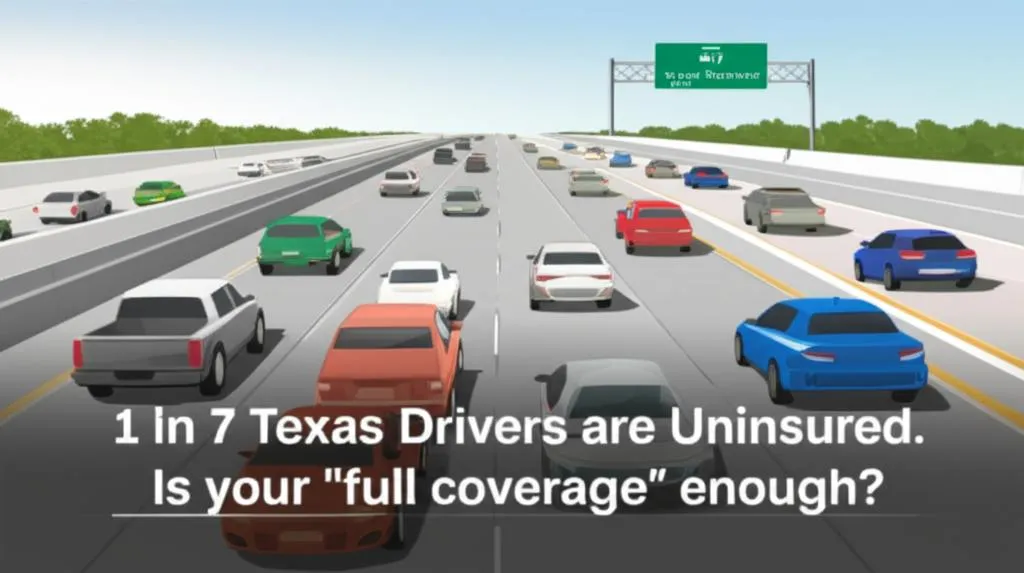
When "Full Coverage" Isn't Enough
Last Tuesday at 2:47 PM, Maria Gonzalez watched $4,200 disappear from her family's vacation fund in the time it takes a traffic light to turn green. The uninsured driver who rear-ended her Honda CR-V on Preston Road didn't just damage her bumper—he shattered her assumption that "doing everything right" would protect her financially.
Three weeks later, Maria still drives a rental car while waiting for an insurance settlement that may never come. Her careful 15-year driving record and comprehensive coverage meant nothing when the other driver handed her a fake insurance card and vanished before police arrived.
Maria's experience isn't an outlier—it's becoming the norm across Texas. One in seven drivers around you right now lacks required insurance coverage. That means every time you merge onto I-35, navigate the Katy Freeway, or drive through downtown Dallas, you're sharing the road with over a million uninsured motorists who could leave you financially devastated.
Your Protection Strategy: UM/UIM Coverage
Before we dive into the scope of Texas's insurance crisis, let's address the most important question: How can you protect yourself?
Uninsured/Underinsured Motorist (UM/UIM) coverage is your financial shield against drivers like the one who hit Maria. Texas law requires insurers to offer this protection to every policyholder, though purchasing remains optional. If you decline, you must do so in writing—reflecting the state's recognition that this coverage is essential in our current environment.
What UM/UIM Actually Protects
This coverage steps in when accidents involve drivers who lack adequate insurance or flee the scene. Hit-and-run incidents where you cannot identify the at-fault driver trigger UM coverage benefits. Drivers whose insurance proves insufficient for serious accident damages activate your UIM coverage.
The coverage includes property damage protection with a $250 deductible, making it financially accessible while providing substantial protection. More importantly, UM/UIM covers medical expenses, lost wages, and vehicle replacement costs that uninsured drivers cannot pay.
Smart coverage recommendation: Purchase UM/UIM limits that match or exceed your liability limits. Given that many Texas drivers carry only minimum coverage—inadequate for serious accidents—consider limits sufficient to replace your vehicle and cover potential medical expenses.
The modest premium increase provides protection against tens of thousands in potential out-of-pocket expenses. For most drivers, this coverage costs an additional $15-25 monthly—far less than Maria's $4,200 surprise bill.
Why One in Seven Cars Around You Lacks Insurance
Texas confronts an insurance crisis affecting every driver who pays premiums responsibly. Current data reveals 13.8% of Texas drivers lack mandatory coverage—approximately 1.2 million people driving without insurance across the state.
State agencies suspect the real problem is much worse. While consumer research firms cite 13.8%, Texas officials suggest the rate could reach 20%—potentially over 3 million uninsured drivers. This massive discrepancy highlights how difficult tracking becomes when dealing with people actively avoiding the system.
Uninsured rates have climbed steadily since 2019, driven by rising insurance costs, economic uncertainty, and inflation. When insurance premiums jumped 23.8% in 2022 and another 25.5% in 2023, many Texas families faced an impossible choice: pay for groceries or pay for car insurance.
The Economics Behind the Crisis
Consumer surveys reveal that 82% of uninsured Texas drivers cite affordability as their primary reason for lacking coverage. Single mother Carmen Rodriguez from Houston describes the impossible choice facing many families: "When my premium jumped from $180 to $280 per month, I had to choose between car insurance and groceries for my kids. I drove without insurance for three months until I found a cheaper company, but I was terrified every day."
Geographic inequality amplifies the problem. Premium impacts hit differently based on where you live and work. Low-income neighborhoods face premium increases up to five times higher than affluent areas, creating a vicious cycle where rising costs push more people into the uninsured category.
A Harris County study revealed shocking disparities: drivers in zip codes like 77026 (Third Ward) pay average premiums of $3,200 annually, while drivers in 77024 (Memorial) pay just $1,100 for similar coverage.
The $900 Hidden Fee Every Texas Driver Pays
Here's what insurance companies don't advertise prominently: responsible Texas drivers pay approximately $900 extra annually because of uninsured motorists. This hidden surcharge funds claims that uninsured drivers should cover but can't, forcing insurance companies to absorb costs and pass them to paying customers.
When an uninsured driver causes $15,000 in damage, that money doesn't disappear—it gets distributed across all policyholders through higher premiums. Insurance companies tracked over $2.6 billion in uncompensated claims related to uninsured drivers in Texas during 2023.
This situation intensified as Texas experienced some of America's steepest auto insurance increases. The state's average annual premium reached approximately $1,700 in 2023—significantly above the national average of $1,424. The uninsured driver component represents a substantial portion that responsible drivers subsidize involuntarily.
What Texas Law Actually Protects (And What It Doesn't)
Texas requires all drivers to carry minimum liability coverage: $30,000 for bodily injury per person, $60,000 for total bodily injury per accident, and $25,000 for property damage. These requirements trace back to the Texas Motor Vehicle Safety Responsibility Act, designed to ensure accident victims receive basic compensation.
However, these minimums prove woefully inadequate for real-world accidents. Modern vehicle values average $35,000-$50,000, while medical expenses from serious injuries easily exceed $100,000. Even when at-fault drivers carry required insurance, victims frequently face substantial out-of-pocket costs.
When Penalties Don't Deter
Texas imposes escalating penalties meant to discourage uninsured driving. First-time offenders face fines of $175-$350 plus a misdemeanor conviction, though courts can reduce penalties for demonstrated financial hardship.
Repeat offenders encounter harsher consequences: fines increase to $350-$1,000, accompanied by license and registration suspension lasting up to two years. The state requires an SR-22 financial responsibility filing and imposes a $250 annual surcharge for three years.
Uninsured drivers involved in accidents face the most severe penalties: fines up to $4,000 and possible jail time if serious injury or death results. Yet despite these harsh consequences, uninsured rates continue climbing, suggesting economic desperation often outweighs fear of penalties.
Your Risk Changes Dramatically at State Lines
Texas sits at the national average of 14% uninsured drivers, but regional patterns reveal troubling trends. If you think Texas roads are risky, crossing into New Mexico means nearly one in four drivers around you lacks insurance—making that family road trip to Santa Fe significantly more dangerous than you realized.
Regional uninsured rates that affect your travel: - New Mexico: 24.9% (nearly 1 in 4 drivers) - Mississippi: 22.2% - Louisiana: 13.7% (similar to Texas) - South Carolina: 12.3% (better than Texas) - North Carolina: 11.1%
When nearly one in four drivers in neighboring states lacks coverage, the problem becomes regional, not just local. Adjust your coverage accordingly if you frequently travel to high-risk states.
Real Texas Drivers Share Hard-Learned Lessons
Twenty-eight-year-old Austin resident Jake Morrison learned about uninsured drivers the expensive way when a pickup truck ran a red light and T-boned his Honda Civic on South Lamar Boulevard. The at-fault driver not only lacked insurance but also provided false contact information before fleeing the scene.
"I thought having full coverage meant I was protected," Jake explains. "I didn't realize I needed special coverage for uninsured drivers. My insurance covered most of the damage, but I still paid $1,800 out of pocket for my deductible and rental car expenses."
Jake's story illustrates why the term "full coverage" misleads consumers. True protection requires understanding what your policy actually covers—and more importantly, what it doesn't.
The Technology Gap
Texas operates the TexasSure verification system, an electronic database matching registered vehicles to active insurance policies for real-time verification during traffic stops. While innovative, the system faces significant implementation challenges.
Data reporting lag creates temporary false "uninsured" flags when insurance changes haven't updated in the system. More problematically, limited enforcement authority means database verification alone hasn't substantially reduced uninsured rates.
Your Financial Protection Action Plan
Given Texas's persistent uninsured driver challenges, responsible drivers must take proactive steps to protect their financial interests.
Immediate Steps You Can Take Today
1. Audit your current policy immediately to confirm active UM/UIM coverage at adequate levels. Many drivers unknowingly declined this coverage or carry insufficient limits. Call your agent today to verify your coverage details.
2. Increase coverage limits to match your vehicle's value and potential medical expense exposure. Consider UM/UIM limits that equal or exceed your liability coverage.
3. Shop competitively by comparing rates annually using Texas Department of Insurance comparison tools. Premium variations between companies can exceed $500 annually for identical coverage.
Document Everything After Any Accident
- Take photos of all vehicles, license plates, and driver's licenses
- Get contact information for all parties and witnesses
- Call police even for minor accidents—many uninsured drivers rely on avoiding official reports
- Never accept "I'll pay cash" offers from at-fault drivers
Supporting Long-Term Solutions
Contact your state representatives to support legislative initiatives addressing insurance affordability and territory-based pricing inequities. Reform proposals include subsidized insurance programs for low-income drivers and enhanced oversight of pricing practices.
Report suspected uninsured violations to law enforcement when safe to do so. While individual reports may have limited immediate impact, aggregate data helps authorities identify enforcement priorities.
Breaking the Cycle: What Comes Next
Texas's uninsured driver crisis demands both immediate personal protection and long-term systemic solutions. The hidden $900 annual tax that uninsured drivers impose on responsible policyholders demonstrates why individual protection through adequate UM/UIM coverage remains essential today.
However, sustainable solutions must address root causes driving families to abandon insurance coverage. Rising premiums that outpace wage growth create impossible choices for working families, while territory-based pricing practices worsen economic inequality through insurance costs.
Consumer frustration has prompted legislative proposals for public insurance options and state-backed programs designed to improve affordability and access. These initiatives reflect growing pressure for systemic solutions beyond individual consumer protection measures.
Success requires coordinated efforts: responsible drivers protecting themselves through adequate coverage, policymakers addressing affordability and equity issues, and enforcement systems that effectively deter uninsured driving without creating undue hardship for struggling families.
The bottom line: While we work toward better solutions, protect yourself now with robust UM/UIM coverage. The modest premium increase provides protection against catastrophic expenses while offering peace of mind for daily driving among over one million uninsured Texas motorists.
Don't let your story end like Maria's—wondering why "full coverage" wasn't enough.
References
-
FinanceBuzz. (2025, April 16). Uninsured motorist statistics by state. https://financebuzz.com/uninsured-motorist-statistics-by-state
-
Jim Adler Legal Blog. (2024, July 22). More drivers going uninsured as car insurance rates rise. https://www.jimadler.com/blog/more-drivers-going-uninsured-as-car-insurance-rates-rise/
-
Texas Department of Insurance. (2025, March 7). Protect against other drivers with uninsured motorist coverage. https://www.tdi.texas.gov/blog/protect-against-other-drivers-with-uninsured-motorist-coverage.html
-
Texas Appleseed. (2025, February 4). New Harris County study finds drivers in low-income ZIP codes more likely to pay higher car insurance. https://texasappleseed.org/new-harris-county-study-finds-drivers-low-income-zip-codes-more-likely-pay-higher-car-insurance
-
Insurance Information Institute. (2024). Facts + statistics: Uninsured motorists. https://www.iii.org/fact-statistic/facts-statistics-uninsured-motorists
-
ValuePenguin. (2024, May 15). Auto insurance: Texas penalties for driving without insurance. https://www.valuepenguin.com/auto-insurance/texas/penalties-driving-without-insurance