

This article is part of our complete guide to types of car insurance coverage — for the full picture on every coverage type, start there.
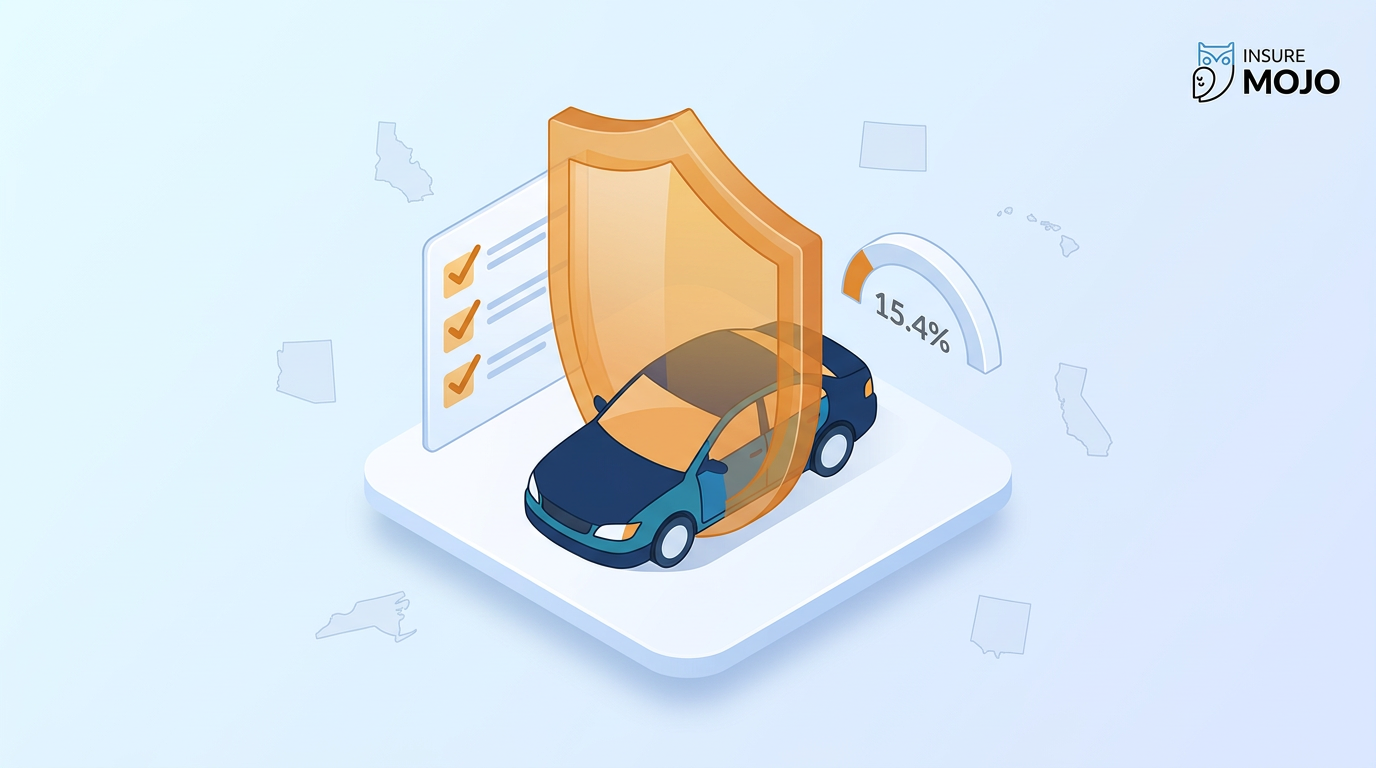
Uninsured motorist (UM) coverage pays your medical bills and repairs when the at-fault driver has no insurance. According to the Insurance Research Council's 2025 study, 15.4% of U.S. drivers — roughly 1 in 7 — were uninsured in 2023. UM/UIM coverage typically adds just $50–$75 per year to your premium.
What Is Uninsured Motorist Coverage?
When a driver runs a red light and hits your car, their liability insurance is supposed to pay for your medical bills and repairs. That's how the system is designed.
But what if they don't have insurance? That's where uninsured motorist (UM) coverage steps in. It fills the gap left by an at-fault driver who has no policy at all — and it also covers you in hit-and-run accidents where there's no one to chase for payment.
Underinsured motorist (UIM) coverage is the companion protection. It kicks in when the at-fault driver has insurance, but their limits aren't high enough to cover your total losses. If someone rear-ends you with a $25,000 bodily injury policy and your hospital bill is $80,000, UIM bridges the $55,000 difference.
In most states, UM and UIM are sold as separate optional coverages — though 22 states and D.C. require at least one of them. Even where optional, 1 in 7 drivers on the road right now has no insurance at all.
UM vs. UIM: The Difference Explained
These two coverages protect against different failure modes:
| Situation | At-Fault Driver's Insurance | Coverage That Helps |
|---|---|---|
| At-fault driver has no insurance | None | Uninsured Motorist (UM) |
| Hit-and-run driver flees the scene | Unknown/None | Uninsured Motorist (UM) |
| At-fault driver has minimum-only limits | Exists but too low | Underinsured Motorist (UIM) |
| At-fault driver has adequate coverage | Adequate | Neither needed |
Source: Insurance Information Institute (III) coverage definitions, 2024.
UMBI vs. UMPD: The Two Components
Both UM and UIM coverage split into two distinct components, each covering a different type of loss:
Uninsured/Underinsured Motorist Bodily Injury (UMBI/UIMBI) — Pays for your medical expenses, lost wages, pain and suffering, and rehabilitation costs when an uninsured or underinsured driver injures you. It also covers passengers in your vehicle. Think of it as the PIP insurance equivalent for accidents caused by others who can't pay.
Uninsured Motorist Property Damage (UMPD) — Covers repairs to your vehicle when an uninsured driver damages it. Note: not all states offer UMPD, and in some states collision coverage serves this purpose instead. UMPD usually carries a deductible of $200–$300.
If you already carry collision coverage, UMPD may be redundant — your collision policy covers vehicle damage regardless of fault. The real protection gap is bodily injury, where UMBI is irreplaceable.
States Where UM/UIM Is Required
As of 2024, 22 states and Washington D.C. require drivers to carry some form of uninsured or underinsured motorist coverage, according to the Insurance Information Institute.
| State | Coverage Required | Minimum Limits (per person/per accident) |
|---|---|---|
| Connecticut | UM + UIM | 25/50 |
| Washington, D.C. | UM | 25/50 |
| Illinois | UM + UIM | 25/50 |
| Kansas | UM + UIM | 25/50 |
| Maine | UM + UIM | 50/100 |
| Maryland | UM + UIM | 30/60 |
| Massachusetts | UM | 20/40 |
| Minnesota | UM + UIM | 30/60 |
| Missouri | UM | 25/50 |
| Nebraska | UM + UIM | 25/50 |
| New Hampshire* | UM (if insured) | 25/50 |
| New Jersey | UM + UIM | 25/50 |
| New York | UM + UIM | 25/50 |
| North Carolina | UM + UIM | 30/60 |
| North Dakota | UM + UIM | 25/50 |
| Oregon | UM + UIM | 25/50 |
| South Carolina | UM | 25/50 |
| South Dakota | UM + UIM | 25/50 |
| Vermont | UM + UIM | 50/100 |
| Virginia | UM + UIM | 30/60 |
| West Virginia | UM | 25/50 |
| Wisconsin | UM | 25/50 |
*New Hampshire doesn't require auto insurance, but if you buy a policy, it must include UM coverage. Source: Insurance Information Institute, December 2023.
Where Uninsured Drivers Are Most Common
The risk of encountering an uninsured driver varies dramatically by state. In Mississippi, you have roughly a 1-in-5 chance the driver who hits you has no insurance. In Wyoming, that risk drops below 1-in-17.
According to the IRC's 2023 study (using data through 2022), one in three drivers nationwide was either uninsured or underinsured — a 10-point increase since 2017.
| Rank | State | Uninsured Driver Rate (2022) | UM/UIM Required? |
|---|---|---|---|
| 1 | Washington, D.C. | 25.2% | Yes (UM) |
| 2 | New Mexico | 24.9% | No |
| 3 | Mississippi | 22.2% | No |
| 4 | Tennessee | 20.9% | No |
| 5 | Michigan | 19.6% | No |
| 6 | Kentucky | 18.7% | No |
| 7 | Delaware | 18.1% | No |
| 8 | Georgia | 18.1% | No |
| 9 | Colorado | 17.5% | No |
| 10 | Ohio | 17.1% | No |
Source: Insurance Information Institute, citing Insurance Research Council data, 2022. Lowest rate: Wyoming at 5.9%, followed by Idaho and Maine at 6.2%.
Eight of the top 10 states with the most uninsured drivers do NOT require UM/UIM coverage — leaving millions of drivers exposed with no automatic safety net.
What Happens When You Have No UM Coverage
Imagine you're driving through New Mexico — where nearly 1 in 4 drivers is uninsured — and someone runs a stop sign and T-bones your car. You're taken to the hospital with a fractured collarbone and a concussion. Your car is totaled.
Total costs: $45,000 in medical bills, $18,000 vehicle replacement, $8,000 in lost wages during recovery.
The at-fault driver has no insurance and no assets. Without UM coverage, your options are: sue them personally (expensive, slow, and usually collects nothing), use your own health insurance for medical bills only, and pay out of pocket for your car. You absorb most of the $71,000 loss.
With UM/UIM coverage at $100,000/$300,000 limits? Your insurer covers your medical bills, lost wages, and pain and suffering up to your limits — and UMPD handles your car. Your total out-of-pocket is your deductible.
Health insurance covers medical bills, but not lost wages, pain and suffering, or vehicle repairs. Without UM coverage, those costs fall entirely on you — even when the accident wasn't your fault.
How Much UM/UIM Coverage Should You Carry?
The standard advice from insurance professionals: match your UM/UIM limits to your liability limits. If you carry 100/300/100 in liability coverage, get 100/300 in UM/UIM bodily injury protection.
Why? Because the gap your UM/UIM coverage needs to fill mirrors the gap someone else's liability coverage would leave. Carrying $25,000 in UM bodily injury when a single ambulance ride and overnight hospital stay can exceed $30,000 isn't real protection.
Minimum state requirements are a legal floor, not a recommended coverage level. At 25/50 minimums — the most common state requirement — a single serious accident can easily exceed your limits.
- Minimum recommended: 50/100 UM/UIM bodily injury
- Better protection: 100/300 UM/UIM bodily injury
- For high-asset drivers: Consider an umbrella policy on top of 250/500 limits
How Much Does UM/UIM Add to Your Premium?
This is the part most drivers don't expect: UM/UIM is genuinely cheap. According to industry data aggregated by Insure.com, UM/UIM coverage averages around $67 per year — about $5.60 per month.
*Costs vary by state, insurer, driving record, and coverage limits. Rates are higher in states with elevated uninsured driver populations like New Mexico and Michigan.
Rates are higher in states with large uninsured populations — Michigan, New Mexico, and D.C. drivers typically pay at the upper end of that range. If you're in Wyoming or Maine, you'll pay less because the risk pool is smaller.
When comparing quotes, ask insurers to break out UM/UIM as a line item. Many bundle it with other coverages, making it hard to see. You can often double your UM limits for less than $10/month difference.
Frequently Asked Questions
Health insurance covers medical bills but not lost wages, pain and suffering, or vehicle damage. UM/UIM coverage fills those gaps that health insurance doesn't touch. If you're hit by an uninsured driver and can't work for two months, your health insurer won't write you a check for lost income — your UM policy will.
"Stacking" means combining UM coverage limits across multiple vehicles on the same policy. About 30 states allow stacking, which can significantly increase your protection in a serious accident. If you have two cars each with $100,000 UM bodily injury, stacking gives you $200,000 in coverage for an accident involving either vehicle. Check your state's rules — some states allow it by law, others prohibit it.
In most states, filing a UM claim after an accident where you weren't at fault will not raise your rates — it's treated like a not-at-fault claim. However, some insurers do factor in UM claims when calculating premiums, so policies vary. Check your insurer's policy before filing, and consider the size of the claim relative to a potential rate increase.
Collision coverage pays for vehicle damage regardless of fault, including accidents with uninsured drivers. UM property damage (UMPD) specifically covers vehicle damage caused by an uninsured driver. The key difference: collision typically has a higher deductible ($500–$1,000) while UMPD deductibles run $200–$300. UMBI covers bodily injury — collision coverage doesn't cover medical bills at all.
- Insurance Research Council (IRC) — Uninsured and Underinsured Motorists: 2017–2023 Study
- Insurance Information Institute (III) — Facts + Statistics: Uninsured Motorists
- Insurance Information Institute (III) — Automobile Financial Responsibility Laws by State
- FinanceBuzz — Uninsured Motorist Statistics By State (2026)
- Triple-I Blog — IRC Report: 1 in 3 Drivers Uninsured or Underinsured in 2023
- ValuePenguin — Uninsured Motorist Statistics: Changes by State and Over Time