

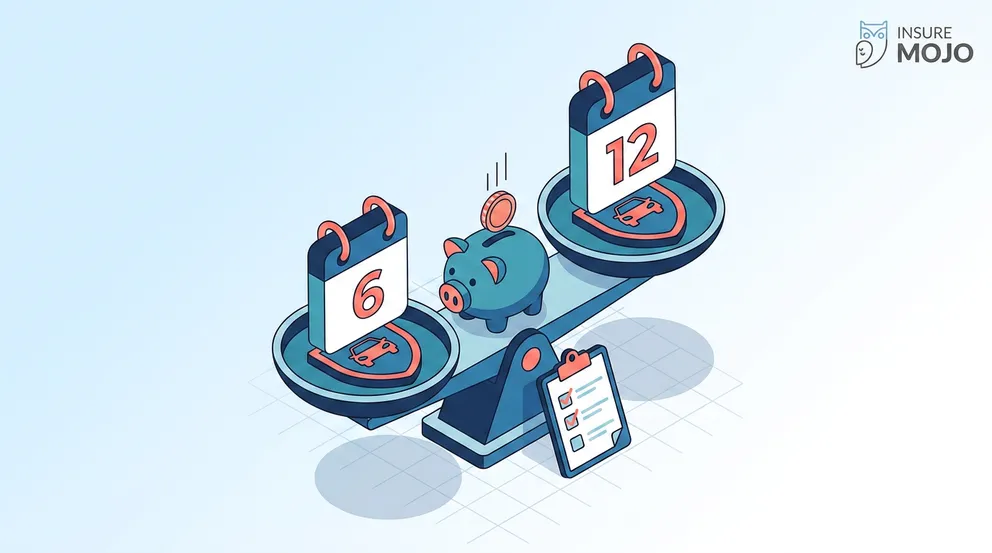
A 6-month policy lets your insurer reprice your coverage twice a year, so improvements like a cleaner driving record or better credit score lower your premium sooner. A 12-month policy locks your rate for the full year, shielding you from mid-year increases. According to MoneyGeek's 2026 analysis, the average 6-month full coverage premium is $747, with Travelers offering the lowest at $582.
Most drivers never realize they can choose between a 6-month and 12-month car insurance term. If you're shopping around or buying car insurance for the first time, the term length you pick affects how quickly rate changes hit your wallet. Insurify projects auto premiums will rise about 1% nationally in 2026, making this decision more consequential than it was a year ago.
How 6-Month and 12-Month Policies Differ
Both terms deliver identical coverage (liability, collision, comprehensive, uninsured motorist). The only mechanical difference is renewal frequency, and that single variable creates a chain of practical trade-offs.
| Feature | 6-Month Policy | 12-Month Policy |
|---|---|---|
| Rate adjustments | Every 6 months at renewal | Once per year at renewal |
| Time to capture improvements | Up to 6 months | Up to 12 months |
| Protection after a new violation | Rate increase hits within 6 months | Rate locked for the full year |
| Shopping opportunities | 2 natural windows per year | 1 natural window per year |
| Pay-in-full discount threshold | ~$747 (full coverage avg.) | ~$1,494 (full coverage avg.) |
| Cancellation flexibility | Shorter commitment, lower early-cancel risk | May incur cancellation fees mid-term |
Source: MoneyGeek, 2026. Averages based on Quadrant Information Services data for a 40-year-old driver with clean record and 100/300/100 coverage.
Coverage quality stays the same regardless of term. Your deductible, liability limits, and how your policy pays claims don't change based on whether you renew in June or December.
When a 6-Month Policy Saves You Money
Shorter terms function as a repricing tool. Every renewal is a checkpoint where your insurer recalculates based on your current profile, and that recalculation works in your favor when your risk profile is improving.
A speeding ticket typically drops off your insurance record after 3 to 5 years, according to Bankrate. With a 6-month policy, you'll see the rate decrease at your next renewal rather than waiting up to 6 extra months on an annual term.
Drivers turning 25 save an average of 9% on premiums at that age threshold, according to The Zebra's 2026 rate data. A 6-month policy ensures you capture that drop within months instead of waiting until an annual renewal rolls around. The same logic applies if you're actively improving your credit score; FICO increases of 50+ points can reduce premiums by $200 to $400 per year in states that allow credit-based rating, per Insurify's 2025 analysis.
Falling market rates also favor shorter terms. Auto insurance premiums dropped 6% nationally in 2025, according to Insurance Journal, and drivers on 6-month policies captured those decreases at their mid-year renewal while annual policyholders waited until their full-year anniversary. If you want to time your shopping around rate drops, 6-month terms give you twice the opportunities.
When a 12-Month Policy Is the Smarter Pick
Annual terms protect you from rate increases for twice as long. If you just received an at-fault accident surcharge (which averages a 43% premium increase, per Bankrate), a 12-month lock delays the next potential hike by an extra 6 months.
Drivers with a recent DUI face average surcharges of 65% to 75%, according to Insure.com. A 12-month rate lock means your insurer can't add further increases from industry-wide adjustments until your full-year renewal.
Clean-record drivers who simply want predictability also benefit. Bankrate notes that with a 12-month policy, your premium stays consistent for the entire year, making budgeting straightforward. You also deal with half the paperwork: one renewal notice, one payment cycle, one chance to accidentally lapse coverage. For drivers who prefer to set their insurance and forget about it, annual policies reduce administrative friction. Consider comparing quotes from multiple carriers at your single annual renewal to make that one shopping window count.
Which Carriers Offer Each Term Length
Most major insurers default to 6-month terms. Annual policies are available from a smaller set of carriers, and availability can vary by state.
| Insurance Company | Default Term | Avg. 6-Month Full Coverage | Notes |
|---|---|---|---|
| Travelers Lowest Rate | 6 months | $582 | 22% below national average |
| GEICO | 6 months | $590 | 12-month available with 3+ years clean record |
| State Farm | 6 months | $724 | Largest U.S. auto insurer by market share |
| Progressive | 6 months | $752 | Name Your Price tool available |
| Allstate | 6 months | $800+ | Drivewise telematics discount available |
| Liberty Mutual | 12 months | Varies | Annual term is default in most states |
| USAA | 12 months | Varies | Military families only |
| Safeco | 12 months | Varies | Sold through independent agents |
Source: MoneyGeek and Policygenius, 2026. Rate data from Quadrant Information Services for a 40-year-old driver with clean record, 100/300/100 full coverage, $1,000 deductible.
If you want to switch from a 6-month to a 12-month policy (or vice versa), you can do so at any renewal. Contact your current insurer to ask about available terms in your state, or shop carriers that default to the length you prefer.
Paying a 6-month premium in full costs around $747 on average, while a 12-month pay-in-full requires roughly $1,494 upfront. Both qualify for a pay-in-full discount (typically 5% to 10%), but the 6-month option makes that discount accessible to more budgets, according to Bankrate.
Frequently Asked Questions
No. Your insurer calculates the same annual rate regardless of term length, according to MoneyGeek. A 6-month policy simply splits that annual cost into two payment periods. The difference is renewal frequency, not pricing. Paying a 6-month premium in full is often easier to budget, and many carriers offer a 5% to 10% pay-in-full discount either way.
Yes. You can switch at your next renewal or by canceling your current policy and purchasing a new one. Liberty Mutual, USAA, and Safeco default to 12-month terms, while GEICO offers annual policies to drivers with 3+ years of clean driving history. Check with your insurer about available terms in your state, since not every company offers both options everywhere.
Your insurer typically sends a renewal notice 30 to 45 days before your term ends, followed by a grace period of 10 to 30 days depending on your state, according to MoneyGeek. Missing that window causes a coverage lapse, which increases your future rates because insurers treat gaps as high-risk behavior. Setting up autopay eliminates the risk of an accidental lapse.
- MoneyGeek — Six-Month Car Insurance: Costs & Cheapest Providers (2026)
- Bankrate — 6 Month vs. 12 Month Car Insurance
- The Zebra — 6-Month vs. 12-Month Car Insurance Policies: Compare Rates & Save
- Insurance Journal — After Falling 6% in 2025, Average Auto Insurance Cost Will Stabilize in 2026
- Insurify — 6-Month vs. 12-Month Car Insurance Policies (2026)
- Policygenius — Do You Need 6-Month or 12-Month Car Insurance?
- Insure.com — Understanding Six-Month Car Insurance