
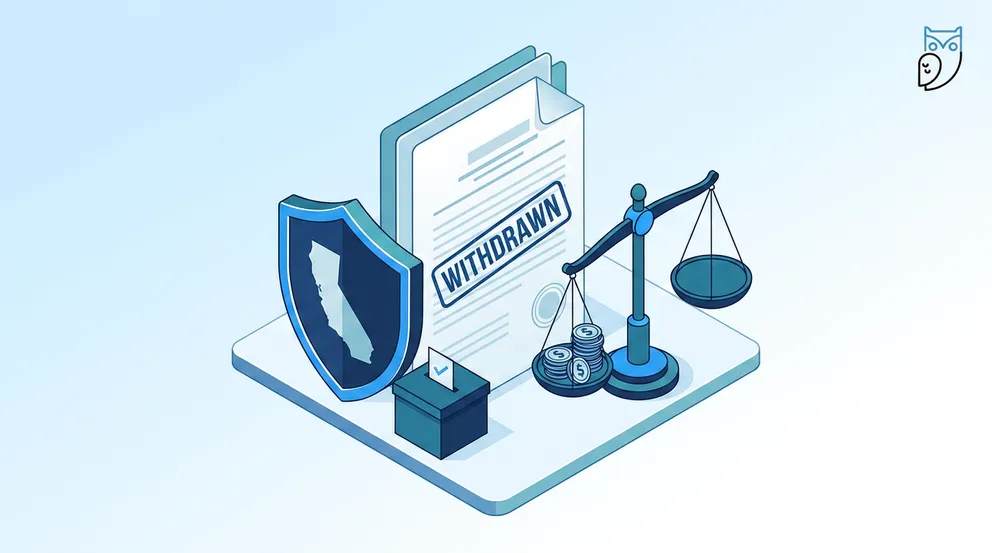
The ballot measure that would have repealed California's Proposition 103 auto insurance rate-cap law was withdrawn from the November 2026 ballot on December 2, 2025, locking in the 37-year-old framework that governs how California drivers' auto rates get reviewed. State Farm policyholders will see a 6.2% auto rate reduction take effect May 8, 2026, the first major California rate cut since premiums climbed more than 33% between 2023 and 2025.
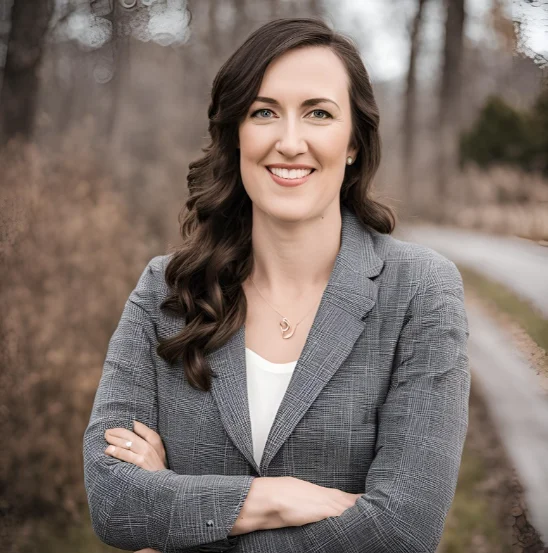
Independent insurance broker Elizabeth Hammack withdrew her ballot initiative to repeal Proposition 103 on December 2, 2025, in a mutual agreement with Consumer Watchdog. The withdrawal preserves California's 1988 rate-review law, including the requirement that insurers justify any auto rate increase of 7% or higher.
- Withdrawn December 2, 2025, before the 546,651-signature April 17, 2026 deadline
- Hammack pulled the measure as part of a mutual deal with Consumer Watchdog
- Prop 103's intervenor process and elected commissioner role both remain in place
- State Farm's 6.2% auto rate cut takes effect May 8, 2026 for California drivers
How the Withdrawal Happened
Hammack, owner of Panorama Insurance Associates in Roseville, filed the California Insurance Market Reform Act of 2026 with the Attorney General's Office on August 11, 2025. The Secretary of State cleared the initiative (#25-0012) for signature gathering on October 16, 2025, giving backers six months to collect 546,651 valid voter signatures by April 17, 2026. Hammack pulled the petition on December 2, 2025, citing what she called a misleading title and summary that the Attorney General assigned to the measure.
The withdrawal was coordinated with Consumer Watchdog, the advocacy group founded by Prop 103 author Harvey Rosenfield. Consumer Watchdog had filed a competing measure called the Policyholder Bill of Rights, which would have required insurers to write policies for homeowners who meet state wildfire mitigation standards. Both groups filed paperwork at the Secretary of State's office in Sacramento to pull their initiatives on the same day.
"This armistice preserves the landmark protections and consumer savings under insurance reform Proposition 103, which was the principal reason we filed the Policyholder Bill of Rights this year," said Jamie Court, president of Consumer Watchdog. "We said if the broker withdrew, we would withdraw."
What Prop 103 Keeps Doing
The withdrawn measure targeted three pillars of Proposition 103, which California voters approved in November 1988. It would have converted the elected insurance commissioner role into a governor-appointed position requiring 10 or more years of insurance industry experience. The initiative also imposed a 120-day deadline on rate-filing reviews unless both parties agreed to extend it. Insurers could have factored reinsurance costs and wildfire mitigation credits into rate calculations, both currently banned under Prop 103.
The intervenor process stays intact for California drivers. Consumer groups can still challenge any auto rate filing of 7% or higher under existing law, and successful intervenors are paid by the insurer being challenged. Consumer Watchdog estimates its interventions have saved California policyholders more than $6 billion since Prop 103 took effect in 1989.
What This Means for California Drivers
The same framework that produced both the 33% run-up and the recent reversal stays in place. California auto rates climbed 13% in 2023, jumped 15.4% in 2024, and rose another 6% in 2025 according to Insurify and beinsure data, with carriers representing roughly 85% of state policies driving the increases. Drivers in Los Angeles, San Francisco, and San Diego absorbed the steepest hikes due to higher claim frequencies and repair costs.
The trend started reversing in early 2026. State Farm Mutual Automobile Insurance Company received California Department of Insurance approval for a 6.2% personal auto rate reduction effective May 8, 2026, applying to both new business and renewals. Geico held its California auto rates flat for 2026, and several other top-10 carriers filed smaller increases or held steady.
| Year | Approved Auto Rate Change | Cumulative Since 2023 |
|---|---|---|
| 2023 | +13.0% | +13.0% |
| 2024 | +15.4% | +30.4% |
| 2025 | +6.0% | +38.2% |
| 2026 (State Farm) | -6.2% | +29.6% |
Source: Insurify, beinsure, and California Department of Insurance rate filings. 2023-2025 figures reflect average approved rate changes for the top 10 California auto insurers covering roughly 85% of policies. The 2026 row reflects State Farm's approved -6.2% adjustment effective May 8, 2026.
Drivers in California currently pay an average of $2,274 per year for a full-coverage policy and $1,104 per year for liability-only coverage, according to Insurify's 2026 quote data. That breaks down to about $190 per month for full coverage and $92 per month for the state's minimum 30/60/15 limits. See city-by-city rate breakdowns on our California car insurance hub.
The withdrawn measure would not have lowered auto premiums by itself. It would have changed the rules for how rate filings get reviewed. California drivers comparing carriers in 2026 should focus on the State Farm 6.2% reduction and the broader rate-flattening trend, not the ballot withdrawal.
Why the Industry Pushed for Reform
Reinsurance costs, banned from California auto rate calculations under Prop 103, remain the industry's top reform target. The withdrawn measure would have allowed carriers to pass through these costs, which industry filings claim added more than $1 billion in unrecovered expenses for top California auto insurers between 2022 and 2024. Our deeper look at why consumer protections sometimes backfired in California's market covers how the rate-cap framework set up the crisis carriers spent 2024 trying to escape.
Insurance Commissioner Ricardo Lara separately advanced the first major overhaul of the intervenor process in 35 years in early 2026. The new regulations require intervenors to disclose their funding sources, set hourly fee caps, and impose tighter timelines on rate challenges. Lara framed the changes as a way to streamline reviews without weakening core Prop 103 consumer protections.
State Farm separately reached a settlement with the California Department of Insurance and Consumer Watchdog in March 2026 over its prior emergency interim rate request for homeowners. Read our full State Farm auto insurance review for the carrier's California pricing details.
What You Should Do Now
Pull Your Renewal Notice
Verify your current monthly premium and the date your policy renews. Carriers must give 60 days' notice of any rate change in California.
Compare Quotes From At Least Three Carriers
State Farm's 6.2% cut applies to its policyholders only. Drivers at other carriers should request fresh quotes to capture any 2026 rate softening.
Ask About New 2026 Discounts
California carriers expanded telematics, EV, and good-driver discounts in 2026 as the market stabilized. Existing customers should call their agent to confirm every applicable credit is on the policy.
Looking Ahead
Consumer Watchdog signaled the fight will return to the ballot if the legislature does not act. "We will spend the next year building support in order to pressure the insurance industry to sell policies in higher-risk areas and to treat their customers better," Jamie Court said in the December 2 statement. The group plans a 2028 ballot push if state lawmakers do not enact protections similar to those in the Policyholder Bill of Rights.
Industry groups including the American Property Casualty Insurance Association continue lobbying Sacramento for legislative reform of the rate-filing timeline. The state Senate Insurance Committee advanced multiple bills in April 2026 targeting transparency, claims handling, and non-renewal rules. None of those bills would alter the underlying Prop 103 framework.
Frequently Asked Questions
No. The California Insurance Market Reform Act of 2026 was withdrawn on December 2, 2025, before any signatures were submitted to qualify it for the ballot. Proposition 103, passed by California voters in November 1988, remains the law governing how auto and homeowners rate filings get reviewed.
State Farm policyholders will see a 6.2% reduction effective May 8, 2026. Geico held its rates flat for 2026. Other carriers vary, so comparing renewal quotes from three or more insurers is the best way to confirm your actual change.
The intervenor process lets consumer groups challenge any insurance rate filing of 7% or higher in California. Successful challenges are paid by the insurer. Consumer Watchdog credits the process with saving California policyholders more than $6 billion since 1989.
Yes. Consumer Watchdog said it will pursue a 2028 ballot measure if the legislature does not pass requested reforms. Industry groups including the American Property Casualty Insurance Association also continue pushing for legislative changes to rate-filing timelines.
Yes. The withdrawn ballot measure would have applied to both auto and homeowners rate-filing rules. Both markets continue operating under the existing Prop 103 framework, including the requirement that insurers justify any rate increase of 7% or higher.
- Consumer Watchdog - Joint Withdrawal Statement (December 2, 2025)
- Ballotpedia - California New Insurance Market Regulations Initiative (2026)
- ABC10 - California Eyes Insurance Overhaul With New 2026 Ballot Initiative
- CalMatters - Long-Shot Ballot Initiative Could Have Huge Effect on California Insurance
- State Farm Newsroom - 6.2% Auto Rate Reduction for California Drivers
- Insurify - Average Car Insurance Cost in California (2026)
- Beinsure - California Auto Insurance Rates Jump Over 30% Since 2023
- California Department of Insurance - Intervenor Reform Regulations