
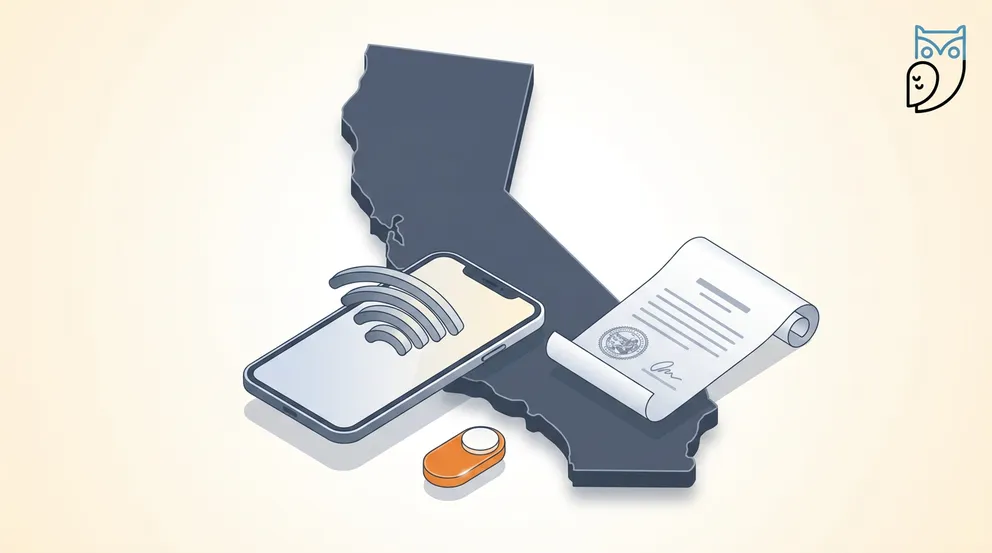
California lawmakers are advancing a bill that would let auto insurers price policies on tracked driving behavior, ending the only state ban of its kind in the country. Assembly Bill 311 cleared the Senate Insurance Committee 5-0 after a June 24 hearing and now sits in Senate Appropriations, over written opposition from the California Department of Insurance.
Drivers paying California's $3,444 average full-coverage premium could trade location, speed and braking data for discounts that reach 30% at State Farm and 40% at Allstate in the other 49 states. Maryland regulators found the trade does not always pay off: 24% of enrolled drivers there watched their rates go up instead.
AB 311, the Consumer Driving Data Protection Act of 2026, would amend Proposition 103 so California drivers can opt into telematics tracking to establish a driving record. Assemblymember Tina McKinnor (D-Inglewood) rewrote the bill as a gut-and-amend on June 10, 2026. It passed two Senate committees within days and awaits an Appropriations vote before the August 31 constitutional deadline.
- California is the only state that bars insurers from using telematics data to set auto rates
- Deputy Insurance Commissioner Josephine Figueroa opposed the bill in a June 20 letter to Senate Insurance Chair Steve Padilla
- Maryland Insurance Administration data from 2023: 31% of enrollees saved, 24% paid more, 45% saw no change
- Consumer Watchdog, the ACLU California Action and Privacy Rights Clearinghouse all registered opposition
- Nothing changes for your policy in 2026 even if the bill passes, because rate filings need commissioner approval first
What AB 311 Would Change
Proposition 103 has governed California auto pricing since 51% of voters approved it in 1988. The law forces insurers to weigh three factors first: driving safety record, annual miles driven, and years of driving experience. Harvey Rosenfield, who founded Consumer Watchdog, wrote that initiative, and it also mandates a 20% discount for drivers who qualify as good drivers.
AB 311 adds a fourth path. Drivers could volunteer telematics data, gathered through a smartphone app or a system embedded in the vehicle, to establish their driving record alongside what the DMV already reports. The bill bars insurers from using that data for any purpose other than rating private passenger auto insurance, and it blocks them from conditioning discount eligibility on enrollment unless the insurance commissioner approves the discount first.
McKinnor framed the measure as a road safety tool at the June committee hearing.
"AB 311 puts vehicle users in the driver's seat to improve safety on our roads and highways to create an optional and more accurate way to determine vehicle insurance rates through the use of telematics technology," McKinnor said. "This bill also contains nation leading driver data protections."
Kellie Montalvo testified in support, describing the 2020 crash that killed her 21-year-old son Benjamin while he rode his bike. The driver who hit him had exchanged 24 texts in the six minutes before the collision and already carried speeding tickets, prior crashes and three earlier hit-and-runs. Streets Are for Everyone co-sponsored the bill, joined by the American Property Casualty Insurance Association and several bicycle associations.
Why the Insurance Department Opposes It
Four days before the Senate Insurance Committee voted, Deputy Insurance Commissioner Josephine Figueroa sent Chair Steve Padilla a letter laying out the department's objections.
"The bill creates broad liability loopholes, dilutes regulator oversight, and allows insurance companies to shift core regulatory responsibilities to unregulated third-party telematics vendors, among other concerns," Figueroa wrote on June 20, 2026.
Figueroa flagged vague due-diligence language covering third-party vendors and pointed to documented cases where neutral-looking criteria produced disparate impacts, citing census-tract voter registration rates used as a proxy for race or citizenship. She also called consumer savings claims generally unproven. The committee approved the bill anyway, 5-0.
Consumer Watchdog attacked the rating logic itself. Executive Director Carmen Balber told the same committee that California law requires premiums to rest on what a driver actually did, not on a prediction.
"In California, auto insurance has to be rated in a driver's actual driving history, not the product of an unverified algorithm or artificial intelligence system predicting future driving," Balber said.
Becca Cramer, speaking for Privacy Rights Clearinghouse before both Senate committees, argued the bill "would authorize an opaque surveillance pricing infrastructure for a product Californians are legally required to purchase." That concern echoes the broader regulatory scrutiny of algorithmic pricing we covered when state regulators launched a review of AI in auto insurance underwriting.
What Telematics Would Mean for Your Premium
Start with what a California driver pays today. Full coverage at 100/300/100 limits averages $3,444 a year, or $287 monthly, while a state-minimum 15/30/5 policy runs $1,019 annually. The mandatory good driver discount under Prop 103 already strips 20% off that full-coverage figure, worth roughly $689 for drivers who qualify.
Layering a telematics discount on top could push savings further, but the outcome distribution matters more than the maximum. Maryland's insurance regulator ran the first state study of telematics results, and the numbers cut three ways.
| Outcome for Enrolled Drivers | Share (Maryland, 2023) | Effect on a $3,444 CA Premium |
|---|---|---|
| Premium decreased | 31% | Savings, amount varies by score |
| No change | 45% | $0, data shared for nothing |
| Premium increased | 24% | Higher cost after enrollment |
Source: Maryland Insurance Administration 2023 telematics survey, cited by California Deputy Insurance Commissioner Josephine Figueroa in her June 20, 2026 letter to the Senate Insurance Committee and reported by CalMatters. Maryland's review also documented insurers collecting trip route, days driven, G-force, unsafe following and aggressive turning, with most carriers outsourcing collection to third parties.
A 2024 Consumer Reports survey cited by CalMatters found a median annual saving of $120, with larger savings for Black and Latino drivers than for white and Asian drivers. Against California's $3,444 average, $120 works out to a 3.5% cut, roughly $10 a month. Some surveyed drivers paid more.
Allstate Drivewise, GEICO DriveEasy, Liberty Mutual RightTrack, Travelers IntelliDrive and Progressive Snapshot can all raise your premium based on your score. Roughly 1 in 5 Snapshot users pays more after enrollment. Nationwide SmartRide, State Farm Drive Safe and Save, USAA SafePilot and American Family KnowYourDrive cannot increase your rate. Our full telematics discount program comparison breaks down all ten carriers.
The Privacy Fight Behind the Bill
California regulators are not arguing hypotheticals. Attorney General Rob Bonta announced a $12.75 million settlement with General Motors on May 8, 2026, the largest CCPA penalty in state history and nearly five times the previous record. Investigators alleged GM sold connected-vehicle data, including precise geolocation and driving behavior, from hundreds of thousands of Californians to data brokers, earning about $20 million between 2020 and 2024.
Michael DeLong of the Consumer Federation of America put the lesson bluntly to CalMatters: "You can't trust companies to do this without oversight." His group plans to file a letter opposing AB 311.
Legislatures elsewhere reached similar conclusions from the opposite direction. Maryland, Missouri, New York, North Carolina and Tennessee all filed telematics privacy bills in 2026, most of which stalled, while Texas sued Allstate and its Arity subsidiary over data collected from 45 million drivers. We tracked those fights in our report on five states introducing telematics privacy bills. California would be doing the reverse: opening the door those states are trying to narrow.
Campaign money runs through the story too. McKinnor has taken about $38,000 from insurance industry groups and employees since 2022, according to state campaign finance records reviewed by CalMatters. Padilla has received a comparable sum since 2022, and Senate Privacy Committee Chair Christopher Cabaldon has collected roughly $27,000 dating back to his 2008 Assembly run.
What California Drivers Should Do Now
Confirm You Have the Good Driver Discount
Prop 103 guarantees 20% off for drivers with a clean enough record, worth about $689 on a $3,444 full-coverage policy. Call your carrier and ask whether that discount is applied to your current declarations page.
Check What Your Car Already Transmits
GM's OnStar case proves connected vehicles share data whether or not you joined an insurance program. Open your automaker's app, find the data sharing settings, and disable any third-party or marketing data sale.
Compare Quotes on Today's Rules
Insurify projects California rates rising 1% in 2026, so shopping still beats waiting on legislation. Pull quotes from at least three carriers and see how those compare against average California car insurance rates by city.
If AB 311 becomes law, ask one question before enrolling in any program: can this score raise my premium? That single answer separates Nationwide SmartRide from Allstate Drivewise, and it determines whether the trade carries downside. Drivers weighing the mechanics can read how tracking devices affect your premium before opting in anywhere.
What Happens Next
Senate Appropriations holds the bill after a July 9 amendment. The California Constitution requires each house to pass bills by August 31 in even-numbered years, and floor sessions run without committee hearings from August 17 onward, which leaves a narrow window. The Department of Insurance is meeting with McKinnor's staff about its objections, according to department spokesperson Michael Soller.
Even passage would not change your bill this year. Insurers would still need to file telematics rating plans and win commissioner approval under Prop 103's prior-approval system, a process that routinely takes months. November's election for California insurance commissioner will decide who reviews those filings.
Frequently Asked Questions
No. California is the only state that does not let insurers use telematics data to set auto insurance rates. Proposition 103 limits primary rating to driving safety record, annual miles driven and years of driving experience. Low-mileage discounts are permitted because miles driven is already an approved factor.
No. Participation would be voluntary, and the bill bars insurers from conditioning discount eligibility on enrollment unless the insurance commissioner approves that discount. Privacy Rights Clearinghouse and Consumer Watchdog argue the choice is effectively coercive for price-sensitive drivers who cannot afford to skip a discount.
In states where these programs operate, yes. Allstate Drivewise, GEICO DriveEasy, Liberty Mutual RightTrack, Travelers IntelliDrive and Progressive Snapshot can all increase premiums based on driving scores, and about 1 in 5 Snapshot users pays more. Maryland Insurance Administration data from 2023 showed 24% of enrolled drivers saw increases.
A 2024 Consumer Reports survey found a median annual saving of $120, which equals about 3.5% of California's $3,444 average full-coverage premium. Maximum advertised discounts reach 40% at Nationwide and Allstate, but only top-scoring drivers earn them. In Maryland, 45% of enrollees saw no change at all.
Not immediately. The Legislature must pass bills by August 31, 2026, and the governor then acts on them. Insurers would still have to file telematics rating plans and receive approval from the California insurance commissioner under Proposition 103's prior-approval process before any driver sees a rate based on tracked data.
- CalMatters - Proposal would allow drivers to trade personal data for potentially lower insurance rates (July 2026)
- California Legislative Information - AB 311, Consumer Driving Data Protection Act of 2026
- Repairer Driven News - California bill would allow auto insurance telematics programs (July 22, 2026)
- Insurance Journal - California Bill to Let Insurers Use Driver Telematics Mulled by Legislature (July 9, 2026)
- Consumer Watchdog - Do Policyholders Want Car Premiums To Be Determined By Secret AI?
- California Attorney General - $12.75 Million General Motors Privacy Settlement (May 8, 2026)
- CarInsurance.com - Average California Car Insurance Costs 2026 (Quadrant Information Services)
- California State Senate - 2026 Tentative Legislative Calendar and Deadlines