

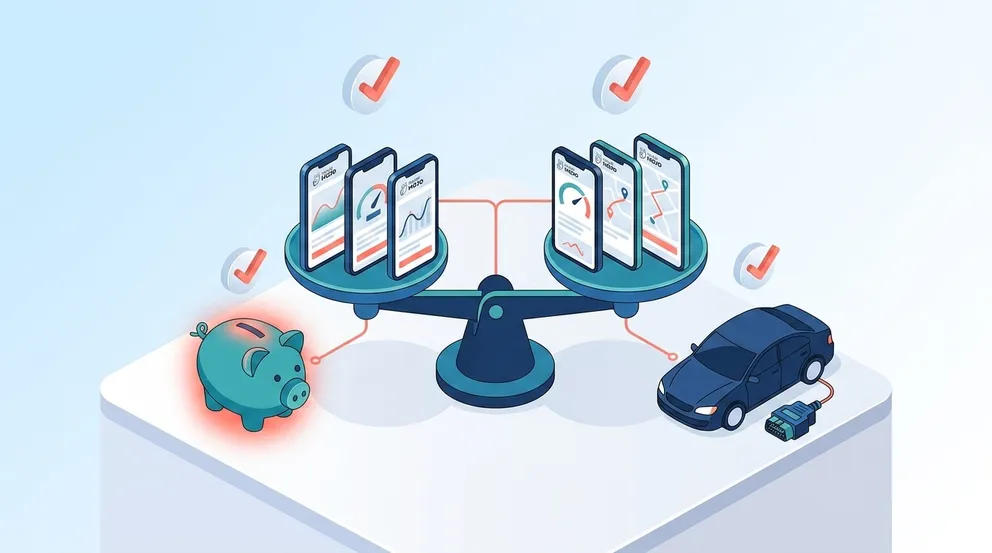
Telematics insurance programs save safe drivers an average of 10% to 30% on car insurance, according to industry data from Bankrate and the Consumer Federation of America. Allstate Drivewise and Nationwide SmartRide offer the largest maximum discount at 40%, but Allstate can raise your rate for unsafe driving while Nationwide cannot.
Rates and rules for car insurance discounts vary significantly from one program to the next, and telematics discounts carry a catch that most articles gloss over: some programs can actually raise your premium if you score poorly. Progressive reports that roughly 1 in 5 Snapshot users pays more after enrollment, according to Bankrate's 2024 analysis. Knowing which programs only reward and which ones also penalize separates a smart savings move from a costly gamble.
How Telematics Discounts Work
A telematics program uses your smartphone app or a plug-in OBD-II device to track driving behavior like hard braking, acceleration, speed, and phone use. Your insurer translates that data into a driving score, and the score determines your discount at renewal. Most carriers run the monitoring period for 90 days, though Progressive's Snapshot extends to a full six-month policy term.
Three discount categories exist across major carriers, according to Bankrate. Enrollment discounts (typically 5% to 10%) reward you just for signing up. Safety discounts (up to 30% to 40%) depend on your actual driving score. Low-mileage rates replace traditional premiums with a per-mile charge, benefiting drivers who log fewer than 7,500 miles per year.
Ask your insurer whether the telematics discount stacks with other savings. State Farm's Drive Safe & Save 10% enrollment discount applies on top of multi-car, good student, and bundling discounts, potentially combining for 35% to 45% total savings.
Best Telematics Programs Compared
Ten major carriers offer telematics programs in 2026, but the discount amounts, enrollment bonuses, and rate-increase risks vary widely. The table below compares every major program side by side.
| Carrier | Program Name | Enrollment Discount | Max Discount | Can Raise Rates? |
|---|---|---|---|---|
| Nationwide | SmartRide | 10% | Up to 40% | No |
| Allstate | Drivewise | 10% | Up to 40% | Yes |
| State Farm | Drive Safe & Save | 10% | Up to 30% | No |
| Liberty Mutual | RightTrack | 5% | Up to 30% | Yes |
| Travelers | IntelliDrive | 5% | Up to 30% | Yes |
| USAA | SafePilot | 10% | Up to 30% | No |
| GEICO | DriveEasy | Undisclosed | Up to 25% | Yes |
| Progressive | Snapshot | $94 avg | $231/yr avg | Yes |
| American Family | KnowYourDrive | 5% | Up to 20% | No |
| Farmers | Signal | 5% | Up to 15% | No |
Source: Bankrate, AutoInsurance.com, and carrier websites, based on 2024-2026 program terms. Maximum discounts represent the best-case scenario for top-scoring drivers; typical savings average 10% according to the Consumer Federation of America.
Progressive stands out for reporting savings as dollar amounts ($231/year average) rather than percentages, making direct comparison tricky. On a $2,000/year policy, that $231 translates to roughly 11.5%, while Allstate's 40% maximum on the same policy would save $800.
Which Programs Can Raise Your Rates
Five carriers (Allstate, GEICO, Progressive, Liberty Mutual, and Travelers) can increase your premium if the telematics data reveals risky habits, according to Consumer Reports and Bankrate. The remaining five (State Farm, Nationwide, American Family, Farmers, and USAA) operate discount-only tracking programs where the worst outcome is earning zero savings.
Progressive discloses that about 20% of Snapshot users see a rate increase at renewal. If you frequently drive between 11 p.m. and 4 a.m. or commute in stop-and-go traffic that triggers hard-braking events, a discount-only program like State Farm's Drive Safe & Save or Nationwide's SmartRide carries less financial risk.
The Consumer Federation of America found in a 2024 study that insurers exaggerate telematics savings and continue rating based on non-driving factors like credit score and ZIP code. Maryland's insurance department confirmed these findings: most drivers enrolled in telematics programs in the state did not see premium reductions. Choosing a discount-only program protects you from a double penalty where the app flags your driving and your rate still reflects your credit tier.
Consumer Reports surveyed telematics users and found median annual savings of $324, but drivers under 25 saved $245 more than average, making telematics particularly valuable for young drivers seeking premium reductions.
What Each Program Actually Tracks
Privacy trade-offs differ by carrier. Some programs monitor only three data points while others collect six or more behavioral metrics. Allstate's Drivewise tracks just speeding, hard braking, and late-night driving, while GEICO's DriveEasy captures braking, acceleration, cornering, phone use, time of day, and overall driving smoothness.
| Factor Tracked | Allstate | GEICO | Nationwide | Progressive | State Farm |
|---|---|---|---|---|---|
| Hard Braking | Yes | Yes | Yes | Yes | Yes |
| Acceleration | No | Yes | Yes | Yes | Yes |
| Cornering | No | Yes | No | No | Yes |
| Phone Use | No | Yes | No | Yes | Yes |
| Speeding | Yes | No | No | No | Yes |
| Late-Night Driving | Yes | Yes | Yes | Yes | No |
Source: Bankrate telematics comparison table, updated November 2024. "Phone use" tracking availability varies by state for Progressive.
Only California and New York enforce strict statewide regulations on how insurers collect, store, and share telematics data, according to Bankrate. In all other states, your carrier's privacy policy may allow sharing or selling your driving data to third parties. Read the terms before enrolling, especially with GEICO's DriveEasy, which tracks the most data points of any major program.
Best Candidate for Each Program
State Farm's Drive Safe & Save fits drivers who want guaranteed savings without rate-increase risk. The 30% maximum discount trails only Allstate and Nationwide, and State Farm's base rates already rank among the most competitive for bundled home-and-auto customers. Commuters in stop-and-go traffic benefit because State Farm does not penalize hard braking events.
Nationwide SmartRide offers the safest path to the highest discount: 40% maximum with zero risk of a rate increase. Nationwide ranked first among usage-based insurers in the 2024 J.D. Power U.S. Auto Insurance Study. The 10% enrollment discount applies immediately, and SmartRide does not track phone use, which reduces the privacy footprint compared to GEICO or State Farm.
Progressive Snapshot works best for low-mileage drivers confident in their habits. The average $231/year savings rewards consistent performance, and Progressive's app provides real-time feedback on your score. Just remember that 20% of users pay more, so drivers with long commutes or frequent night driving should consider pay-per-mile alternatives instead.
USAA SafePilot offers up to 30% off with no rate-increase risk, but eligibility requires military affiliation. Active-duty service members, veterans, and their families should check USAA before enrolling in any other telematics program.
Allstate Drivewise appeals to minimalist trackers who want high upside. The program monitors only three factors (speeding, hard braking, late-night driving), giving you fewer behaviors to worry about. However, Allstate will raise your rate for poor scores, so conservative drivers who rarely speed or brake hard benefit most.
Choose the right program
Pick a discount-only program (State Farm, Nationwide, USAA, Farmers, American Family) if you commute in heavy traffic or drive at night. Select Allstate or Progressive only if you consistently drive during low-risk hours with smooth braking habits.
Time your enrollment
Enroll before your policy renewal date so the monitoring period completes in time for the discount to apply. Most programs need 90 days of data collection before calculating your final score.
Reduce hard-braking events
Leave 3 to 4 seconds of following distance to avoid sudden stops. Every carrier tracks hard braking, making it the single most impactful factor across all programs.
Stack with other discounts
Combine the telematics savings with multi-policy bundling (up to 25%), good driver (up to 20%), and paperless billing (5% to 10%) discounts. Call your agent and ask which discounts apply alongside the telematics program.
Frequently Asked Questions
Maximum discounts range from 15% (Farmers Signal) to 40% (Allstate Drivewise and Nationwide SmartRide), according to Bankrate. However, the Consumer Federation of America reports that typical savings average closer to 10%. Consumer Reports found the median annual savings among telematics users was $324.
Five major carriers (Allstate, GEICO, Progressive, Liberty Mutual, and Travelers) can raise your premium based on telematics data. Progressive reports that about 20% of Snapshot users see a rate increase. State Farm, Nationwide, USAA, Farmers, and American Family operate discount-only programs where rates cannot increase.
All major programs track hard braking. Most also monitor acceleration, late-night driving (typically 11 p.m. to 4 a.m.), and total miles driven. State Farm and GEICO additionally track phone use and cornering. Only Allstate and State Farm monitor speeding, according to Bankrate's 2024 comparison data.
Nationwide SmartRide offers the best combination for safe drivers: a 40% maximum discount, 10% enrollment bonus, no rate-increase risk, and top ranking in J.D. Power's 2024 U.S. Auto Insurance Study. State Farm Drive Safe & Save (up to 30%, no rate increase) is the strongest runner-up for drivers who bundle home and auto policies.
- Bankrate — How Does Car Insurance With Telematics Work?
- Consumer Federation of America — Insurance Companies Claim Telematics Will Save You Money
- Consumer Reports — Car Insurance Telematics Pros and Cons
- AutoInsurance.com — Best Car Insurance Telematics Discounts in 2026
- J.D. Power — 2024 U.S. Auto Insurance Study
- Bankrate — Best Usage-Based Insurance
- Maryland Insurance Administration — CFA Comment Letter on Telematics (November 2025)