
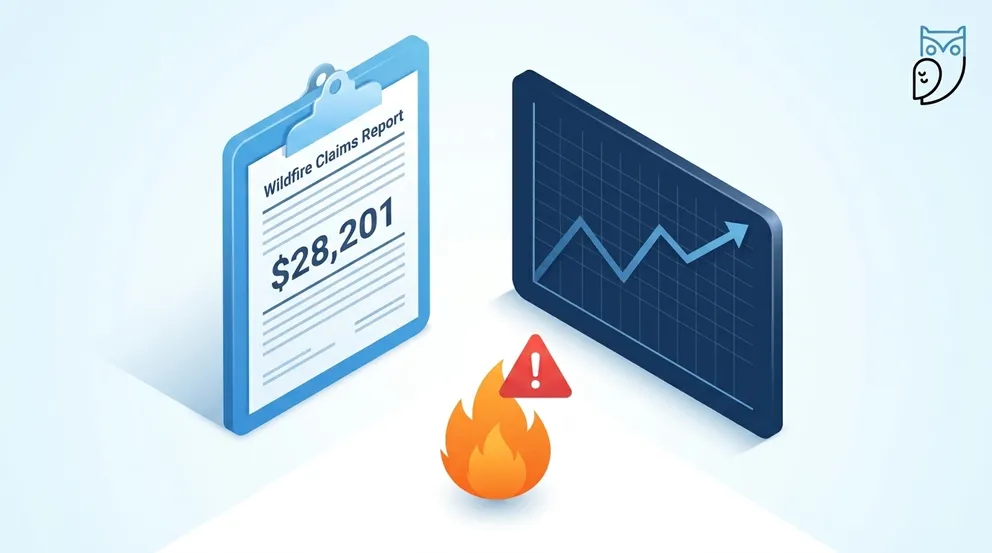
Comprehensive coverage pays for wildfire damage to your vehicle, including flames, smoke, ash, and melted trim. Insurers paid $191,289,567 on 6,783 auto claims from the January 2025 Palisades and Eaton fires, an average of $28,201 per paid claim, according to California Department of Insurance data released in March 2026.
Firefighters responded to 51,774 wildfires across the United States between January and late August 2026, burning more than 8.1 million acres, which the National Interagency Fire Center calculates at 165% of the ten-year average for acreage. Liability coverage pays nothing toward a burned car. Only comprehensive, the optional piece that 80% of insured drivers carry according to the Insurance Information Institute, converts a scorched vehicle into a settlement check.
Drivers in the remaining 20% absorb the entire loss out of pocket. In the Los Angeles fires that meant surrendering a vehicle whose average settlement, for policyholders who did carry the coverage, came to $28,201.
- Comprehensive coverage pays for wildfire damage; liability and collision pay nothing
- LA wildfire auto claims averaged $28,201, roughly 10 times the $2,738 average comprehensive claim
- 683 of 7,466 auto claims filed after the Palisades and Eaton fires had received no payment 14 months later
- California regulators cited State Farm for improperly denying smoke damage claims in a May 2026 enforcement action
- Items inside your car fall under homeowners or renters insurance, capped at 10% to 20% of your personal property limit
What Comprehensive Coverage Pays For After a Wildfire
Comprehensive appears on many declarations pages as other than collision, and it responds to fire no matter how the fire began. A lightning strike 40 miles upwind and a downed utility line on your own street trigger identical coverage. Collision does nothing in a wildfire because no impact occurred, a split explained further in our breakdown of comprehensive vs. collision coverage.
- Flames that reach the vehicle, whether it sits in a garage, a driveway, or a highway shoulder during evacuation
- Smoke and soot pulled through cabin vents, which adjusters commonly price between $500 and $3,000 for ozone treatment and interior remediation
- Ash etching on paint and clear coat, an abrasive and mildly acidic residue the Texas Department of Insurance names as a covered fire loss
- Melted headlight housings, wheel well liners, bumper covers, and window seals
- Water and fire retardant dropped by aircraft count as fire damage, not a separate uncovered peril
- Theft or vandalism inside an evacuated zone settles under the same comprehensive deductible
What Your Auto Policy Will Not Cover
Personal property inside the vehicle sits outside every standard auto policy. The laptop, the camping gear, and the file boxes you threw in the trunk during evacuation get reimbursed by homeowners or renters insurance instead, typically limited to 10% to 20% of your personal property coverage when items are away from the residence. File that portion with your property carrier and skip the auto adjuster entirely.
Aftermarket equipment receives narrow treatment as well. Most carriers cap custom stereo systems, lift kits, and vinyl wraps at $1,000 unless you purchased a specific endorsement before the loss.
Carriers impose binding restrictions the moment a named fire ignites. Multiple California insurers suspended new comprehensive coverage inside evacuation warning ZIP codes during the January 2025 fires. Add the coverage during a quiet week in February for roughly the cost of a tank of gas per month, not the afternoon smoke appears on the ridge.
What LA Wildfire Auto Claims Actually Paid
Most coverage articles stop at the word yes. The California Department of Insurance publishes the settlement data, and it reframes what a wildfire auto claim is worth.
| Fire | Auto Claims Filed | Claims With Payment | Total Paid | Average Per Paid Claim | vs. Average Comprehensive Claim ($2,738) |
|---|---|---|---|---|---|
| Palisades Fire | 3,652 | 3,391 (92.9%) | $129,257,519 | $38,118 | 13.9x higher |
| Eaton Fire | 3,814 | 3,392 (88.9%) | $62,032,047 | $18,288 | 6.7x higher |
| Combined | 7,466 | 6,783 (90.9%) | $191,289,567 | $28,201 | 10.3x higher |
Source: California Department of Insurance, Insured Losses from the 2025 Palisades and Eaton Wildfires, reported as of March 2026. Figures cover commercial and personal auto physical damage. The $2,738 comparison benchmark is the mean comprehensive claim reported by ISO and cited by the Insurance Information Institute for 2022.
Claim volume ran nearly even between the two fires, with 3,652 filed after Palisades and 3,814 after Eaton. Settlements diverged sharply. Palisades vehicles averaged $38,118 against $18,288 for Eaton vehicles, a $19,830 spread that mirrors the difference in vehicle values between Pacific Palisades and Altadena.
Look at the payment rate rather than the averages and a harder number surfaces. Of 7,466 auto claims filed across both fires, 683 had received nothing as of March 2026. That leaves 9.1% of drivers who reported a burned or smoke damaged vehicle still waiting 14 months after the flames went out.
Why Auto Claims Get Less Attention Than Property Claims
| Claim Type | Claims Filed | Share of All Claims | Amount Paid | Share of Dollars Paid |
|---|---|---|---|---|
| Residential property | 38,835 | 78.8% | $21,969,711,402 | 92.0% |
| Commercial and personal auto | 7,466 | 15.2% | $191,289,567 | 0.8% |
| Commercial property | 2,965 | 6.0% | $1,709,807,018 | 7.2% |
Vehicles accounted for 15.2% of every claim filed after the two fires yet drew only 0.8% of the $23.9 billion paid out. That imbalance explains a frustration many policyholders reported: adjuster bandwidth flows toward the residential file, and the car sits in queue behind a $600,000 dwelling claim.
Smoke and Ash Damage Is Where Claims Get Denied
Total burnouts settle cleanly because nobody disputes a melted chassis. Arguments start when the vehicle survives and the damage is chemical rather than structural.
California regulators quantified the problem. The Department of Insurance completed a market conduct examination of State Farm's Los Angeles wildfire claim handling and announced legal action on May 4, 2026. Examiners reviewed 220 claims and documented 398 violations of state law across 114 of them. Improper denial of smoke damage claims appears by name in the findings, alongside settlement offers the department called unreasonably low, investigations not opened within the required 15 days, and repeated adjuster reassignments that left policyholders re-explaining the same loss.
Penalties reach $5,000 per violation, or $10,000 where a violation was willful, under the California Insurance Code. State Farm handled roughly 11,300 residential claims from the two fires, close to one third of the 38,835 filed industrywide. A state senator separately petitioned regulators to revoke the carrier's auto insurance license, a fight covered in our report on the push to pull State Farm's California auto license.
Photograph the ash layer before you wash the car. Wipe a white microfiber cloth across the hood and seal it in a bag as physical evidence. Then get a written estimate from a detailer or body shop that names the contaminant and lists ozone treatment, cabin filter replacement, and paint decontamination as separate line items. Adjusters approve shop letterhead far faster than a policyholder's description of a smell.
When the Adjuster Declares Your Car a Total Loss
Carriers total a vehicle once repair cost plus salvage value meets or exceeds actual cash value immediately before the loss. Fire clears that threshold within minutes. Set the $28,201 average LA wildfire payout against the $2,738 average comprehensive claim nationally and the math tells the story: the overwhelming majority of those vehicles never saw a body shop, which is the pattern explained in our guide to what happens when your car is totaled.
Actual cash value means depreciated market value. It is not your purchase price and not the cost of an equivalent replacement at today's dealer lot. Your comprehensive deductible comes off the top of that figure before any check gets cut.
That $5,100 shortfall disappears if you carry gap insurance, which pays the difference between the loan balance and the actual cash value. Most gap contracts exclude the deductible itself, so budget the $500 regardless.
Disagreeing with the valuation is normal and often productive. Pull three comparable listings within 50 miles, matching trim, mileage, and options, and submit them in writing. Our walkthrough on negotiating a total loss settlement covers the appraisal clause most policies contain when the two sides stay apart.
Which Coverages Pay After a Wildfire
| Coverage | Wildfire Vehicle Damage | Deductible Applies | What It Will Not Do |
|---|---|---|---|
| Comprehensive | Covered: flames, smoke, ash, melted parts, theft | Yes, $500 to $1,000 typical | Reimburse belongings inside the car |
| Collision | Not covered | Not applicable | Respond without an impact |
| Liability | Not covered | No deductible | Pay anything toward your own vehicle |
| Rental reimbursement | Pays while the car is repaired or replaced | No | Continue indefinitely after a total loss offer |
| Gap insurance | Covers loan balance above actual cash value | No | Cover the deductible under most contracts |
Rental reimbursement runs $2 to $15 per month and pays $30 to $70 per day against a per claim cap near $900 to $1,500. It attaches only to policies already carrying comprehensive and collision. After a total loss most carriers fund the rental for a short window past the settlement offer, commonly 3 to 5 days, so the clock starts when the check is issued rather than when you find a replacement vehicle.
How to File a Wildfire Auto Claim
Report the loss before you clean anything
Call the claims line or file through the mobile app the same day access reopens. Washing ash off the paint destroys the evidence an adjuster needs to price decontamination.
Photograph every surface and the VIN
Shoot wide shots of the vehicle in place, close-ups of ash accumulation, the interior, the engine bay, and the odometer. Capture the VIN plate and the license plate in the same frame as the damage.
Log every call the NAIC way
The National Association of Insurance Commissioners advises recording the date, time, and name of every insurance employee you speak with, plus keeping all receipts. That log becomes your proof if the 15-day and 40-day response deadlines slip.
Get an independent estimate
A body shop or certified detailer quote on letterhead gives you a number to compare against the carrier's offer. Smoke remediation quotes between $500 and $3,000 are routine and frequently exceed a first offer.
Escalate to your state insurance department
California recovered more than $280 million for Eaton and Palisades survivors through direct intervention. Filing a complaint costs nothing and creates a regulatory record on your file.
Documentation habits carry over from any other claim, and the general sequence in our guide to filing a car insurance claim applies here with one wildfire-specific addition: never accept a first offer on smoke damage without a shop estimate in hand.
Wildfire Risk States and What Drivers Should Do
Risk concentrates in the West, though 2026 scrambled that assumption. The Morrill Fire became the largest in Nebraska's recorded history in March 2026, and two southern Georgia fires burned more than 50,000 acres in April, destroying more than 120 homes in the state's worst wildfire losses on record.
Oregon insurers filed for auto rate increases ranging from roughly 6% to 21% for 2026 following the state's worst wildfire season on record in 2024. Colorado drivers now pay above $3,100 annually on average, pushed up by weather-driven claim severity. California moved the other direction on auto specifically, where State Farm won approval for a 6.2% auto rate cut even as its wildfire claim handling drew enforcement action. Compare current figures on our California car insurance page and our analysis of 2026 rate trends.
Carriers reduce wildfire exposure by non-renewing policies rather than raising prices, particularly in the wildland urban interface. If a non-renewal notice arrives, you have roughly 30 to 45 days depending on state law to place new coverage before a lapse hits your record. Our guide on what to do when your insurer exits your state covers the replacement process.
Comprehensive earns its cost against more than fire. The same coverage handles hail, flooding, falling trees, and animal strikes, which is why coastal drivers reach the identical conclusion in our look at hurricane season and auto coverage.
A driver who dropped comprehensive to save roughly $200 a year and lost a vehicle in the Palisades Fire walked away from an average of $38,118 in unrecovered value. That is 190 years of premium savings erased in one afternoon.
Frequently Asked Questions
Yes, comprehensive coverage pays for wildfire damage to your vehicle, including flames, smoke, soot, ash etching, and melted components. Liability and collision coverage pay nothing. Insurers paid $191,289,567 on 6,783 auto claims from the 2025 Palisades and Eaton fires, an average of $28,201 per paid claim, according to California Department of Insurance data as of March 2026.
Comprehensive coverage includes smoke, soot, and ash damage, though these claims face the most disputes. California regulators reviewed 220 State Farm wildfire claims and found 398 violations across 114 of them, citing improper denial of smoke damage claims by name in a May 2026 enforcement action. Photograph the ash before washing the car and get a written shop estimate listing ozone treatment and cabin filter replacement as separate line items.
Paid auto claims from the Palisades Fire averaged $38,118 and Eaton Fire claims averaged $18,288, for a combined average of $28,201. That is roughly 10 times the $2,738 average comprehensive claim nationally, because fire damage usually exceeds a vehicle's value and triggers a total loss settlement at actual cash value minus your deductible.
No, auto insurance does not cover personal property inside the vehicle. Homeowners or renters insurance covers those belongings under off-premises personal property protection, typically limited to 10% to 20% of your total personal property coverage. File the vehicle itself with your auto carrier and the contents with your property carrier.
Usually no. Carriers impose binding restrictions once a named fire is active, and multiple California insurers suspended new comprehensive coverage inside evacuation warning ZIP codes during the January 2025 fires. Coverage must be in place before the loss occurs, so add it during a quiet period rather than when smoke is visible.
Yes, your comprehensive deductible of typically $500 to $1,000 is subtracted from the settlement. On a vehicle valued at $26,400 with a $500 deductible, the carrier issues $25,900. Gap insurance covers a loan balance above the actual cash value but excludes the deductible under most contracts.
- California Department of Insurance - Insured Losses from the 2025 Palisades and Eaton Wildfires as of March 2026
- California Department of Insurance - Legal Action Against State Farm Over LA Wildfire Claims Handling
- National Interagency Fire Center - National Fire Statistics
- Insurance Information Institute - Facts + Statistics: Auto Insurance
- NAIC - What Should I Do After a Wildfire?
- Texas Department of Insurance - Frequently Asked Questions About Fire, Smoke and Explosion Damage
- Verisk - Industry Insured Loss Estimates for the Palisades and Eaton Fires