

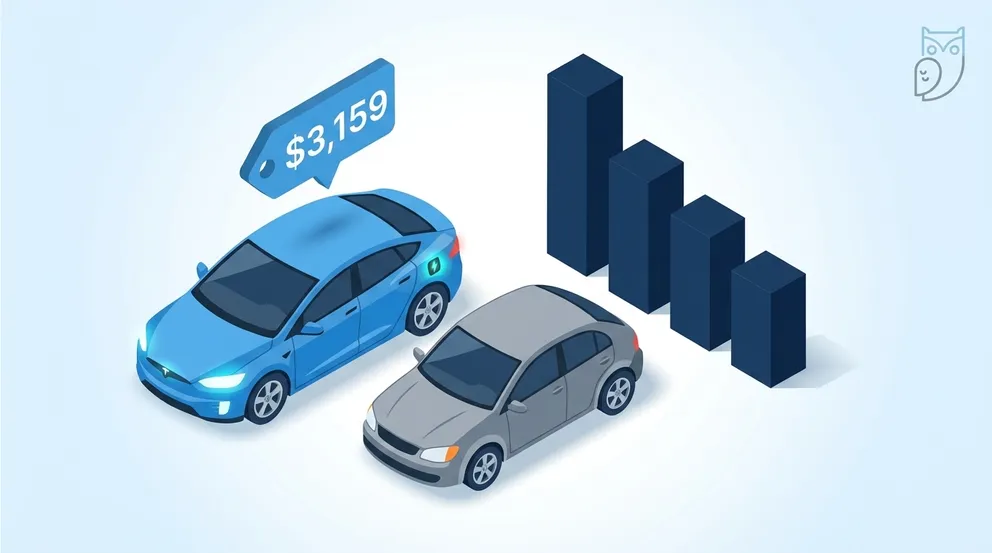
Electric vehicles cost an average of $3,159 a year to insure with full coverage in 2026, about 42% ($941) more than the $2,218 gas-powered cars pay, according to an Insurify report released June 2 based on more than 235 million quotes. The gap shrinks to 18% when only 2024-or-newer models are compared, and it ranges from a 54% premium in Massachusetts to a 4% discount in Montana and West Virginia.
Insuring an electric car still costs hundreds of dollars more than insuring a gas one, but the penalty is shrinking fast for the newest models. Insurify's June 2 analysis pegs the average EV full-coverage premium at $3,159 a year versus $2,218 for gas vehicles, a 42% gap worth $941 annually.
For drivers shopping a 2024, 2025, or 2026 EV, the difference is far smaller. Comparing only those newer model years, the gap narrows to 18%, or $501 a year, because driver-assist technology that once set EVs apart is now standard on gas cars too.
- EVs average $3,159/year to insure across all model years, 42% above the $2,218 gas average
- Limit the comparison to 2024-or-newer models and the gap falls to 18% ($501)
- Massachusetts shows the widest newer-model spread at 54%; Montana and West Virginia run 4% cheaper for EVs
- Washington, D.C. is the priciest place overall at $6,394 for an EV versus $4,124 for gas
- Lemonade, Root, and GEICO offered the most affordable EV coverage, Insurify found
Why EVs Cost More to Insure
Repair economics drive most of the disparity. Ryan Mandell, a vice president at repair-data firm Mitchell, puts the EV repair premium at roughly 15%, citing expensive batteries, complex electronics, and the absence of an engine block to absorb crash forces.
Mandell pointed to the Ford F-150 as a clean comparison, since Ford sold gas and electric Lightning versions side by side from 2022 to 2025. In Mitchell's front-end crash testing, the gas truck's engine absorbed much of the impact, so Ford reinforced the Lightning's front end at a structure that costs about 30% more to repair. Ford also requires technicians to remove the battery before any work, which adds labor hours.
Batteries remain the single biggest claim-cost driver. Replacement runs from $9,000 for a Chevrolet Bolt pack to $21,000 for a Silverado EV, with Tesla's Model 3 and Model Y landing near $13,500, according to EV.com data cited in the report.
EV Insurance Cost by State
Location swings the math more than any single factor. Insurify ranked states using only newer EVs and gas cars (model years 2024 through 2026) to compare technologically similar vehicles, and the average gap across those models was 18%. Massachusetts topped the list at 54%, where Insurify's Daniel Lucas blamed a body-shop network that has not kept pace with affluent early adopters around Boston.
"When your car needs a specialist and the nearest qualified shop has a three-week wait, that's not just an inconvenience, it shows up in your premium," said Daniel Lucas, senior carrier partnerships manager at Insurify.
| State | EV vs Gas Gap | Newer EV ($/yr) | Newer Gas ($/yr) |
|---|---|---|---|
| Massachusetts | +54% | $3,560 | $2,318 |
| New York | +45% | $4,531 | $3,135 |
| Rhode Island | +39% | $6,043 | $4,344 |
| New Jersey | +36% | $5,632 | $4,145 |
| Oregon | +36% | $3,346 | $2,454 |
| California | +21% | $3,584 | $2,969 |
| Florida | +18% | $3,954 | $3,352 |
| Texas | +10% | $3,227 | $2,926 |
| Ohio | +2% | $1,677 | $1,649 |
| Wisconsin | +1% | $1,774 | $1,761 |
| Nebraska | -1% | $2,055 | $2,086 |
| Montana | -4% | $2,242 | $2,339 |
| West Virginia | -4% | $2,062 | $2,148 |
Source: Insurify, based on 235M+ quotes across 50 states and Washington, D.C., for the 2026 report. State figures reflect model years 2024 through 2026 for a driver with a clean record and average or better credit. Full coverage assumes $1,000 comprehensive and collision deductibles. Alaska, Hawaii, North Dakota, New Hampshire, South Dakota, Vermont, and Wyoming were excluded for low quoting volume.
In a handful of low-density states, newer EVs cost the same or less than gas cars. Montana and West Virginia both run 4% cheaper, where light traffic, few severe-weather claims, and thin EV claim histories keep the entire market subdued. We track these regional swings on our car insurance by state hub, and drivers in the priciest markets can compare local figures on our Massachusetts, New York, and Florida car insurance pages.
What This Means for EV Drivers
The headline 42% gap overstates the cost for anyone buying a current-year EV. A Massachusetts driver in a new EV pays $3,560 versus $2,318 for a comparable new gas car, a real $1,242 difference. A Texas driver faces just $301 more, since the Lone Star gap sits at 10%.
Higher gas prices have widened the EV fuel advantage. Insurify estimates EV owners save about $1,508 a year on fuel with gas at $4.49 a gallon, which more than offsets the $941 average insurance premium for most drivers. The math flips state by state, so review our electric car insurance guide and quote the exact model before you sign.
Premiums are also moving in EV owners' favor. Newer-EV insurance costs rose 37.6% from 2023, then reversed course and fell 11.1% over the past year, outpacing the 7.7% drop for newer gas cars. Falling battery prices help explain it: BloombergNEF reports lithium-ion pack prices dropped 8% to $108 per kilowatt-hour in 2025, down from roughly $500 in 2015. We covered the longer-term trend in our report on how the EV premium gap narrowed to 18% earlier this year.
How to Lower Your EV Insurance Costs
Quote insurance before you choose a model
Luxury EVs from Mercedes-Benz, Tesla, and BMW top $4,000 a year, while Volvo, Chevrolet, Ford, and Hyundai sit at the low end. Pull quotes on two or three candidates first.
Compare the carriers that price EVs aggressively
Insurify named Lemonade, Root, and GEICO as the cheapest for EV coverage. Get at least three quotes rather than renewing on autopilot.
Raise your deductible and protect your credit
Moving from a $500 to a $1,000 deductible lowers the premium, and a strong credit history cuts rates in every state except Massachusetts, California, Hawaii, and Michigan, where insurers cannot use it.
Sign up for usage-based discounts
Telematics programs reward low-mileage EV commuters. Read our guide to telematics savings of up to 30% before enrolling.
Looking Ahead
Two policy shifts could reshape EV ownership costs. A proposed federal bill would charge EV owners a $130 annual registration fee to replace gas-tax revenue, well above the $73 to $89 a typical driver pays in federal gas tax, according to ZETA. Meanwhile, the September 30, 2025 expiration of the federal EV tax credit already sent fourth-quarter EV sales down 46.5%, per Cox Automotive.
Insurers are still competing hard for EV business as battery costs fall and repair networks expand. Julia Taliesin, the Insurify economic analyst and licensed agent who wrote the report, expects the trend to continue. Drivers weighing an EV against a gas car should re-quote at every renewal, because the 42% headline gap is already a year out of date for the newest vehicles. For the full picture, see our earlier analysis of the EV insurance cost gap and how owners can close it.
Frequently Asked Questions
Across all model years, EVs average $3,159 a year for full coverage versus $2,218 for gas cars, a 42% gap of $941, according to Insurify's June 2026 report. For 2024-or-newer models the gap narrows to 18%, or $501 a year.
Massachusetts leads at 54% more for a newer EV than a newer gas car, followed by New York at 45% and Rhode Island at 39%. In Montana and West Virginia, newer EVs actually cost about 4% less than comparable gas cars.
Insurify identified Lemonade, Root, and GEICO as offering the most affordable EV coverage in its analysis of more than 235 million quotes. Rates vary by state and model, so compare at least three carriers before buying.
Battery replacement ranges from $9,000 for a Chevrolet Bolt to $21,000 for a Silverado EV, with Tesla packs near $13,500. Those costs, plus specialized labor and the need to remove the battery for many repairs, push EV claim costs about 15% above gas cars, according to Mitchell.
It is improving for newer cars. Newer-EV insurance costs fell 11.1% over the past year, faster than the 7.7% drop for newer gas cars, as battery prices declined and more carriers competed for EV customers.
- Insurify - The EV Premium Penalty: Insuring an EV Is 42% More Expensive Than a Gas Car (June 2, 2026)
- Grist - The Hidden Cost of Owning an EV: Expensive Insurance
- BloombergNEF - Lithium-Ion Battery Pack Prices
- Cox Automotive - EV Market Monitor and Sales Insights
- U.S. Energy Information Administration - Retail Gasoline Prices
- EV.com - EV Battery Replacement Cost by Brand