
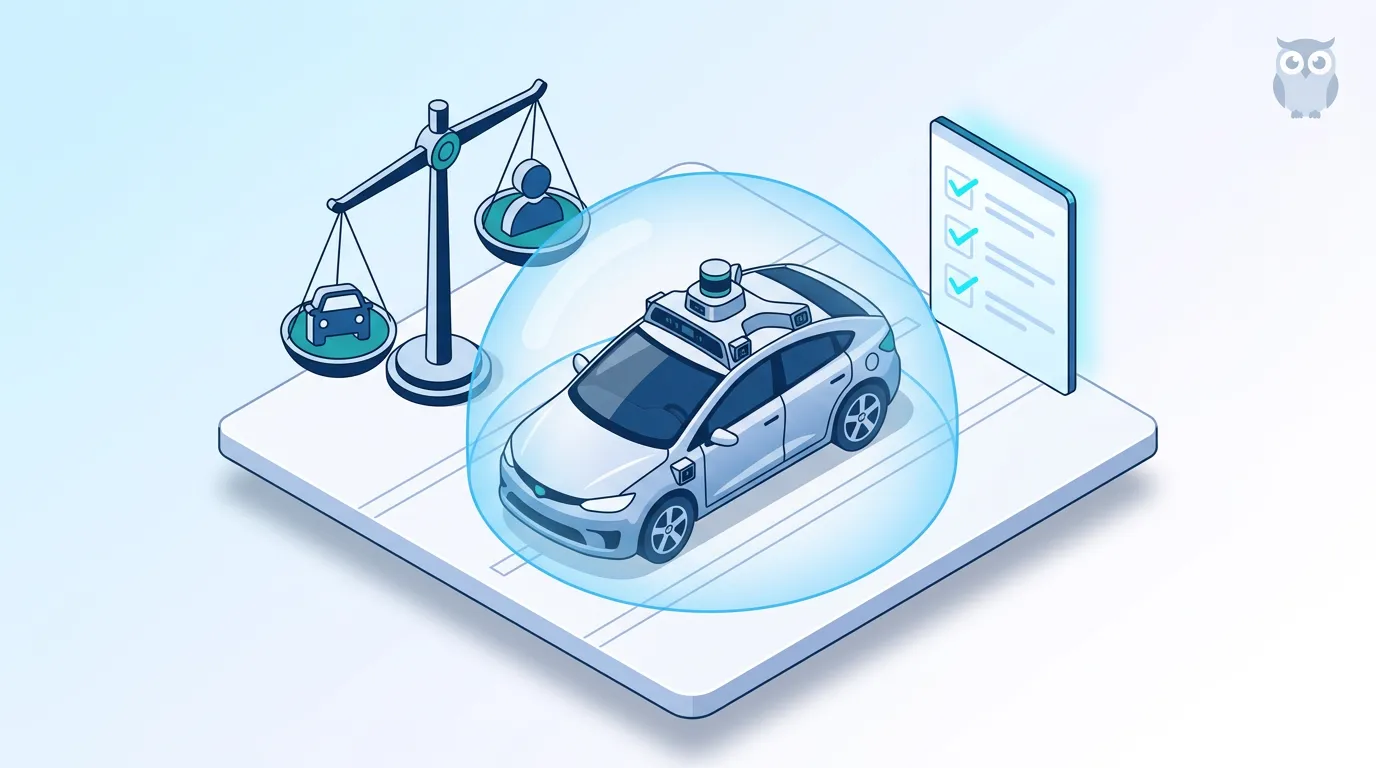
Right now, most self-driving cars still require you to carry standard auto insurance — because most consumer vehicles only reach Level 2 automation, where you're still legally the driver. As vehicles become more autonomous, liability shifts toward manufacturers. But the full insurance overhaul? That's still years away.
Here's a question worth thinking about: if your car drives itself and gets into an accident, who's actually at fault? You? The software? The company that made it?
That one question is quietly upending the entire auto insurance industry — and the answer keeps changing depending on how "self-driving" your car actually is.
Whether you own a Tesla with Full Self-Driving, a new BMW with driver assist, or you're just curious about where all this is heading, here's what you actually need to know about self-driving car insurance in 2026.
- Level 1-2 vehicles (what most people drive today) still require standard personal auto insurance
- Liability increasingly shifts to manufacturers as automation level increases
- Waymo's commercial robotaxis use fleet insurance — the vehicle itself is insured, not a driver
- Despite fewer accidents, insurance won't get cheaper soon due to $100K+ sensor repair costs
- Goldman Sachs projects insurance costs will drop ~50% by 2040 as AVs prove their safety record
- Lemonade now offers Tesla-specific insurance with discounts for miles driven in Full Self-Driving mode
Understanding the 5 Levels of Self-Driving — and Why They Matter for Insurance
The Society of Automotive Engineers (SAE) defined six levels of vehicle automation, from 0 (fully manual) to 5 (fully autonomous). Your insurance implications depend almost entirely on which level you're dealing with.
Here's the breakdown in plain English:
| Level | What It Means | Examples | Who's Liable? |
|---|---|---|---|
| Level 0 | No automation at all | Older vehicles | You, always |
| Level 1 | One assist feature (cruise control, lane keep) | Most modern vehicles | You |
| Level 2 | Combined steering + speed assist, but driver must stay alert | Tesla Autopilot, GM Super Cruise, Ford BlueCruise | You (still) |
| Level 3 | Car handles driving in specific conditions; can ask you to take over | Mercedes-Benz Drive Pilot (CA & NV only) | Shared — complex |
| Level 4 | Drives itself most of the time; no driver needed in approved zones | Waymo robotaxis | Manufacturer / operator |
| Level 5 | Fully autonomous everywhere, no human needed ever | Not commercially available yet | Manufacturer |
As of 2026, only Level 1 and Level 2 vehicles are available for consumers to purchase. Everything you can buy at a dealership today still requires you — the human — to stay engaged and legally responsible.
What Insurance Do You Actually Need Today?
If your car has Tesla Autopilot, GM's Super Cruise, or any other Level 2 system, the insurance situation is straightforward: nothing has changed. You still need the same coverage you've always needed.
That's because at Level 2, you are still the driver. The car assists you — it doesn't replace you. If something goes wrong while those systems are active, you're still legally on the hook.
Standard requirements still apply:
- Liability coverage (required in nearly every state)
- Collision and comprehensive (required if you have a loan or lease)
- Uninsured/underinsured motorist coverage (required in many states)
The only real difference? Your repair bills after a fender bender are significantly higher. More on that in a bit.
Where Things Get Complicated: Level 3 and Above
Level 3 is where the liability question gets genuinely thorny — and where insurers are paying very close attention.
Mercedes-Benz Drive Pilot is currently the only Level 3 system legally operating in the U.S. (in California and Nevada). When it's active on approved highways under 40 mph, the car is driving. You can legally look away from the road.
So if Drive Pilot causes an accident while it's active — who pays?
Mercedes says they do. They've publicly stated that they'll accept liability for accidents that occur while Drive Pilot is engaged. That's a significant shift from every Level 1 and 2 system, where manufacturers explicitly disclaim responsibility.
As automation increases beyond Level 3, federal research suggests liability shifts increasingly to the manufacturer and software developer — not the person sitting in the driver's seat.
Even if a manufacturer accepts liability at higher automation levels, you still need your own insurance policy. Until federal standards clarify the rules, having adequate personal coverage protects you during the inevitable legal gray areas.
Tesla Full Self-Driving and What It Means for Your Policy
Tesla occupies a unique space in this conversation. Their FSD (Full Self-Driving) system is technically Level 2 — Tesla requires you to keep your hands available and eyes on the road — but it's far more capable than a basic lane-keep assist.
For years, Tesla owners complained that their FSD subscription cost them more in insurance, since their vehicles were statistically more expensive to repair. Sensors, cameras, and radar systems don't come cheap.
That changed with Lemonade. They launched the first insurance specifically designed around Tesla's FSD capabilities, tracking how many miles you drive in FSD mode versus manual mode — and discounting rates accordingly. Initially available in Arizona, with an Oregon launch in February 2026 and more states following.
The concept is simple: if FSD is statistically safer when active, why should you pay the same rate whether you're using it or not? Lemonade bet on the data being right.
If you own a Tesla and use FSD regularly, check whether usage-based insurance products are available in your state. As more states approve these programs, early adopters may lock in lower rates that reflect their actual driving behavior.
Waymo and the Commercial Robotaxi Model
Waymo represents Level 4 automation operating commercially right now — and their insurance model is fundamentally different from anything a consumer buys.
Instead of individual driver policies, Waymo insures their vehicles as a fleet. The "driver" in their system is the autonomous software, so the company itself is the insured party. It works similarly to how taxi companies or delivery fleets operate, but without any human driver liability in the mix at all.
The numbers are striking. A December 2024 study from Swiss Re (commissioned by Waymo) found:
Waymo has already expanded to Austin and Atlanta with Uber, and has announced fully autonomous commercial operations launching across Miami, Dallas, Houston, San Antonio, and Orlando in 2026.
As a passenger in a Waymo, you're covered by their fleet policy. You don't need to worry about your personal auto insurance at all — you're a passenger, full stop.
How State Laws Are Handling All This
Here's where things fragment quickly. The U.S. has no comprehensive federal autonomous vehicle insurance law. Instead, 42 states and D.C. have enacted their own legislation — and in the first few months of 2025 alone, lawmakers in 25 states introduced 67 new bills related to autonomous vehicles.
A few states stand out:
- California: Increased minimum liability requirements for autonomous vehicles in 2025 and requires companies to disclose how they handle claims involving autonomous systems
- Florida: Requires $1 million minimum coverage for fully autonomous vehicles — the highest threshold in the country
- Texas: Has gone the other direction, permitting fully driverless truck operations, making it a hub for AV freight testing
- Arizona: Home to significant Waymo operations and generally AV-friendly via executive orders encouraging testing
- Nevada: One of two states where Mercedes Drive Pilot Level 3 can legally operate
If you live in a state that hasn't passed specific AV legislation, standard auto insurance laws apply as-is. You're essentially waiting for your state legislature to catch up.
The Cost Paradox: Why Insurance Won't Get Cheaper Anytime Soon
Here's a counterintuitive reality that surprises most people: even though self-driving cars have drastically fewer accidents, insuring them often costs more today — not less.
The reason comes down to repair costs. Modern autonomous vehicles are loaded with expensive sensors, cameras, and radar systems that are extraordinarily costly to replace and recalibrate after even minor damage.
- A windshield replacement that once cost $300 now exceeds $1,000+ when sensor recalibration is factored in
- Long-range radar systems: $1,500+
- High-resolution and thermal cameras: $500+ per unit
- A complete Level 4/5 sensor suite adds $100,000+ to a vehicle's cost
A minor parking lot bump can become a $5,000+ repair bill when the front bumper has LIDAR sensors embedded in it. Insurers know this, and they price accordingly.
If you drive a vehicle with advanced driver-assistance systems (ADAS), make sure your collision coverage limits are high enough to cover expensive sensor repairs. The days of $1,500 fender-bender claims are largely gone for tech-heavy vehicles.
The Risk Nobody's Talking About: Cybersecurity
Traditional insurance covers crashes. But autonomous vehicles introduce a completely new risk category: hacking.
An autonomous vehicle relies on real-time data from sensors, cameras, GPS, and cloud servers. All of those connections are potential attack vectors. Cybersecurity systems cost between $1,000 and $10,000 per vehicle, and insurers are just beginning to develop products that cover cyber-related losses.
Imagine a scenario where a hacker remotely interferes with a vehicle's navigation system. Who pays? Is it covered under your comprehensive policy? Your liability policy? A specialized cyber policy?
The honest answer right now is: it depends on the policy, and most standard auto insurance policies weren't written with this scenario in mind. This is one of the fastest-developing areas in insurance product development.
The Data Problem: Why Claims Take Longer
When a human-driven car gets into an accident, investigators look at skid marks, witness accounts, and dashcam footage. With an autonomous vehicle, there's a treasure trove of data: sensor logs, system diagnostics, camera feeds, and AI decision records from the moments before impact.
The catch? Manufacturers control that data. And right now, there are no regulatory standards requiring them to share it with insurers.
This creates a frustrating situation where insurers can't fully investigate claims, which means claims take longer and may not be settled fairly. It's one reason Fitch Ratings has said autonomous vehicles will "indelibly alter" the insurance industry — but over a longer timeline than most people expect.
If you're in an accident involving an autonomous feature — even Level 2 — document everything yourself. Take photos, note what systems were active, and save any driver-facing data from your vehicle's app before the manufacturer's systems overwrite logs.
Where Is This All Heading? The 2030-2040 Outlook
The long-term picture is genuinely optimistic — it'll just take time to get there.
Goldman Sachs projects that insurance costs will drop by more than 50% over the next 15 years: from approximately $0.50 per mile in 2025 to $0.23 per mile by 2040. That tracks with Waymo's accident data and the mathematical reality that human error causes over 90% of crashes.
By 2035, S&P Global Mobility forecasts nearly 87 million Level 2 vehicles on U.S. roads, alongside 45 million Level 2+ vehicles, 3.5 million Level 3 vehicles, and 1.7 million Level 4 vehicles. As higher levels proliferate:
- Product liability insurance (for manufacturers) will grow significantly
- Personal auto liability insurance will shrink proportionally
- New hybrid policies will track autonomous vs. manual miles separately
- Cybersecurity coverage will become standard
- Claims processing will increasingly rely on AI-reviewed vehicle data
Fitch Ratings and most major industry analysts agree: expect no meaningful structural change in the next decade, then rapid transformation in the decade after.
What You Should Do Right Now
If you own or plan to buy a vehicle with autonomous features, here's practical advice for navigating insurance in 2026:
- Don't reduce coverage thinking ADAS makes you safer. Fewer accidents doesn't mean cheaper repairs. Keep robust collision limits.
- Look for usage-based options if you drive a Tesla or other AV-capable vehicle. Products like Lemonade's Tesla-specific coverage reward you for using autonomous features safely.
- Check your state's rules. Especially in California and Florida, minimum requirements for autonomous-capable vehicles may be higher than standard minimums.
- Understand what your policy covers regarding ADAS failures. Ask your insurer directly: "If my lane-keep assist causes an accident, am I covered?" The answer should be yes — but verify.
- Document autonomous feature use. If you're ever in an accident while a driver-assist system was active, having records of usage could matter for liability purposes.
Frequently Asked Questions
Not necessarily — Tesla FSD is Level 2 automation, so standard auto insurance still applies. However, specialized products like Lemonade's Tesla insurance are emerging that offer discounts based on how many miles you drive using FSD. Check availability in your state.
It depends on the automation level. For Level 1-2 vehicles, the driver is liable — you're still legally in control. At Level 3 and above, liability increasingly shifts toward the manufacturer or software developer. Mercedes-Benz, for example, has publicly accepted liability for accidents caused while Drive Pilot is engaged.
Often yes, despite fewer accidents. High-tech sensors and cameras are extremely expensive to repair or replace — a simple windshield replacement can exceed $1,000 on sensor-equipped vehicles. Insurance rates reflect repair costs, not just accident frequency.
Yes. Commercial robotaxi operators like Waymo carry fleet insurance that covers passengers. You don't need to use your personal auto insurance as a rider — you're treated the same as a passenger in any commercial vehicle.
Industry analysts project meaningful cost reductions by 2035-2040, with Goldman Sachs estimating a 50%+ decline in per-mile costs over 15 years. The next decade will see preparation and product development; the decade after is when structural changes hit consumers' premiums.
- Insurance Information Institute — Background on Self-Driving Cars and Insurance
- Progressive — Insurance for Driverless Cars
- Lemonade — Self-Driving Car Insurance Explained
- Inszone Insurance — Impact of Autonomous Vehicles on Auto Insurance in 2025
- S&P Global — How Autonomous Vehicles Will Change the Future of Car Insurance
- Insurance Journal — A 10-Year Wait for Autonomous Vehicles to Impact Insurers, Says Fitch