
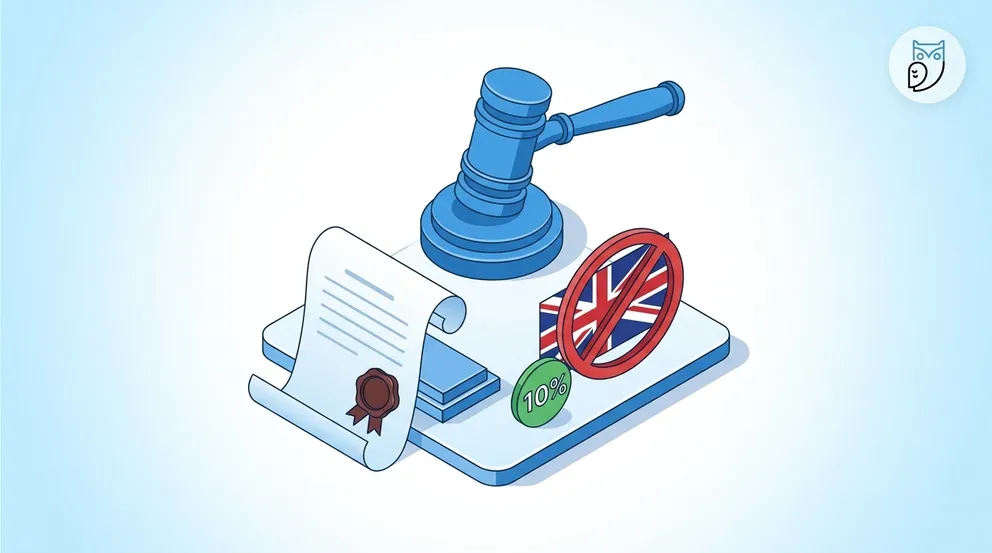
Ohio Gov. Mike DeWine signed House Bill 105 on July 7, 2026, forcing outside investors who bankroll lawsuits to register with the state attorney general, hand over their funding contracts after a case ends, and stay out of settlement decisions. Foreign-financed agreements are banned outright, and consumer lawsuit advances under $400,000 now carry a 10% interest cap.
Ohio just put its lawsuit investors on a registry. DeWine signed HB 105 into law July 7, requiring third-party litigation funders to register with the attorney general before operating in the state and to disclose their funding agreements once a case resolves, according to the Insurance Information Institute.
For the 8 million licensed drivers in Ohio, the change touches the machinery behind bodily injury claims rather than next month's premium notice. Litigation costs in Ohio ran $2,583 per household in 2022, the U.S. Chamber Institute for Legal Reform reported when it welcomed the bill on July 8.
- Litigation funders must register with the Ohio attorney general before doing business in the state
- Agreements financed by persons or entities domiciled outside the United States are prohibited
- Consumer lawsuit advances below $400,000 face a 10% interest rate cap and a ban on referral fees
- Funders cannot pick your lawyer, direct your case, or veto a settlement
- Ohio drivers pay $1,404 a year for full coverage, $117 monthly, per Insurify 2026 data
What HB 105 Actually Requires
Reps. Meredith Craig, R-Smithville, and Jim Thomas, R-Jackson Township, sponsored the measure. Registration with the attorney general comes first, before a funder writes a single check in Ohio. Once litigation resolves, the funder must file the agreement with that office.
The foreign-money provision drew the sharpest language in the bill text, which cites "the grave risk posed by foreign actors that seek to interfere" with Ohio courts. Funders may not contract with parties domiciled outside the U.S., nor may they finance claims backed directly or indirectly by foreign capital.
Consumer protections run deeper than the trade coverage suggests. Law firm Tucker Ellis notes that HB 105 defines a consumer agreement as one involving cash payments below $400,000, applies a 10% interest rate cap to those deals, and forbids funders from paying commissions or steering claimants toward particular attorneys or medical providers. Defendants can also demand that a plaintiff confirm a funding agreement exists and produce it.
Pre-settlement advances have historically carried effective annual rates far above 10% because they are structured as non-recourse purchases rather than loans. Ohio's new 10% cap applies only to consumer agreements under $400,000. Ask any funder in writing what the total repayment will be at 12, 24, and 36 months before signing.
How Lawsuit Investing Reaches Your Premium
Third-party litigation funding works like venture capital for lawsuits. An investor pays the legal costs, then collects a share of any settlement or judgment. Triple-I argues the arrangement stretches cases out and pushes demands higher, since a funder with capital at risk has little reason to accept an early offer.
"Third-party litigation financing has evolved into a global multibillion-dollar asset class of dark money," said Mark Friedlander, Triple-I's senior director of media relations. "Without question, there needs to be more transparency and that's why this legislation is so important."
The verdict data explains the industry's urgency. Marathon Strategies counted 135 nuclear verdicts of $10 million or more against corporate defendants in 2024, a 52% jump over 2023 and the highest total since tracking began in 2009. Median verdict size climbed to $51 million from $44 million. Thermonuclear awards above $100 million rose 81.5% to 49 cases, five of which topped $1 billion.
Capital keeps arriving. Westfleet Advisors found new commitments to U.S. commercial litigation finance rose roughly 23% in 2025, breaking a two-year contraction, with 39 active funders and an average transaction of $8.1 million. The 2024 edition of that report put 42 capital providers in charge of $16.1 billion in assets.
Where Ohio Fits Among the States
Triple-I places Ohio alongside six states with comparable frameworks. Each differs in mechanism, though all mandate clearer disclosure of financing agreements and block foreign-funded deals.
| State | Bill | Year | Approach |
|---|---|---|---|
| North Carolina | SB 481 | 2026 | Effective ban, narrow exceptions |
| Ohio | HB 105 | 2026 | AG registration, post-resolution disclosure, 10% consumer cap |
| Utah | HB 280 | 2026 | Disclosure, foreign funding prohibited |
| Colorado | HB25-1329 | 2025 | Disclosure, foreign funding prohibited |
| Mississippi | SB 2747 | 2025 | Disclosure, foreign funding prohibited |
| Oklahoma | HB 2619 | 2025 | Disclosure, foreign funding prohibited |
| Tennessee | HB 2108 | 2025 | Disclosure, foreign funding prohibited |
Source: Insurance Information Institute, July 14, 2026, citing each state's enacted legislation. Indiana, Kansas, Louisiana, Montana, West Virginia and Wisconsin had litigation funding rules on the books before this legislative wave, per Missouri Lawyers Media reporting from January 2026. Approach column summarizes the primary regulatory mechanism, not the full statute.
North Carolina went furthest, and our coverage of the first state to ban third-party litigation funding lays out the exceptions carved into that statute. Ohio chose registration and post-case transparency instead of prohibition.
"Consumers shouldn't be paying more because an outside financier, or even a foreign entity, saw a lawsuit as a profit opportunity," said Stephen Waguespack, president of the U.S. Chamber Institute for Legal Reform.
What Ohio Drivers Should Expect
Nobody should watch the mailbox for a refund. Full coverage in Ohio averages $1,404 a year, or $117 per month, and liability-only runs $772 annually at $64 monthly, Insurify reported for 2026. Those rates already sit well under the national average, and Insurify projects roughly flat movement through the rest of 2026.
Source: Insurify 2026 Ohio rate analysis. Figures reflect statewide averages across driver profiles; full coverage includes liability, collision, and comprehensive. Ohio full-coverage rates rose 15% in 2024 over 2023 before flattening.
Reform states offer a rough timeline. Louisiana recorded more than $340 million in private passenger auto premium reductions in 2025 after its tort changes, and 20 Louisiana insurers filed rate decreases in the months that followed. Texas drivers, by contrast, carry an estimated $1,724 per year in hidden litigation costs baked into premiums. Two to three years is the realistic window before filings reflect a change of this kind.
What You Should Do Now
Raise Your Liability Limits
Ohio requires only 25/50/25. Moving to 100/300/100 typically costs $150 to $300 more per year and protects your assets against exactly the oversized judgments this law targets.
Reject Any Lawsuit Advance Above 10%
Injured in a crash and offered cash before settlement? Confirm the funder is registered with the Ohio attorney general and demand the total repayment figure in writing.
Requote Every Renewal
Compare at least three carriers each term. Ohio rate spreads between the cheapest and most expensive carrier for the same driver routinely exceed $600 annually. Start with our Ohio car insurance rate breakdown.
Looking Ahead
Congress is circling the same target. Sen. Chuck Grassley introduced the Litigation Funding Transparency Act of 2026 in February, and Rep. Darrell Issa filed the Litigation Transparency Act of 2025 in the House, both aimed at forcing disclosure in federal courts.
Watch the Ohio attorney general's registry for its first published list of funders, expected as the office builds out the registration process. Watch too for whether Ohio insurers cite HB 105 in 2027 and 2028 rate filings, which is where any premium effect becomes visible.
Frequently Asked Questions
Not immediately. The law affects how injury lawsuits are financed and litigated, and any savings would show up through lower bodily injury loss costs in future rate filings. Louisiana took roughly two years after its tort reforms before insurers filed meaningful auto rate decreases.
An outside investor pays the costs of a lawsuit in exchange for a share of the settlement or judgment if the case wins. Triple-I says the practice can prolong cases and contribute to nuclear verdicts of $10 million or more, a large portion of which goes to the investor rather than the plaintiff.
Yes. Agreements involving cash payments under $400,000 count as consumer agreements and carry a 10% interest rate cap. The funder also cannot pay referral fees or send you to a specific attorney or medical provider.
No. HB 105 bars both consumer and commercial funders from influencing case strategy, settlement decisions, and the selection of counsel. That authority stays with you and your attorney.
Triple-I lists Colorado, Mississippi, Oklahoma, Tennessee, Utah and North Carolina as having comparable measures. North Carolina's law, effective July 2026, is the most restrictive and functions as a ban with narrow exceptions.
- Insurance Information Institute - Ohio Joins National Push to Reform Third-Party Litigation Funding (July 14, 2026)
- Office of Gov. Mike DeWine - Governor DeWine Signs Bills Into Law (July 7, 2026)
- Ohio Legislature - House Bill 105, 136th General Assembly
- U.S. Chamber Institute for Legal Reform - Ohio Third-Party Litigation Funding Reform (July 8, 2026)
- Tucker Ellis LLP - Ohio Legislature Seeks to Further Regulate Third-Party Litigation Funding Agreements
- Westfleet Advisors - The Westfleet Insider: 2025 Litigation Finance Market Report
- Risk & Insurance - Litigation Finance Capital Commitments Rebound 23%
- Insurify - Average Car Insurance Cost in Ohio (2026)
- Missouri Lawyers Media - Commercial Litigation Funding Faces Scrutiny, Calls for Transparency (January 2026)
- U.S. Senate Judiciary Committee - Grassley Proposes Third-Party Litigation Funding Reform