

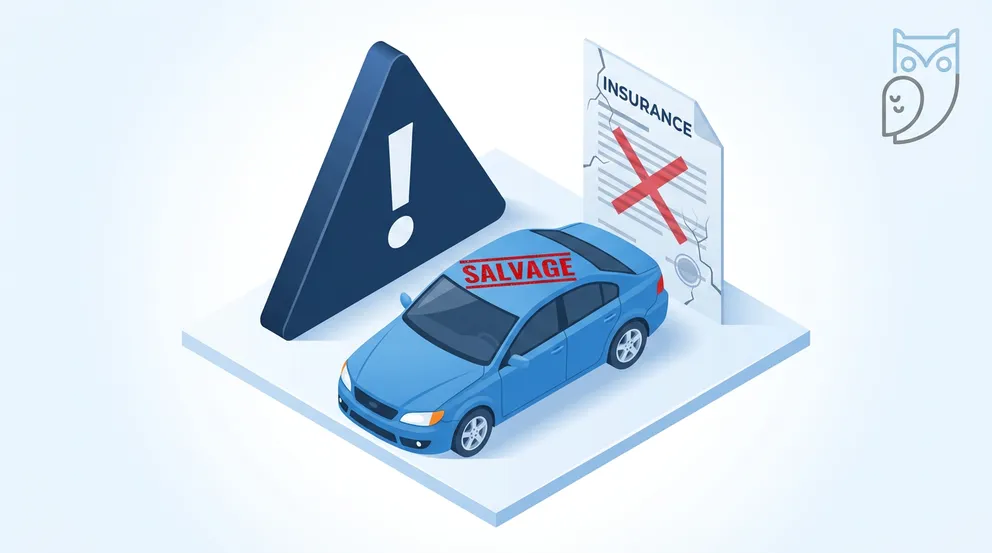
A car becomes uninsurable when an insurer decides the risk is too high to price. The five most common triggers are a salvage or branded title, heavy modifications or gray-market imports, high-theft or ultra-high-value models, a driving record with DUIs or repeat claims, and a coverage lapse. Most drivers can still find coverage through a non-standard carrier or a state assigned-risk pool, usually at 20% to 40% higher rates.
"Uninsurable" rarely means no company on earth will touch your car. It usually means the mainstream carriers, State Farm, GEICO, Progressive, and Allstate, have declined your specific vehicle or your specific record. According to ValuePenguin's 2026 analysis, a single DUI raises a full-coverage premium by about $183 a month, and a rebuilt-title car costs roughly 20% more to insure than a clean-title version, per WalletHub. Both are still insurable. The problem is finding the carrier willing to write the policy and swallowing the surcharge.
Below are the five reasons an insurer says no, what the data shows about each, and the exact path back to coverage.
- Salvage-title cars are generally uninsurable until rebuilt and inspected; repair costs must exceed 70% to 95% of the car's actual cash value to trigger the brand.
- State Farm and Progressive paused new policies on certain Kia and Hyundai models after theft claims spiked 767% in Chicago.
- One DUI adds about $1,585 a year to a premium and $4,755 over three years, according to LendingTree.
- A coverage lapse pushes you into the high-risk tier even with a clean driving record.
- Non-standard carriers like The General and state assigned-risk pools exist specifically to cover drivers the big carriers reject.
1. Your Car Has a Salvage or Branded Title
An insurance adjuster totals a car when repair costs cross a state-set share of its actual cash value (ACV), typically between 70% and 95%, according to WalletHub. That car gets a salvage title, and in that raw state almost no carrier will insure it because it is not legal to drive. Rebuild it, pass a state inspection, and it earns a rebuilt title, which is insurable but tougher to cover.
Even after the rebuild, many carriers refuse collision and comprehensive because they cannot verify the frame's structural integrity. You may only qualify for liability. The table below shows which national carriers write full coverage on rebuilt titles versus liability only, based on WalletHub's 2026 carrier survey.
| Coverage on Rebuilt Title | Carriers |
|---|---|
| Liability + collision & comprehensive | GEICO, Progressive, State Farm, USAA, Farmers, Liberty Mutual, AAA, Mercury, The General |
| Liability (minimum) only | American Family, National General, Allstate (select states) |
Source: WalletHub 2026 rebuilt-title carrier survey. Availability varies by state and individual vehicle inspection results.
Flood, hail, lemon-law buyback, and odometer-fraud brands trigger the same reluctance. A flood-branded car can hide corrosion in wiring and electronics for years, so insurers treat it like a salvage vehicle. Expect the roughly 20% surcharge WalletHub documents, and bring your rebuilt-title certificate, inspection paperwork, repair receipts, and before-and-after photos when you shop. If you are weighing whether full coverage is even worth it on an older rebuilt car, our guide on when to drop collision and comprehensive coverage walks through the math.
Some carriers offer liability on a rebuilt title but cap the payout on comprehensive and collision at a percentage of a clean-title car's value, often 80%. Ask for the payout basis in writing before you buy.
2. It's Heavily Modified, a Kit Car, or a Gray-Market Import
Standard policies price a factory vehicle with a known repair cost and a known parts supply chain. Bolt on a turbo kit, swap the engine, or build a replica from a kit, and the insurer loses that predictability. Custom parts also introduce a coverage gap: aftermarket components usually are not covered unless you specifically list them and pay for added protection.
Gray-market imports are the hardest case. A car never built for the U.S. market, like a JDM Toyota Supra RZ, cannot be federally registered without a compliance conversion that can run upward of $28,000 through a government-authorized shop. Cars older than 25 years bypass that federal requirement, which is why the 25-year import rule drives so much of the JDM market, but they can still fail state safety inspections and get denied.
For modified, kit, or collector cars, look at specialty insurers such as Hagerty or Grundy that write agreed-value policies. You and the insurer agree on the car's worth up front, so a total loss pays the agreed figure instead of a depreciated ACV. See our agreed value insurance guide for how the payout works.
3. It's a High-Theft or Ultra-High-Value Model
Sometimes the driver is spotless and the car itself is the problem. Two versions of this exist, at opposite ends of the price scale.
High-theft models
After a 2022 social-media trend exposed how to hotwire certain keyed-ignition Kia and Hyundai models with a USB cable, thefts exploded. Chicago recorded a 767% jump, and in Milwaukee 66% of all vehicles stolen in 2021 were Kias or Hyundais, per reporting cited by Jalopnik. State Farm and Progressive stopped writing new policies on the affected models in some cities, and Safeco dropped existing customers. Coverage returned only after Hyundai and Kia pushed a software update that cut theft claims 51% to 55%. If your model sits on a carrier's high-theft list, expect a comprehensive surcharge or an outright decline until an anti-theft fix is installed.
Ultra-high-value and exotic cars
A car can also be too expensive to insure conventionally. A Lamborghini Aventador runs close to $8,000 a year because parts are factory-ordered and only specialized technicians can service it. Exotics and collectibles typically require agreed-value policies, mileage caps, and proof of garaged storage, which standard carriers do not offer. For a Ferrari or a low-production supercar, a mainstream quote may simply come back declined.
A car is not uninsurable because it is worthless. It is uninsurable when the insurer cannot predict what a claim will cost, whether that is a $28,000 import conversion or an $8,000 exotic premium.
4. Your Driving Record Set Off the Alarms
The vehicle can be flawless and still get denied because of who is driving it. Insurers non-renew or decline drivers whose records signal repeat losses: multiple at-fault accidents, a string of tickets, or a DUI.
The DUI numbers are stark. LendingTree found premiums climb an average of $132 a month after a DUI conviction, which adds up to $1,585 a year and $4,755 over three years. In 2026, a ticket, accident, or DUI raises rates an average of 54% nationally, and North Carolina drivers see the steepest jump at 137%, according to ValuePenguin. One offense usually means a surcharge and an SR-22 filing. Two or more often means non-renewal.
Non-renewal is not the same as cancellation. Your insurer simply declines to offer a new term at renewal, which is legal in most states with proper notice. It does not erase your coverage mid-policy, but it does flag you as high-risk to the next carrier.
A record that gets you dropped does not lock you out of the road. Carriers like The General, Progressive, and Direct Auto specialize in this tier. Our roundup of the best car insurance for high-risk drivers compares them, and if your license was pulled, getting covered again after a suspension covers the SR-22 process. To see how a single ticket ripples through your rate, read how points on your license impact car insurance.
5. You Let Coverage Lapse or Missed Payments
A gap in coverage, even a few days, reclassifies you as high-risk regardless of an otherwise clean record. Insurers read a lapse as either a hidden risk or an inability to pay, and they price accordingly or decline. In 2026, "high-risk" typically means drivers with DUIs, multiple accidents, coverage lapses, or very low credit scores in states where credit is a permitted rating factor, per ValuePenguin.
The lapse trap is worst for drivers with an SR-22 requirement. If the insurer filing your SR-22 non-renews, they notify the state that the filing ends on your policy date. Miss the handoff to a new SR-22 policy and the state sees you as non-compliant, which can suspend your license all over again. If you do not own a car but still need continuous coverage to satisfy a filing, non-owner car insurance keeps the SR-22 active.
Never let a policy lapse to save money between cars. A 30-day gap can push a clean-record driver into a surcharge tier that costs far more than the premium you skipped. Buy a non-owner or storage policy to stay continuous.
How to Get Covered When You've Been Denied
A decline from one carrier is not a verdict from the whole market. Work through these steps in order.
Ask why, in writing
Insurers must state the reason for a decline or non-renewal. A salvage brand, a specific theft-list model, and a DUI each have different fixes, so pin down the exact trigger first.
Fix the fixable
Rebuild and inspect a salvage car, install the Kia/Hyundai anti-theft update, or complete a state-approved defensive driving course to trim points before you reshop.
Shop non-standard carriers
The General, Progressive, Direct Auto, and National General write policies mainstream insurers reject. Get at least three quotes; surcharges vary widely by company.
Use your state's assigned-risk pool
Every state runs an automobile insurance plan of last resort that guarantees coverage to drivers no voluntary carrier will take. Rates are high, but you stay legal.
High-risk status is temporary. A DUI surcharge typically fades after three to five years, and a lapse stops mattering once you rebuild 6 to 12 months of continuous coverage. Reshop the voluntary market every renewal to escape the non-standard tier as soon as you qualify.
Frequently Asked Questions
Not in its raw salvage state, because it is not legal to drive. Once you rebuild it and pass a state inspection, it becomes a rebuilt title, which carriers like GEICO, Progressive, and State Farm will insure, though often at about 20% higher rates and sometimes with liability only.
Certain keyed-ignition Kia and Hyundai models became theft targets after a 2022 social-media trend, with Chicago thefts up 767%. State Farm and Progressive paused new policies on those models in some cities. Installing the free anti-theft software update, which cut theft claims 51% to 55%, usually restores eligibility.
A DUI raises premiums about $132 a month on average, or $1,585 a year and $4,755 over three years, according to LendingTree. Some full-coverage policies rise closer to $183 a month. Two or more DUIs can lead to non-renewal, pushing you to a high-risk carrier.
It does not make you uninsurable, but it reclassifies you as high-risk even with a clean driving record. Insurers may decline you or charge a surcharge. Buying a non-owner or storage policy between cars keeps your coverage continuous and avoids the penalty.
Every state runs an assigned-risk automobile insurance plan that guarantees coverage to drivers the voluntary market rejects. Rates are high, but it keeps you legal. Non-standard carriers like The General and National General are the next best option before falling back on the state pool.