

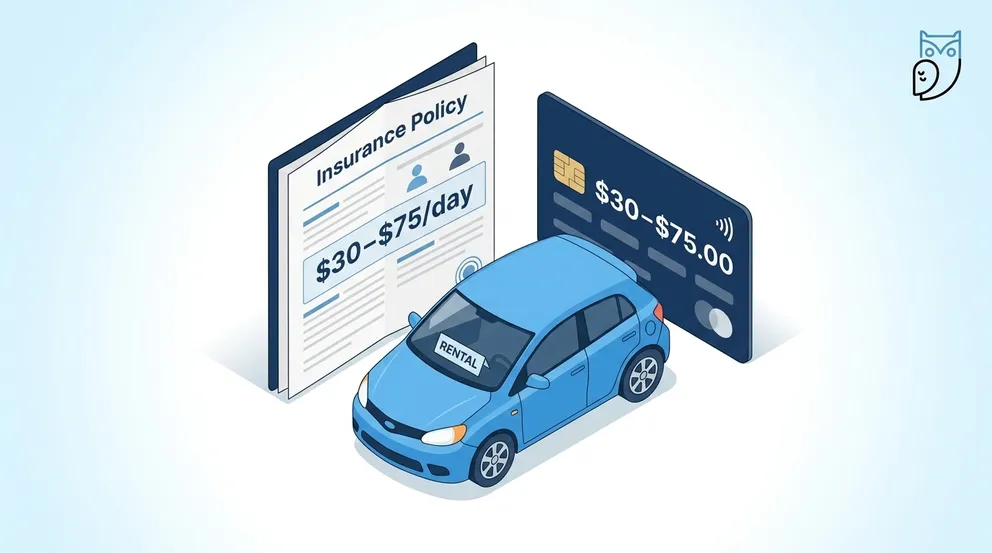
Your car is in the body shop after an accident, repairs will take 12 days, and rental rates near you start at $52/day. Three different insurance scenarios decide who writes that $624 check, and the rules change drastically depending on who hit whom. The most overlooked detail: when the other driver caused the crash, their liability coverage typically pays your full rental rate with no daily cap, while your own rental reimbursement maxes out at $30 to $75 per day according to Progressive.
If you have rental reimbursement coverage on your own policy, it pays $30 to $50 per day up to a $900 to $1,500 cap while your car is being repaired. If the other driver caused the crash, their liability insurance pays your full rental cost, often without any daily cap, until your car is fixed or declared a total loss, per Bankrate.
Filing the claim through the right insurer matters because each path has tradeoffs in speed, cost, and out-of-pocket exposure. Walking through the right sequence is part of any solid car insurance claim process, so this guide breaks down all three scenarios you might face when your vehicle goes into the shop.
Scenario 1: The Accident Was Your Fault
When you caused the crash, your own policy is the only one paying for your rental, and it only pays if you specifically added rental reimbursement coverage. Standard liability and even full coverage policies don't include rental cars by default. You have to opt in, usually for $2 to $15 per month according to Way's 2026 coverage analysis.
Common policy limits look like this: $30/day with a $900 cap, $40/day with a $1,200 cap, or $50/day with a $1,500 cap. AAA caps payouts at $35/day and $1,050 total. Progressive offers tiers from $40 to $70 per day for up to 30 to 45 days, depending on your state. Whatever your daily limit is, multiply it by your rental's daily rate to see how much you'll pay out of pocket.
| Coverage Tier | Daily Limit | Total Cap | Monthly Cost (Avg) | Days at $52 Rate |
|---|---|---|---|---|
| Basic | $30/day | $900 | $2-$5 | 17 days covered |
| Mid-tier | $50/day | $1,500 | $5-$10 | 28 days covered |
| Premium | $75/day | $2,250 | $10-$15 | 30 days covered |
Source: Wallethub 2026 Rental Reimbursement Guide and Progressive policy data, based on a $52/day mid-size rental rate. Caps reset per claim, not per year.
The deductible question trips people up. Rental reimbursement itself almost never carries a deductible, but it only activates when you file a covered collision or comprehensive claim, and those deductibles still apply to your vehicle damage. So if you have a $500 collision deductible, you pay $500 toward repairs while your rental gets reimbursed up to your daily cap.
Pick a rental in the same vehicle class as the car being repaired. Insurers reject claims for "unreasonable" upgrades like swapping a Honda Civic for a Cadillac Escalade. Stay within your vehicle's class and the daily cap, and you'll avoid an awkward gap at checkout.
Scenario 2: The Other Driver Caused the Accident
This is the scenario where most drivers leave money on the table. When another driver is liable for the crash, their property damage liability coverage owes you a "loss of use" payment, which means a comparable rental for as long as your repairs take. Their insurer pays the full rental rate, not a $30 daily fragment, and there's typically no per-day cap, just a reasonableness standard tied to your damaged vehicle's class.
Filing this through the at-fault driver's insurer (a third-party claim) is almost always the better financial move if liability is clear. ValuePenguin's claims guide notes that the at-fault carrier is responsible for "reasonable rental expenses incurred while a vehicle is being repaired," and reasonable means same-type, same-value, not a luxury upgrade.
A 14-day repair on a $52/day rental costs $728. Your rental reimbursement at $30/day pays $420. The at-fault driver's liability pays the full $728. That $308 gap is the price of filing under the wrong policy.
The catch: speed. Liability admissions take time. The other driver's insurer has to investigate, contact their policyholder, and accept fault before they'll authorize a rental. If the police report is unambiguous and the other driver isn't disputing fault, this can happen within 48 hours. If liability is contested, you might wait 7 to 14 days, and you can't drive a car that's in the shop.
Two practical workarounds when the at-fault carrier delays:
- If you have rental reimbursement on your own policy, use it first. Your insurer pays the rental immediately, then pursues subrogation against the at-fault carrier to recover what they spent. You get your deductible back if subrogation succeeds.
- Pay out of pocket and submit receipts to the at-fault insurer once liability is accepted. This works if you can float the cost for 1 to 2 weeks and you're confident liability is clear.
Don't sign a property damage release from the at-fault driver's insurer until you confirm rental coverage is settled. Some adjusters bundle a "release of all property damage claims" with the repair payment, which can shut down your rental claim. Read every form before signing.
Scenario 3: An Uninsured Driver Hit You
About 14% of US drivers are uninsured according to the Insurance Research Council's most recent estimate, and they're concentrated in states like Mississippi, New Mexico, and Florida where uninsured rates run above 20%. If one of them hits you, the at-fault liability path closes because there's no policy to file against.
Three options remain for getting a rental:
- Uninsured motorist property damage (UMPD). About 22 states allow UMPD as a coverage option, with limits typically running $3,500 to $25,000. Some state UMPD policies cover rental costs as part of the property damage payout. Check your declarations page for specifics, since rules vary widely by state. Uninsured motorist coverage details explains the bodily injury vs property damage split.
- Your own collision coverage plus rental reimbursement. If you have both, this path works the same as Scenario 1: you pay your collision deductible, and rental reimbursement pays your daily cap toward the rental. Your insurer may attempt to recover from the uninsured driver, but those collections often go nowhere.
- Hit-and-run claims. If the at-fault driver fled, you'll need a police report filed within 24 hours in most states for UMPD or collision coverage to apply. Without it, the claim will likely be denied.
When the Insurer's Rental Reimbursement Runs Out Before Repairs Are Done
Body shop backlogs averaged 17 days for moderate-damage repairs in early 2026, and parts shortages can push that to 30+ days for certain models, per Mitchell International's industry trends report. If your rental cap hits before the shop hands back your keys, you're paying out of pocket from that point forward.
Before you accept the daily charges, push back on these:
- Call your insurer and ask whether the cap can be extended. If repair delays were caused by the shop or parts supply, some adjusters will authorize an additional 5 to 7 days.
- If the at-fault carrier is paying, document every delay with dated emails and shop status notes. Their "reasonable" duration standard expands when delays are outside your control.
- Switch to a cheaper rental class. Going from a midsize sedan at $52/day to an economy car at $34/day stretches a $1,500 cap by 12 extra days.
- Ask the body shop about loaner cars. Some collision centers keep a small fleet of free or low-cost loaners for customers facing parts delays.
If your car is declared a total loss, rental coverage stops the day the insurer makes a settlement offer, not the day you accept it. Start shopping for a replacement vehicle as soon as you hear "total loss" from the adjuster, because every day you delay is a day you're paying for the rental yourself.
Direct Billing vs Pay-and-Reimburse: Which Rental Company to Pick
Insurers maintain partnerships with specific rental companies, and choosing a partner usually means the insurer pays the rental agency directly. You hand over a credit card for the security deposit, drive off, and never see a bill for the covered portion.
| Insurer | Preferred Rental Partner | Billing Method |
|---|---|---|
| GEICO | Enterprise Rent-A-Car | Direct billing |
| State Farm | Enterprise, Hertz | Direct billing or reimbursement |
| Allstate | Hertz, Enterprise | Direct billing |
| Progressive | Enterprise, Hertz | Direct billing through claim adjuster |
Source: Carrier claims process documentation. Direct billing availability depends on your specific claim and rental location.
Going off-network means you front the rental cost on a personal credit card, save every receipt, and submit them to the claims adjuster for reimbursement. Reimbursement timing runs 7 to 14 business days after submission for most major carriers. Two costs the rental claim won't cover regardless of who's paying: fuel charges and any optional rental insurance you buy at the counter, since you already have coverage through your auto policy. Skip the loss damage waiver upsell and save $15 to $30 per day. For the bigger picture on what your auto policy actually covers in a rental scenario, see our rental reimbursement coverage guide.
Frequently Asked Questions
Only if you specifically added rental reimbursement coverage to your policy. Standard liability and full coverage don't include rental cars. The add-on costs $2 to $15 per month and pays $30 to $75 per day toward a rental during a covered claim, according to Wallethub's 2026 coverage guide.
Most rental reimbursement policies cap coverage at 30 days or until the total dollar limit (typically $900 to $1,500) is hit, whichever comes first. If the at-fault driver's liability insurance is paying, coverage continues for the reasonable repair duration with no fixed day cap, but ends immediately if your car is declared a total loss.
Yes. Their property damage liability coverage owes you a comparable rental for the duration of repairs, typically without a daily cap. You file a third-party claim directly with their insurer. The downside is delay: liability has to be accepted first, which can take 2 to 14 days depending on how clear-cut the fault determination is.
You pay out of pocket from that point forward. Call your adjuster first to request an extension if shop or parts delays caused the overrun, since some insurers grant 5 to 7 extra days. Switching to a cheaper rental class can also stretch a $1,500 cap further, and some body shops offer free loaner cars when waiting on parts.
- Progressive Insurance: Rental Car Reimbursement Coverage
- Bankrate: Does Insurance Cover Rental Cars?
- Wallethub: 2026 Rental Reimbursement Coverage Guide
- ValuePenguin: How to Get a Rental Car from an Insurance Claim
- Way: Rental Reimbursement Car Insurance Coverage 2026
- Insurance Information Institute: Auto Insurance Basics
- GEICO: Rental Reimbursement Claims Process