

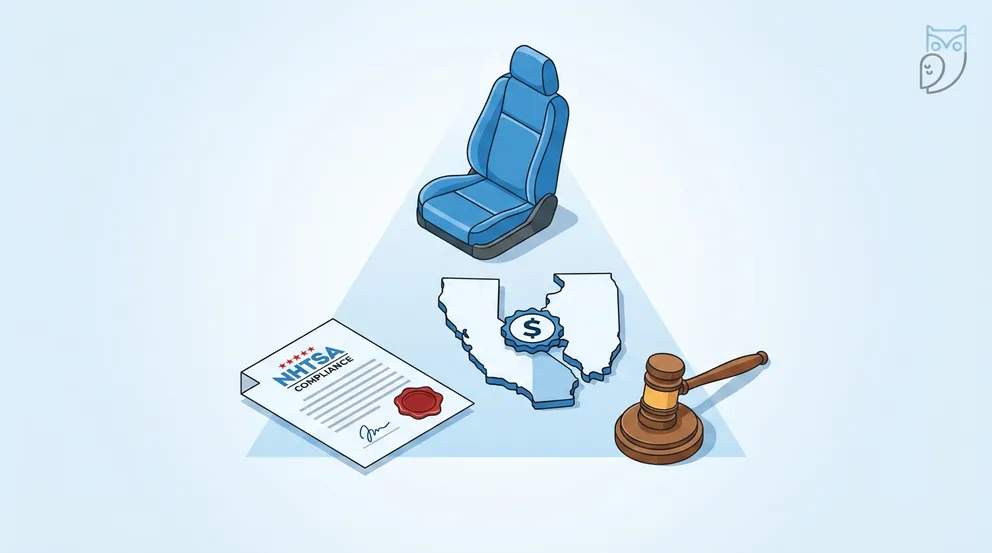
NHTSA requires car seat replacement after any moderate or severe crash, and a crash only counts as minor if all five NHTSA conditions apply. Collision coverage pays for the new seat after your deductible, and California and Illinois legally require insurers to cover it.
- All five NHTSA minor-crash conditions must apply, so one deployed airbag forces replacement
- Graco, Chicco, Evenflo, Clek, Cybex, and Doona void the seat after any collision regardless of severity
- California Insurance Code 11580.011 obligates the insurer to ask whether a child seat was in the vehicle
- Replacement seats run $79.99 to $509.99, so a $500 collision deductible often erases the payout
- Billing the at-fault driver's property damage liability coverage skips your deductible entirely
A fender bender at 12 mph in a parking lot doesn't obviously wreck a $300 convertible seat, and that ambiguity costs parents money in both directions. Some toss a perfectly usable Britax; others keep a Graco that the manufacturer already considers scrap. NHTSA settles the question with a five-part test, and 2024 federal data counts 677 children under 14 killed and more than 127,000 injured in passenger vehicle crashes, which explains why the agency errs toward replacement.
When NHTSA Says You Have to Replace the Seat
NHTSA recommends replacing a car seat after any moderate or severe crash. A crash qualifies as minor, meaning the seat can stay in service, only when every one of these conditions holds true:
- The vehicle was driven away from the crash site under its own power
- Damage skipped the door nearest the car seat
- Nobody riding in the vehicle sustained an injury
- No airbag deployed, in vehicles equipped with them
- Inspecting the seat turns up no visible damage
Fail one condition and the crash is moderate or severe by definition. A driver who walked away uninjured from a 20 mph impact that dented the rear passenger door still has to replace the seat, because criterion two failed.
Visible damage is the weakest of the five tests. Consumer Reports crash-tests seats for its ratings and reports that some seats subjected to full crash forces "don't exhibit any indicators of the crash," meaning stressed polypropylene shells, micro-cracks at the belt path, and stretched harness webbing pass a driveway inspection. That hidden-damage problem is why the other four criteria carry the weight.
Your Car Seat Brand May Override NHTSA
NHTSA tells consumers to follow the manufacturer's instructions when they are stricter than the federal guidance, and roughly half of major brands are stricter. Chicco puts it bluntly: "we recommend erring on the side of caution and replacing your car seat even after a minor crash." Clek voids every seat involved in a collision "of any kind, regardless of the severity of the impact."
| Brand | Replacement Policy | Stricter Than NHTSA? |
|---|---|---|
| Graco, Chicco, Evenflo, Clek | Replace after any crash | Yes |
| Cybex, Doona, Baby Trend, Century | Replace after any crash | Yes |
| Harmony, Orbit Baby, BubbleBum | Replace after any crash | Yes |
| Britax, UPPAbaby, Diono | Replace after moderate or severe crash | No, follows NHTSA |
| Maxi-Cosi, Safety 1st, Cosco, KidsEmbrace | Replace after moderate or severe crash | No, follows NHTSA |
| Nuna, Peg Perego, Combi, RideSafer | Varies by model, check the manual | Model-specific |
Source: Car Seats For The Littles brand policy tracker and manufacturer support pages, current as of 2026. Diono moved from an any-crash policy to the NHTSA criteria in 2021, so a manual printed before then may contradict the brand's current position.
Check the sticker on the side of the shell for your model and serial number before you call anyone. Clek asks for both when you report a collision, and adjusters routinely request the manual page that states the policy.
Which Coverage Pays for a New Car Seat
Four different coverages can fund a replacement seat, and picking the right one changes what you pay by hundreds of dollars. Collision coverage is the default answer most carriers give, but it's rarely the cheapest route when someone else caused the crash.
| Coverage | When It Applies | Deductible Applies? | Your Out-of-Pocket on a $250 Seat |
|---|---|---|---|
| Other driver's property damage liability | The other driver is at fault | No | $0 |
| Your collision coverage | You are at fault, or fault is disputed | Yes, typically $500 | $250, claim pays nothing |
| Your comprehensive coverage | Theft, fire, flood, hail, falling objects | Yes, typically $500 | $250, claim pays nothing |
| Uninsured motorist property damage | At-fault driver carries no insurance | Varies, $0 to $250 by state | $0 to $250 |
Methodology: out-of-pocket figures assume a $250 replacement seat, a $500 collision and comprehensive deductible, and a single claim covering both vehicle damage and the seat. When vehicle repairs already exceed the deductible, adding the seat to that same claim costs you nothing extra.
That last sentence matters more than the table. Rear-ending damage that runs $4,200 blows past a $500 deductible on its own, so tacking the car seat onto the existing repair claim adds $250 to the payout at no additional cost. Filing a standalone $250 seat claim against a $500 deductible pays you nothing. Drivers without collision coverage have no first-party option at all, which is one more argument in the liability-only versus full coverage decision.
When another driver caused the crash, itemize the seat in your third-party property damage claim against their carrier. No deductible applies, and the claim goes on their loss history rather than yours.
California and Illinois Require Insurers to Pay
Two states wrote car seat replacement into statute rather than leaving it to policy language. California Insurance Code 11580.011 reaches further than any other law on the books.
| State | Statute | What It Requires |
|---|---|---|
| California | Ins. Code 11580.011 | Liability, UM property damage, and collision policies must all cover replacement. Insurers must proactively ask whether a seat was in the vehicle. |
| Illinois | 215 ILCS 5/143.32 | Auto policies issued or renewed must cover replacement of a restraint in use by a child during a covered accident. |
| Other 48 states | No statute | Coverage depends on policy wording, usually collision or comprehensive as covered personal property. |
Subdivision (e) of the California statute is the part adjusters forget. It imposes "an obligation to ask whether a child passenger restraint system was in use by a child during an accident or was in the vehicle at the time of a loss," plus an obligation to replace it or reimburse the cost. Quote that subdivision if a California adjuster tells you seats aren't covered, and check our California car insurance page for the state's other consumer protections.
California goes further than Illinois in one respect: the statute covers a seat that was merely present and damaged, not only one occupied by a child. Illinois ties its requirement under Illinois auto policies to a restraint "in use by a child during an accident," so an empty seat in the trunk falls outside 215 ILCS 5/143.32.
Whether Filing a Claim Beats Paying Out of Pocket
Replacement seats span $79.99 to $509.99 across Amazon, Walmart, and Target. Budget models like the Cosco Easy Elite run $99 and the Cosco Entrada sells just under $90, while the Graco SlimFit 3-in-1 lists at $239.99.
Even the $509.99 seat nets you $9.99 as a standalone claim, and that claim still lands on your record. A single at-fault claim raises premiums for three to five years, so read our breakdown of how much rates go up after an accident before filing anything small. The same deductible arithmetic sinks most standalone windshield claims.
Never skip replacement because the claim pays $0. A compromised shell fails at the moment it matters, and car seats cut fatal injury risk 71% for infants and 54% for toddlers aged 1 to 4 in passenger cars. Buy the $90 Cosco out of pocket rather than reusing a seat your manufacturer voided.
How to File the Car Seat Claim
Photograph the seat before you remove it
Shoot the seat installed in the vehicle, the model and serial sticker, and any belt-path stress marks. Adjusters deny reimbursement when nothing documents that the seat sat in the damaged vehicle.
Pull the manual page stating the crash policy
Graco and Chicco owners need this most, since their any-crash policy is what justifies replacement after a fender bender NHTSA would call minor.
Raise the seat when you open the claim
Tell the adjuster the seat type and that a child occupied it, ideally in the same call that starts the vehicle claim. Our step-by-step claim guide covers the rest of the intake.
Ask for like kind and quality, not cash value
Carriers pay for a replacement matching the type and quality of the damaged seat, so a $239.99 convertible should not be settled with a $79.99 booster.
Keep the receipt for the new seat
Most carriers reimburse rather than ship a seat, and the receipt is what converts an approved claim into a check.
Deadlines tighten when the vehicle itself is a write-off, because salvage yards take possession of everything inside. Retrieve the seat before the tow, or read what happens when your car is totaled to understand the timeline you're working against.
What to Do With the Old Seat
Cut the harness straps, write "CRASHED, DO NOT USE" across the shell in permanent marker, and remove the fabric cover before disposal. A seat left intact at the curb gets resold on Facebook Marketplace within hours, and the next buyer has no way to know it absorbed 30 mph of crash energy.
Target and Walmart run periodic trade-in events that swap any old seat for a store coupon, typically 20% off a new seat or gear. Some insurers request the damaged seat as salvage before cutting a reimbursement check, so confirm with your adjuster before you destroy it.
Expiration dates matter alongside crash history. Most seats expire six to 10 years from the manufacture date stamped on the shell, so a crash at year seven is often the moment to replace rather than repair the arrangement.
Frequently Asked Questions
NHTSA says no, provided all five minor-crash conditions apply: the vehicle drove away, the door nearest the seat was undamaged, nobody was injured, no airbag deployed, and the seat shows no visible damage. But Graco, Chicco, Evenflo, Clek, Cybex, and Doona require replacement after any crash regardless of severity, and the manufacturer instruction overrides the federal guidance.
Yes, under collision or comprehensive coverage, subject to your deductible. If another driver caused the crash, itemize the seat in a property damage liability claim against their insurer instead, which carries no deductible. California and Illinois require insurers to cover replacement by statute.
Usually not on its own. With replacement seats costing $79.99 to $509.99 against a typical $500 deductible, a standalone claim on a $239.99 seat pays nothing. Add the seat to an existing vehicle repair claim that already exceeds the deductible, and the insurer covers it in full.
California under Insurance Code 11580.011 and Illinois under 215 ILCS 5/143.32. California is broader because it covers a seat that was damaged even if unoccupied, and it obligates the insurer to ask whether a child restraint was in the vehicle. The other 48 states leave the question to policy wording.
You often cannot tell. Consumer Reports found that seats subjected to full crash forces in its own testing sometimes show no external indicators at all. Stressed plastic, micro-cracks at the belt path, and stretched harness webbing pass a visual inspection, which is why NHTSA relies on crash circumstances rather than appearance.
- NHTSA - Car Seat Use After a Crash: Replacing Car Seats
- NHTSA CrashStats - Traffic Safety Facts: Children
- California Insurance Code Section 11580.011 - Child Passenger Restraint System Coverage
- Illinois General Assembly - 215 ILCS 5/143.32 Child Restraint System Replacement
- Car Seats For The Littles - Manufacturer Crash Replacement Policies
- Consumer Reports - Should You Replace Your Car Seat After a Crash?
- Progressive - Does Insurance Cover Car Seats?
- Clek - Accident Replacement Policy