

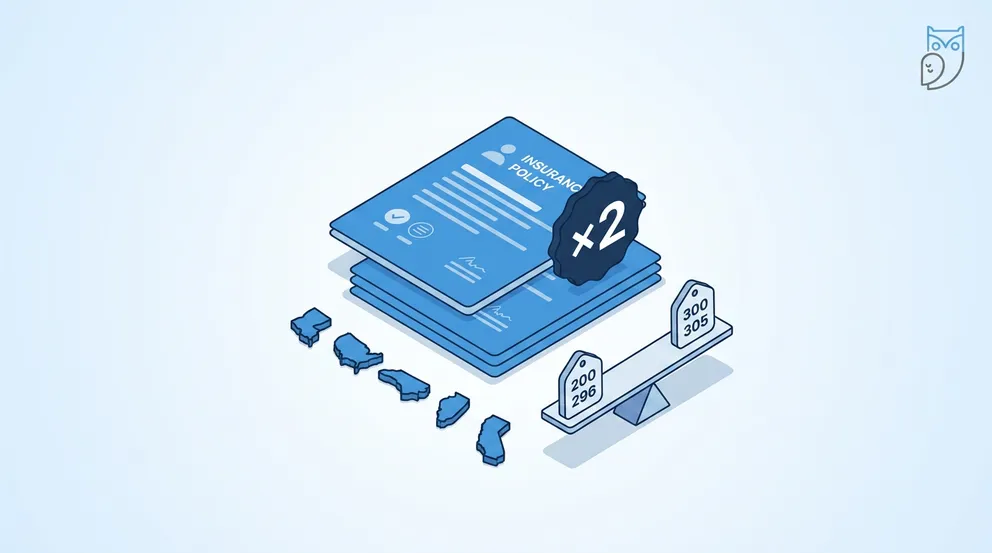
Stacking combines the uninsured/underinsured motorist bodily injury limits on each of your vehicles into one pool. Two cars carrying $50,000 limits become $100,000 of protection. Roughly 30 states permit it, and it adds about 20% to 30% to your UM premium, or $20 to $30 a year on a typical two-car policy.
- Stacking raises only uninsured and underinsured motorist bodily injury limits. Liability, collision, and UM property damage stay exactly where they are.
- Eighteen states ban stacking outright, and two of them (Michigan at 22.3% uninsured drivers, California at 20.4%) rank among the ten riskiest states in the country.
- Florida Statute 627.727 requires insurers to cut your UM premium at least 20% if you sign away stacking.
- Pennsylvania flips the default: stacked coverage applies unless you sign a waiver whose exact wording is dictated by 75 Pa.C.S. 1738.
- Colorado records the nation's highest underinsured rate at 49.7% and permits both forms of stacking, making it the single strongest case for the coverage.
What Stacking Does to Your Coverage Limits
Stacking multiplies your uninsured and underinsured motorist bodily injury limit by the number of vehicles on the policy. Insure a Civic and a pickup at $50,000 per person apiece, and a stacked policy will pay up to $100,000 after one crash with an uninsured driver. That identical policy written unstacked stops at $50,000, and it does not matter which of the two cars you were driving.
Insurers apply the higher limit to injuries only. Your medical bills, lost wages, and pain-and-suffering claim draw from the stacked pool. Repairs to the bumper do not.
Stacking never increases liability coverage. A 100/300/100 policy stays 100/300/100 whether you own one vehicle or four. It also skips uninsured motorist property damage, so a hit-and-run driver who flattens your parked truck still triggers only the single-vehicle UMPD limit.
The 2025 Insurance Research Council study puts 15.4% of U.S. drivers on the road without insurance and 33.4% either uninsured or underinsured, a 10-point jump in the combined figure since 2017. Those numbers explain why stacking exists at all: your own policy has become the primary source of recovery in roughly one crash out of three.
Vertical vs. Horizontal Stacking
Two mechanics operate under the same label, and carriers price them differently.
Vertical stacking
Vertical stacking combines limits inside a single policy. Three vehicles at $25,000 per person produce $75,000 of available coverage. Mismatched limits add rather than multiply: $25,000 on the sedan plus $50,000 on the SUV yields $75,000, not $100,000.
Horizontal stacking
Horizontal stacking reaches across separate policies. A 23-year-old carrying $35,000 in UM coverage who still qualifies as a resident relative on a parent's $25,000 policy can claim against both for $60,000 total. Nine states, among them Texas, New York, and Georgia, permit horizontal stacking while barring the vertical kind.
| Feature | Vertical stacking | Horizontal stacking |
|---|---|---|
| What combines | Vehicles on one policy | Separate policies covering the same insured |
| Typical trigger | Multi-car household on a single declaration page | Resident relatives, college students, second policies |
| States permitting it | 21 | 30 |
| Premium impact | Charged as a UM endorsement | Often no extra charge, since each policy is paid for separately |
| Applies to | UM/UIM bodily injury only | UM/UIM bodily injury only |
Which States Allow Stacking, and Where It Matters Most
Roughly 30 states permit at least one form of stacking. Eighteen prohibit it: Alaska, Arizona, California, Connecticut, Idaho, Illinois, Iowa, Kansas, Louisiana, Maine, Maryland, Massachusetts, Michigan, Minnesota, Nebraska, North Dakota, South Dakota, and Washington. Arkansas and Ohio sit in a middle category where carriers may refuse stacking as long as the policy language is unambiguous.
Legality alone tells you little. Pair each state's rule with its uninsured-driver rate and the picture sharpens considerably.
| State | Uninsured drivers (2023) | vs. national 15.4% | Stacking permitted? |
|---|---|---|---|
| Mississippi | 28.2% | +12.8 pts | Vertical and horizontal |
| New Mexico | 24.1% | +8.7 pts | Vertical and horizontal |
| Michigan | 22.3% | +6.9 pts | Prohibited |
| Tennessee | 21.3% | +5.9 pts | Horizontal only |
| Missouri | 20.7% | +5.3 pts | Vertical and horizontal |
| Florida | 20.6% | +5.2 pts | Vertical and horizontal |
| California | 20.4% | +5.0 pts | Prohibited |
| Colorado | 19.7% | +4.3 pts | Vertical and horizontal |
| Washington | 19.1% | +3.7 pts | Prohibited |
| Maine | 5.7% | -9.7 pts | Prohibited |
Sources: Insurance Research Council, Uninsured and Underinsured Motorists 2017-2023 (published March 2025), for uninsured rates; MoneyGeek and WalletHub 2026 state stacking surveys for statutory availability. Stacking rules can also turn on individual policy language, so confirm with your carrier before assuming a limit applies.
Three of the ten riskiest states for uninsured drivers, plus Washington, forbid the one tool that would let residents buy more protection cheaply. Michigan drivers face a 22.3% uninsured rate with no stacking option, which pushes the burden onto raising the base UM limit instead. Our breakdown of uninsured driver rates in every state covers the rest of the map.
Colorado deserves its own footnote. The IRC pegs Colorado's underinsured rate at 49.7%, the highest in the country, meaning nearly half of insured Colorado drivers carry limits too thin to cover a serious injury claim. Colorado permits both stacking types, so a two-car Denver household can double its UIM protection for the price of a UM endorsement. Compare quotes on our Colorado car insurance page.
What Stacked Coverage Costs
Most guides on this topic skip the numbers entirely. Uninsured motorist bodily injury runs a median of about $50 per vehicle per year according to CarInsurance.com, and stacking typically raises that UM line by 20% to 30%.
| Household | Unstacked limit | Stacked limit | Extra premium/year | Cost per $1,000 of added coverage |
|---|---|---|---|---|
| 2 vehicles at $50K each | $50,000 | $100,000 | $20 to $30 | $0.40 to $0.60 |
| 3 vehicles at $50K each | $50,000 | $150,000 | $30 to $45 | $0.30 to $0.45 |
| 2 vehicles at $100K each | $100,000 | $200,000 | $36 to $54 | $0.36 to $0.54 |
Methodology: modeled on a $50 median annual UM bodily injury premium per vehicle (CarInsurance.com, 2026) and the 20% to 30% stacking surcharge range reported by MoneyGeek and WalletHub. Actual charges swing widely by state, since carriers price UM higher where uninsured rates run above 20%. Request a quote both ways before you decide.
Run that against a real claim. A broken leg with surgery, three days inpatient, and eight weeks off work clears $80,000 without much effort. On a two-car policy the unstacked $50,000 leaves $30,000 unpaid, while $25 in extra annual premium would have covered the shortfall. Over ten years you spend $250 to close a $30,000 hole.
At $0.40 per $1,000 of coverage, stacking is the cheapest protection on an auto policy. Raising liability limits or lowering a collision deductible costs several times more per dollar of benefit.
Florida and Pennsylvania Run on Signed Forms
Two states convert stacking from a shopping choice into a paperwork question, and drivers lose money in both when the form goes unread.
Florida: Fla. Stat. 627.727
Florida requires carriers to offer at least a 20% reduction in the UM premium in exchange for non-stacked limits, and the election is only valid on a state-approved form signed by the policyholder. Insurers who cannot produce that signed form may find the policy read as stacked at claim time. One detail catches people out: the non-stacking election rolls forward automatically through every renewal and replacement policy, so a signature from 2019 still governs a 2026 declaration page. Switching back requires an affirmative request and the higher premium. With 20.6% of Florida drivers uninsured, the 20% saving buys a real reduction in protection.
Pennsylvania: 75 Pa.C.S. 1738
Pennsylvania reverses the default. Stacked UM and UIM coverage applies automatically unless the first named insured signs a waiver, and the statute prescribes the exact sentence that must appear on it: "I knowingly and voluntarily reject the stacked limits of coverage." Forms lacking the statutory language, a signature, or a date are void, and courts have repeatedly restored stacked limits on that basis. The Pennsylvania Superior Court went further, holding that a new waiver is required whenever the stacked UIM amount changes, whether it goes up or down. Pennsylvania drivers who added a third car and never re-signed may already have stacked coverage they are not aware of.
Pull your declarations page and look for the phrase "non-stacked" or "limited UM" next to the uninsured motorist line. Owning three cars does not by itself produce stacked limits, and a non-stacking form signed years ago still caps a 2026 claim at one vehicle's limit.
When Stacking Pays Off, and When It Does Not
- Your household insures two or more vehicles on one policy
- State uninsured rates exceed 15.4%, the national figure, as they do in 20 states
- A high-deductible health plan means the first $5,000 to $8,000 of medical bills lands on you
- Teen or young-adult drivers share the policy, since a resident student also gains horizontal stacking rights
- Base UM limits sit at or near the state minimum of $25,000 per person
- One vehicle, one policy, nothing to stack against
- Maine, Idaho, and Utah residents face uninsured rates of 5.7%, 6.4%, and 6.2%, and all three states restrict or bar stacking anyway
- Health insurance and long-term disability coverage already absorb injury costs
- Your UM limits already run $250,000 per person or higher
- An umbrella policy with UM/UIM follow-form coverage sits above the auto policy
What to Do If Your State Bans Stacking
Drivers in the 18 prohibited states still have four levers, and the first one usually costs less than people expect.
- Buy the limit outright. Moving UM from $50,000 to $100,000 per person typically adds $30 to $60 a year, which lands close to what stacking would have cost.
- Uninsured motorist property damage fills the gap stacking never touched. Median cost sits near $38 annually per CarInsurance.com.
- MedPay of $5,000 to $10,000 covers deductibles and copays regardless of fault, and it runs $30 to $70 a year in most states.
- Personal umbrella policies from carriers including State Farm, Nationwide, and Erie can extend UM/UIM by $1 million for $150 to $300 a year, though not every insurer includes the UM endorsement by default. Ask specifically.
Choosing among these depends on the same limit math covered in our guide to how much car insurance you actually need, and it is worth remembering that state minimum limits fall well short of the average injury claim in 2026.
How to Add Stacked Coverage to Your Policy
Read the declarations page
Find the uninsured motorist line and check for the words "stacked," "non-stacked," or "limited." Missing labels usually mean unstacked in the 30 states where you must opt in.
Confirm your state permits it
Cross-check the table above, then verify with your state insurance department. Arkansas and Ohio allow carriers to exclude stacking through policy language even though the state permits it.
Price it both ways
Ask your agent for the annual UM premium stacked and unstacked. Florida policyholders should see at least a 20% spread, because the statute requires it.
Get the endorsement in writing
Request an updated declarations page after the change and store it. Claim disputes over stacking turn almost entirely on documentation, as Pennsylvania waiver litigation demonstrates.
One more habit worth adopting: re-check the stacking line every time you add or drop a vehicle. Carriers frequently reissue the policy as unstacked when the vehicle count changes, and the IRC data showing 1 in 3 drivers uninsured or underinsured makes that a costly clerical error.
Frequently Asked Questions
Stacked insurance combines the uninsured and underinsured motorist bodily injury limits across every vehicle on your policy, so two cars with $50,000 limits give you $100,000 of coverage. Unstacked insurance caps you at one vehicle's limit, $50,000 in that same example, regardless of how many cars you insure. Stacking applies only to UM and UIM bodily injury, never to liability or property damage.
Stacking typically raises the uninsured motorist portion of your premium by 20% to 30%. On a two-car policy where UM bodily injury runs the national median of about $50 per vehicle per year, that works out to roughly $20 to $30 extra annually, or about $0.40 to $0.60 per $1,000 of additional coverage. Rates run higher in states such as Florida and Michigan where uninsured driver rates exceed 20%.
Eighteen states prohibit stacking: Alaska, Arizona, California, Connecticut, Idaho, Illinois, Iowa, Kansas, Louisiana, Maine, Maryland, Massachusetts, Michigan, Minnesota, Nebraska, North Dakota, South Dakota, and Washington. Arkansas and Ohio permit stacking but let insurers exclude it through clear policy language. Nine additional states, including Texas, New York, and Georgia, allow horizontal stacking across policies but not vertical stacking within one policy.
For most multi-vehicle households in states with above-average uninsured rates, yes. At $0.40 per $1,000 of added coverage it is the cheapest protection available on an auto policy, and 33.4% of U.S. drivers were uninsured or underinsured in 2023 according to the Insurance Research Council. Single-vehicle owners have nothing to stack, and drivers in low-risk states such as Maine at 5.7% uninsured gain much less.
Florida does not require it, but Fla. Stat. 627.727 requires insurers to offer a premium reduction of at least 20% on the UM portion if you elect non-stacked limits, and the election must be made on a state-approved form you sign. If the insurer cannot produce that signed form, courts may treat the policy as providing stacked coverage. The non-stacking election carries forward automatically through renewals until you affirmatively change it.
That is horizontal stacking, and 30 states permit it. A common example is a young adult with $35,000 of UM coverage on their own policy who also qualifies as a resident relative on a parent's $25,000 policy, giving them $60,000 in combined limits. Some states restrict horizontal stacking to policies issued by the same insurer, so verify the rule in your state before relying on it.
- Insurance Research Council - Uninsured and Underinsured Motorists: 2017 to 2023
- Florida Senate - Chapter 627 Section 727, Uninsured and Underinsured Vehicle Coverage
- 75 Pa.C.S. Section 1738 - Stacking of Uninsured and Underinsured Benefits and Option to Waive
- Insurance Information Institute - Facts + Statistics: Uninsured Motorists
- MoneyGeek - Stacked vs. Unstacked Car Insurance (2026)
- WalletHub - Stacked vs. Unstacked Auto Insurance: 2026 Guide
- CarInsurance.com - Guide to Uninsured Motorist Coverage