

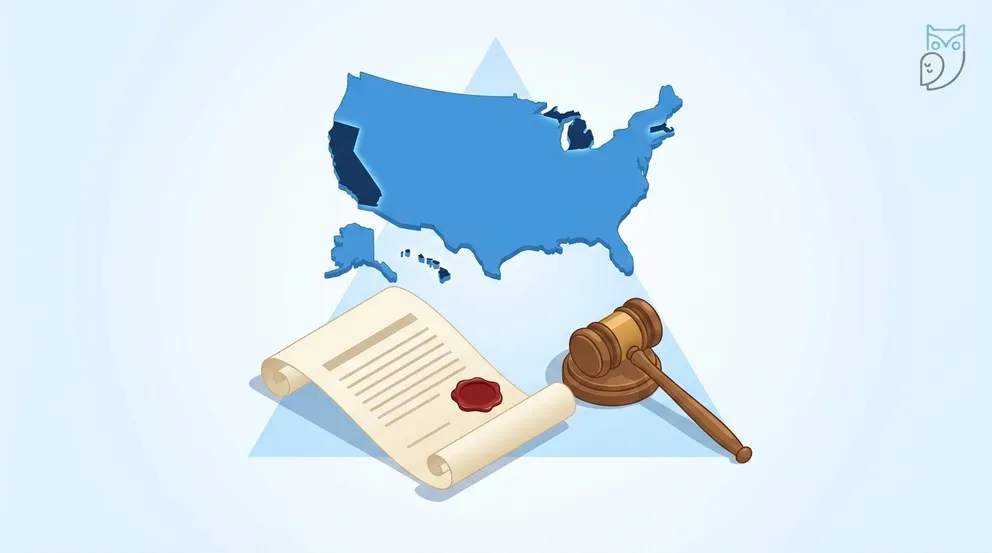
Four states ban auto insurers from using credit scores to set rates: California, Hawaii, Massachusetts, and Michigan. Three more states (Maryland, Oregon, and Utah) restrict how insurers can apply credit data, typically blocking its use for cancellations or non-renewals. The remaining 43 states allow credit-based insurance scores, where drivers with poor credit pay an average of 105% more than those with excellent credit, according to Bankrate's 2026 rate analysis.
- California, Hawaii, Massachusetts, and Michigan prohibit auto insurers from using credit information in rating, underwriting, or renewal decisions.
- Maryland, Oregon, and Utah place partial limits, with Utah only allowing credit-based discounts (no surcharges).
- Consumer Federation of America research shows good drivers with poor credit pay $1,012 a year on average, compared to $470 for those with excellent credit.
- In four states, drivers with poor credit pay more than drivers with a DUI conviction when credit is allowed as a rating factor.
- Iowa, Oklahoma, Pennsylvania, and New York have introduced 2026 legislation to ban or restrict credit-based pricing.
If you've ever wondered why two drivers with identical records can get quotes hundreds of dollars apart, your credit-based insurance score is likely the reason. Most state insurance departments allow carriers to weight credit data heavily when calculating premiums, but seven jurisdictions push back. This guide breaks down exactly which states ban the practice, which limit it, and how much money you save (or lose) depending on where you live, with state-by-state rules drawn from Department of Insurance filings and the National Association of Insurance Commissioners.
The Four States That Ban Credit Scores in Auto Insurance Pricing
Four states block auto insurers from using credit data anywhere in the pricing process: not for new applications, not for renewals, and not for setting individual premiums. Each state arrived at its ban through a different legislative or regulatory path.
California (Proposition 103, 1988)
California voters passed Proposition 103 in November 1988, restricting the rating factors auto insurers can use to driving safety record, miles driven annually, and years of experience. The California Department of Insurance enforces a flat prohibition: credit history, credit-based insurance scores, and credit reports cannot be used to underwrite, rate, renew, or cancel an auto policy. The same protection applies to homeowners insurance pricing in California.
Hawaii
Hawaii Revised Statute 431:10C-207 forbids auto insurers from considering credit ratings, credit history, or credit-based insurance scores when establishing underwriting standards or rating plans. The Hawaii Insurance Division applies this to all private passenger auto policies issued or renewed in the state. Hawaii's homeowners market does not share this protection, so credit can still affect home insurance quotes there.
Massachusetts
Massachusetts General Laws Chapter 175E and supporting Division of Insurance regulations bar auto carriers from using credit information at any stage of the policy lifecycle. The ban covers both new business and renewals across all 50 carriers writing auto policies in the state. Massachusetts also prohibits credit-based pricing on homeowners coverage, making it the only state with a complete two-line credit ban for personal lines insurance.
Michigan (No-Fault Reform Act, 2020)
Michigan eliminated credit-based insurance pricing on July 1, 2020, as part of the no-fault auto insurance overhaul signed by Governor Gretchen Whitmer. The reform package replaced an unlimited Personal Injury Protection mandate with tiered options and simultaneously banned credit scores, ZIP codes, gender, marital status, occupation, and education from rate calculations. Insurers in Michigan can still consider credit when offering installment payment plans, but cannot factor it into the base premium.
States With Partial Restrictions on Credit-Based Insurance Scores
Three additional states allow credit data only in narrow situations. The rules vary enough that drivers should read them carefully before assuming they're protected.
Maryland
Maryland Insurance Article §27-501 lets auto insurers consider credit history when issuing a brand-new policy, but blocks them from using credit to deny the original application, cancel an active policy, refuse renewal, or raise premiums during a renewal cycle. The Maryland Insurance Administration also caps how steeply carriers can surcharge any one factor, which softens the blow even on initial quotes. Homeowners coverage in Maryland has stronger protection: insurers can't use credit there at all.
Oregon
Oregon Revised Statute 746.661 permits insurers to consider credit when initially deciding whether to issue an auto policy, but prohibits cancellations or non-renewals based on credit. Oregon further restricts which credit report items can be used, blocking factors such as the number of credit inquiries from consumer-initiated shopping. The Oregon Division of Financial Regulation has tightened these rules twice since 2018.
Utah
Utah Code §31A-22-320 takes a discount-only approach. Auto insurers can use credit during initial underwriting, but after the policyholder has been with the company for 60 days, credit cannot be used to cancel, refuse renewal, or decline coverage on a newly added vehicle. More importantly, Utah carriers can only use credit information to offer discounts, never to charge a higher premium. Once a credit-based discount is applied, the insurer cannot remove it solely because the driver's credit score dropped.
Complete Table: Credit Score Use in Auto Insurance by State
| State | Credit Score Use Status | What's Allowed | Source / Statute |
|---|---|---|---|
| California | Banned | Prohibited entirely | Prop 103 (1988) |
| Hawaii | Banned | Prohibited entirely | HRS 431:10C-207 |
| Massachusetts | Banned | Prohibited entirely | MGL Ch. 175E |
| Michigan | Banned | Prohibited (2020 reform) | PA 21 & 22 of 2019 |
| Maryland | Partial | New policies only; no cancel/non-renew | MD Ins. §27-501 |
| Oregon | Partial | Initial underwriting only | ORS 746.661 |
| Utah | Partial | Discounts only; no surcharges | Utah Code §31A-22-320 |
| 43 other states & DC | Allowed | Standard credit-based insurance scoring | NAIC model law |
Source: NAIC state-by-state filings, Experian Insurance Insights (March 2025), and individual state Department of Insurance bulletins. Rules current as of May 2026.
How Much More Drivers With Poor Credit Pay When States Allow It
The Consumer Federation of America's 2023 study "The One Hundred Percent Penalty" priced 60 quotes per major city across the 47 states (plus DC) that permit credit-based pricing. Drivers with excellent credit averaged $470 a year for state-minimum liability coverage, while drivers with fair credit averaged $701, and drivers with poor credit averaged $1,012. That's a 115% premium hike tied entirely to credit standing, not driving behavior.
| Credit Tier | Avg. Annual Premium | Monthly Cost | vs. Excellent Credit |
|---|---|---|---|
| Excellent (760+) Baseline | $470 | $39 | 0% |
| Good (700-759) | $571 | $48 | +21% |
| Fair (640-699) | $701 | $58 | +49% |
| Poor (580-639) | $1,012 | $84 | +115% |
Source: Consumer Federation of America, "The One Hundred Percent Penalty" (July 2023). Quotes pulled for state-minimum liability coverage for a 35-year-old driver with a clean record.
Bankrate's 2026 rate study found a similar gap on full coverage policies, with poor credit drivers paying $4,082 a year compared to $1,991 for excellent credit, a 105% premium difference. The Zebra's 61-million-quote dataset shows drivers with credit scores under 580 paying $2,729 annually for liability versus $1,308 for those with scores over 800, a $1,421 yearly gap or 109% increase. In four states, drivers with perfect records and poor credit pay more than drivers with a DUI on their record.
A driver with poor credit relocating from Florida to California saves an average of $1,074 per year on auto insurance based on credit alone, before any other rating factors are considered.
The Political Battle: Consumer Advocates vs. Insurance Industry
The American Property Casualty Insurance Association argues that credit-based insurance scores are statistically validated predictors of loss, citing actuarial studies including a 2007 Federal Trade Commission report finding correlation between credit and claim frequency. Insurers maintain that banning the factor forces good-credit drivers to subsidize higher-risk policyholders, raising overall rates.
The Consumer Federation of America, NAACP, and Center for Economic Justice counter that credit scores function as a proxy for race and income, producing what they call disparate impact under the Fair Housing Act and analogous state laws. CFA's research found that drivers in majority-Black ZIP codes face 24% higher premiums than equivalent drivers in majority-white ZIP codes, much of which traces to credit-based scoring.
Four states have introduced active 2026 legislation to follow Michigan's lead. Iowa, Oklahoma, Pennsylvania, and New York are debating bans or sharp restrictions, with the Pennsylvania bill (HB 1832) furthest along. The COVID-19 pandemic accelerated the debate after credit scores fell for millions of Americans through job loss, exposing how quickly insurance rates can spike for reasons unrelated to driving.
What to Do If You Have Poor Credit in a State That Allows Credit Scoring
Drivers stuck in the 43 states where credit affects rates have several practical options that don't require a cross-country move.
Request your credit-based insurance score (separate from your FICO) directly from your insurer. LexisNexis and TransUnion produce these scores, and federal law gives you the right to know what number is being used against you and to dispute errors.
Shopping around matters more when credit hurts you. Insurers weight credit very differently, with some carriers (Travelers, Auto-Owners) penalizing poor credit harshly while others (USAA, GEICO) take a lighter approach. Quotes from at least five carriers can swing the result by hundreds of dollars annually.
State minimum liability and high-deductible full coverage both reduce the dollar impact of any premium percentage hit. Bundling auto with renters or homeowners, completing a defensive driving course, and enrolling in usage-based or telematics programs can all stack discounts on top of unfavorable credit-based pricing.
If your credit is recovering after a hardship, ask your insurer about extraordinary life circumstances exceptions. Most states allowing credit scoring require carriers to consider documented events like divorce, identity theft, military deployment, or a death in the immediate family when the policyholder asks.
Improving your credit by even one tier (poor to fair, or fair to good) typically lowers premiums on the next renewal cycle. Paying down revolving balances, settling collections, and avoiding new credit applications produce the fastest movement on credit-based insurance scores, which weight payment history and credit utilization most heavily.
Frequently Asked Questions
California, Hawaii, Massachusetts, and Michigan ban auto insurers from using credit-based insurance scores or credit history when underwriting, rating, or renewing a policy. California's ban dates to Proposition 103 in 1988, and Michigan most recently joined the group on July 1, 2020, as part of its no-fault auto insurance reform package.
Not in California, Hawaii, Massachusetts, or Michigan, where credit cannot be used at any policy stage. Maryland, Oregon, and Utah also block cancellations and non-renewals based on credit. In the other 43 states, insurers can use a credit drop as one factor in renewal pricing, though most carriers do not non-renew solely because of credit changes.
Drivers with poor credit save an average of $542 a year on liability coverage in banned-credit states, based on Consumer Federation of America 2023 data showing poor-credit drivers pay $1,012 nationally versus $470 for excellent-credit drivers. The savings are larger on full coverage policies, where Bankrate measured a $2,091 annual gap between excellent and poor credit in 2026.
Iowa, Oklahoma, Pennsylvania, and New York have all introduced 2026 legislation to restrict or ban credit-based pricing in auto insurance. Pennsylvania House Bill 1832 has advanced furthest, with hearings underway in the House Insurance Committee. Federal action is unlikely in the near term, since insurance regulation falls primarily to states under the McCarran-Ferguson Act of 1945.
Credit-based insurance scoring sits at the intersection of consumer protection, actuarial science, and civil rights law. The four banned states show that auto insurance markets can function without credit as a rating factor, while the seven-state patchwork of partial restrictions points to where the legal fight is heading. Drivers in the remaining 43 states need to monitor their credit, shop aggressively across carriers, and check the minimum coverage requirements in their state to make sure they're not paying for more than they need.
- Experian: Which States Restrict the Use of Credit Scores in Determining Insurance Rates? (March 2025)
- Consumer Federation of America: The One Hundred Percent Penalty (July 2023)
- Bankrate: Car Insurance Rates by Credit Score (2026)
- The Zebra: Drivers With Poor Credit Pay Twice as Much for Car Insurance
- National Association of Insurance Commissioners: Credit-Based Insurance Scores
- Michigan Department of Insurance and Financial Services: No-Fault Reform Implementation
- CNBC: Insurance Rates Based on Credit History Draw Scrutiny From Lawmakers (April 2026)