
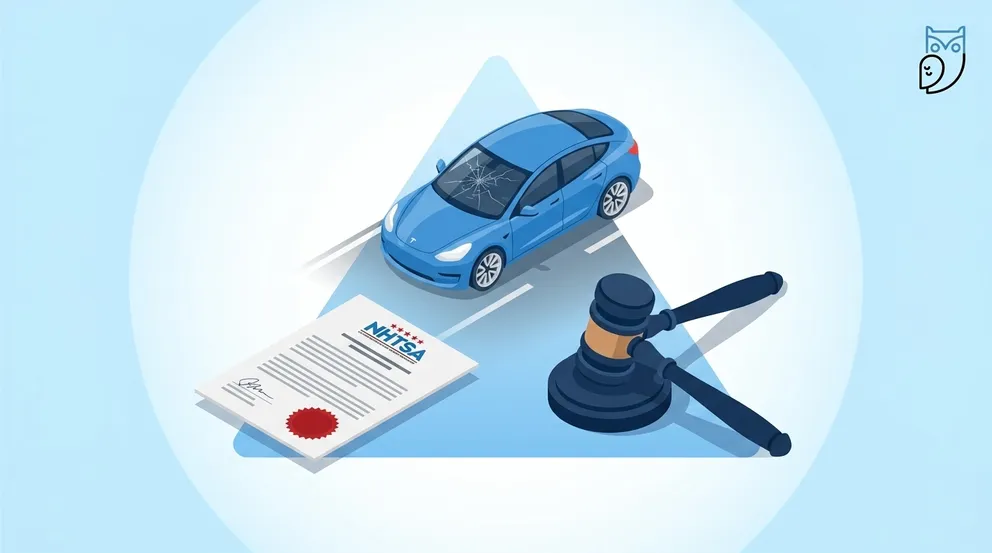
On June 19, 2026, a Tesla Model 3 the driver said was in self-driving mode crashed into a Katy, Texas home and killed 76-year-old Martha Avila. NHTSA has opened a Special Crash Investigation, and on June 23 Avila's relatives sued both Tesla and the driver for wrongful death. Who was in control, the human or the software, now decides which insurance policy pays, and the answer reaches every driver who uses Autopilot or Full Self-Driving.
A Tesla Model 3 that its driver said was in self-driving mode crashed through the brick wall of a Katy, Texas home shortly after 8 p.m. on June 19, 2026, killing 76-year-old Martha Avila as she stood inside. The car had failed to make a sharp right turn at the end of Rose Hollow Lane, according to the Harris County Sheriff's Office, which reported no evidence of a mechanical malfunction in its initial review.
The National Highway Traffic Safety Administration responded within days. Federal investigators opened a Special Crash Investigation, the agency's most intensive crash inquiry, and pledged to pull the Model 3's event data recorder independently. On June 23, four days after the crash, Avila's daughter and son-in-law, Jennifer and Justin Barbour, sued Tesla and 44-year-old driver Michael Butler in Harris County district court, seeking more than $1 million in damages plus punitive damages.
- Disputed cause: the driver reported self-driving mode, while Tesla says its log shows he floored the accelerator to 73 mph.
- NHTSA's Special Crash Investigation feeds a larger probe, EA26002, that already covers roughly 3.2 million Tesla vehicles.
- Because Autopilot and Full Self-Driving are SAE Level 2 systems, the human driver stays legally responsible in all 50 states.
- At just $25,000, Texas's minimum property-damage limit cannot come close to rebuilding a destroyed home.
What Happened on Rose Hollow Lane
Michael Butler was driving east on Rose Hollow Lane when his Model 3 continued straight instead of turning, jumped the curb, and tore through the front of the two-story house where Avila was visiting her daughter's family. Justin Barbour was also inside and suffered injuries to his neck, back, and shoulders. The impact left the home uninhabitable, and the Barbours have been living in hotels since.
Butler told Harris County deputies the vehicle was operating on Autopilot, Tesla's driver-assistance system. He was cooperative and showed no signs of intoxication, investigators said. Tesla pushed back within 72 hours.
Ashok Elluswamy, Tesla's head of AI, said the company's vehicle log shows Butler "manually overrode self-driving by pressing the accelerator all the way to 100% of the accel pedal in this residential area." By Tesla's account, the Model 3 reached 73 mph with the pedal floored, and the pedal stayed depressed even after the car had plowed through the brick wall. Authorities have not confirmed that account, and the cause remains under federal investigation.
Tesla's Self-Driving Probe Was Already Open
The Katy crash landed in the middle of an existing federal review. In March 2026, NHTSA upgraded its Full Self-Driving inquiry to Engineering Analysis EA26002, a designation that covers an estimated 3.2 million Tesla vehicles, including 2017 through 2026 Model 3 sedans like the one in this crash. Investigators are examining nine incidents in which FSD allegedly failed to handle reduced visibility from sun glare, fog, or airborne dust, including one earlier pedestrian fatality.
An Engineering Analysis is the final step before regulators can demand a recall, though NHTSA had ordered no recall as of late June 2026. The agency typically completes this phase within 18 months. Driverless technology now triggers the same recall machinery as faulty brakes, and earlier this year Waymo recalled 3,791 robotaxis over a flooded-road software flaw.
The Lawsuit Puts Liability on Trial
The Barbour family's wrongful-death suit, filed in Harris County's 61st District Court, names both Tesla and Butler. It alleges that Tesla's Autopilot and Full Self-Driving systems were defectively designed, that the car failed to detect the dead-end street and the house in its path, that the system inadequately monitored whether the driver was paying attention, and that the vehicle may have experienced "sudden unintended acceleration." Butler is accused separately of negligence and gross negligence.
Those competing claims map directly onto different insurance policies, because whoever is found responsible determines which insurer, or which corporation, ultimately writes the check.
Who Pays When a Self-Driving Car Crashes?
Every U.S. state still follows one rule on this point: at SAE Level 2, where Tesla's Autopilot and Full Self-Driving operate, the human in the driver's seat is legally responsible for the car's movements. No 2026 consumer vehicle is approved above Level 2, so "self-driving" remains a supervised feature rather than a legal handoff. That single fact shapes how a crash like the one in Katy gets paid for, and it is the part most owners misunderstand about how self-driving car insurance works.
When a vehicle destroys a home and kills someone inside, four separate sources of money can come into play, each with its own limits and conditions.
| Who pays | What it covers | Typical limit | The catch |
|---|---|---|---|
| Driver's auto liability (Butler) | Avila's death and the home's damage, if the driver is at fault | TX min 30/60/25 | $25,000 property damage cannot rebuild a home; $30,000 per person is thin for a death |
| Homeowner's policy (Barbours) | Structural damage to the house itself | Dwelling limit ($250K+) | Pays after the driver's auto insurer; deductible applies; insurer then subrogates |
| Driver's collision coverage | Damage to the Tesla Model 3 itself | Vehicle cash value | Optional coverage; pays regardless of fault only if carried |
| Product liability (vs. Tesla) | Damages if Full Self-Driving is proven defective | Set by a jury | Requires proving a defect in court, the path the Barbour suit takes |
Texas's 30/60/25 minimum requires $30,000 of bodily-injury coverage per person, $60,000 per accident, and $25,000 for property damage. Actual payouts depend on the limits each party bought and the final finding of fault.
In practice, the Barbours would file first against Butler's auto policy, then lean on their own homeowner's coverage for the gap, after which their insurer would chase Butler and potentially Tesla for repayment through subrogation. If a jury later finds Full Self-Driving defective, the financial weight shifts toward Tesla and away from a single driver's policy limits. The disputed cause therefore matters in dollars, not just in headlines.
Why a State-Minimum Policy Leaves Texas Drivers Exposed
Texas is an at-fault state, which means the driver who causes a crash answers for the resulting damage, and a single at-fault accident adds roughly $60 a month to a premium. The mandatory minimum of 30/60/25 sounds like real protection until you price out a destroyed two-story home, as our Texas car insurance guide details. Rebuilding a house easily runs into six figures, yet state law requires just $25,000 of property-damage coverage.
Full coverage in Texas averages $2,422 a year, or about $202 a month, according to Experian data from May 2026, and dense urban ZIP codes run higher. Drivers in fast-growing Houston suburbs like Katy tend to pay above that average, a pattern our Houston car insurance breakdown lays out. Raising limits to 100/300/100 usually costs a modest amount more each month while shielding your savings from a claim that blows past $25,000 in seconds.
What Self-Driving Features Do to Your Premium
Engaging Autopilot earns you no discount for letting the car drive. The hardware that enables driver assistance actually pushes premiums up, because each camera, radar unit, and sensor is expensive to replace after a fender-bender. Vehicles with Level 2 systems run roughly 10% to 25% above the national average for full coverage, and a single front-bumper sensor can cost $500 to $2,000 to swap out, according to AAA.
Tesla ownership reflects that math. A Tesla Model 3 averages about $3,871 a year, or $323 a month, for full coverage, while a Model S runs closer to $5,285 a year. Several carriers, including Tesla's own insurance arm in select states, now price policies using telematics that track real driving behavior rather than rewarding the use of automation. Knowing which coverage actually pays after a crash, from property-damage liability to comprehensive, helps you buy the right limits instead of the cheapest ones, and our guide to the types of car insurance coverage breaks down each one.
Raise Your Liability Limits
Compare the cost of moving from Texas's 30/60/25 minimum to 100/300/100. The upgrade often adds only a modest monthly amount while covering catastrophic property and injury claims.
Treat Driver-Assist as Supervised
Remember that Autopilot and Full Self-Driving are Level 2 features. You remain legally and financially responsible, so keep your hands ready and your eyes on the road.
Price Your Specific Vehicle
Gather quotes from at least three carriers before buying an EV or a sensor-heavy car. A Model 3 can cost $3,871 a year to insure, and rates vary widely by insurer.
Confirm Your Home Coverage
Verify that your homeowner's dwelling limit reflects current rebuild costs, since a vehicle strike is a covered peril that your insurer will later subrogate against the driver.
Looking Ahead
NHTSA's data pull will likely settle the central question of whether software or the driver controlled the Model 3 in its final seconds, and that finding could either clear Tesla or push EA26002 toward a recall of 3.2 million vehicles. The Barbour lawsuit will move on a slower track, with discovery into Tesla's logs potentially stretching across months. Both outcomes will shape how insurers price Autopilot-equipped cars and how courts assign blame the next time a driver insists the car was in control.
Frequently Asked Questions
The at-fault driver's property-damage liability coverage pays first. If that limit is too low or the driver is uninsured, your homeowner's policy covers the rest, then seeks repayment from the driver through subrogation. In Texas, the driver's required property-damage limit is only $25,000, so a serious strike often forces your home insurer to step in.
No. Autopilot and Full Self-Driving are SAE Level 2 systems, and every U.S. state still treats the human in the driver's seat as legally responsible. Holding Tesla responsible requires a separate product-liability lawsuit that proves the software was defective, which is exactly what the Barbour family is attempting in Harris County.
No. Vehicles with Level 2 driver assistance cost roughly 10% to 25% more to insure than the average car because their cameras and sensors are expensive to repair. A Tesla Model 3 averages about $3,871 a year for full coverage, and a single bumper sensor can run $500 to $2,000 to replace.
Often it is not. Texas's $25,000 property-damage limit would not rebuild a destroyed home, and its $30,000 per-person bodily-injury limit can fall short of a single hospital stay. Raising coverage to 100/300/100 usually adds only a modest monthly cost while protecting your assets.
Engineering Analysis EA26002, opened in March 2026, covers about 3.2 million Tesla vehicles and examines whether Full Self-Driving fails to handle reduced visibility such as sun glare and fog. An Engineering Analysis is the last step before the agency can request a recall, and no recall had been ordered as of late June 2026.
- Electrek - NHTSA probes fatal Tesla crash into Texas home
- Electrek - Tesla admits FSD was on in fatal Texas crash, blames driver
- Electrek - Tesla sued over fatal Katy crash that killed 76-year-old
- CNBC - Tesla faces federal probe after Model 3 slams into Texas home
- KHOU 11 - NHTSA investigating after Tesla crashes into Katy-area home
- Electrek - NHTSA upgrades Tesla FSD probe to 3.2 million vehicles (EA26002)
- CarInsurance.com - Self-Driving Car Insurance: Cost, Levels and Coverage (2026)
- Experian - Average Cost of Car Insurance in Texas for 2026
- Progressive - Does Insurance Cover Car Damage to Property?