

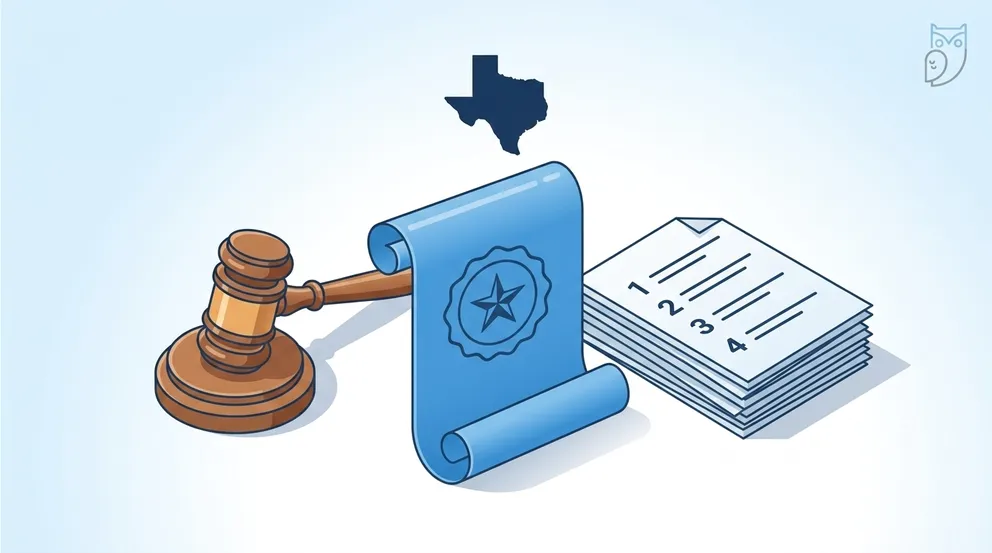
The Texas Department of Insurance (TDI) proposed amendments on May 7, 2026 that add four new consumer rights to the state's Auto Bill of Rights. Drivers will gain a written explanation for cancellations, an annual credit re-rate request, a loss-amount appraisal option, and protection against discrimination after a spouse's death. The updated bill of rights takes effect November 1, 2026, and the public comment window closes June 15, 2026 at 5:00 p.m. Central.
- Four 2025 bills (HB 2067, SB 458, SB 1238, SB 1644) drive the amendments to 28 TAC §5.9970
- OPIC petitioned TDI on August 27, 2025; General Counsel Jessica Barta certified the rule on May 1, 2026
- Insurers must hand out the updated 8-page document at first renewal after November 1, 2026
- Texas full-coverage premiums average $2,498 to $2,751 per year, and every personal auto policy renewed in the state will carry the new rights
What Changed on May 7
The Texas Department of Insurance (TDI) filed proposed amendments to 28 TAC §5.9970, the rule that governs the Personal Auto Bill of Rights distributed by every Texas auto insurer. General Counsel Jessica Barta signed the proposal on May 1, 2026, and Repairer Driven News broke the story two days later on May 7. OPIC, the Office of Public Insurance Counsel, petitioned TDI on August 27, 2025 to incorporate four bills passed by the 89th Legislature.
The four bills are HB 2067, SB 458, SB 1238, and SB 1644. Each one expands what Texas drivers can demand from their carrier, and each one will appear as a new bullet point on the eight-page Bill of Rights that arrives in every renewal envelope.
Source: Insurify rate data through March 2026; Bankrate placed the same figure at $2,751. Driver profile assumes a 30-year-old with a clean record and average credit.
HB 2067: Written Explanation for Cancellations
Insurance Code §551.109, amended by HB 2067, forces every Texas property and casualty insurer to deliver a written reason any time a policy is declined, canceled, or non-renewed. The Bill of Rights amendment text reads: "the right to a written explanation for a cancellation or non-renewal of an insurance policy (HB 2067)." That right took effect January 1, 2026 and applies to all decisions issued after that date.
Carriers must also report their denial reasons by ZIP code to TDI, which posts the aggregated data publicly. We unpacked the broader fallout from this law in our coverage of Texas's policy-denial explanation rule.
SB 458: Appraisal for Disputed Loss Amounts
Senate Bill 458 created Insurance Code Chapter 1813, which now requires personal auto and residential property policies to include a mandatory appraisal clause when the carrier and the insured disagree on the dollar amount of a loss. The amendment language adds: "the right to request appraisal to resolve disputes about loss amounts (SB 458)." Texas drivers whose totaled vehicle is undervalued by the insurer can invoke the clause and trigger a third-party valuation process.
The underlying law took effect September 1, 2025 and was followed by TDI's separate rule docket (28 TAC §5.9800) that spelled out the appraisal procedure in April 2026.
SB 1238: Protection After a Spouse's Death
Insurance Code §544.002 was amended to prohibit any Texas auto insurer from discriminating against a policyholder based on marital status following a spousal death. The Bill of Rights amendment will state: "The right to not be discriminated against following a spousal death (SB 1238)." Carriers cannot raise the surviving spouse's premium, refuse to renew, or reclassify the household solely because one spouse died. The protection matters most when the deceased spouse held the primary policy or anchored a household discount with a longer clean-record history.
SB 1644: Annual Credit Re-Rating Request
SB 1644 added Insurance Code §559.058 to the books. Every Texas auto insurer is now required to review a policyholder's credit information and re-rate the premium at least once every three years. Drivers can also submit one request per year for an immediate re-underwrite based on a current credit report or insurance score.
The amendment text on the Bill of Rights reads: "how insurers must use updated credit information and the right to request an insurer to re-underwrite and re-rate the policy based on current credit information (SB 1644)." Credit-based insurance scoring can move Texas premiums by hundreds of dollars per year between top and bottom score tiers; our explainer on insurance score versus credit score walks through how the calculation actually works.
"These amendments will ensure that the Auto Bill of Rights is consistent with the law and that consumers are informed of their rights related to their personal automobile insurance policies." Texas Department of Insurance, in the May 7, 2026 proposal.
Why This Matters for Texas Drivers
Texas full-coverage premiums averaged $2,498 in March 2026 according to Insurify, with Bankrate placing the figure at $2,751 for similar profiles. Insurify projects a modest 0.3% rate increase for the state in 2026, which would push the typical full-coverage policy up by just $7 per year. Drivers in Houston, Dallas, and Austin already pay above the state average, so any leverage on cancellation explanations or credit-based re-rates can translate directly into renewal savings.
Adjacent states have taken sharper action. Florida, Georgia, and Louisiana have all delivered measurable rate cuts after passing tort reform packages, while Texas drivers continue to absorb roughly $1,724 per year in hidden litigation costs (a figure documented in our analysis of Texas's lack of tort reform). And the credit-rating debate is itself moving fast nationwide, with four states proposing outright bans (covered in our piece on state-level credit-score restrictions). Texas instead reinforced the consumer's right to demand a re-rate rather than abolishing the practice.
SB 1644 lets you ask once per year. The carrier must use a current credit report or insurance score, and the re-underwrite must be in writing. If your insurer refuses, file a complaint with TDI's Consumer Help Line at 1-800-252-3439 or via tdi.texas.gov.
What You Should Do Now
Save Your Renewal Packet
Read the new 8-page Bill of Rights when it arrives, and verify your insurer is using the 2026 version. Carriers must deliver it at first renewal after November 1.
Pull a Free Credit Report
Visit AnnualCreditReport.com to download all three bureau reports. Carriers can pull a fresh insurance score the same day if your number has improved meaningfully.
Submit a Written Re-Rate Request
Use email so you have a date stamp. Cite Insurance Code §559.058 in the subject line and ask for the re-underwrite output in writing.
Submit a Public Comment
Email [email protected] before 5:00 p.m. Central on June 15, 2026 if you want to weigh in on the proposed language. Mail comments go to Office of the Chief Clerk, MC: GC-CCO, P.O. Box 12030, Austin, TX 78711-2030.
Looking Ahead
TDI's comment window closes June 15, 2026 and a public hearing must be requested separately by the same deadline. Insurers will start distributing the new 8-page Bill of Rights with renewals issued on or after November 1, 2026, and a parallel update applies to the Homeowner Bill of Rights under 28 TAC §5.9971. Approximately 124 small business insurance carriers in Texas, plus every major national writer, will face an administrative cost of 4 to 10 staff hours and printing fees of $0.03 to $0.05 per page.
Watch for the final adopted version after June 15. Texas typically issues final rule text within 60 to 90 days of the comment close, which would put publication around mid-August 2026.
Frequently Asked Questions
The amended Auto Bill of Rights becomes mandatory November 1, 2026. The underlying laws (HB 2067, SB 458, SB 1238, SB 1644) all took effect earlier in 2025 or January 1, 2026, so the consumer protections themselves are already enforceable. The November 1 date applies to when insurers must include the four new rights on the printed document.
No. Texas Insurance Code §501.156 already requires every personal auto insurer to deliver the Bill of Rights with each new policy and at every renewal. Starting November 1, 2026, carriers must use the 2026 version automatically. Spanish-language copies are available on request.
Once per year. SB 1644 added Insurance Code §559.058, which gives every Texas auto policyholder the right to demand one annual re-underwrite based on a current credit report or insurance score. The carrier must also conduct a review on its own at least every three years.
File a complaint with the Texas Department of Insurance Consumer Help Line at 1-800-252-3439 or online at tdi.texas.gov. TDI tracks consumer complaints by carrier and publishes the totals annually. If a carrier violates HB 2067 by failing to send a written cancellation reason, TDI can impose administrative penalties.
Email [email protected] before 5:00 p.m. Central on June 15, 2026 with your written comments. Mail comments go to the Office of the Chief Clerk, MC: GC-CCO, Texas Department of Insurance, P.O. Box 12030, Austin, Texas 78711-2030. A public hearing request must be submitted separately by the same deadline.
- Texas Department of Insurance - Proposed Amendments to 28 TAC §5.9970 and §5.9971 (May 1, 2026)
- Repairer Driven News - Texas Proposes Update to Auto Bill of Rights to Include Four Passed Bills
- TDI - Know Why Your Auto or Home Policy Was Declined, Canceled, Not Renewed (February 2026)
- Insurify - Average Car Insurance Cost in Texas (2026)
- Bankrate - Average Cost of Car Insurance in Texas in 2026
- LegiScan - Texas SB 1644, 89th Legislature (2025)
- LegiScan - Texas HB 2067, 89th Legislature (2025)
- LegiScan - Texas SB 1238, 89th Legislature (2025)