

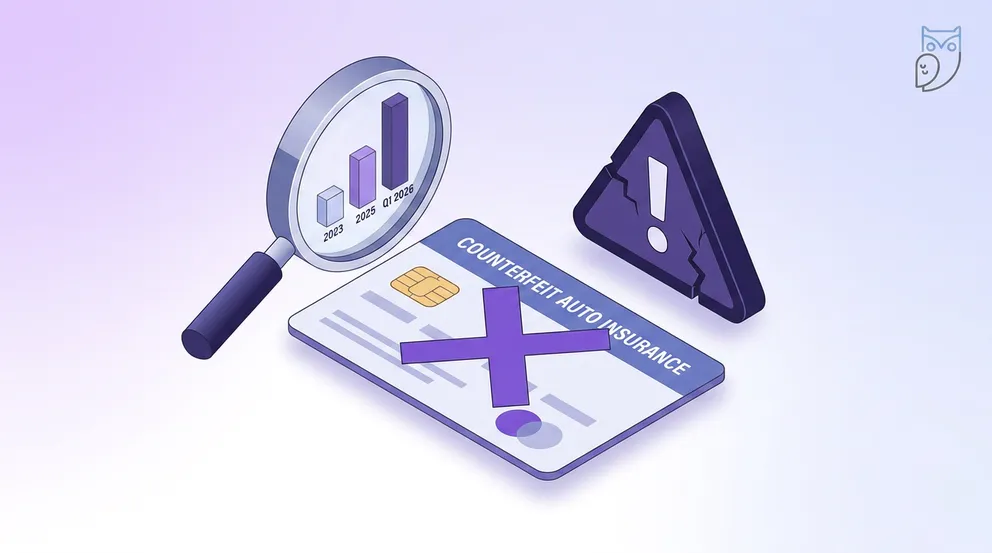
The Texas Department of Insurance recorded 126 fraud reports tied to fake auto insurance cards in 2025, more than triple the 38 reports it logged in 2023. Another 37 reports landed at TDI during the first quarter of 2026, putting Texas on pace to break last year's total.
NBC 5 Dallas-Fort Worth investigative reporters Diana Zoga and Robin Carter broke the numbers on April 29, 2026, after sitting with State Farm agent Ann Nguyen at her Arlington office. Nguyen said her staff fields routine calls about policies she never issued, with the fraudulent cards listing her name as the licensed agent.
Fake auto insurance card fraud is surging in Texas. TDI fraud reports jumped from 38 in 2023 to 126 in 2025, a 232% increase. Scammers sell counterfeit policies through unofficial websites, social-media DMs, and cash-only deals. Verify any agent through TDI's license lookup and call the carrier directly with the policy number before you pay.
- TDI fraud reports rose from 38 in 2023 to 126 in 2025, with 37 already filed in Q1 2026
- Scam payments are typically cash, peer-to-peer apps, or off-platform transfers
- Drivers caught with a fake card face an altered-ID misdemeanor, vehicle impound, and a court summons
- Verify any agent through the TDI license lookup at tdi.texas.gov before handing over money
- Fraud losses pass through to legitimate Texas drivers as higher premiums, per TDI
The Numbers Behind the Spike
TDI's fraud-report totals have climbed in a sharp arc. The agency logged 38 fake-card reports in 2023, 126 in 2025, and 37 in just the first three months of 2026, according to data Mistie Hinote of TDI shared with NBC 5 Responds. That arc represents a 232% jump in two years and a quarterly run rate that already approaches the full 2024 totals.
Hinote said the actual victim count is likely far higher because most consumers do not realize their policy is counterfeit until a crash or traffic stop forces them into the system. By that point, the seller has gone dark and the cash payment is unrecoverable.
How the Scam Works
Nguyen described a typical case in her Arlington office. A consumer arrives with a digital insurance card showing a State Farm logo, Nguyen's name as the agent, and a policy number that returns nothing in the carrier's database. The formatting is slightly off, the policy does not exist on State Farm's books, and the buyer paid cash to a third party who advertised through a friend, a Facebook group, or a Spanish-language community page.
One victim, Raul Manzano, paid $1,500 cash for what he was told was six months of Texas auto liability coverage. He found out the document was counterfeit only after Minnesota police pulled him over and charged him with possession of an altered insurance ID card. Lisa Hartman, the Minnesota advocate helping him respond to the court summons, told NBC 5 Responds that the seller has gone unreachable and the money is gone.
Manzano did not have a U.S. driver's license and shopped through word-of-mouth, paying someone who knew someone selling policies. He never noticed that the proof-of-insurance document listed Texas liability coverage rather than Minnesota, where he was driving.
Red Flags Texas Drivers Should Watch For
Hinote and Nguyen flagged several warning signs that separate a legitimate quote from a counterfeit one. Cash-only payment requests rank at the top, since licensed Texas carriers run premium charges through their own portals, not through Cash App, Zelle, or in-person handoffs.
| Red Flag | Why It Matters |
|---|---|
| $50 per month full coverage | Texas average is $208 to $229 per month, per Bankrate and Insurify 2026 data |
| Cash, Zelle, or Cash App payment | Real carriers process payments through their licensed portals, per TDI guidance |
| No underwriting questions | Licensed agents must collect VIN, driving history, and address before binding a policy |
| Pressure to buy "today" | Hinote: "Insurance companies usually don't have sales" |
| Agent has no Texas license number | State law requires every selling agent to be licensed by TDI |
| Card formatting looks off | Real Texas cards include carrier NAIC code, policy number, VIN, and effective dates |
Premium ranges sourced from Bankrate's 2026 Texas average of $229 per month for full coverage and Insurify's 2026 figure of $208 per month, both based on profiles of drivers ages 30 to 50 with clean records and average credit.
State minimum liability runs about $65 to $77 per month, while full coverage runs $208 to $259 per month, depending on the carrier and driver profile. Any quote materially below the minimum-liability floor should trigger a license check before you pay a dollar.
How to Verify a Texas Auto Insurance Policy
Texas drivers can confirm both the agent and the carrier in under five minutes. Run both checks before sending any payment, since the policy contract on file with the insurer is what protects you in a crash, not the printed card.
Look Up the Agent on TDI
Visit tdi.texas.gov and use the agent license search, or call 1-800-252-3439. Enter the agent's name or license number. A legitimate Texas agent appears with active license status, lines of authority, and appointed carriers.
Confirm the Carrier Is Licensed in Texas
Use TDI's company lookup or call the same hotline. Foreign and unauthorized insurers cannot legally sell Texas auto liability, and any policy from one is unenforceable at claim time.
Call the Carrier Directly With the Policy Number
Read the carrier's customer service line off the company's official website, not off the card the seller gave you. Provide the policy number and ask the rep to confirm the named insured, vehicle VIN, effective dates, and limits.
Refuse Cash and Third-Party Payment Apps
TDI's published guidance instructs consumers never to pay premiums in cash or through third-party mobile payment apps. Pay through the carrier's portal, by check made out to the insurer, or by card on the official site.
Save the Declarations Page, Not Just the Card
Ask the agent to email the full declarations page from the carrier's domain. The dec page lists VIN, coverage limits, deductibles, and the underwriter, while a card alone proves nothing in court or at claim time.
What to Do If You Already Bought a Fake Policy
Move quickly if any verification step fails. Manzano's case shows how fast the consequences mount once a traffic stop or claim exposes the counterfeit, with citations, court fees, and uninsured-driver penalties that can dwarf the original cash payment.
- File a fraud report with TDI online at tdi.texas.gov/fraud or by phone at 1-800-252-3439
- Notify the carrier whose name appears on the fake card so its fraud unit can investigate
- Submit a complaint to the Texas Attorney General's consumer protection division
- Report online elements of the scam to the FBI's Internet Crime Complaint Center at IC3.gov
- Buy real coverage immediately to avoid driving uninsured under Texas Transportation Code 601, which can also trigger an SR-22 filing requirement after a citation
- Keep all texts, screenshots, payment receipts, and the fake card for the investigation
Why This Fraud Raises Premiums for Everyone
Fake-card fraud does not stay with the buyer. Hinote told NBC 5 Responds that uninsured-claim costs flow back into rate filings, lifting premiums for every legitimately covered Texas driver. Roughly 13.8% of Texas drivers are already uninsured, and counterfeit policyholders push that share even higher because their fake coverage offers no recovery to anyone they hit.
"That's money out of the insurance company's pocket, and they're going to pass that on to policyholders with increased premiums. So we're all seeing the effect of insurance fraud through our premiums," Hinote said.
Texas already ranks among the more expensive states for auto coverage, with Insurify pegging the 2026 statewide average at $208 per month for full coverage. Carriers cite fraud, severe weather losses, and rising litigation costs that add about $1,724 per Texas household as the top drivers behind recent rate filings. Texas residents can compare verified carrier rates and city-level premium data on our Texas car insurance page before requesting a quote from any agent.
Frequently Asked Questions
Call the insurance carrier's main number from its official website (not from the card) and read out the policy number. Ask the rep to confirm the named insured, vehicle VIN, coverage limits, and effective dates. You can also confirm the agent's license through the Texas Department of Insurance at tdi.texas.gov or 1-800-252-3439.
Possession of a counterfeit insurance ID can lead to a misdemeanor charge, vehicle impound, and a court summons. The driver becomes liable for any damages caused in a crash because the policy does not exist, and Texas Transportation Code 601 also imposes uninsured-driver penalties on top of the criminal charge.
Only if you carry uninsured motorist (UM) coverage. Texas auto policies are required to offer UM and underinsured motorist (UIM) coverage, but drivers can reject it in writing. TDI recommends carrying UM/UIM because of the rise in fake-card fraud and uninsured driving across the state.
File a fraud report with TDI online at tdi.texas.gov/fraud or by calling 1-800-252-3439. Also submit complaints to the Texas Attorney General's consumer protection division and to the FBI's Internet Crime Complaint Center at IC3.gov if any part of the scam happened online.
A real Texas auto ID card lists the insured's name, the named carrier and its NAIC code, a policy number, effective and expiration dates, and the vehicle's year, make, model, and VIN. State law requires drivers to carry proof of financial responsibility at all times, and the document must come from a carrier licensed by TDI.
- NBC 5 Dallas-Fort Worth - Spike in fake insurance cards (April 29, 2026)
- Texas Department of Insurance - Report Fraud
- TDI - How to find a licensed insurance agent or adjuster
- TDI - Don't use third-party mobile payment apps to buy insurance
- TDI - Insurance fraud guide
- Bankrate - Average Cost of Car Insurance in Texas 2026
- Insurify - Average Car Insurance Cost in Texas 2026
- Texas Penal Code Chapter 35 - Insurance Fraud