

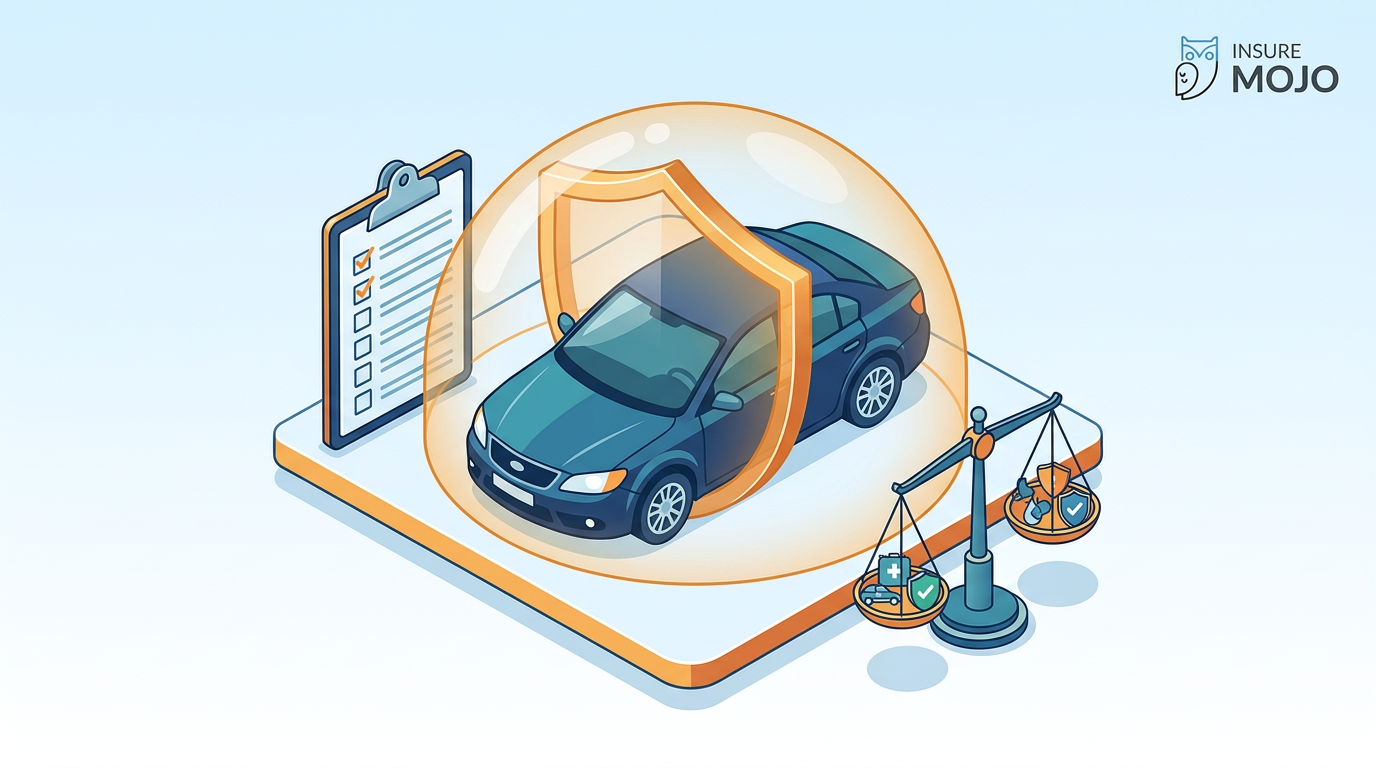
There are eight main types of car insurance coverage: liability, collision, comprehensive, uninsured/underinsured motorist, personal injury protection (PIP), medical payments (MedPay), gap insurance, and rideshare insurance. The average full coverage policy costs $2,496 per year in 2026, according to Bankrate, while minimum liability-only coverage averages $912 annually.
- Full coverage car insurance averages $2,496/year ($208/month) in 2026, while minimum liability costs $912/year ($76/month)
- About 80% of U.S. drivers carry both collision and comprehensive coverage, according to the Insurance Information Institute
- 15.4% of U.S. drivers are uninsured (1 in 7), with Mississippi leading at 28.2%, per the Insurance Research Council's 2025 study
- Adding comprehensive and collision to a liability-only policy costs roughly $1,300-$1,600 more per year but protects your own vehicle
- Florida will repeal its mandatory PIP requirement on July 1, 2026, switching to a fault-based system with required bodily injury liability
Car insurance is not a single product. It is actually a bundle of different coverage types, each designed to protect you from a specific financial risk. Some coverages are legally required by your state, others are mandated by your lender, and a few are entirely optional but can save you thousands if something goes wrong.
Understanding the difference between these coverage types matters because the wrong combination leaves you exposed. A driver in Michigan needs different protections than someone in Texas, and a person financing a new SUV has different needs than someone driving a paid-off sedan. This guide breaks down all eight major types of car insurance, what each one costs, and a framework to help you figure out which coverages actually make sense for your situation.
Car Insurance Coverage Types at a Glance
Before diving into the details, here is a snapshot of every major coverage type, what it protects, and what it costs on average in 2026.
| Coverage Type | What It Covers | Avg. Annual Cost | Required? |
|---|---|---|---|
| Liability (BI/PD) | Other people's injuries and property damage you cause | $300-$600 | Yes (nearly all states) |
| Collision | Damage to your car from accidents | $400-$800 | No (but lender may require) |
| Comprehensive | Theft, weather, vandalism, animal strikes | $140-$350 | No (but lender may require) |
| Uninsured/Underinsured Motorist | Your costs when the at-fault driver lacks coverage | $100-$300 | Required in ~20 states |
| Personal Injury Protection (PIP) | Your medical bills and lost wages, regardless of fault | $50-$200 | Required in 12 no-fault states |
| Medical Payments (MedPay) | Your medical bills after an accident, regardless of fault | $25-$100 | Required in ME and NH |
| Gap Insurance | Difference between your car's value and your loan balance | $88 (via insurer) | No |
| Rideshare Insurance | Coverage gaps for Uber/Lyft drivers | $120-$480 endorsement | No (but essential for drivers) |
Source: MoneyGeek, Bankrate, and Insurify 2026 rate data. Costs reflect national averages for a 35-year-old driver with a clean record and good credit.
Liability Car Insurance: The Foundation of Every Policy
Liability insurance is the backbone of every car insurance policy and the only coverage required by law in nearly every state. It pays for other people's injuries (bodily injury liability) and property damage (property damage liability) when you cause an accident. It does not cover your own injuries or damage to your own vehicle.
Bodily Injury Liability (BI)
If you cause a crash that injures someone, your bodily injury liability coverage pays their medical bills, rehabilitation costs, and lost wages up to your policy limits. It also covers your legal defense if you get sued. Limits are written in split format: $25,000/$50,000 means up to $25,000 per person and $50,000 per accident.
Property Damage Liability (PD)
Property damage liability pays to repair or replace another driver's vehicle, a fence, a guardrail, or any other property you damage in an at-fault accident. Most states require at least $10,000 to $25,000 in property damage coverage, but with the average new car costing over $48,000 in 2026, those minimums are dangerously low.
State minimum liability limits are often far too low. For example, a state minimum of 25/50/25 only covers $25,000 in property damage. If you total someone's $55,000 SUV, you are personally on the hook for the remaining $30,000. Most insurance professionals recommend at least 100/300/100 in liability coverage.
Liability coverage has no deductible. Your insurer pays claims directly up to your policy limits. For a deeper dive into how much you actually need, see our guide to liability car insurance.
Collision Coverage: Protecting Your Car in a Crash
Collision coverage pays to repair or replace your vehicle after an accident, regardless of who caused it. This includes crashes with other vehicles, single-car accidents like hitting a guardrail, and rollovers. Unlike liability, collision covers your car specifically.
Collision comes with a deductible, typically $500 or $1,000, that you pay out of pocket before insurance kicks in. Your insurer then pays up to your vehicle's actual cash value (ACV), which is the car's current market value minus depreciation. Collision is one of the two key components of what most people call full coverage car insurance.
No state requires collision coverage, but if you finance or lease your vehicle, your lender almost certainly does. The average annual cost runs $400 to $800, according to MoneyGeek's 2026 rate analysis. Drivers with newer, more expensive vehicles pay toward the higher end of that range.
Raising your collision deductible from $500 to $1,000 can reduce your collision premium by 15-20%, according to the Insurance Information Institute. If you have enough savings to cover a $1,000 out-of-pocket expense, the premium savings add up quickly.
For a side-by-side comparison with comprehensive coverage, including when it makes sense to drop both, read our comprehensive vs. collision insurance guide.
Comprehensive Coverage: Everything Except Collisions
Comprehensive coverage, sometimes listed as "other than collision" (OTC) on your policy, pays for damage to your vehicle from events that are not traffic accidents. That includes theft, vandalism, hail, flooding, fire, falling objects, and hitting an animal. It also typically covers windshield damage, sometimes with a separate, lower glass deductible.
Like collision, comprehensive has a deductible and pays up to your car's actual cash value. The average annual cost is noticeably lower than collision: $140 to $350 nationally in 2026, according to Insurify. The lower cost reflects the fact that non-collision losses happen less frequently than crashes.
Comprehensive is optional unless your lender requires it. About 80% of U.S. drivers carry it alongside collision, according to the Insurance Information Institute, creating what most people call a "full coverage" policy. If you drive an older vehicle, the decision of whether to keep comprehensive becomes more nuanced.
Comprehensive insurance is often the cheapest way to protect against some of the most expensive surprises. A single hailstorm can cause $3,000-$5,000 in damage, and the average car theft costs victims $10,000+, according to the NICB. It even covers cracked windshield repairs in many cases. Meanwhile, comprehensive coverage averages just $140-$350 per year.
Uninsured and Underinsured Motorist Coverage (UM/UIM)
One in seven drivers on U.S. roads has no insurance at all. A recent IRC report found that 1 in 3 drivers is uninsured or underinsured. That figure climbs to more than one in four in Mississippi (28.2%), and tops 20% in New Mexico, Tennessee, Michigan, Missouri, Florida, and California, according to the Insurance Research Council's 2025 study. In Texas alone, 13.8% of drivers are uninsured. If one of those uninsured drivers hits you, your own UM/UIM coverage is what pays your bills.
Uninsured motorist (UM) coverage applies when the at-fault driver has zero insurance. Underinsured motorist (UIM) coverage applies when the at-fault driver has insurance but not enough to cover your costs. Both come in two forms:
- UMBI (Bodily Injury): Covers your medical bills, lost wages, and pain and suffering
- UMPD (Property Damage): Covers damage to your vehicle (not available in all states)
UM/UIM is required in about 20 states, including Illinois, New York, Oregon, and Virginia. Even where it is optional, insurance professionals almost universally recommend it. The cost is modest: $100 to $300 per year on average, according to MoneyGeek. Most experts advise matching your UM/UIM limits to your liability limits.
Learn more about whether this coverage is worth it in our uninsured motorist coverage guide.
Personal Injury Protection (PIP)
Personal injury protection is a first-party coverage that pays for your medical expenses, lost wages, and sometimes household services after an accident, regardless of who was at fault. PIP is a cornerstone of no-fault auto insurance systems, where each driver's own policy pays their own costs instead of suing the at-fault driver.
PIP is mandatory in 12 states: Delaware, Florida, Hawaii, Kansas, Massachusetts, Michigan, Minnesota, New Jersey, New York, North Dakota, Oregon, and Utah. In "choice" states like Pennsylvania, Kentucky, and New Jersey, drivers can opt between a no-fault PIP plan and a traditional tort (at-fault) plan.
Florida is repealing its mandatory $10,000 PIP requirement effective July 1, 2026. The state is switching to a fault-based system that requires minimum bodily injury liability of $25,000/$50,000 per accident plus $5,000 in MedPay. If you drive in Florida, this is a significant change to your required coverages.
The average annual cost of PIP ranges from $50 to $200, depending on your state and coverage limits. Michigan historically has the most expensive PIP because it once required unlimited lifetime medical benefits, though a 2019 reform now lets drivers choose lower coverage levels.
For a complete breakdown, see our PIP insurance guide.
Medical Payments Coverage (MedPay)
MedPay is similar to PIP but narrower in scope. It covers medical expenses for you and your passengers after an accident, regardless of fault, but it does not cover lost wages or household services like PIP does. Coverage limits typically range from $1,000 to $10,000 per person.
MedPay is only required by law in Maine and New Hampshire. In states that offer both PIP and MedPay, they generally don't overlap. MedPay is more commonly available in at-fault states where PIP isn't offered.
At $25 to $100 per year on average, MedPay is one of the most affordable coverages you can add. It is especially valuable if you have a high-deductible health plan, since it can cover your medical bills without waiting for a fault determination. Read our MedPay coverage guide for details on when this add-on makes sense.
Gap Insurance: Closing the Loan-Value Gap
When you drive a new car off the lot, it immediately depreciates. Within the first year, most vehicles lose 20% or more of their value, according to Edmunds. If your car is totaled or stolen, your insurer pays its current market value, not what you owe on your loan or lease. Gap insurance covers that difference.
For example, say you owe $28,000 on your auto loan but your car's actual cash value is only $22,000 when it gets totaled. Without gap insurance, you would be responsible for the $6,000 difference. Gap insurance eliminates that out-of-pocket cost.
Gap insurance is most important during the first 2-3 years of a new car loan, especially if you made a small down payment or have a long loan term (60-84 months). Once your loan balance drops below your car's value, you can drop it. For more details, check out our complete gap insurance guide.
Rideshare Insurance: Coverage for Uber and Lyft Drivers
If you drive for Uber, Lyft, or another rideshare platform, your personal auto insurance policy likely won't cover you while you are working. Rideshare companies provide some coverage, but it has significant gaps, particularly during Period 1 (when you are online and waiting for a ride request but have not yet been matched with a passenger).
A rideshare endorsement fills that gap. For a complete breakdown of coverage periods and costs, see our TNC insurance guide. The endorsement extends your personal policy to cover the periods when rideshare company coverage is limited or nonexistent. Adding a rideshare endorsement to your existing policy typically costs $10 to $40 per month, according to rate data from State Farm, Progressive, and Allstate.
Driving for Uber or Lyft without a rideshare endorsement or commercial policy can void your personal auto insurance entirely. If your insurer discovers you were using your car commercially during a claim, they can deny the claim and potentially cancel your policy.
Which Coverages Do You Actually Need?
The "right" coverage combination depends on three factors: your state's legal requirements, your lender's requirements, and your personal financial situation. Here is a decision framework to help you choose.
Coverage Decision Framework
| Your Situation | Recommended Coverages | Estimated Annual Cost |
|---|---|---|
| Financing/leasing a new car (worth $25K+) | Liability (100/300/100) + Collision + Comprehensive + UM/UIM + Gap | $2,500-$3,200 |
| Own a car outright (worth $10K-$25K) | Liability (100/300/100) + Collision + Comprehensive + UM/UIM | $2,000-$2,800 |
| Own an older car (worth under $5K) | Liability (50/100/50 or higher) + UM/UIM | $800-$1,400 |
| Rideshare driver (Uber/Lyft) | All of the above + Rideshare endorsement | $2,600-$3,700 |
| High net worth ($500K+ in assets) | Maximum liability + all physical damage + Umbrella policy | $3,000-$4,500+ |
Estimates based on 2026 national averages from Bankrate and Insurify for a 35-year-old driver with a clean record.
The Coverage Calculator Concept
Think of coverage selection as answering three questions:
What does your state require?
Start with your state's minimum requirements. Every state except New Hampshire and Virginia requires liability insurance (Virginia allows a $500 uninsured motorist fee instead). Some states also mandate PIP, UM/UIM, or MedPay. Check your state's Department of Insurance website for current minimums.
What does your lender require?
If you have a car loan or lease, your lender almost certainly requires collision and comprehensive coverage with a maximum deductible (usually $500 or $1,000). Some lenders also require gap insurance. Check your loan agreement for specific requirements.
What can you afford to lose?
If your car is worth $15,000 and you cannot afford to replace it out of pocket, collision and comprehensive are worth the $500-$1,100 per year they cost. If your car is worth $3,000 and you have savings, the premiums may exceed the potential payout. The 10% rule helps: if your annual comprehensive plus collision premium exceeds 10% of your car's value, consider dropping those coverages.
Full Coverage vs. Minimum Coverage: The Real Cost Difference
The term "full coverage" is not an official insurance term. It typically means a policy that includes liability, collision, and comprehensive coverage. Minimum coverage refers to the lowest liability limits your state allows, with no collision or comprehensive.
| Policy Type | Average Annual Cost (2026) | Average Monthly Cost | What's Covered |
|---|---|---|---|
| Full Coverage (100/300/100) | $2,496 | $208 | Other people + your car |
| Minimum Coverage (state min liability) | $912 | $76 | Other people only (limited) |
| Difference | $1,584 | $132 | Collision + comprehensive + higher limits |
Source: Bankrate 2026 national average rate data for a 35-year-old driver with good credit and a clean record.
That $132 per month difference buys collision and comprehensive protection for your own vehicle plus significantly higher liability limits. For drivers with newer vehicles, the math strongly favors full coverage. A single fender-bender that costs $4,000 to repair would take more than two years of premium savings to offset if you had chosen minimum coverage instead.
- Protects your own vehicle from accidents, theft, and weather damage
- Higher liability limits reduce personal financial exposure
- Required by lenders for financed or leased vehicles
- Peace of mind knowing you are covered in most scenarios
- Costs roughly $1,584 more per year than minimum coverage
- May not be cost-effective for vehicles worth less than $4,000-$5,000
- Still has deductibles ($500-$1,000) for collision and comprehensive claims
State Minimum Requirements: A Quick Overview
Every state sets its own minimum insurance requirements. Most require liability insurance, but the limits vary dramatically. Here are some notable examples for 2026:
- California: 30/60/15 (increased from 15/30/5 in January 2025, the first increase since 1967)
- New Jersey: 35/70/25 (increased from 25/50/25 effective January 1, 2026)
- Florida: Currently 10/20/10 for BI plus $10,000 PIP; switching to 25/50/5 with MedPay on July 1, 2026
- Michigan: 50/100/10 with required PIP (coverage level is now driver's choice after 2019 reform)
- Texas: 30/60/25
- New Hampshire: No mandatory insurance requirement (but must prove financial responsibility after an accident)
For detailed state-by-state coverage requirements, visit our state car insurance guides.
Explore Each Coverage Type in Detail
A deep dive into bodily injury and property damage liability, including state-by-state minimum requirements, why 25/50/25 is not enough, and how to decide between 50/100/50 and 100/300/100 based on your assets.
Side-by-side comparison of what each covers, what each costs, and the 10% rule for deciding when to drop coverage on an older vehicle. Includes deductible impact analysis.
State-by-state uninsured driver rates, where UM/UIM is legally required, and the case for carrying it even in states where it is optional. Includes a real-world accident cost scenario.
Which states require PIP, how it differs from MedPay, and what Florida's 2026 PIP repeal means for drivers. Includes coverage limit recommendations by state.
When gap insurance makes sense, how to get it for $88/year instead of $500+ at the dealership, and when you can safely drop it as your loan balance decreases.
How MedPay works, how it differs from PIP and health insurance, and why it is one of the most affordable add-ons at just $25-$100 per year.
Frequently Asked Questions
The eight main types are: liability (bodily injury and property damage), collision, comprehensive, uninsured/underinsured motorist (UM/UIM), personal injury protection (PIP), medical payments coverage (MedPay), gap insurance, and rideshare insurance. Liability is required in nearly every state, while the others may be required or optional depending on your state and lender.
Full coverage car insurance (liability, collision, and comprehensive) costs an average of $2,496 per year, or about $208 per month, in 2026, according to Bankrate. Rates vary significantly by state: Maryland drivers pay the most at $4,227 per year, while Vermont drivers pay the least at around $1,427 per year.
Nearly every state requires liability insurance. Beyond that, about 20 states require uninsured motorist coverage, and 12 states require personal injury protection (PIP): Delaware, Florida, Hawaii, Kansas, Massachusetts, Michigan, Minnesota, New Jersey, New York, North Dakota, Oregon, and Utah. Maine and New Hampshire require MedPay. New Hampshire is the only state that does not require liability insurance.
Consider dropping collision and comprehensive when your annual premiums for those coverages exceed 10% of your car's current market value. For example, if your car is worth $4,000 and you pay $500 per year for collision and comprehensive combined, that is 12.5% of the car's value, meaning you might save money by self-insuring. Also consider whether you have enough savings to replace the car if it is totaled.
Both PIP and MedPay cover your medical expenses after an accident regardless of fault, but PIP is broader. PIP also covers lost wages, rehabilitation, and household services, while MedPay only covers medical bills. PIP is required in 12 no-fault states, while MedPay is only required in Maine and New Hampshire. PIP typically costs $50-$200 per year, while MedPay costs just $25-$100 per year.
- Bankrate — What Are the Different Types of Car Insurance Coverage?
- MoneyGeek — Types of Car Insurance Coverages Explained
- Bankrate — Average Cost of Car Insurance in April 2026
- Insurify — Average Car Insurance Rates as of March 2026
- Insurance Information Institute — Facts + Statistics: Uninsured Motorists
- NAIC — Insurance Topics: Uninsured Motorists
- Insure.com — Average Cost of Gap Insurance in 2026
- Experian — Minimum Car Insurance Requirements by State in 2026
- WalletHub — What Is Personal Injury Protection (PIP)? 2026 State Requirements