
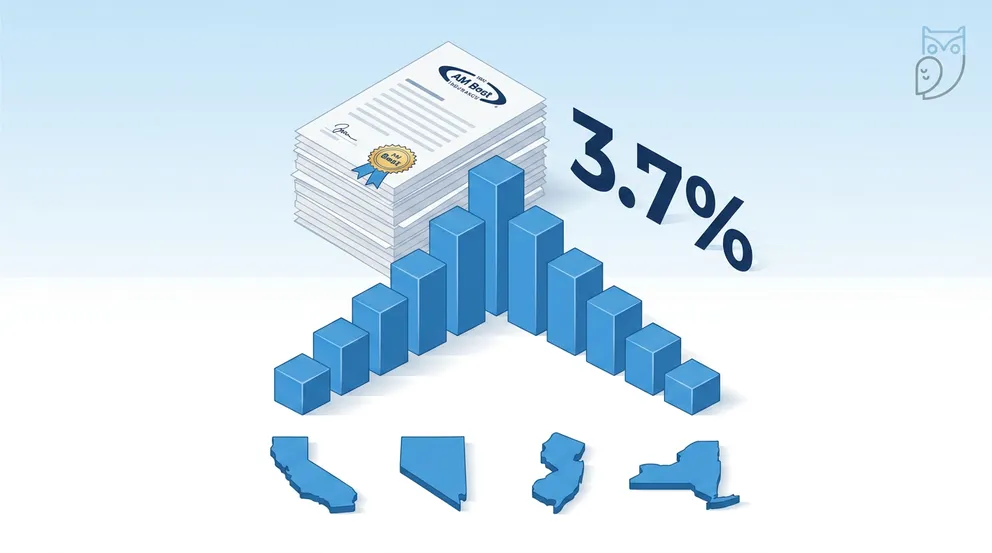
The average approved private passenger auto rate change in the United States fell to 3.7% in 2025, down from 9.7% in 2024, according to a Best's Special Report released by AM Best on May 18, 2026. Drivers in California, Nevada, New Jersey, and New York saw rates climb well above the national average and face the smallest near-term relief.
Rate hikes on U.S. auto insurance policies decelerated sharply last year, with the average approved private passenger auto (PPA) rate increase falling to 3.7% in 2025 from 9.7% in 2024, AM Best reported on May 18, 2026. The shift puts approved increases back in line with pre-pandemic norms after three years of sustained double-digit filings.
The slowdown reflects improved underwriting results across the industry. PPA insurers booked an underwriting profit in 2024 for the first time since 2020, when COVID-era driving drops temporarily lowered claims, according to the AM Best Special Report titled Personal Auto and Homeowners Markets' Stabilization Evident Despite a Decline in Approved Rate Changes.
- Average U.S. private passenger auto rate change in 2025: 3.7%, down 6 percentage points from 9.7% in 2024
- Homeowners average approved rate change fell 5.2 percentage points to 8.3% in 2025
- U.S. homeowners loss ratio improved from 74.8 in 2023 to 65.6 in 2025, a 9.2 percentage point drop
- California, Nevada, New Jersey, and New York remain the four states with disproportionately high 2025 rate increases
- AM Best expects near-term rate filings in those four states to reflect more favorable 2025 underwriting results
What the AM Best Report Found
AM Best built the analysis on its proprietary State Rate Filings database, which tracks every approved auto and home rate change across U.S. jurisdictions. The agency identified a clear inflection point: after the loss frequency and severity spikes that drove filings up in 2023 and 2024, insurers logged improving loss ratios and pulled back on the size of new filings in 2025.
For homeowners, the U.S. industry loss ratio fell from 74.8 in 2023 to 65.6 in 2025, a 9.2 percentage point improvement. The drop translated into smaller approved increases. The home market's average approved rate change came in at 8.3% in 2025, down from 13.5% the year prior.
"The improvement experienced by U.S. homeowners' insurers has been driven by both aggressive rate increases and enhanced pricing sophistication in states that had been generating the most adverse results. PPA and homeowners underwriting results have made progress, partly because of a concerted push for premium adequacy," said David Blades, associate director at AM Best.
Four States Are Still Paying More
The 3.7% national headline hides a sharp geographic split. Auto insurance rates in California, Nevada, New Jersey, and New York remained disproportionately high in 2025, AM Best found. Over the past three years, insurers in most states with the smallest 2024-to-2025 rate changes ran aggregate loss ratios higher than the U.S. average, which delayed the relief showing up in other markets.
Insurify data confirms the split is widening into 2026. The aggregator projects New Jersey premiums to climb 10.46% in 2026, Nevada 6.42%, California 6.13%, New York 6.02%, and Washington, D.C. 5.36%, while the national average rises less than 1%.
| State | 2025 Premium Change | 2026 Projected Change | Driver of High Rates |
|---|---|---|---|
| New Jersey | +20% | +10.46% | PIP reform fallout, urban claim density |
| Nevada | Flat to up | +6.42% | Severe weather, casino-corridor crash density |
| California | Up | +6.13% | Prop 103 prior-approval delays, 30/60/15 minimum reset |
| New York | -13% average | +6.02% | No-fault fraud, comparative-negligence payouts |
| U.S. average | -6% | +0.67% | Improved underwriting results |
Sources: AM Best Special Report (May 2026), Insurify 2026 forecast, Repairer Driven News. State 2025 changes are average premium changes reported by Insurify; AM Best figures reflect approved rate change filings rather than realized premiums.
What This Means for Your Premium
A 3.7% approved rate change does not refund money to drivers who already overpaid in 2023 and 2024. It signals smaller increases at renewal, not rebates. On a $2,313 national average full-coverage premium tracked by Bankrate, the average 2025 filing translates to roughly $86 in additional annual cost, compared with $224 a year earlier at the 9.7% pace.
Filings also do not hit every policyholder evenly. A carrier that won a 12% increase in one state can sit out filings for two years and still post a 0% renewal change on customers whose rating factors stayed clean. Drivers with a recent claim, ticket, or credit drop can still see double-digit jumps even when the carrier's overall approved change runs near zero.
Renewal letters reflect the carrier's filed rates by territory, plus your individual risk score. Compare the new annualized premium to your last term, then pull two quotes from competing carriers before signing. The Q1 2026 LexisNexis Demand Meter registered shopping intensity as "warm," meaning carriers expect competition and many have launched new-customer discounts to defend market share.
Why Four States Stayed Stuck
Each high-cost state has its own structural reason for slow rate relief. California's prior-approval regime under Proposition 103 routes every carrier filing through the Department of Insurance, often delaying approvals by 12 to 18 months. The state's mandatory minimum limits also reset to 30/60/15 on January 1, 2025, lifting baseline premium costs for liability-only buyers. We covered the deeper context in our analysis of California's auto insurance crisis and the resulting rate freeze. See California car insurance rates by city for full breakdowns.
Nevada drivers face high severity per claim along the Las Vegas casino corridors plus rising hail and flood frequency in the north. Carriers filed 13 of the 50 largest 2024 PPA increases in Nevada, according to the AM Best data. Compare your options on the Nevada car insurance page.
New Jersey absorbed PIP reform changes and the state's dense urban geography keeps medical claim severity elevated. NJ jumped from the 15th most expensive state to the 6th over 2024-2025, according to Insurify. Our New Jersey state page tracks city-level pricing.
New York remains constrained by no-fault claim leakage and large comparative-negligence verdicts in NYC and Long Island courts. The state's rate filings cycle should improve as the 2026 reform package phases in. Drivers can see how city pricing varies on the New York car insurance page.
An approved rate change is what regulators allow a carrier to charge on new and renewing business. It is not a refund, and it is not what every policyholder will see. Your renewal premium depends on the approved change in your state, your carrier's filing schedule, and your personal rating factors.
What You Should Do Now
Softening cycles reward shoppers because rate-filing wins are uneven across companies. A carrier that recently won a 9% increase may now look more expensive than a competitor still queued for filings. Insurify and Bankrate both reported widening spreads between cheapest and priciest national carriers through Q1 2026, and our auto insurance market outlook tracks which carriers are most likely to underprice the cycle.
Pull Your Current Declarations Page
Log into your insurer's portal and download the latest declarations page. Confirm your current limits, your renewal date, and your effective premium. If your renewal includes an increase, the rate change percentage will usually appear on a separate state-mandated disclosure.
Get Two Competing Quotes
Pull quotes from at least two carriers you do not currently use. Use identical coverage limits and deductibles for an apples-to-apples comparison. Drivers in soft-market states (FL, TX, MI, OH) should compare regional carriers in addition to national brands.
Ask About New Discount Programs
Telematics, paperless billing, multi-policy bundling, and renewal-cycle credits often launch during softening markets. Call your agent and ask which discounts have changed since your last renewal. Telematics enrollment alone can save 8% to 25% depending on the carrier.
"Because insurers in these states experienced more favorable underwriting results in 2025, rate filings in the near future will likely reflect those positive results," said Dylan Catania, Associate Analyst at AM Best.
Looking Ahead
AM Best expects rate filings filed in the second half of 2026 to skew smaller in the four high-cost states, reflecting their improved 2025 underwriting. Drivers in California should watch for the first wave of post-Prop 103 backlog approvals, which were stalled through most of 2024. New York's reform package is expected to begin showing up in approved filings by Q4 2026.
Loss-cost watch points remain. Tariffs on imported auto parts, repair-shop labor inflation, and severe weather frequency could re-accelerate filings if any one of them spikes. Bankrate analysts and Insurify both flagged the part-cost variable as the largest single risk to continued rate stabilization through 2027.
Frequently Asked Questions
Not necessarily. The 3.7% is a national weighted average of approved filings, not what individual drivers will see at renewal. Your premium also reflects your rating factors, your carrier's specific filing in your state, and any coverage changes. Drivers with clean records in stable states may see 0% to 2% changes, while drivers in California, Nevada, New Jersey, or New York could still see larger increases.
No. Approved rate changes apply prospectively to new and renewing business. They are not retroactive. Some carriers, like State Farm, have announced separate dividend programs, but those are dividend declarations tied to surplus, not refunds of past premiums.
AM Best found that loss ratios in those four states remained higher than the U.S. average over the past three years, which delayed the rate relief seen nationally. California has prior-approval rate-filing delays under Proposition 103, Nevada faces high claim severity and weather losses, New Jersey is recovering from PIP reform fallout, and New York continues to deal with no-fault fraud and large comparative-negligence verdicts.
AM Best Associate Analyst Dylan Catania said rate filings in the near future will likely reflect the more favorable 2025 underwriting results. Industry analysts expect the first wave of smaller filings in California, Nevada, New Jersey, and New York to appear in the second half of 2026 and into 2027.
Compare at least two competing quotes before switching. During softening markets, carriers compete aggressively for new business, so shopping each renewal can produce meaningful savings. Make sure the quotes use identical coverage limits and deductibles, and confirm whether any switching discounts disappear after the first term.
- AM Best - Best's Special Report: Personal Auto and Homeowners Markets' Stabilization Evident Despite a Decline in Approved Rate Changes (May 18, 2026)
- Business Wire - AM Best Special Report Release (May 18, 2026)
- Insurify - Car Insurance Prices Tumbled 6% in 2025, Affordability Gap Projection for 2026
- LexisNexis Q1 2026 U.S. Insurance Demand Meter
- Bankrate - Auto Insurance Rates May Be Stabilizing, Why Is My Premium Still Going Up?
- Repairer Driven News - Auto Insurance Premiums Dropped 6% in 2025